
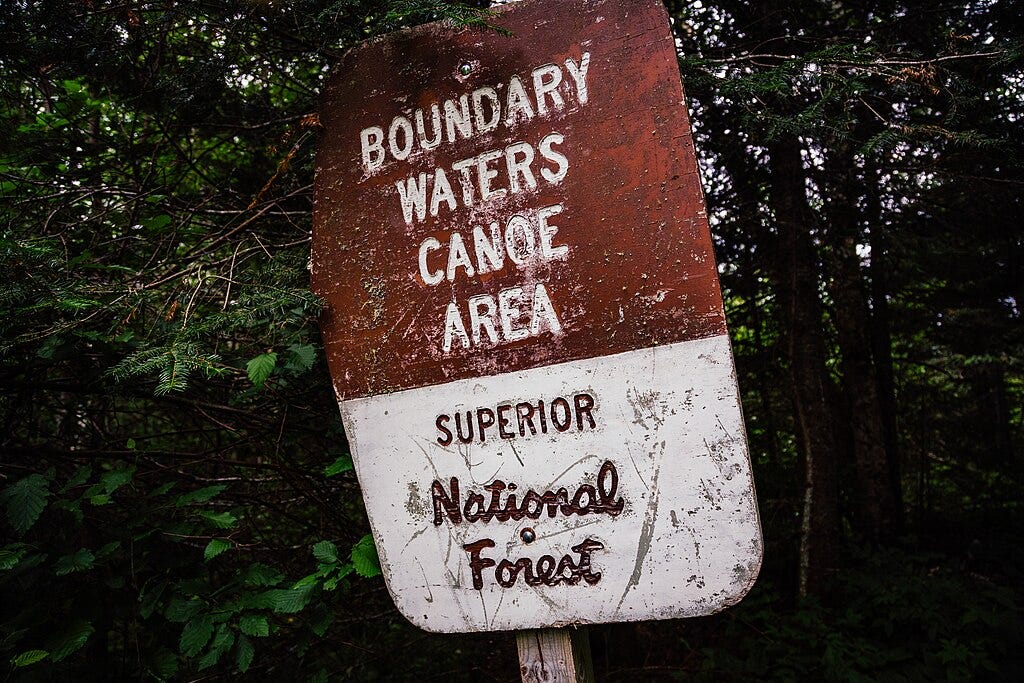
This month, it’s been difficult for those of us in the U.S. to pay attention to anything other than the events unfolding in Minneapolis and St. Paul — the horrific killings and abductions by federal agents, the courage of the tens of thousands of Minnesotans who are standing up for their neighbors (and, while they’re at it, demonstrating that their communities are cohesive because of their diversity, not despite it). If you care about conservation, though, you may have also heard that Congressional Republicans are messing with the Boundary Waters.
The Boundary Waters Canoe Area Wilderness, a maze of glacial lakes that stretches for 150 miles along the border between Minnesota and Ontario, is many things. It is the most-visited designated wilderness in the country; it is one of the places where the Bois Forte, Fond du Lac, and Grand Portage Bands of Chippewa exercise their treaty-protected hunting, fishing, and gathering rights. It is famous for its extraordinarily clean water and its abundance and variety of biting insects. It is part of an international network of protected public lands that includes the rest of the Superior National Forest, Voyageurs National Park, and, in Canada, Quetico Provincial Park.
What Congressional Republicans are up to in the Boundary Waters threatens to undermine the whole practice of conservation on U.S. public lands, but understanding why requires some wonky background. Here goes.
Last week, the House of Representatives approved a resolution, introduced by Rep. Pete Stauber of Minnesota, that would use a 1996 law called the Congressional Review Act to reverse a Biden-era ban on mining and geothermal leasing in a quarter-million acres of national forest lands within the Boundary Waters watershed. In related news, the Government Accountability Office recently responded to a request by Rep. Celeste Maloy of Utah with a non-binding opinion stating that the Congressional Review Act could also be used to cancel the current management plan for the Grand Staircase-Escalante National Monument in southern Utah.
The Congressional Review Act, which allows Congress to overturn federal agency rules, was successfully invoked only once between 1996 and 2016. Since the beginning of Trump’s first term, though, Congress has applied the act much more frequently, overturning 18 rules last year alone. Among these rules were plans and policies that had taken years to develop, including energy-conservation standards for various appliances and resource management plans for three Bureau of Land Management offices. Significantly, once a rule has been overturned via the Congressional Review Act, the relevant agency is prohibited from issuing any rule that is “substantially the same” without Congressional permission.
The goal of Stauber, Maloy, and their allies, apparently, is to give Congress the power to veto almost any rule issued by a federal government agency. Conservation groups are, to put it mildly, alarmed.
Hang on, though. The modern conservation movement has a long history of top-down, anti-democratic interventions. Plenty of people would argue that Grand Staircase-Escalante National Monument, singlehandedly designated by President Clinton under the Antiquities Act, continued that dubious tradition. Congress is the branch of the federal government that, at least in theory, most directly represents the people. Wouldn’t an expansion of Congressional power over conservation represent, as some are claiming, a step in the right direction?
This isn’t a rhetorical question, at least not for me. It’s worth wrestling with, and it doesn’t have a simple answer.
History teaches us that, in general, conservation should move from the bottom up, not the top down. Conservation solutions developed by those who depend on the landscapes being conserved have a better shot at succeeding — both because they’re more appropriate to their place and because they enjoy local support. Interior Secretary Bruce Babbitt recognized this when, after the surprise designation of Grand Staircase-Escalante in 1996, he established a process for monument proposals that took local concerns into account. (He later helped create the Conservation Lands Foundation, which supports community organizations that advocate for their local national monuments and other protected public lands.)
Ecology teaches us that conservation has to operate on multiple scales, for the basic reason that life operates on multiple scales. Some forms of life never move an inch; others travel from pole to pole. Some live only days; others live generations. So while the most successful conservation efforts tend to have deep local roots, not all can be managed locally. Large-scale, long-lasting conservation requires large, enduring institutions. And even small-scale efforts are most effective when coordinated across space and time. Fikret Berkes, a Canadian ecologist with deep experience in community-led conservation, writes that while conservation efforts should strive for “as much local solution as possible,” they also need “institutional interplay.”
The conservation plans and policies targeted by the Congressional Review Act were developed over many years and with many layers of public input. These processes are very far from perfect, and the Trump administration’s attacks on the National Environmental Policy Act may well make them worse. At their best, though, they incorporate local concerns and knowledge while providing the stability and reach needed to conserve public lands at the regional and national levels.
The expanding interpretation and use of the Congressional Review Act would allow a simple majority of Congress to trash any of these policies at any time — and, worse, prohibit their replacement, silencing all those who helped shape them in the first place.
Think of it this way: Using the Congressional Review Act and claiming that you’re advancing democracy is like yelling at your family and claiming that you’re improving household communication. Dangling a Congressional veto over U.S. public land plans and policies might resemble democracy in some ways, but it wouldn’t accomplish democracy’s goals — and it would make effective conservation impossible.
For continuing coverage of U.S. public lands — including the multiplying misuses of the Congressional Review Act — please read and support the work of More than Just Parks, Our Public Lands and Waters, and the crack investigative team at Public Domain.
Finally: tell me about your favorite essays!
Comments
Nothing yet. Say the first thing.
Sign in to join the conversation.