
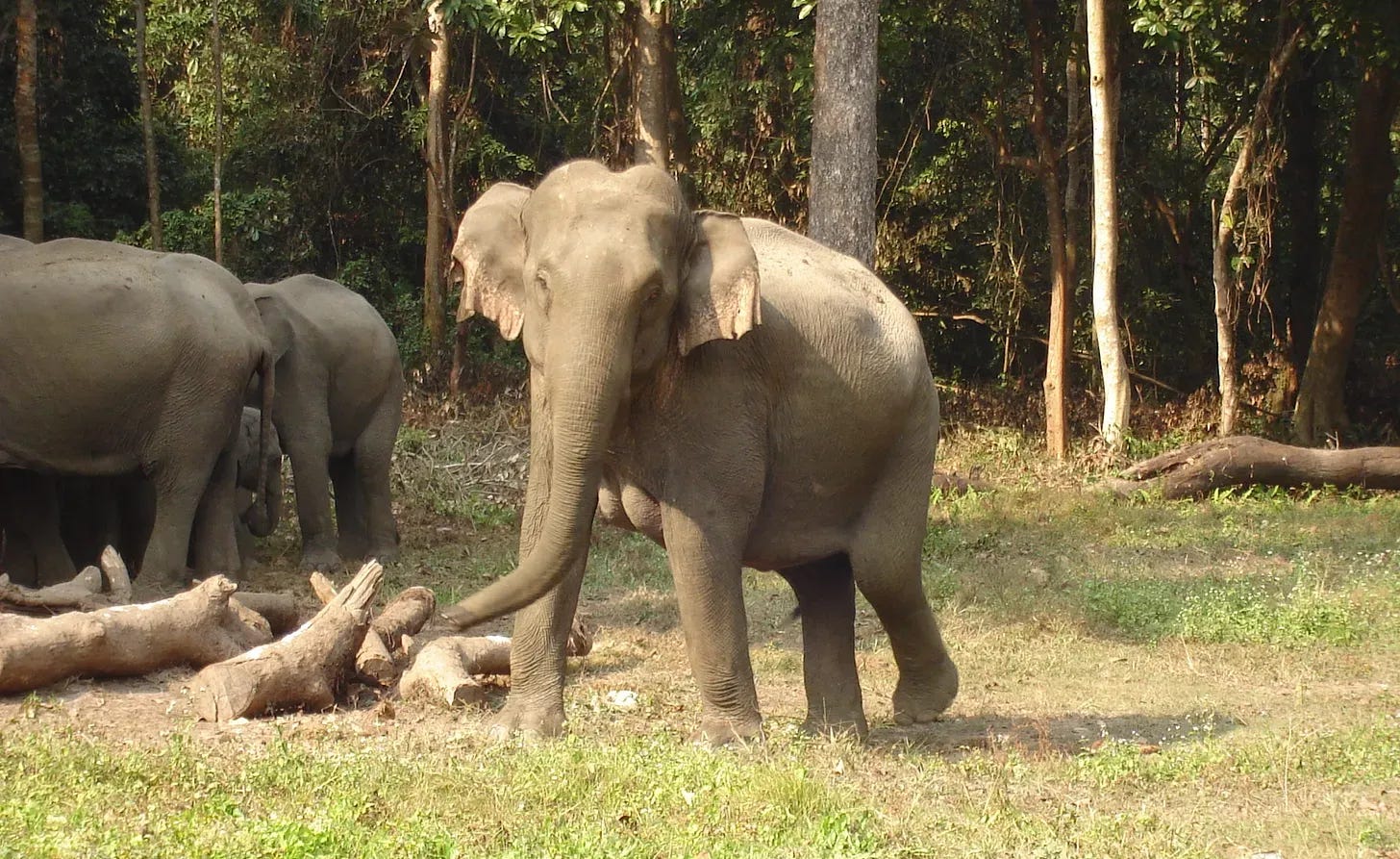
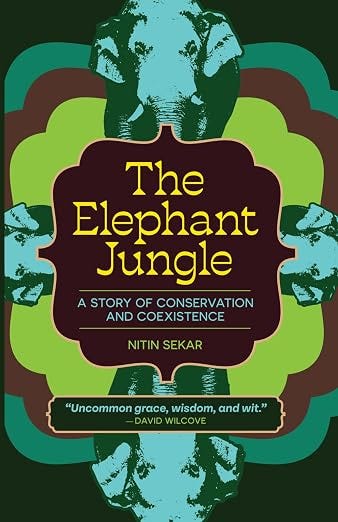
“The problem of human-wildlife conflict in part seems intractable because it is hard to know whom to root for,” writes conservation scientist Nitin Sekar in his new book The Elephant Jungle: A Story of Conservation and Coexistence.
Sekar, who grew up in the U.S., conducted his doctoral research in northern India’s Buxa Tiger Reserve, where he was immersed in the everyday — and too often deadly — realities of life alongside elephants and other species. He came to agree with a 2010 Indian government task force report on human-elephant conflicts, which observed that they are “tragic for elephants as well as humans … Both are victims of victims.”
The Elephant Jungle intertwines the story of Sekar’s years in Buxa with the eventful life story of Sekar’s research assistant, Netra Sharma, whose upbringing and livelihood were shaped by Buxa’s conservation challenges. Together, their experiences are a fascinating portrait of the complexities of human-wildlife conflict in Buxa and beyond.
Sekar, the director of coexistence and alternative proteins at Conservation X Labs, previously served as the national lead for elephant conservation at WWF India.
I edited this interview for length and clarity.
MN: The Elephant Jungle delves very deeply into the story of one place and one person, which is an unusual approach for a book about a broad conservation issue. What led you to focus on Netra’s life story?
NS: We often frame conservation as being about species and ecosystems, and obviously, those are very important. But I think that what really draws us to conservation, certainly what draws me to conservation, are the stories of individuals — often individual animals, but also individual people. Netra’s story and the story of the elephants of the Buxa Tiger Reserve demonstrate what conservation is working for as well as its core tensions. I hope the book captures both in a way that speaks to people.
MN: How would you sum up those core tensions?
NS: Buxa Tiger Reserve includes human communities that have been there since before the reserve was created, and many of them were living below the poverty line for much of the period covered by the book. Since these people depend on resources from the reserve, if you really protect the reserve as a fortress — if you engage in fortress conservation — you might protect wildlife from poaching and smuggling, but you’d cut off some very poor people from some very important resources.
On the other hand, if the people managing the reserve say, “You know what? We’re just going to let people do whatever they need and want to do to survive,” you can end up with material improvements for people at the expense of habitat and wildlife. If we as a society value human well-being and wildlife and, to some degree, animal well-being, we have to be more specific about exactly what we want and navigate that balance carefully.
MN: In situations where there are trade-offs, how do you articulate what conservation is aiming for?
NS: We should be aiming for the people most affected by conservation decisions to have control over the decision-making process. There should be a role for international conservation actors, but I would love for those actors to say explicitly that basic human needs come first — that conservation shouldn’t happen at the expense of people’s access to food, clean water, sanitation, and education. That should be the floor.
Beyond expressing those and other values, I think international conservation actors can create options for communities. If a community doesn’t really have a livelihood opportunity other than one that’s extractive, for example, an international NGO can say, “We’ll help you set up an ecotourism business here. We’ll invest so that you’re able to make money without having to extract resources.” Then the community has a real choice.
MN: Your time in Buxa was a hugely formative experience for you, and in your book, you’re very honest about the things that went wrong and the things that worked out in ways you didn’t expect. How did your perspective on elephant-human conflict change over the time you spent in Buxa?
NS: To those of us who grow up in Western countries — or in middle-class urban areas in India — wildlife is often presented as a victim. Humans consume everything, we’re always expanding our footprint, we’re so greedy, we take so much. Humans are the aggressor, and wildlife is the hapless victim.
In a place like Buxa, you learn that the situation is much more complicated. You see how people can be affected by human-wildlife conflict. You see that a state can value an elephant’s life more than a human’s life, especially when those humans are poor and not well-represented politically.
You also see how much diversity there is among elephant personalities. A lot of elephants avoid conflict, but some individuals seem to be pretty interested in getting into trouble and causing harm to people. All of that forces you to think about more nuanced solutions.
MN: You moved from Buxa to a position where you were working on human-elephant conflict across India. How did working at a national level change your view of the problem?
NS: Some patterns extend across India and even across continents. As elephants are protected, they’ll become bolder and start to raid the crops on the outer edge of a community. The farmers whose crops are being raided go to the community and say, “Hey, we should really build a fence around this whole village to keep elephants from coming in,” but the farmers closer to the center of the village feel insulated and don’t invest enough.
Eventually, the farmers on the outer edge stop maintaining the barrier, and maybe they stop farming altogether. Then the people in the center are exposed, and there’s no one left to help them build a fence or otherwise invest in collective protection. The tragedy of the commons can happen around natural resources, but it can also happen around collective protection.
Another problem across India is the increase in train collisions with wildlife. The government wants to build high-speed rail that allows people and goods to travel very quickly, so not only elephants but tigers, leopards, domestic cattle, and other animals are subject to more rail strikes.
There are regional and local differences, though. When communities get more resources and political support, they start erecting barriers around their fields to keep elephants out. In places like Assam, in northeast India, where barriers are relatively new, a single-strand fence with a nonlethal electrical pulse is often enough to deter an elephant. In southern India, where people have been using those kinds of fences for a long time, elephants have realized that they can just drop a log on the strand, or move it aside with their tusks.
In southern India, people have adopted what are called hanging fences, where the electrified wire is hung on tall T-shaped posts. Even then, an elephant might figure out that they can bring a tree down on a hanging fence pole and knock it over. So there’s an arms race, and in some parts of the country the arms race has progressed further than in others.
There are also regional differences in political empowerment, and those have serious consequences. Around the time that I started my job at WWF India, a couple of elephants moved from Nepal into the state of Uttar Pradesh and killed several people in the course of a week or two. And there was no real public protest, no hue and cry. Whereas in the state of Kerala, in southern India, when an elephant killed an elderly man and a young boy, very quickly there was a hunger strike underway. Levels of education and literacy are much higher in Kerala, and people there said, “You absolutely need to capture this elephant and take it into captivity.” They recognized that their rights were being violated.
Governments don’t respond the same way to every human life that’s lost. Governments respond much more quickly when a person from a politically connected community loses their life than when it’s a person from a more marginalized place.
MN: Your book ends with measured optimism, some of which is tied to India’s 2006 Forest Rights Act. You say very clearly that the law is imperfect, but it seems to have led to some meaningful progress. What’s been accomplished, and what’s still needed?
The Forest Rights Act recognizes community rights to traditional uses of local resources, like subsistence farming on land they occupy, gathering firewood, or grazing livestock. The idea is that if local people have the right to benefit from natural resources, they’ll sustainably use and protect the forests around them.
The act requires the government to document each family’s claim to these rights, essentially providing them with a land title. In Buxa, many of the people who had settled illegally in the area, hoping to benefit from tourism, didn’t qualify for those rights. Apparently that has led to less illegal settlement in Buxa. So that’s meant less habitat destruction and development in Buxa and places like it.
In India, we still need a comprehensive planning process to help us understand where elephants should be and shouldn’t be — which areas they need for habitat, which areas they need to move between habitats, where people can coexist with them without too many problems, and where elephants really shouldn’t be at all. We need better processes for establishing and maintaining barriers, and compensation systems that are truly fair.
Finally, we need a database of individual elephants because as I mentioned, individual elephant behavior varies. When there are elephants that have learned to break down barriers and are doing it all the time, or individuals who have taken to killing humans, the government needs to know that so that the problem can be addressed appropriately.
MN: You now work at Conservation X Labs, where you’re the director of coexistence and alternative proteins. Can you spell out the connection between your two responsibilities?
NS: So one of the biggest drivers of biodiversity loss is habitat loss. That’s obviously a big issue in South Asia, where the human population is so high, but it’s a problem across the board. Often conservationists are playing defense, right? Elephants have lost their habitat and are coming into people’s fields, and you’re trying to prevent them from doing that.
But what if we were to actually address the causes of habitat loss? About fifty percent of the Earth’s surface that’s not covered by ice is already used for agriculture. And about 80% of that land is used, directly or indirectly, to raise animals for meat and milk and eggs and related products, even though these products provide only 18% of the calories and 37% of the protein we consume. One of the ways we can help reduce the pressure on habitat is to shift away from animal and animal-sourced foods.
Conservation X Labs sees alternative proteins as a really critical tool in that effort. We want people to enjoy the foods they’ve always loved, but are made with something that tastes exactly like meat yet doesn’t come from animals. It might be derived from plants, or yeast, or fungi. Now, it might be made from cultivated animal cells that are brewed in the way we brew beer.
If we can produce those proteins efficiently, they’ll allow us to use much less land and water, emit less carbon dioxide, and continue to have a lot of the food we enjoy while reducing pressure on ecosystems.
MN: As someone who’s gone back and forth between South Asia and the U.S. and between rural and urban places, what are the biggest misunderstandings about human-wildlife conflict that you encounter?
NS: I think they have to do with the push and pull factors in human-wildlife conflict.
It’s true that wildlife has lost a lot of habitat. It’s true that climate change is making a lot of habitat less hospitable, and forcing wildlife to look for resources outside the spaces we’ve allocated for them. In addition, though, wildlife is responding to the opportunities we give them.
If someone told us that we could either wander around a forest all day to find food or pick it up quickly in one place and have plenty of time left over to hang out with our communities and go on dates, I think most of us would choose the latter, and animals are no different.
They like our agricultural fields. They like that we have big pools of water. They’re adapting to those opportunities. So the fact that animals are coming out of the forest doesn’t necessarily mean there aren’t enough resources for them in the forest. It just means that agricultural fields present an optimal foraging strategy.
So it’s really important to disentangle how much of the conflict is being caused by push factors and how much is due to pull factors, and a comprehensive approach to human-wildlife conflict requires looking at both.
Comments
Nothing yet. Say the first thing.
Sign in to join the conversation.