
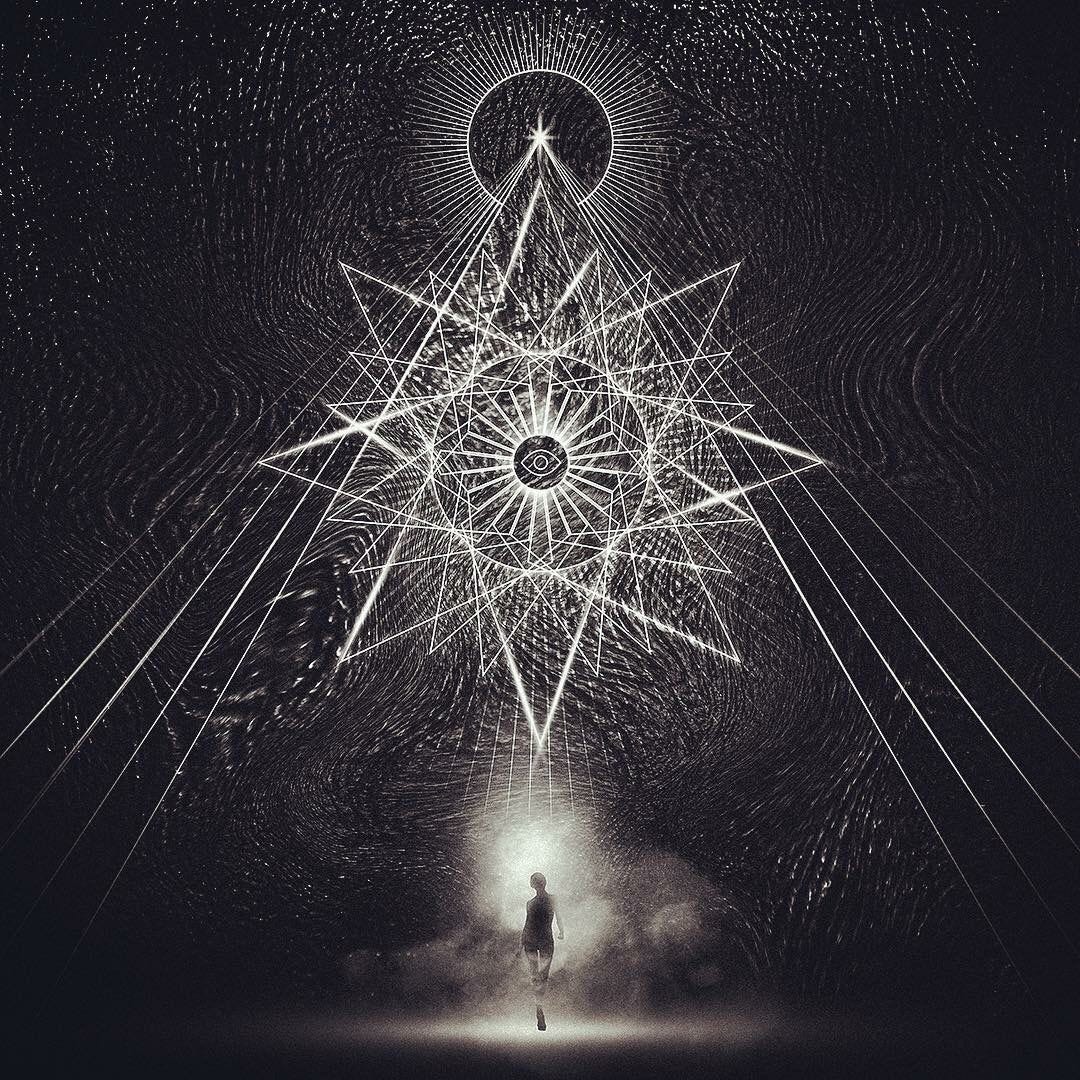
Geometry is dedicated to the study of relationship, proportion, symmetry, repetition, boundary, scale and spatial organisation… not so?
So why the term… “Sacred”, then?
Long before these principles were formalised through mathematics, our ancestors encountered them in the natural world and incorporated them into architecture, ritual, art and cosmology, recognising that certain relationships appeared repeatedly within the structures surrounding them and that these relationships could be observed, measured, reproduced and ultimately preserved through physical form…
The practice therefore became a method of passing knowledge down through the ages, encoded into structures designed to withstand the ravages of time, with proportion, orientation, symmetry, repetition and spatial arrangement carrying information long after the individuals who first observed them had disappeared.
Hence the attributed name of Sacred Geometry, for in ancient times, the acquisition of knowledge for the purpose of gaining wisdom was itself considered a sacred undertaking… a path taken by few, but revered by all.
Across ancient cultures, circles, squares, triangles, spirals, radial arrangements and proportional systems appear repeatedly within architectural and symbolic traditions for this very reason, although the significance assigned to these forms differed considerably between civilisations. What remained consistent was the recognition that geometry represented something considerably greater than decoration, because geometry provided a means through which relationships could be observed, understood, encoded and reproduced.
Perhaps, then, the sacred was never contained within the shape itself, perhaps it existed within the relationship that the shape revealed instead…
A circle establishes a centre and a boundary, while simultaneously defining an exact relationship between the two… a triangle establishes a stable relationship between three points, a spiral expresses continuous transformation through rotation and scale, symmetry establishes correspondence, proportion establishes hierarchy, repetition establishes continuity, and recursion allows a relatively simple relationship to generate increasingly elaborate structures. Geometry therefore becomes more than the description of form, because beneath every form lies a network of relationships, and beneath those relationships lies the possibility of organisation.
This is where the ancient understanding of “Sacred Geometry” intersects with something that remains entirely relevant to modern physics…
The physical Universe does not permit every conceivable arrangement of matter and energy to persist. Systems are constrained by their constituent forces, boundary conditions, conservation laws, symmetries, energy distributions and interactions, and from those constraints particular configurations emerge and remain stable while others rapidly disappear. Geometry is therefore not something imposed upon nature from outside, but rather, it is one of the mathematical languages through which the consequences of physical relationships become visible, a physical manifestation of encoded knowledge…
A crystal does not need to understand symmetry in order to produce a lattice, nor does a vortex require an architect to determine its rotational structure. The geometry emerges because the physical relationships governing the system permit certain configurations to persist. The form is therefore an expression of constraint, and the recurring appearance of particular forms across apparently unrelated systems becomes an indication that different physical processes can converge upon related organisational solutions.
This distinction is important because it allows Sacred Geometry to be approached without reducing it either to superstition or to an untestable claim that every geometric pattern represents a hidden cosmic message.
However, there exists a deeper appreciation entrenched within the practices of “Sacred Geometry” that is considerably more interesting…
“Geometry is the visible expression of relationships that remain invisible to those who would considered them independently.”
The Circle and the Principle of the Centre…
Consider the circle, perhaps the simplest of all geometric forms and yet one of the most conceptually complete. Every point upon its circumference maintains the same relationship to a central reference, creating a continuous correspondence between centre, radius and boundary, while the absence of any privileged direction around that centre establishes radial symmetry.
For the ancient mind, the centre therefore represents origin, unity, source or potential, while the circumference represented manifestation, limitation or the boundary within which lasting relationships could occur.
These interpretations belong not only to the metaphysical traditions that developed around geometry, but also to the mathematical reality that exists beneath them, one that requires no metaphysical assumption whatsoever…
A circle is defined through an invariant relationship, and its significance therefore lies in the relationship itself.
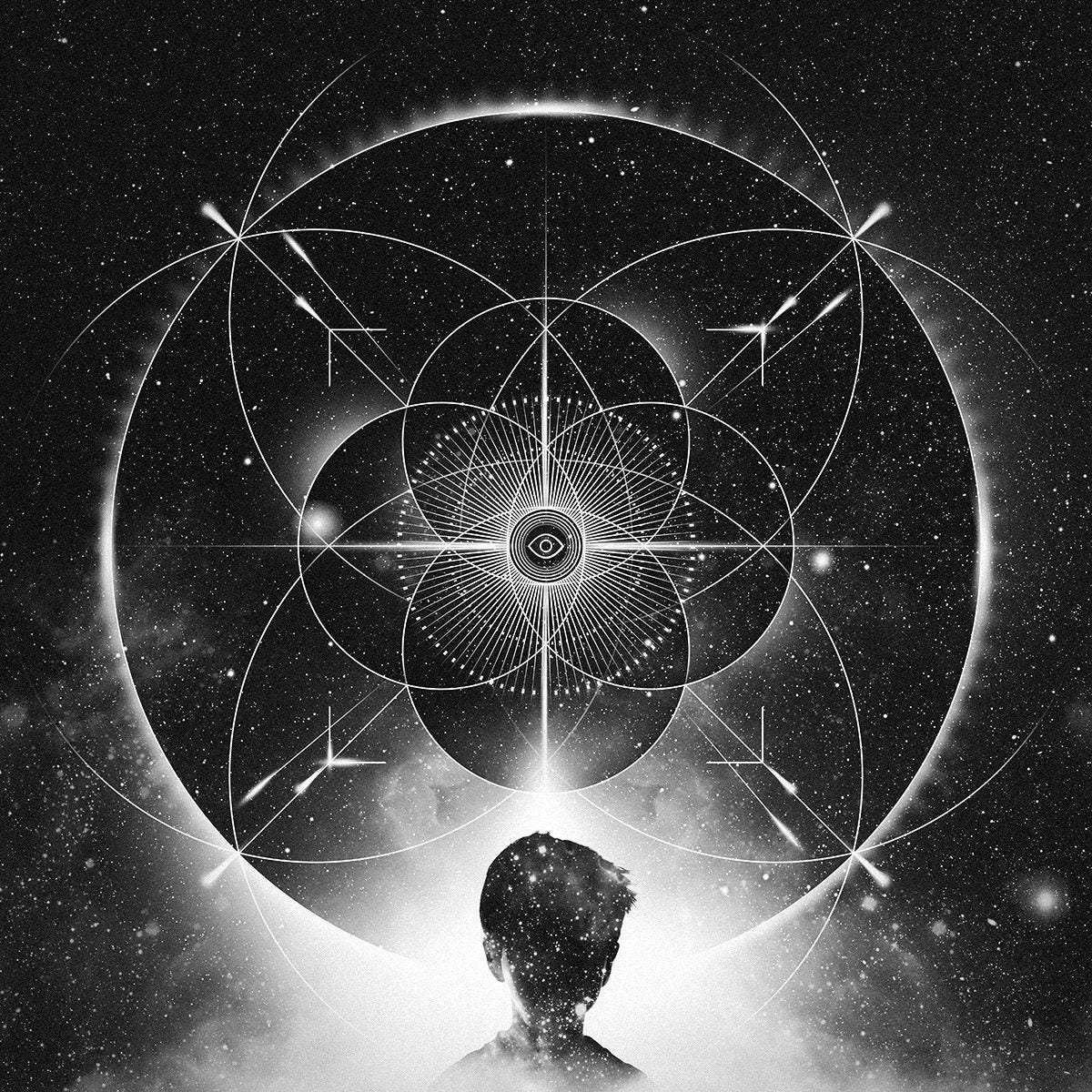
Introduce another circle of identical radius, positioned according to the centre of the first, and the geometry immediately becomes more complex. Intersections appear, new centres can be established, new symmetries emerge and additional relationships become possible. Continue the same process repeatedly and increasingly intricate geometric structures arise from a remarkably simple initial rule…
This principle lies behind many of the geometric constructions that became associated with Sacred Geometry, including the Seed of Life, the Flower of Life and all of the related systems generated through recursive circular generation. Whether or not one accepts the metaphysical interpretations later attributed to these forms, the underlying mathematical principle remains interesting because the resulting structure contains a record of the relationships used to generate it.
The pattern therefore does not simply exist, it contains information about how it came to exist.
That distinction introduces the first real connection between geometry and information… related through the understanding that geometric structure can preserve and prolong the stability and coherence of such relationships. These “relationships” preserve the conditions under which a structure exists, and when those relationships are reproduced, the structure can be regenerated… repeated, renewed.
The Geometry of Emergence…
This progression from simplicity toward complexity appears repeatedly within mathematical and physical systems, and it may help explain why ancient traditions placed such emphasis upon geometric sequences, proportional relationships and the transition from one form into another. The movement from point to line, line to plane, plane to volume, and simple relationship toward increasingly complex organisation can be interpreted symbolically as creation, but it can also be understood mathematically as the progressive establishment of additional degrees of relational freedom.
The metaphysical interpretation and the mathematical description do not necessarily have to be placed into opposition… one describes what the relationship means, while the other describes how the relationship operates.
This distinction is particularly relevant to the ancient principle of “As Above, So Below, As Within, So Without”… and it is because its deeper proposition need not require the claim that every structure in the Universe is physically identical. Instead, it may be understood as an assertion that similar organisational relationships can emerge at different scales when systems are governed by comparable constraints.
The heavens were observed because they displayed order…
The Earth was organised according to that perceived order…
The human being was then understood as existing within the same continuum…
And it is “The temple” that becomes the physical meeting point between those levels of division.
This is why geometry became so deeply embedded within ancient architecture, because to construct according to proportion was to translate an understanding of relationship into physical space, preserving an intellectual and cosmological principle in a form that could be experienced by anyone who entered it, regardless of whether they understood the mathematics from which the structure had been derived.
The Temple as Geometry Made Physical…
A temple constructed according to deliberate proportions is therefore more than an arrangement of walls and chambers, because its dimensions determine relationships between movement, distance, light, sound, orientation and human perception.
A change in the dimensions of an enclosed space alters its acoustic behaviour… a change in orientation alters its relationship with sunlight and the surrounding environment… a change in proportion alters the visual relationships experienced by the observer… and a change in spatial sequence alters the way a person moves through and experiences the structure itself.
These effects require no supernatural explanation, they are simply the consequences of geometry.
Yet the ancient builders did not necessarily need modern mathematical formalism to understand them. Practical knowledge can precede theoretical explanation, and a civilisation can discover that a particular chamber produces unusual acoustic effects without possessing the mathematical language required to describe standing waves, resonance modes or boundary conditions.
This becomes particularly important when considering the possibility that some ancient structures were deliberately designed to influence sensory and physiological experience. It would be irresponsible to assume that every ancient monument was constructed as an advanced scientific instrument, yet it would be equally premature to dismiss the possibility that ancient architects possessed empirical knowledge of the effects produced by particular geometries, materials, orientations and acoustic environments.
And it is the structure itself becomes the preserved record of that knowledge… while the geometry becomes a form of memory.
This would rationally qualify as one of the reasons why the ancient association between geometry and sacred practice persisted for so long.
A structure could preserve knowledge without requiring the original observer to remain alive, and that knowledge could survive in stone…
Geometry and Resonance…
This becomes particularly relevant when considering resonance, because the geometry of a physical system determines the ways in which energy can move through it. Every enclosed space possesses characteristic modes of vibration, determined by its dimensions, shape, materials and boundaries, while waves entering that environment can be reflected, reinforced, attenuated or redirected according to those conditions.
The geometry therefore participates directly in the behaviour of energy.
A chamber is not acoustically neutral…
A cavity is not geometrically irrelevant…
A structure does not merely occupy space…
It is geometry that determines how processes occurring within that space unfold.
This provides a physically grounded reason to take ancient acoustic architecture seriously without turning every historical structure into a speculative technological device… If ancient builders repeatedly experimented with chamber dimensions, wall curvature, ceiling height, material selection and spatial enclosure, they could have accumulated a substantial practical understanding of how sound behaved within particular environments, even without possessing the mathematical formalism of modern acoustics.
The resulting architecture could then influence human experience through entirely physical mechanisms.
Sound enters the body, the nervous system responds, breath changes and focus is directed… resulting in psychological rhythms being shifted accordingly, allowing for one’s subjective experience of time and perception to become altered… hence the term, an “altered state of being”.
It is therefore the science of “Sacred Geometry” that proceeds the metaphysical interpretation… qualified by the fact that the “metaphysical experience” only begins after the physical sequence has already been established.
The Architecture of Consciousness…
This brings “Sacred Geometry” into its most interesting territory, because consciousness is never experienced independently of the physical conditions through which perception occurs. The brain possesses an extraordinarily complex architecture, the body contains multiple interacting physiological rhythms, and the nervous system continuously integrates information arriving through sensory, autonomic, internal pathways, as well as “external sources”…
The “sentient being” is therefore already a geometrically organised system.
Neural structures possess spatial relationships, blood vessels branch according to physical constraints, cellular membranes establish boundaries, and the heart generates rhythmic electrical activity. The lungs, vascular system and nervous system operate through continually changing patterns of spatial and temporal organisation.
There is no point at which consciousness steps outside this physical architecture in order to experience the world, it all occurs through it.
It is here that the notion of “As Within, So Without” acquires another layer of meaning….
The internal state of the organism influences how the external environment is perceived, while the external environment continually modifies the internal state through sensory information, physical interaction and physiological regulation. The distinction between inside and outside therefore remains real, but it is not an isolated division, but rather an interface through which continuous exchange occurs.
Sacred architecture may consequently be understood as an attempt to deliberately shape that interface. The geometry of the environment becomes part of the geometry of perception, and once this simple concept is understood, such ancient practices become considerably more sophisticated…
The Geometry of the Microcosm…
The recurring association between human proportion and cosmic proportion becomes particularly relevant when examined in this light…
Ancient traditions frequently placed the human body at the centre of their cosmological reasoning, not necessarily because they believed the Universe literally resembled a human being, but because the human body provided the most immediate example of organised proportion available to them.
The body could be measured… its proportions could be represented geometrically, its rhythms could be observed, and the relationship to the body’s surrounding environment could therefore be experienced directly…
The temple then reproduces aspects of that organisation at a larger scale, creating a deliberate correspondence between the individual and one’s immediate surrounding environment.
The microcosm reflected the macrocosm, and it was then the macrocosm that provided the reference for the microcosm.
As Above, So Below…
This phrase therefore becomes a straightforward statement about correspondence between levels of organisation.
The same human tendency can still be seen today whenever we use mathematical models to describe biological systems, architectural structures, planetary motion or electromagnetic fields. We repeatedly search for relationships that remain meaningful when scale changes.
The ancient language was symbolic where our modern language is primarily mathematical, however the underlying human impulse is remarkably similar…
A need to discover the pattern, to understand the relationship, and to then reproduce it…
Ultimately, what it comes down to is our insatiable need to discover the unknown, hoping to understand ourselves through what we perceive…
The Geometry of Information…
There is another reason this becomes relevant to the broader question of reality.
A pattern is information.
Not information in the sense of a substance floating independently through space, but information encoded in relationships between elements of a system. Symmetry tells us that certain relationships are equivalent, repetition tells us that a rule is operating consistently, proportion tells us that quantities are constrained relative to one another, and recursion tells us that an existing relationship is being used to generate another.
This essentially makes it far easier to conclude that geometry therefore provides a physical language for representing relational information…
This may be why geometric symbolism survived across cultures even when the original languages, religious systems and political structures disappeared…
A geometric relationship can be preserved visually even when its original verbal explanation has been lost.
The symbol survives even in the event that the interpretation may change, nevertheless, the underlying relationship will always remain true…
In this sense, “Sacred Geometry” may be best understood as a form of cultural compression, where complex observations concerning nature, proportion, cosmology, architecture and human experience were reduced into forms capable of being transmitted across generations.
The modern mind may then rediscover the symbol without immediately recovering the knowledge that originally accompanied it.
And this creates an intriguing possibility…
Perhaps some ancient geometric traditions were not attempting to hide knowledge at all, but were rather attempting to preserve it.
The Platonic Solids and the Mathematics of Order…
The Platonic solids provide another example of this relationship between geometry and metaphysical interpretation.
The tetrahedron, cube, octahedron, dodecahedron and icosahedron possess highly constrained symmetry and precise mathematical relationships, which is why they became objects of fascination within ancient Greek philosophy and later esoteric traditions. Their association with the classical elements belongs to a historical cosmology rather than established physics, yet the geometric properties of the solids remain mathematically exact regardless of the symbolic interpretation placed upon them.
This distinction is imperative…
A geometric structure does not become less significant because its metaphysical interpretation cannot be scientifically demonstrated.
Nor does the existence of a mathematically elegant structure prove the metaphysical interpretation.
The two must remain distinguishable…
The value lies in allowing the mathematics to inform the metaphysics without pretending that mathematics has already answered the metaphysical question. This is precisely where “Sacred Geometry” can occupy an intellectually useful position between Physics and Metaphysics.
It provides a language through which the measurable and the meaningful can be placed into relationship without requiring either to become the other.
And so… in returning to the question with which we began…
Why “Sacred”?
If geometry describes relationship, then the sacred element existed in the way that knowledge was used.
Knowledge without understanding can become accumulation… where understanding without application can remain an abstraction, but when knowledge is integrated into perception, behaviour, architecture, culture and one’s understanding of existence… does it not become wisdom?
The ancients appear to have recognised this distinction, they did not simply record astronomical observations, they built structures according to them….
They did not only contemplate proportion either, they incorporated proportion into architecture.
They did not observe rhythm, but rather embedded rhythm into ritual, movement, sound and ceremony.
Knowledge became the environment, that environment became the actual experience, and that kind of experience… well, it gained meaning…
This progression may be one of the most important aspects of “Sacred Geometry”, a perspective that has been obscured by its modern reduction to decorative symbols and esoteric imagery…
That geometry was never the true destination, but rather the method in which to reach it.
And perhaps this is where the ancient principle of “As Above, So Below, As Within, So Without” acquires its deepest significance.
The cosmos is not literally reproduced inside the human being, perhaps accessible, yes, but not reproduced… nor is the human being literally reproduced within the cosmos, yet both exist through relationships of structure, boundary, rhythm, proportion and interaction.
The same mathematical language can therefore describe aspects of both, while the meaning attributed to those relationships remains dependent upon the observer and the cultural framework through which the observation is interpreted.
The sacred may consequently be found neither entirely in the geometry nor entirely within the observer, but within the relationship that exists between them…
That is where knowledge becomes experience, where structure becomes meaning, and perhaps where “Sacred Geometry” was always pointing…
Not toward a particular shape, a hidden code or a forgotten collection of supernatural formulas, but toward the recognition that relationship precedes isolation, that form is inseparable from the conditions that produce it, and that every structure we encounter carries something of the relationships through which it came into existence.
The circle therefore remains a circle.
The triangle remains a triangle.
The spiral remains a spiral.
But once we understand that each is an expression of relationship, constraint, proportion and transformation, we begin to see why these forms have fascinated the human imagination for thousands of years.
It is perhaps this, that the ancients were attempting to tell us…
That it is through geometry that relationship becomes visible, and it is the geometry of relationship through which existence itself becomes knowable.
By Shaun Higgins, PhD.
(Apologies in advance for any and all grammatical or spelling errors… they will be corrected in due course)
No posts
Comments
Nothing yet. Say the first thing.
Sign in to join the conversation.