
For centuries, humanity’s attempt to understand the Universe has unfolded across two distinct realms: the study of the unimaginably vast and the exploration of the infinitesimally small. Yet if a truth is sufficiently fundamental, perhaps it does not await discovery in the conventional sense, nor depend upon increasingly sophisticated instruments for its significance. Certain truths may exist as structural necessities, as architectures so deeply woven into the relationship between consciousness and reality that they become inseparable from existence itself. They may present themselves not through a mechanism as deliberate as the scientific method, but through the recognition of patterns that appear to persist beneath perception, more akin to an underlying geometric structure revealed through sustained examination of the conscious mind.
Imagine a vast subterranean ocean pressing silently against the floor of a desert. The surface appears dry, fractured and isolated, yet every shifting dune, every unexpected oasis and even the pressure beneath one’s feet are influenced by the immense body of water concealed below. In much the same way, what we perceive as reality may represent the visible expression of a deeper structure extending beyond the limits of ordinary observation, and once such a pattern becomes perceptible, it becomes increasingly difficult to ignore as one continues to examine the relationship between mind, matter and the structure of existence itself.
For millennia, humanity has mapped the apparent surface of existence, charting the distances between stars and establishing distinctions between self and other, here and there, past and future. We have treated the four-dimensional framework of space-time as the definitive boundary of the real, seldom considering whether the solidity of everyday experience might represent only the observable manifestation of a larger dimensional process.
The cosmic ledger, perhaps, is not written in an external language awaiting translation. It may instead exist as an intrinsic record within the architecture of existence itself, continually expressing its presence through the geometry of thought, the rhythms of living systems and the deeper structural relationships through which reality becomes accessible to observation.
Whether expressed through the symbolic language of ancient mythology or through the mathematical formalism of modern physics, the possibility of an underlying pattern remains a recurring feature of humanity’s attempt to understand existence. The language changes, the mathematics develops and our instruments become increasingly precise, yet the search itself remains directed towards the relationships beneath the appearances.
One of the most compelling features of physical reality is the appearance of separation. Bound by the limitations of four-dimensional perception, we observe a Universe that can, under certain speculative higher-dimensional interpretations, be compared with the interior geometry associated with a black-hole spacetime, particularly through the behaviour of the Schwarzschild interior metric, where the causal roles of the radial and temporal coordinates change. From within such a description, we inhabit a curved and apparently self-contained space-time governed by horizons and thermodynamic constraints. From a higher-dimensional perspective, however, the same structure could potentially admit a different interpretation, in which our observable Universe represents an interior manifestation associated with an expanding higher-dimensional geometry. Such a possibility introduces a corresponding duality into the question of cosmic origin, in which the boundary of our observable Universe may be considered in relation to a higher-dimensional horizon.
Within this interpretation, the birth of the Universe is therefore no longer considered solely as an entropic eruption from nothingness, but as a continuous and highly ordered projection from a deeper dimensional structure.
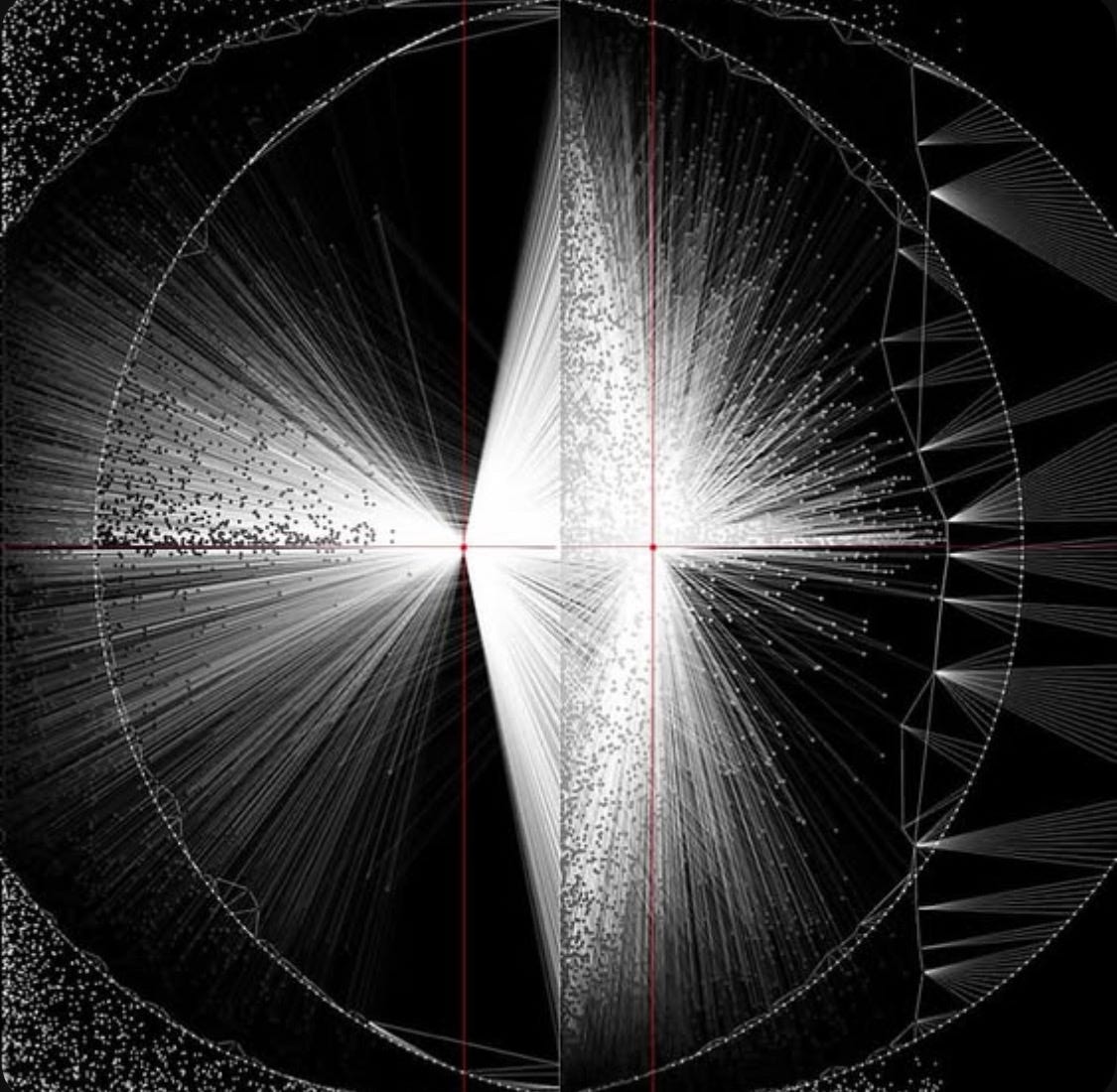
The suggestion is that the information constituting our observable reality may not be generated exclusively within local space-time itself, but could instead be encoded upon a lower-dimensional boundary associated with the exterior horizon of a higher-dimensional progenitor, referred to here as the secretion disc. In relation to holographic principles and the mathematical structure associated with the Bekenstein-Hawking entropy bound, such a boundary may be considered as a ledger of cosmic information. Through an inversion singularity, that informational structure could then be represented within the observable interior through null-ray congruences, giving rise to the three-dimensional volumetric reality through which experience is constructed.
Within this interpretation, the speed of light becomes a property of the interface through which information propagates within our observable domain. It represents the maximum causal propagation speed permitted by relativity, while the vacuum is characterised by its electromagnetic properties, expressed through the permittivity and permeability of free space. What we experience as temporal succession could consequently be understood, at least conceptually, as the sequential sampling of a structure whose complete description is not itself confined to that succession, transforming a higher-dimensional informational description into the linear causal narrative through which experience unfolds.
Anchoring reality to such a boundary offers a speculative perspective upon several of physics’ persistent asymmetries.
As information passes through an inversion threshold, the universal wave function may, within this interpretation, undergo a topological separation associated with quantum entanglement. Components directed towards our observable interior could condense into the baryonic matter from which stars, planets and living systems emerge, while corresponding time-reversed components remain associated with the exterior boundary. Such a separation would preserve a relationship between matter and antimatter across dimensional domains without requiring their direct local annihilation, while maintaining the possibility of a larger charge-parity-time symmetry across the complete system. What appears locally as an imbalance could therefore represent a deeper global relationship extending beyond the limits of the observable domain.
This framework also offers an alternative perspective upon phenomena currently described as dark matter and dark energy. Rather than necessarily representing unknown particles or exotic substances, they could be interpreted, within this speculative framework, as manifestations of large-scale informational and geometric structures existing beyond direct electromagnetic interaction.
They would therefore represent boundary-entangled geometric signatures of energy configurations associated with the exterior structure. Although inaccessible to local observation through electromagnetic coupling, their influence could remain detectable through gravitational effects, appearing as structural signatures that contribute to the behaviour of galactic rotation and the expansion of space-time.
The implications then extend beyond cosmology and into the nature of consciousness.
If our Universe emerges from a deeper informational substrate, then every atom within the human body remains, in principle, part of the same physical continuity through which that structure is expressed. Consciousness need not therefore be considered solely as a product generated by the brain, although this remains the established scientific position regarding the dependence of conscious experience upon brain function. Within the present perspective, consciousness may instead be considered an emergent interface through which an extraordinarily complex biological system integrates information across multiple scales. The brain consequently functions not simply as a producer of isolated signals, but as an interpreter and organiser of information, with neural structures, including the highly ordered architecture of microtubular assemblies, participating in the physical processes through which coherent subjective experience arises.
The heart, meanwhile, occupies a significant position within the body’s electromagnetic architecture. Through its rhythmic electrical activity and associated electromagnetic field, together with its continuous physiological coupling to neural activity, it contributes to the temporal organisation of the organism as a whole. States of physiological coherence, influenced by respiratory rhythm, emotional regulation and synchronisation between cardiac and neural processes, can alter the organisation of physiological activity and consequently influence conscious experience. Within the broader speculative framework presented here, such coherence becomes a potential mechanism through which information is integrated across the organism, rather than evidence by itself for access to an external informational domain.
Whether interpreted through physics, biology or philosophy, these ideas ultimately return us to a question that extends beyond the technical language of singularities, dimensions and cosmological structures.
The deepest implication is not necessarily how far consciousness can travel, nor how many dimensions reality may contain, but whether relationship itself is more fundamental than the isolated object.
Reality appears to be composed not simply of separate things, but of patterns of connection, a principle reflected throughout modern physics, from fields and interactions to quantum entanglement and the relationships through which physical systems acquire their observable properties.
Human beings expend enormous effort maintaining the perception of separation. We divide ourselves into nations, disciplines, identities and beliefs, yet throughout nature, increasingly complex structures emerge through relationships between their constituent parts. Atoms assemble into molecules, molecules into cells, cells into organisms, organisms into ecosystems and larger structures into increasingly extensive networks. Individuality therefore emerges through relationship rather than existing independently of it.
We are consequently not isolated observers suspended within an indifferent void, but localised expressions of a larger unfolding process, points at which the Universe becomes capable of observing and interpreting itself, where the possibility of higher-dimensional structure encounters the immediate reality of three-dimensional experience.
Whether this apparent unity ultimately arises from quantum entanglement, information geometry, higher-dimensional topology or principles yet to be discovered remains an open question. What remains unchanged, however, is the relationship between observer and observed, between physical structure and conscious experience, between the information carried by matter and the capacity of living systems to organise that information into increasingly sophisticated forms.
Separation, at its most fundamental level, may therefore be less a property of reality than a consequence of the way reality is experienced.
Beneath the appearance of division lies a continuity of relationship connecting mind and matter, observer and observed, self and cosmos.
And perhaps the reason consciousness can appear larger than the world it perceives is because, at its deepest level, consciousness is not simply observing a Universe external to itself, but participating in the very physical relationships through which that Universe becomes knowable…
By Shaun Higgins, PhD.
No posts
Comments
Nothing yet. Say the first thing.
Sign in to join the conversation.