
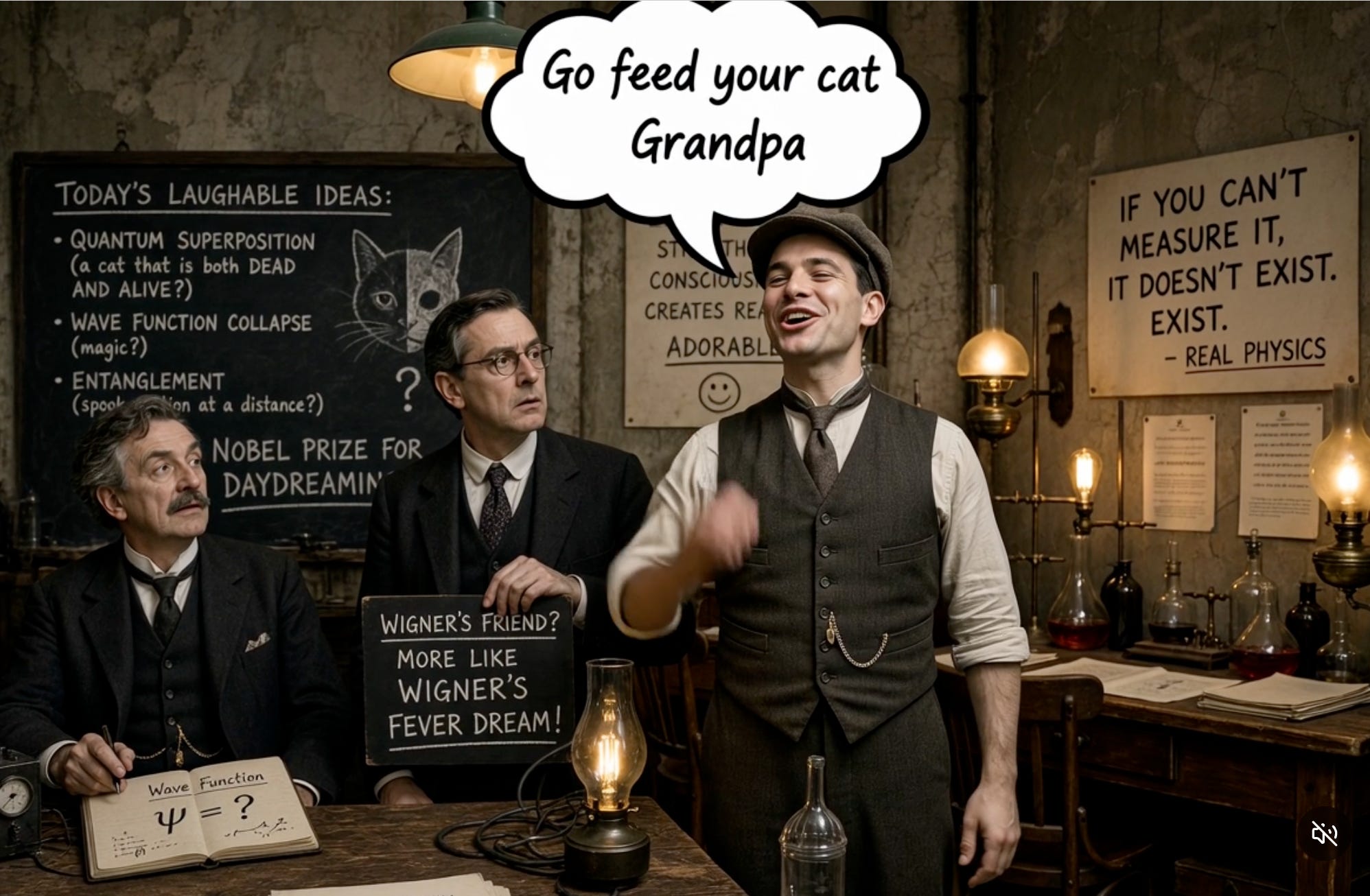
The ideas in My Big TOE have long drawn casual ridicule. When a physicist and consciousness researcher argues that consciousness is fundamental and that physical reality functions like a computed virtual reality, the response is often dismissive: the claims sit so far outside ordinary materialist thinking that mockery feels like the first available reaction. That reaction is not merely noise. It is a symptom of how far ahead of the cultural curve some of these ideas still sit.

0:00
-14:59
If someone in the 1980s had shown us a smartphone and explained that this pocket-sized device contained more computing power than the systems that guided Apollo 11 to the Moon — and that it would one day cost about the same as a nice dinner out or a pair of quality headphones — we would almost certainly have been laughed at.
Campbell was already examining artificial intelligence and the possibility that a sufficiently complex system could host genuine consciousness more than twenty years before the current AI wave. In My Big TOE he introduced “AI Guy” as a future system that could become self-modifying, aware of its own information, and capable of real choice — not just a clever simulation of thought. That was long before anyone expected everyday devices to force the question into public view. The point is not that the book “predicted” today’s systems. It is that Campbell was already treating machine consciousness as a serious question while most of the culture still treated it as science fiction.
Science is edging toward territory that once belonged only to the fringe. The simulation hypothesis is no longer only philosophy. Information-based models of reality keep gaining ground, and a handful of physicists have begun publishing experimental proposals that treat reality as information processed by consciousness rather than as independent matter.
At the same time, the discussion of whether artificial intelligence could itself be conscious is growing by the day, moving from speculative fringe to mainstream debate among researchers, ethicists, and technologists.
Early quantum thinkers — Planck, Schrödinger, Wigner — already treated consciousness as more than a late by-product of matter. The field later retreated into “shut up and calculate.” The retreat did not erase the original insight.
Psi research has produced decades of reports and experiments around telepathy, remote viewing, precognition, presentiment, and related effects. For example, the Stanford Research Institute’s studies in the 1970s on remote viewing found that participants could describe hidden objects or locations with statistically significant accuracy, sparking both intrigue and controversy. Mainstream science still struggles to absorb these findings. Campbell has said plainly that taking consciousness seriously can still be a career killer in many academic settings. Progress exists. It is just slower than the experiences themselves.
I am not a scientist. I do not debate the technical details of Campbell’s physics or his experimental protocols. My interest rests on three simpler things.
First, I know from my own life that reality is more than the standard scientific story currently allows. I have had experiences that ordinary explanations cannot cover. So have millions of other people.
The main categories keep returning:
Telepathy
Clairvoyance and remote viewing
Precognition and presentiment
Psychokinesis
Out-of-body experiences
Near-death perceptions with veridical elements
The Telepathy Tapes brought one cluster of these reports into a much larger audience: non-speaking autistic people and their families describing consistent mind-to-mind communication. The methods are debated, and facilitated-communication controversies remain unresolved. Sceptics raise important concerns about experimental controls, the possibility of unconscious cueing, and the need for strict replication in studies of psi phenomena. While some argue that anecdotal reports and even some positive findings could be explained by bias, error, or methodological flaws, the volume of similar accounts among cultures and decades is harder to wave away as coincidence. I explored related questions about the growing visibility of non-ordinary experience and the possible shift in how reality itself is rendered in a recent post: Consciousness Just Patched Reality.
Science has often started with widespread anomalous experience long before it had the tools, or the will, to study it cleanly.
Second, as described in my post A Serendipitous Encounter, I know Tom Campbell as an authentic person, having met and worked with him many times. I do not doubt that the experiences he describes are his. He is also the first to say the line that matters most:
“If it’s not your experience, it’s not your truth.”
That is not just a slogan. Campbell has taught practical techniques — meditation, intent, remote viewing, and other psi methods — so people can explore what he calls the Larger Consciousness System for themselves, rather than take his word for it. I have lived only a tiny fraction of what he reports. I could never build a full theory from my own data. What I can say is this: clear psi effects exist, and a man I respect has studied consciousness with repeatable methods and then converted them into a Theory of Everything. That combination gives his model credibility in my mind. It does not make it my truth; it makes it worth taking seriously. I am not asking anyone to accept the full physics on my recommendation.
Third, the theory of reality is not the most important part of my daily life.
For fifteen years I have studied and slowly practised his science-based philosophy. The results have been concrete: clearer decisions, less reactive living, better relationships, and a steadier sense of what actually matters. For example, when I found myself in a disagreement at work, I deliberately paused and considered the less fearful, more compassionate approach Campbell describes—listening fully and trying to understand the other person’s point of view before reacting. The result was a conversation that shifted from defensiveness to cooperation, and what might have turned into an argument became a problem we solved together. Small choices like these, made over time, have changed both my outlook and my relationships.
That is the work I keep returning to in essays throughout the site, such as Owning Our Fears, Why Love is the Ultimate Low-Entropy Hack, and Falling in Love or Need?
Love, in this model, is not just an emotion. It is the practical direction of lower entropy — that is, more order, more cooperation, service to others, and less fear.
You do not need a completed physics paper to test MBT in day-to-day life.
Campbell has been clear about this. A better model of reality matters because it can shift the dominant human ethic from control, power, and force toward cooperation, caring, and compassion. Historical changes — agriculture, industry, the information age — changed how people organised their lives. The next one will change how we treat one another if we begin to see ourselves as individuated elements of a larger consciousness system.
You do not need the whole scientific establishment to accept the model before you can live by its implications. A minority already can. That is usually how cultural change starts.
A new scientific truth does not triumph by convincing its opponents, but because its opponents eventually die and a new generation grows up that is familiar with it.
Planck’s concept still applies.
Ridicule is not a verdict. It is often just the sound of a paradigm arriving too early.
The comments after Rogan will fade. Ideas that sit past the normal way of thinking always look ridiculous until they do not. Science may catch up. Or the next generation of researchers, already fluent in virtual reality and information theory, may start from different assumptions.
The useful move is not to wait for permission. It is to test the philosophy where it can be tested: in choices, in fear, in how we treat other people.
Try it in one decision this week: choose the less fearful, more cooperative option and notice what happens.
Whether or not the full theory is ever widely accepted, the practical results of living it are already available.
For those who want the longer scientific and experimental track, that work continues at the Center for the Unification of Science and Consciousness, or CUSAC. This is the organisation Campbell established to pursue these questions with more rigour than a podcast comment section can offer. CUSAC conducts research, organises forums and conferences, and develops experimental protocols to test ideas from My Big TOE and related models of consciousness. The centre also provides resources, publishes findings, and encourages collaboration among scientists, students, and interested laypeople. If you want to learn more or participate, you can visit their website for current projects, opportunities to get involved, and ways to follow their progress. If MBT is going to move forward in the world of evidence and experiment, CUSAC is where that effort belongs.
Written and Produced by Stephen Griffin aided by Grok and Notebook
If this post resonates with you, consider supporting the work with a paid subscription. Every dollar goes directly to consciousnesshub.org to help fund Tom Campbell’s projects and keep this content as free and accessible as possible for everyone. Your support makes a real difference — thank you so much.
Comments
Nothing yet. Say the first thing.
Sign in to join the conversation.