
“Do the best you can until you know better. Then when you know better, do better.”
~Maya Angelou
A father and son get in a car crash and are rushed to the hospital. The father dies. The boy is taken to the operating room, and the surgeon says, “I can’t operate on this boy, because he’s my son.”
How is this possible?
Roughly 40 to 75% of people can’t solve this riddle, because they don’t immediately consider that the surgeon is a woman. The surgeon is the boy’s mother.
That riddle illustrates unconscious bias, also known as implicit bias, which is defined as bias in behavior and/or judgment that we form outside our conscious awareness. Biases are partly based on our biology, our life experiences, the media, and our culture.
We all have bias; it doesn’t make us bad people. Our brain wants to make sense of the world and the people around us. That is human nature. We have an innate need to categorize and label people and situations. It’s tied to our survival.
Yet that tendency for our brains to make snap judgements that aren’t always accurate has a real-world impact. Here are just a few examples of research that shows how bias impacts us:
Even when resumes are identical, those with white-sounding names, such as John Smith, are 50% more likely to get a job interview than ethnic-sounding names like Jamal, Venkat, or Xuan.
Black taxi drivers’ tips averaged 33% lower than White drivers’, and both Black and white customers gave higher tips to the white drivers.
In Malcolm Gladwell’s book Blink, he cites research that found almost 60% of corporate CEOs are men over six-foot-tall; a large disproportion compared to the fact that less than 15% of American men are over this height. Do selection committees seek out only tall white men? Of course not. There’s unconscious bias at work – we have a sense, in our minds, of what a leader is supposed to look like. In the U.S., that has traditionally been a tall, white male.
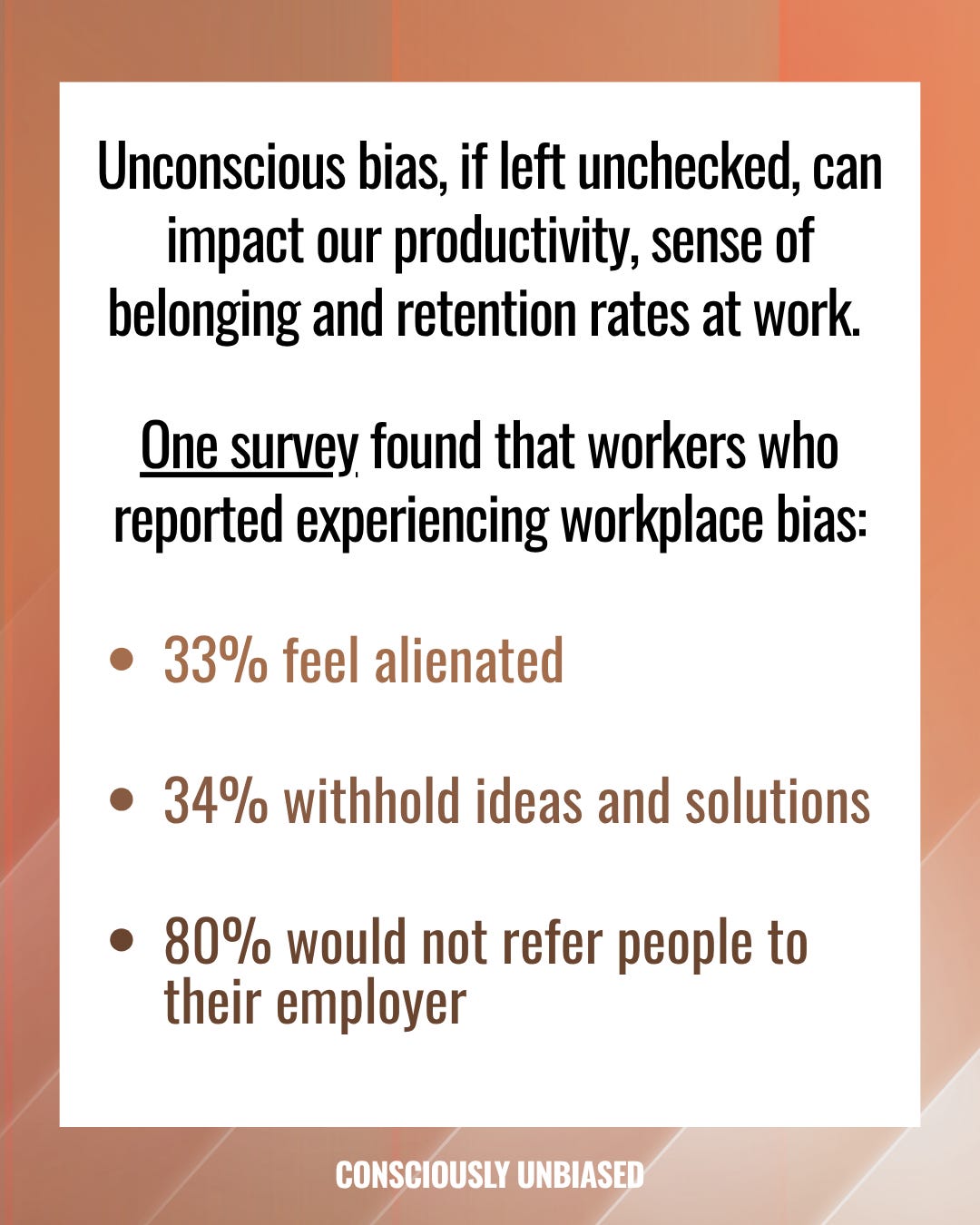
While bias simplifies our decision-making, it may also prevent us from seeing people for who they truly are. Only about 10% of who a person is can be perceived on the surface, such as skin color, age, gender, or accent. The other 90% of one’s identity is not immediately visible, such as gender identity, mental health, socioeconomic status, or education.
This can cause us to make assumptions about who someone is based only on the 10% we can perceive if we don’t dig deeper to really understand and get to know one another.
While the vast majority of us won’t act in a way that is intentionally harmful—but because in a lot of instances biases are so ingrained—they can take the form of subtle actions known as microaggressions that go unnoticed by the person doing them, but are felt enormously by the person on the receiving end.
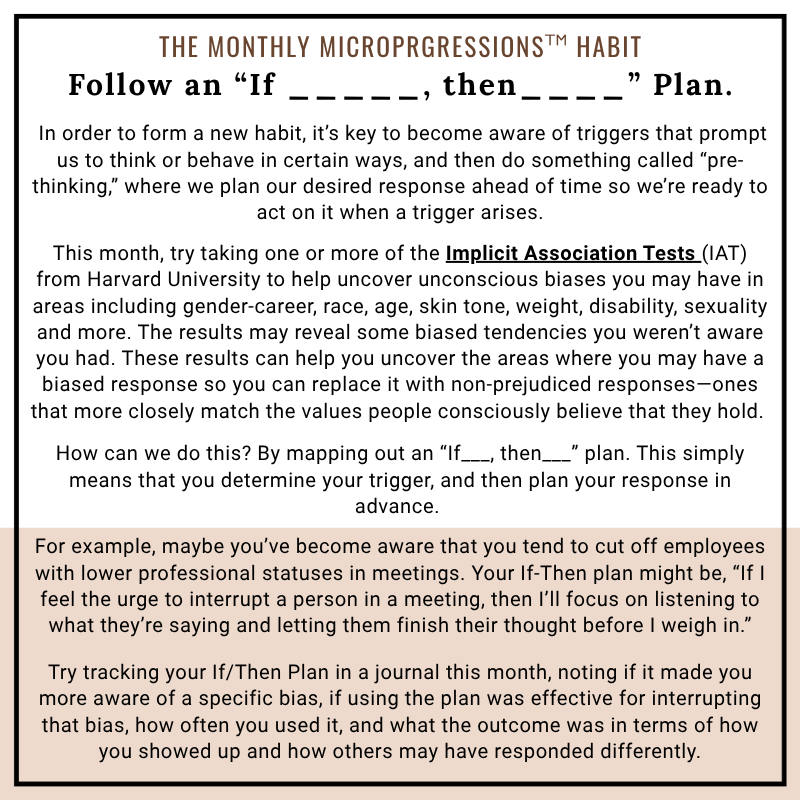
So how do we first become aware of blind spots that impact how we perceive others, and then check our biases so they don’t influence our behavior in ways that are unfair or harmful? Below are some steps for getting started.
BIAS ON THE BRAIN
Biases are like our brain hitting the “easy” button. To save time and effort, humans form judgments and make decisions using cognitive shortcuts. They help us navigate the world and draw conclusions by using information from our life experiences and media influence that’s subconsciously stored in our brains.
But at the same time, these cognitive shortcuts can lead to overly simplistic thinking errors that can even result in irrational decision-making and problematic judgements (such as making a snap judgment about why a colleague, who is a working mom, is leaving the office early, which may be interpreted differently as compared to if that colleague were a man).
This is because the brain does not always search for the most comprehensive or complete interpretation of data, but rather, it looks for the quickest and most efficient definition of what a set of stimuli may be. Ultimately, these subconscious shortcuts frequently hold some type of bias that we are unaware of.
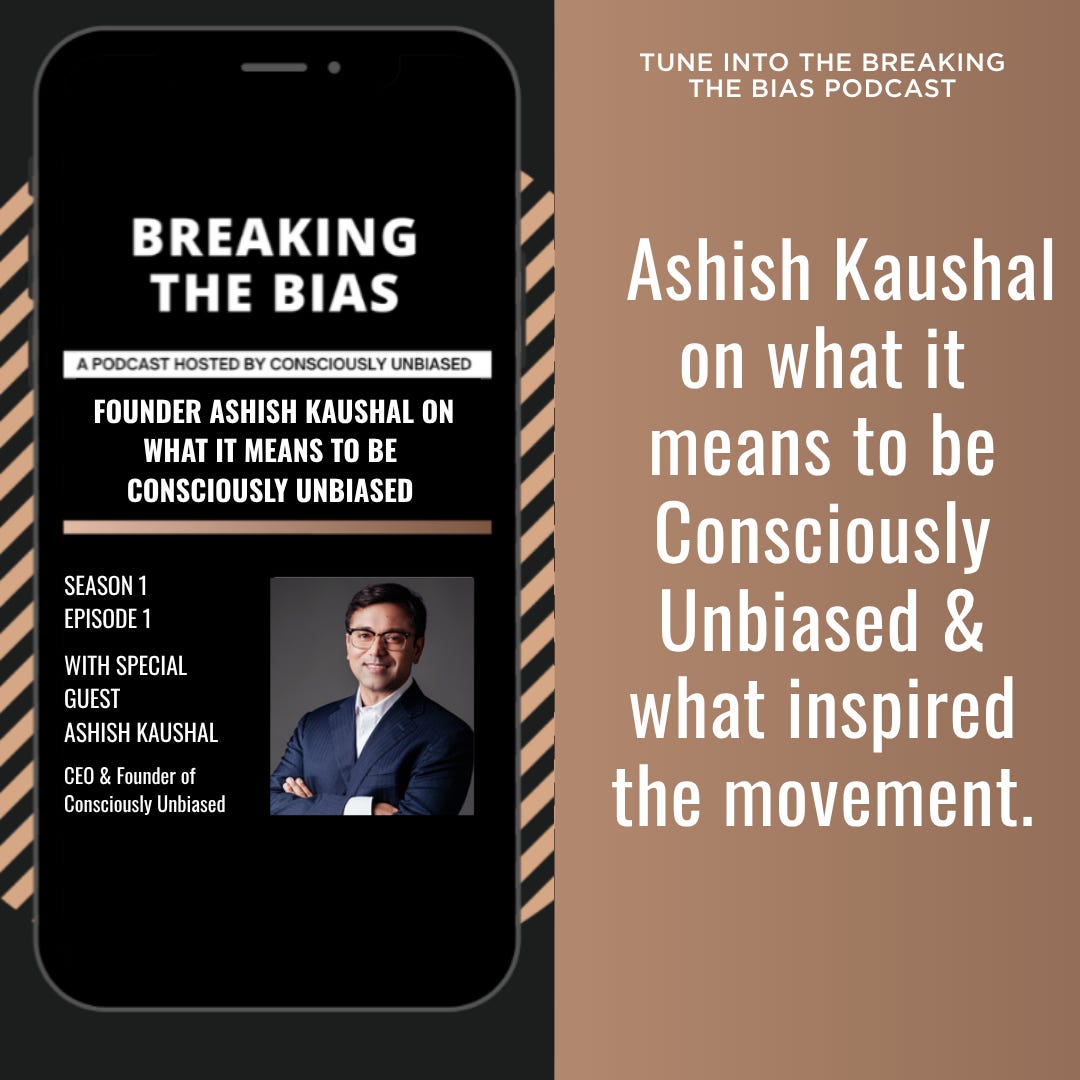
Breaking the Bias: Founder Ashish Kaushal on What It Means to Be Consciously Unbiased.
Last Up: Microprogressions™ Habit Month Two: Mindfulness
Next up: Microprogressions™ Habit Month Four: Strength in Vulnerability, coming in September.
Comments
Nothing yet. Say the first thing.
Sign in to join the conversation.