
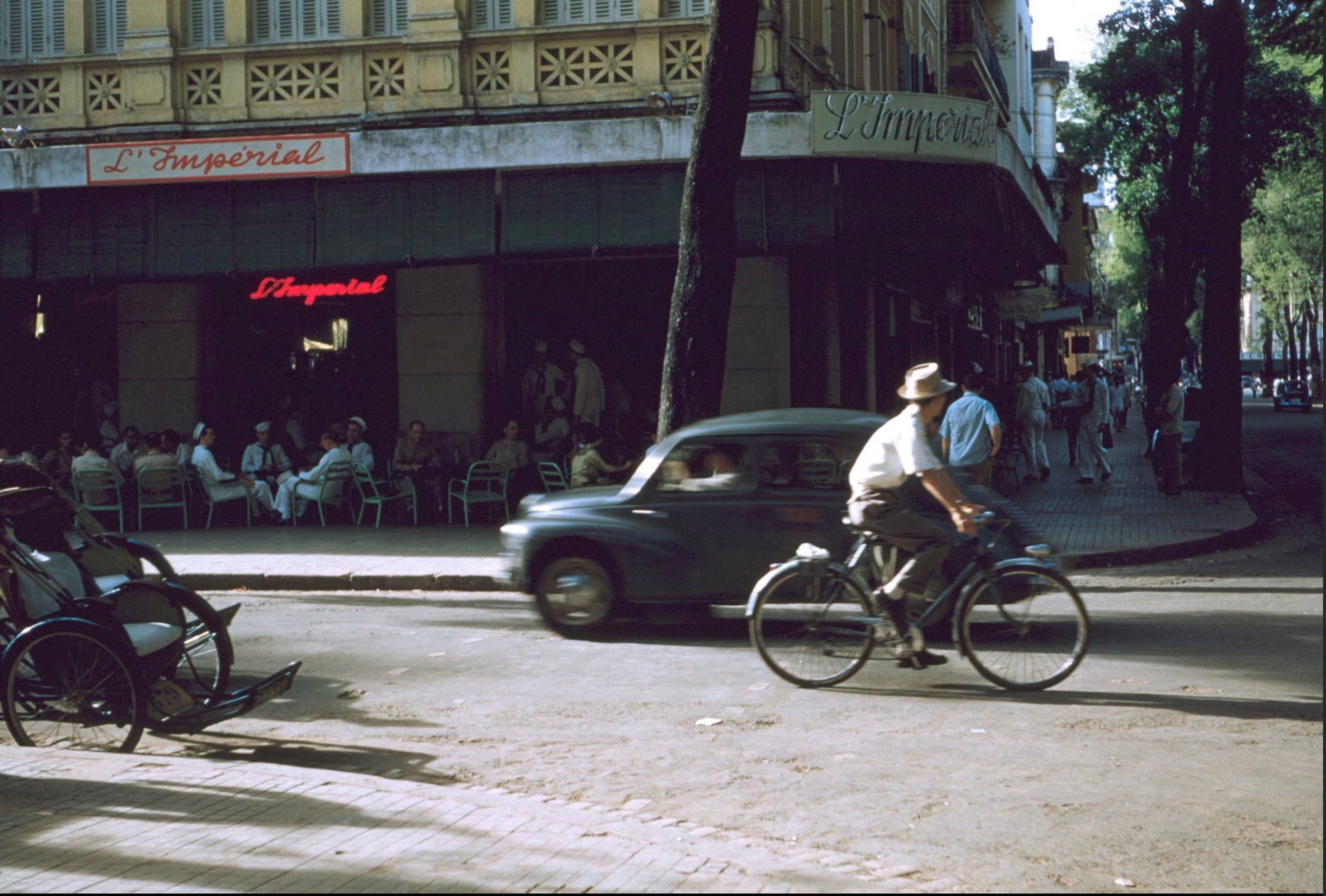
ON THE SURFACE, CENTRAL SAIGON seems reluctant to admit that anything has changed. The boulevards remain shaded beneath tamarind and flame trees, their branches mingling overhead in a dusty green canopy. The façades of colonial ministries, banks, and shipping offices look much as before – sun-faded, perhaps, and a little mildewed by the monsoon, but still imposing. Along the main thoroughfares, classically French cars – Citroën, Peugeot, Renault, et cetera, and a few mud-spattered military jeeps, roll down the road, bullying bicycles and cyclo-pousses to the margins.
At the Hotel Continental Saigon, split bamboo blinds keep out the sun and the heavy rains. In its corridors, whispering Vietnamese boys huddle, trying to determine who will respond in slow motion to the ring of a room bell – a jet-lagged or hungover guest demanding ice, mineral water, or perhaps the services of a discreet, management-approved escort. On the terrace, stout Corsicans – some with legitimate businesses, others with quieter interests in the smuggling trade – sip pastis beneath the fans before moving inside for bouillabaisse, the garlic-heavy aïoli scenting the air.
In nearby streets, sidewalk cafés and restaurants – many draped with anti-grenade netting – serve a mixed clientele of French, Vietnamese, and Chinese customers. Beneath the tall plane trees, attractive Vietnamese women with waist-length black hair secured by a single silver clip stroll in one direction, khaki-clad Foreign Legionnaires with luxuriant moustaches in another. On the terraces of the smarter French establishments, elderly colonials in Panama hats and their chic, deeply tanned wives shoo away shoeless street urchins who lug shoeshine boxes and tuck salvaged cigarette butts behind their ears.
With the sun settling over rue Catinat, an American newcomer – Howard Simpson – learns his first rule of the city: there is a curfew. The logical response, he is told, is to begin drinking early. His guide is John “Black Jack” Pickering of the United States Information Service – a former Chicago newspaperman who once worked for the old Paris edition of the Herald Tribune and covered Lindbergh’s arrival in France. The years haven’t softened him; Pickering still carries the gruffness of a tough city editor.
On Simpson’s first evening they begin with numerous apéritifs at the Continental before wandering down rue Catinat for supper (washed down with Beaujolais and followed by cognac and soda) at the Croix du Sud, where an all-female French orchestra trades winks with a mostly male audience. On the second evening they cool off with several glasses of Tuborg at the Majestic’s rooftop bar, a pianist playing the latest Paris hits while tracer rounds arc across the river from a harassed French post. Later he devours escargots and steak au poivre at l’Amiral on Thái Lập Thành Street, a haunt of parachutists and special-operations men who ignore the presence of Amerloques.
“So is there any tension between the French and the Yanks?” Simpson asks. Pickering looks him up and down beneath bushy eyebrows, shakes his jowls and hacks into his steak. “Don’t worry, kid. You’ll learn the ropes soon enough.”
In the months that follow, Simpson watches the Americans become more visible – patronising the best restaurants and bars, rumbling through the streets in black sedans and new Jeep station wagons; Pickering drives a black Cadillac, imported all the way from Detroit – all contributing to the blue haze that hangs in the air. Simpson is self-aware enough to know he is just another American on the block. When he joins officers and secretaries from USIS and the Aid Mission for pre-lunch beers on the Continental terrace, they quickly grow boisterous, playing match games for drinks and laughing too loudly at anecdotes about another night of sleaze at the Arc en Ciel in Cholon. No one but Simpson seems to have noticed the old colonials have left a neat cordon sanitaire of empty tables around the Americans.
But when Simpson totters toward the W.C. to break the seal, he hears one of them mutter, almost to himself: “Saïgon n’est plus ce qu’elle était.”
The French imprint has started to fade in central Saigon. The paint is peeling on the old Hôtel de Ville. The green shutters along rue Catinat look a little shabby, and wherever a once-bright tricolour hung it is now faded – or simply gone. The boutiques that once sold Christian Dior brassieres, blouses from Nice and Guerlain perfumes are closing, one by one. More distressingly, the wines are running out and cigarettes are selling at a premium. Even Michaud, the unflappable French butcher who plied his trade on a narrow stretch just off rue Catinat, has called it quits and returned to Marseille.
Many Frenchmen remain visible on the terrace of the Hotel Continental Saigon, where they sit and grumble as the world goes by, studying the newcomers with narrowed eyes and speculating on what might just save the Indochina they love. Their wives prefer to arrange a rendezvous at La Pagode, a salon de thé, where they trade news from France, nibble little cakes and sip tea. Although milkshakes have now been added to the menu, they are too stubborn to try such a faddish drink. However, it appeals not just to Americans but to younger middle-class Vietnamese women, who now arrive in Western clothes, their hair set carefully in rolled bangs.
At night clusters of Americans enjoy the river views while sitting comfortably in the deep rattan chairs outside the Hotel Majestic Saigon. Like the Continental, the Majestic is owned by the stern-looking Matthieu Francini, the Corsican businessman who has his fingers in many other pies. Some say he is the capo di capi of the Corsican-Saigonese underworld. Others say he is merely an exalted “fixer” in the Corsican tradition. Emperor Bảo Đại, the Bank of Indochina, General Bay Vien – the river pirate turned commander of the Binh Xuyen Shock Police – every colonial businessman worth his salt is said to have sought financial advice from Francini. Some joke that even the Viet Minh would like a quiet word with him – if only to be sure the economy would not collapse without Francini discreetly steering the ship.
As night falls, the last of the French air force pilots, paratroopers in red berets and Legionnaires – reminders of the Indochina War – stroll down rue Catinat. Legionnaires head to the London Bar next to the Cinéma Majestic; air force pilots to the Croix du Sud. But there is war in Algeria, and they know it will not be long before they are bound for North Africa.
The passing of the guard is visible everywhere. One evening a procession of light armoured cars, jeeps and heavy weapons, all French, moves toward the docks. Stopping to let them pass at the corner of Catinat and Rue Gallieni is a group of officers from the American Military Assistance Advisory Group, staying at the Bachelor Officers’ Quarters in the nearby Brink Hotel, on their way to the “Continental Shelf,” as they now call Monsieur Francini’s other establishment.
Causing quite a stir across Saigon is the sight of a Hollywood production. Director Joseph L. Mankiewicz is in town making The Quiet American with Michael Redgrave and Audie Murphy – working from a script that does not have Graham Greene’s approval. Instead, it bears the fingerprints of Edward Lansdale, the American counterinsurgency specialist, who quietly reshaped the story – ensuring that Alden Pyle would die not as a dupe of empire, but for a noble cause.
One relative newcomer to town is the young anthropologist Gerald C. Hickey, who lands a part as an extra in The Quiet American. Hickey is in Vietnam to pursue his research in the Central Highlands and other far-flung provinces but, when back from the field, he – like many of the American civilians now circulating through Saigon – can be found at the city’s French restaurants or at one of the old colonial institutions – the Cercle Sportif, Club Nautique and Boule Gauloise – still the centres of a shifting Saigon society.
In the eyes of every new American arrival, the city remains distinctly French in flavour. Restaurants such as Aterbea, l’Amiral, La Paix, Le Paris, Paprika and Guillaume Tell have never been busier. On rue Catinat, the large Thai Thach grocery keeps its high shelves stocked with imported canned goods, wines, liquors and brandies, and its refrigerated counter crowded with hams, sausages, pâtés and cheeses. Around the corner, the smaller Au Petit Saint-Antoine displays a blackboard proudly announcing the arrival by Air France of lamb, veal, artichokes and cheeses.
But all is not well for every French entrepreneur. On rue Catinat, the American writer Gloria Emerson meets the owner of a beauty shop – a fierce-looking, small woman with short blonde hair and visible black roots. She tells Emerson – a Francophile who speaks fluent French and dresses like a Parisian – that the salon will soon close, as she can no longer obtain nail polish, peroxide or hair dye from France, items that travel by very different channels from the food shipments that still reach the restaurants. Nor can she sell her business to a Vietnamese and convert those piastres to francs and leave; no one can. Her face suggests she might cry, but she is too proud to crack. She lifts her shoulders in a Gallic shrug. As a cluster of Americans – dressed for the suburbs in short-sleeved shirts, comfortable slacks and loafers – passes by, she mutters a vicious prophecy: “They will never understand this country, they will never change the Vietnamese, and they will not be happy here.”
Emerson sits under the old dryers, which snore and tremble, eavesdropping as French customers speak of the war in Algiers and the uncertainty of their futures, sighing and shrugging. The Vietnamese staff continue their manicures and pedicures very slowly, as if painting tiny canvases, acting as though they hear nothing.
Having arranged to meet Gerald Hickey for dinner, Emerson picks up her Guide de Saïgon to choose a restaurant. Later, as she strolls down rue Catinat and the sky turns soft and pink, she realises there’s a glaring omission from the guidebook – it does not mention the Indochina War, not once, as if nothing has changed and nothing ever will.
When she meets Hickey for dinner at Aterbea, which serves an excellent civet de lapin – rabbit slow-cooked in red wine with shallots and thyme – he announces with a grin: “Have I got a treat for you. Tomorrow night Eleanor Steber is performing at the old Majestic Theatre, and guess who has two tickets?”
The next night they attend. There is no air-conditioning, and such is Steber’s artistry and magnetism that no one complains. Afterwards Hickey and Emerson cadge an extended invitation to a dinner held in Miss Steber’s honour at Bodega – one of the most fashionable French restaurants in town. Mostly star-struck, they avoid pestering the guest of honour.
They drink champagne and listen as the pianist plays “Love Is a Many-Splendored Thing,” when Steber suddenly rises and waves her napkin. “Please. You can’t play this song without knowing the melody is stolen from Puccini.” When the baffled pianist looks dumbstruck, she continues, “Play it again, monsieur.” Then she sings “Un Bel Dì” from Madame Butterfly.
The next day it is said that you could hear her voice – and the standing ovation, her second of the night – all the way down Catinat Street.
Despite all of the changes, Saigon is still a French town in the eyes of nearly every American arrival, with its tree-lined boulevards shaded by tamarind and flame trees, shuttered villas, symmetrical parks and colonnaded public buildings, all suggesting a provincial corner of Europe set down in the tropics. Around the city centre, terraced cafés spill onto the pavements – some patronised by the well-heeled, many more by clerks, cyclo drivers and students lingering over coffee. Along Tự Do Street – still Catinat to Saigonese and French émigrés, but “Rue Cat” to many Americans – boutiques display newly painted Vietnamese names above their doors, a recent change, one reporter, Robert Trumbull, is told as he wanders toward the Saigon River in search of a breeze.
In the hostess bars, there has been another transformation. The regime of President Ngô Đình Diệm – a Catholic and an arch-conservative – now requires women working in such “restaurants” to wear white smocks. The effect is oddly clinical; these girls, Vietnamese and mixed-race alike, resemble, in Trumbull’s eyes, dental assistants.
On his first evening he inevitably passes by the Continental, the old institution still basking in its European air. Veteran waiters serve apéritifs – still mixed according to pre-war recipes – beneath slow fans, and every newcomer scans the tables, hoping to break into one clique or another. Predictably, he falls in with a cluster of fellow scribes. “It’s your first night,” one tells him. “We’ll take you to La Pagode. It’s a classic.”
As the week unfolds, French cuisine establishes itself as the default fare. After dinner at La Pagode, L’Amiral or the Guillaume Tell, the journalists drift to the Mayfair Bar, where customers nurse gin fizzes or pastis, shake dice with the French proprietress – her lacquered hair and fitted dresses unchanged since the 1950s. It’s not quite Rick’s Cafe, but it’s still an appealing scene for Trumbull.
Later he decides to get a little local colour, so he stops by the small cafés near Bodega. Here assemble what might be described as Vietnamese beatniks. In dim, cave-like rooms they cultivate the look and talk of their counterparts on Paris’s Left Bank – black turtlenecks in the tropical heat, cigarettes between their fingers, abstract talk of Sartre and cinema. Among them is a young actor who informs Trumbull that he is Vietnam’s James Dean. He rides a deliberately dented motorcycle and boasts that he never sleeps at the same “pad” two nights running. The journalist cannot miss the cultural crosscurrents at play – American rebellion filtered through French existentialism, replayed beneath the tamarinds and neon beer signs of Tự Do Street.
Elsewhere it is clear that Saigon’s dining scene is beginning to diversify, adjusting to American appetites and American money. An Italian trattoria opens its doors. A small burger bar experiments with milkshakes and grilled beef patties. Cafés add Coca-Cola to their offerings. The number of American civilians continues to rise steadily – advisers, aid officials, contractors, journalists – from a few hundred at the start of the decade to several thousand by the early 1960s.
American newcomers often begin life in Saigon with the same initiation – dinner at the French restaurant on the roof of the Caravelle Hotel, from where it is possible to watch the war at a distance. In 1965 the journalist Ward Just finds himself alongside some peers, introducing a young female reporter to the city in precisely this fashion. He cannot resist playing the old hand, affecting nonchalance as a U.S. Air Force DC-3 drops chandelier flares on the far side of the Saigon River.
“Yes, somewhere there is trouble – perhaps an outpost under attack,” he says, leaning over the table to refill her glass of Bordeaux before asking where she is going tomorrow and what she hopes to see.
The girl is blond, a graduate of Radcliffe, and here in Vietnam on assignment for magazines. In time she will come to grasp the Vietnamese condition as well as anyone in the country, but for now, in the eyes of Just, she is shy and uncertain of what she is doing in Saigon. She speaks of the Buddhists in I Corps and discloses plans to visit Quảng Nam Province. She wants to talk – and learn – about Vietnam. Her dinner partners mainly want to hear about New York and Washington and the mood back home. As ice cream and coffee make their way around the table, a long dialogue unfolds about what Vietnam is doing to America, but no one asks what America is doing to Vietnam – or to Saigon.
On another evening, Just encounters the formidable Martha Gellhorn – she who reported the Spanish Civil War from Madrid under bombardment, defied military censors in the Second World War and landed in Normandy without official accreditation – and the temperature in the room rises several degrees. Just later recalls her verdict on the Saigon press corps. “You know, in Spain correspondents actually went hungry,” she says.
Just and his colleagues – comfortably fed after an excellent meal at La Pagode – feel faintly chastened, even emasculated, as she continues. “We all lived the same. Ate the same food, were hungry together, took the bombs together. In the middle of the city during the siege you could hear the shell come out of the gun and hear it hitting, usually nearby. If you were riding on a tram when it was hit, you were hit along with the people in it. There was a common danger. There was very little liquor, and… the food was terrible.”
On a blindingly hot afternoon in March, the English journalist Richard West walks two blocks in central Saigon – just far enough to burst into a tremendous sweat. It must be the humidity, his compatriot and colleague, the illustrator Gerald Scarfe, concludes gloomily, wiping his own brow.
“Yes,” West replies, briefly recalling the previous day’s uninterrupted drinking session that began at noon and ended – neither man can remember when. “Nothing to do with all the booze coursing through our veins.”
Every foreigner says the same thing: the afternoon heat seems fiercer in Saigon than anywhere else, as if the thermometer were misreading the temperature by ten degrees. West and Scarfe take solace in the fact that the Vietnamese complain as much as anyone, if not more. They blame the heat for laziness, moodiness, melancholy, headaches, colds, stomach trouble, insomnia – and above all for “spring fever,” which, West has noted, seems to last all year. Its symptoms are simple: an inability to sleep at night or to wake properly by day, and a loss of appetite.
So the Saigonese eat like birds, snacking here and there – nibbling on nuts, cooling off with fruit, perhaps eating one of those short baguettes stuffed with ham or pâté, or a small bowl of rice with pieces of fish or pork dipped in fish sauce. When feeling adventurous, West and Scarfe try to do as the Romans do: roast sparrow, curried eel, frogs. But they wave the white flag when presented with a plate of ram’s testicles – or dog meat – and by evening they are much more likely to retreat to one tried-and-tested French restaurant or another, though even over a few months they sense a sharp decline in quality. “God bless America,” Scarfe says dryly when served some mediocre fare – heavily peppered steak au poivre, onion soup packed solid with cheese, or a goat’s cheese salad covered by raw onion and a sweet dressing.
When West casually interviews the French in their own restaurants, many cannot speak for five minutes without introducing their favourite theme: how the Americans have spoiled the standard of living in Saigon.
“Fifteen years ago Vietnam was a paradise,” one tells West. “Saigon truly was the pearl of the Orient. But it’s now completely ruined by the Americans. Before, when there were only four thousand of them, we got on reasonably well. But then too many came and they ruined everything. For us, it’s terrible. Prices have trebled. We don’t get paid in dollars or francs so we don’t get any benefit from the black market exchange rate. A cyclo ride costs fifty piastres and a taxi is out of the question. Even the girls cost one thousand piastres for half an hour. We used to be able to have a good night out at a restaurant and then go across the river to the brothels. But now the drive alone is expensive and the girls all have a dose. The Americans! They live off antibiotics and they drink water imported from the Philippines but they have still spread pox through Vietnam. And their food! Mon dieu! You used to be able to eat superbly in Saigon. It was a real delight. But now it’s steak sandwiches and ketchup, fish that comes in cellophane from the United States, and as for their cheese! Do you know what I do with American chicken? I cut it up, add oil, vinegar and mayonnaise, and serve it up as tunny fish. They can’t even tell.”
Still, here and there a refuge can be found, a place known only to insiders – and eventually West discovers such a place. It is Le Gaulois, whose menu boasts: “No sweet music. No charming hostesses. No air-conditioning. No smart service. No decorations and sometimes no lights. BUT WHAT COOKING!”
A number of French stalwarts gather there to gossip, drink huge amounts of wine and play cards. Together they look almost timeless. One even wears a beret. They are well fed and have beautiful Vietnamese wives. On Bastille Day they get spectacularly drunk, sing La Marseillaise half a dozen times with patriotic fervour, then slip into nostalgia and finally ennui.
“They mucked us up in North Africa too, you know,” says one rather pickled-looking French businessman. “Then they wanted to take over Indochina. Oh, I know how they operate. I’ve read The Men Who Rule the United States and I know about the trusts – the copper and steel combines. It was economics that brought the Americans over here.”
The rant continues: “The U.S. Air Force bombed the Michelin rubber plantations in Vietnam, not to kill the Vietcong, but to knock out competitors of American tyre companies. And did you know the C.I.A. killed several Frenchmen in South Vietnam and blamed the Vietcong?”
“If only we could have fought at the Battle of Dien Bien Phu with all the equipment that the Americans have,” says another, wistfully imagining another reality. “Do you realise how many helicopters France had? Four! The Americans have thousands.”
Like many Englishmen in Vietnam, West feels drawn to the company of the French and gives them a pass for their country’s political wickedness. They behaved very badly in Vietnam, West knows that. But after contemplating the stupendous, wasteful and largely useless American effort to reconstruct South Vietnam, he is also tempted to sigh for the days of the French, whose major technological innovations were contraptions for pressing a duck into soup and for filtering coffee.
“Ah, Indochine,” West says, attempting French after quaffing a bottle of potent Algerian red, “tu étais un paradis… avec très mauvais gouverneurs.”
He manages to get a few laughs but he also knows that life is growing harder for the French who remain. Most speak of leaving sooner or later. Yet when he asks whether they will return to the mother country, they all scoff.
“No, no, no – c’est pas possible,” one tells him. “I’m too old for that. No, I think I’ll go to Africa…”
“So the city yielded up its soul to the Americans as it had done to the French. Some of the old symbols remained, but they were fragments of a French civilization: the opera house, now the building of the National Assembly, white-domed and vaulted with electric fans and birds careering in and out of the wide-open windows; the sporting club, Cercle Sportif, once stiff and formal but now reminiscent of a down-at-the-heels plantation house in the Mississippi Delta, the old retainers dismissed and the house occupied by Snopeses. There was a Club Nautique and the race track at Phu Tho. The old-timers spoke of the excellent food, classical French cuisine, at the Guillaume Tell and L’Amiral, and the special atmosphere of Cholon, the Chinese quarter of Saigon. These all remained, now with a Yankee admixture. Many of the signs were now in English, and there were MPs on Tu Do Street and colonels in the pool at the Cercle. The American symbols tended to be fewer and uglier: Pentagon East, the hangars and modern morgue at Tan Son Nhut, traffic lights, and concrete B.O.Q.’s in Cholon. The traffic lights were the main American achievement.”
~ Ward Just, Saigon and other Syndromes
When Anne Morrissy Merrick moves to Saigon for NBC in 1967, her first apartment stands across a bridge on the far side of the river. At the port, American soldiers and sailors unload trucks, tanks, jeeps and construction materials bound for bases spreading across South Vietnam. The same district attracts Black American soldiers who come to Khanh Hoi ward in search of soul food, alcohol and female company – usually dark-skinned women, Cambodians, or the biracial daughters of Senegalese soldiers left behind from the First Indochina War.
Merrick’s apartment has no hot water, no air-conditioning and no kitchen – but that hardly matters. She lives above the French restaurant Guillaume Tell. Its owner, a stocky blond Alsatian named Madeleine Leccia, is kind and dependable. The food is not the best in Saigon, but it is decent – especially the poulet à la crème. Merrick eats it almost every night.
By 1971, however, much of the same restaurant’s menu looks a little pale.
“If you want to make a delicious poulet à la crème, you can’t – there aren’t any good mushrooms. And you can’t make Swiss fondue because there’s no cheese or kirsch,” Madame Leccia complains. “But I suppose we shouldn’t complain, should we? After all, there’s a war on…”
Her guest – the American journalist Craig Whitney – has just finished two thirds of a set meal: cream of asparagus and vichyssoise followed by duck à l’orange, and now awaits his crème caramel.
Madame Leccia lights a cigarette and fixes him with a steady glare while he murmurs polite sympathy. His meal has not been remarkable. But, all things considered, it has not been bad. All the recipes come from Leccia’s cookbook, though the chef is a wiry Chinese man, who made his first quiche in 1954 – just before the Battle of Dien Bien Phu.
With its large, high-ceilinged room cooled by eight air-conditioners, the Guillaume Tell attracts groups of American businessmen and embassy officials – not for the food but because it has a secluded room thought secure from terrorist attack. The Chinese and Vietnamese waiters wear bow ties and white jackets; the maître d’ sports a tuxedo. But Madame Leccia herself – tall, florid, bespectacled – remains the restaurant’s defining presence. On the wall behind her hangs a motto: In vino veritas. Yet any discussion of wine, especially its price, is a touchy subject.
“They stopped importing wine two years ago,” she laments. “What we have comes from the black market. To import wine you need a license, and there’s a tax of three to five hundred percent. It’s the same with cheese. A camembert costs a thousand piastres – more than three dollars.”
Not all is lost for lovers of French gastronomy. One small stronghold for mushrooms and fresh vegetables survives in the mountain resort of Dalat, where a French restaurant called l’Eau Vive continues to operate. Housed in an old colonial villa, it is run by jolly Catholic lay sisters who consider cooking a religious duty. Their secret, they explain, is simple: they cook for God.
“The possibilities of cuisine here are very limited, because there’s a war on,” a dark-haired young Belgian sister tells a visitor as he enjoys a salade Dalat with crisp lettuce and ripe tomatoes – red and juicy, not the thin, exhausted specimens usually seen in Saigon.
“But we must cook the food perfectly,” she adds gravely, “because otherwise we would be betraying our vows.”
Whitney also ventures out to La Biche aux Abois, a restaurant standing beside a manioc field under a grove of gum trees in Thu Duc, between Saigon and the vast American base at Long Binh. The name means “the doe at bay,” and the menu features several impressive game dishes, including – when available – cuisson de sanglier, leg of wild boar.
The manager, a bald Frenchman named Robert, has recently been ill, but the menu still carries a playful tone. Sandwiches are listed as amuse-gueules, the French expression for something to fill your face with, and pork pâtés come in two varieties: petite and grande cochonneries, a play on words that suggests pigs but means inanities.
The restaurant itself is little more than a crescent-shaped space beneath a corrugated tin roof, otherwise open to the surrounding trees and flowering shrubs. There is even a patch of gravel for pétanque, where for an hour or two the war seems to be a far distant thing.
Yet places of such high-standards are increasingly exceptions. Although Saigon still counts some thirty French restaurants – only a handful run by French émigrés – Whitney notices that affluent Vietnamese celebrating a special occasion rarely choose them. Instead they head for the one of city’s many excellent Chinese restaurants which do not appear to be suffering from a lack of inventory, or waning in standard. If anything, they keep getting better – and the Saigonese seem to know exactly where the better meal can be found. Whitney follows the trend. On his last night in Saigon he eschews tradition – the customary farewell dinner at one of the city’s French restaurants – and invites a few pals to a feast at an excellent Cantonese restaurant in Cholon. They devour crisp-skinned suckling pig, roast duck and a delicate soup studded with water chestnuts while other dishes arrive in steady procession.
The meal is washed down with a wonderful bottle of German Riesling, and when the feast is complete, one of Whitney’s companions pushes back from the table and asks the obvious question: “Seriously, why don’t we come to Cholon more often?”
“Dalat was another exit from the war. The solitude and cool bright weather of the old French hill station, 190 miles north of Saigon, were a relief from the hubbub and heavy damp heat of the capital. The magnificent alpine scenery reminded me of another world. Here, during a period of calm, I went with Jacqueline, walked the mountain paths, ate some of the best French food in Asia at the L’Eau Vive, run by an order of giggling, guitar-playing Catholic nuns; and stayed in the ex-Emperor Bao Dai’s palace, now a hotel. So much of Vietnam was in ruins. But in Dalat you would not have known. Standing on my balcony in the half-light, looking across the little lake to the empty hills, I understood more than ever why Jacqueline did not want to leave.”
Jon Swain, River of Time
When the English writer Jon Swain – who would later watch Phnom Penh fall to the Khmer Rouge and be kidnapped by Eritrean rebels in Ethiopia – returns to Saigon, he is still young, romantic and convinced that history will turn toward the light. He has already fallen for the city on an earlier visit, and soon after resurfacing at the Five O’Clock Follies at the Rex Hotel he wanders outside onto Nguyễn Huệ Street.
There, amid the scented flowers lining the boulevard, he bumps into Jacqueline Desdame, a French-Vietnamese photojournalist he has met before. In Phnom Penh he had once predicted that, should they ever meet again, he would fall head over heels in love with her – and so he does.
Through her, Swain finds himself drawn into a fascinating and intimate Franco-Vietnamese milieu normally closed to Anglo-Saxon correspondents. The French and the Saigonese share, he notices, a genuine bond rooted in a common education. The older generation remains steeped in French thought and literature, while younger Vietnamese idolise Alain Delon and Jean-Paul Belmondo.
In Swain’s eyes Saigon still feels, at its core, unmistakably French.
From the jetty at the Club Nautique, Saigonese and foreigners go water-skiing. The old blue-and-white Renaults still buzz up Pasteur. The Cercle Sportif Saigonnais – looking a little shabby now – remains a gathering point for the city’s dwindling French community. In cafés around town Swain detects another scene – philosophical discussions one might expect on the Left Bank of Paris, and a lingering sense that in sultry Saigon anything could happen.
Before the exodus of American and Australian troops, the French community can still muster enough players for a fortnightly grudge match of rugby – as good a way as any to vent its lingering resentments.
Thanks to Jacqueline and his easy fluency in French, Jon Swain befriends Monsieur Jean Ottavj, the Corsican proprietor of the old Hôtel Royal, who has spent more than thirty years in Saigon. There are more important and influential French figures in the city, but none kinder. A prodigious consumer of opium, Ottavj’s crinkled face is often parchment-white, as if he sleeps in a crypt. Whenever he meets an Englishman he retells the same story – how he once smoked with Monsieur Graham Greene, un homme très particulier, un vrai gentilhomme. Under the influence of his pipe, or dulled by its after-effects, he increasingly confuses Greene with the fictional Thomas Fowler. Why did Monsieur Greene kill the American? he asks Swain – more than once.
Swain also becomes a regular at one of the city’s most resilient French restaurants, Valinco, where he meets Dominique, the sentimental but charismatic Corsican owner. After a good lunch, a man like Swain could easily spend the rest of the afternoon at the bar with him. Pastis in hand, seated beneath a bust of Napoleon, Dominique looks every inch the seedy Corsican adrift in the tropics. There is always a Gitane in his mouth and a woman hovering somewhere in the background – alas, not the woman he loves.
Some time ago he became besotted with the patronne of La Casita, one of Saigon’s finest French restaurants. Many of the town’s journalists – single and married alike – have fallen for her delectable and untouchable daughter, Mireille. But Dominique has eyes only for the mother, now a widow. Earlier in the war, her first husband, a nature-loving Frenchman, was shot dead by the Viet Cong while duck-shooting among the reeds on the far side of the Saigon River, mistaken for a soldier in the hazy afternoon light.
From Swain’s observations, relations between Dominique and Madame are volatile. One afternoon she storms into his restaurant, her beautiful face distorted with rage, hurls dozens of plates against the wall, and then, without a backward glance, sweeps back out into the street. Not long after, she abruptly marries a dull Swiss working for the Red Cross and disappears to Africa, where it is rumored she has opened a new Casita in Kinshasa.
From that moment Dominique is inconsolable. To blunt his sorrow he consumes vast quantities of pastis. Yet Swain understands that Saigon is his life; it is impossible to imagine him anywhere else. And yet the city he cannot leave is already beginning to slip away.
By late 1974, whenever Jon Swain speaks with Jacqueline, born and bred in Saigon, he senses that the end is in sight. She is quieter now, more reflective. The future, once limitless in its promise, has narrowed. Yet there is still time – and space – for a long lunch…
Courtesy of Jacqueline, Swain has become an insider to what he thinks of as the city’s last quintessential French dining experience – Chez Henri, unknown outside a tiny French circle. There are four tables in the kitchen of Henri’s house, where he serves sturdy provincial fare – jambon cru, pâté de campagne, rognons.
Henri, an ex-legionnaire, and his Vietnamese wife share the cooking and the service. To eat here is to feel less like a customer than a guest in a family home. It is heartening, faintly reassuring. Henri himself, compact and cheerful, seems the very definition of a durable Frenchman who has seen it all and is unafraid. His cellar by now is mostly Algerian reds – coarse, perhaps, but strong and dependable.
“Algerian wine has character,” he insists, pouring Swain another generous glass. “And character is more important than elegance. Especially now.”
But the illusion of resistance cannot be sustained. The war rumbles on. Supplies are uncertain. No one knows where they will be this time next year. Already there is nowhere left to forget the war – not even in Henri’s little hideaway.
In the summer of 1974, Sara Mansfield Taber arrives in Saigon to spend the season with her parents. From the window of a Pan Am jet crossing the Pacific, her thoughts return again and again to the one book about the country that she has read: The Quiet American by Graham Greene.
When she lands, she is given her own room at the Duc Hotel – more of a billet for American intelligence officers, a residence with the atmosphere of discretion. She mostly spends her days following her mother, the U.S. embassy’s social services coordinator, through orphanages and offices, into drawing rooms and across guarded thresholds. But one evening she accompanies her parents to dinner at the home of a U.S. embassy employee – perhaps, like her father, a covert operative posing as a diplomat. She does not know the man’s true role. And knows not to ask.
The house is an elegant colonial villa with high ceilings and boldly colored tiled floors, surrounded by a high concrete wall. Two guards stand at the entrance. To enter, guests slip through a slender door cut into the façade – a narrow portal in an otherwise sealed surface. Outside, the country is at war, the enemy pressing steadily down the Ho Chi Minh Trail. Inside, there is French cuisine, formal table manners, and diplomatic small talk.
But the war is nearing its end. It is now just a matter of time.
Yet Sara’s mother appears unflustered. For as long as she can, she will do what she can to help Vietnamese people in need. When she tells Sara she must deliver supplies by plane to an orphanage in Nha Trang, she assures her daughter the town itself is “safe.”
“You should come along.”
On the flight to Cam Ranh, her mother confesses that the real objective is to give Sara a chance to swim in the South China Sea and then eat lobster at Jacques’, which is “divine.”
The sea does not disappoint. A fisherman rows them out into the bay. They plunge into the clear, undulating water, float, then swim toward the curve of the horizon.
Afterward it is time to go to Jacques’, which also lives up to expectations. They tread across pristine sand to a wood-slatted hut with a veranda perched high on stilts. Up the stairs is an exact replica of a French bistro, with four small tables covered in red-checked cloth.
A wild-haired, burly Frenchman in an apron and short-shorts suddenly appears. He waves his towel around the room with proprietary pride, though the two American women are the only diners.
“Sit where you wish, s’il vous plaît!”
Not far from the restaurant coils of barbed wire can be seen, with guards standing watch.
“The Vietcong are just a little way off, out there in the woods,” her mother says.
This is the last outpost of French cuisine – and it feels distinctly vulnerable in the mind of the younger of the two Americans. Yet in spite of everything, Jacques – the only member of staff – produces an exquisite meal. He serves lobster pulled straight from the sea, crisp pommes frites, and a tomato salad shining with oil. Red wine appears.
Mother and daughter chew slowly, savoring each bite. Through the window, the emerald water turns pink and gold as the sun lowers. Occasionally there is a distant boom.
“That’s the VC,” her mother says calmly. “They’re getting close.”
Jacques simply shrugs. Nha Trang has been overrun before, he says, but so far they have left him alone and he hopes to be allowed to stay where he is.
“They know I am but a harmless Frenchman.”
Depending on one’s perspective, Saigon has fallen or been liberated. Either way, some journalists remain to document the period of transition. The Australian photojournalist and combat cameraman Neil Davis will end up staying for three and a half months after April 30. During this time, he wanders the streets of Saigon, chronicling what he describes as a city in a state of bewilderment. The war has been won, but history has not yet turned its page. Many who have already left will be surprised at some of Davis’s observations – for starters, that life goes on.
From day to day Davis mooches around the old quarters, where cafés and restaurants are still open and busy. Locals sit there for hours because there is nowhere else to be. On the sidewalks the stalls remain thick with an astonishing spill of “liberated” items for sale: bottles of wine and whiskey, watches, spare machine parts, shiny tool sets, electric typewriters, bright shirts and dresses.
After April 30, some of the most famous cafes and restaurants closed but for no more than two or three days. Givral, on the main square near the Continental Hotel Saigon and the Caravelle Hotel, reopened quickly, serving almost exactly what it served before. Each day ice cream still arrives – chocolate, strawberry, vanilla – in a truck bearing the faded name of Foremost Dairies, the American dairy cooperative based in Wisconsin. Pastries sit in the glass case. Soupe chinoise, pungent with shrimp and meat and greens, steams in its bowls. And the coffee still packs its familiar kick.
As for the French restaurants – Aterbea, Ramuntcho, Valinco, all clustered near the square by the Saigon Opera House – they too have resumed business, catering largely to their familiar French clientele. The food is at least as good as in the final, anxious months of the old regime, which admittedly isn’t saying much.
When visiting any of these establishments, Davis senses one notable shift. The proprietors, almost all Corsicans, have grown uncharacteristically warm with one another. They visit each other’s restaurants – something they very rarely did before – sharing rumors, comparing notes on dwindling inventories, and calculating how long flour, oil, and wine might last. Competition has given way to camaraderie.
One of the restaurateurs who remains is none other than Dominique – the lovelorn Corsican owner of Valinco. Whenever Davis stops by, Dominique seems in good enough spirits, almost as if he has been liberated by the hopelessness of it all. In the evenings he takes up his Spanish guitar and sings old tunes like “Ô Corse, île d’amour” by Tino Rossi or “La Bohème” by Charles Aznavour – songs of distance, youth, and vanishing worlds.
But one evening – as the sun sinks low and smears the sky in apricot and peach – Dominique finishes a final song, a sentimental ballad for a long-lost love then abruptly hands the guitar to a friend.
“That’s it. I have no songs left to sing. Please keep this and play it often.”
It is the end. Word has come: the airlifts for French citizens are underway. Thousands of them – many Vietnamese or French-Vietnamese – will soon be leaving along with Dominique. Tomorrow the restaurant will close. Next week he will be gone.
But before locking the door of Valinco for the last time, he pours one final round of pastis. The anise blooms milky as water touches it. Dominique lifts his glass, studies the cloudy swirl, and says with a smile:
“Rien ne dure, mes amis. Alors, on boit.”
Nothing lasts, my friends. So, let’s drink.
Did you enjoy this story? A Story from Connla is a reader-supported publication. If you like what you read, you can pay for each post via Ko-Fi or Paypal. Remember a well-caffeinated Connla is five times more productive than a normal one! Also, to receive all new posts, you can (if you haven’t already) subscribe (free or paid).
Simpson, Howard R. Tiger in the Barbed Wire: An American in Vietnam, 1952–1991. New York: Kodansha International, 1992.
Emerson, Gloria. Winners and Losers: Battles, Retreats, Gains, Losses, and Ruins from the Vietnam War. New York: Random House, 1976.
Hickey, Gerald C. Window on a War: An Anthropologist in the Vietnam Conflict. Lubbock: Texas Tech University Press, 2002.
Trumbull, Robert. “Still ‘Paris of the East’; South Vietnamese Live for Today; Tomorrow May Bring Red Attack.” The New York Times, June 3, 1961.
West, Richard. Sketches of Vietnam. London: Faber and Faber, 1968.
Whitney, Craig R. “In Vietnam, a Menu May Be French…But.” The New York Times, August 16, 1971.
Merrick, Anne Morrissy. “My Love Affair with Vietnam.” In War Torn: Stories of War from the Women Reporters Who Covered Vietnam. New York: Random House, 2002
Just, Ward. “Saigon and Other Syndromes.” The New York Times Magazine, April 29, 2001.
Swain, Jon. River of Time. London: Heinemann, 1995. Also published by Vintage / Random House, 1998.
Taber, Sara Mansfield. “My Saigon Summer.” Literary Hub, July 6, 2015.
Davis, Neil. “Letter from Saigon.” The New Yorker, September 29, 1975.
No posts
Comments
Nothing yet. Say the first thing.
Sign in to join the conversation.