
We’re launching the next iteration of With Neighbors to support a nationwide wave of local microgrant initiatives for neighbors to gather with neighbors. Check out our new toolkit on how to organize your own neighborhood microgrant, sign up to learn alongside others interested in doing the same, and join our kickoff call on July 7th. Then, keep reading for a collaborative essay on the initiative — and the theory underpinning it — from me, Elise Granata of GROUP HUG, and Josh Nesbit of the Relational Tech Project. - Sam
When we published “A simple act to strengthen civic life” last September, our expectations were, well, simple.
We (Josh and Sam) thought we might introduce people to the idea of microgrants — lil’ baby grants of $50 to $250 — for neighbors to gather with neighbors. We thought we might help people understand why microgrants for neighbor gatherings work. And, through our small fund, we thought we’d get 50 or so people to host neighbor gatherings themselves.
Yes, all of that did happen. People were jazzed about the concept, the piece, and getting money to host their neighbors. But as we fielded dozens of calls throughout the fall, we realized people were even more jazzed about something bigger and better: Launching their own neighbor gathering microgrants in their own hometowns.
From Chicago to Orlando, San Francisco to Johnson City, people had visions for what these microgrants could do for the places they called home. But much like hosts needed the small permission structure of the microgrant to gather their neighbors, so too did these local organizers need a permission structure to launch a microgrant initiative of their own.
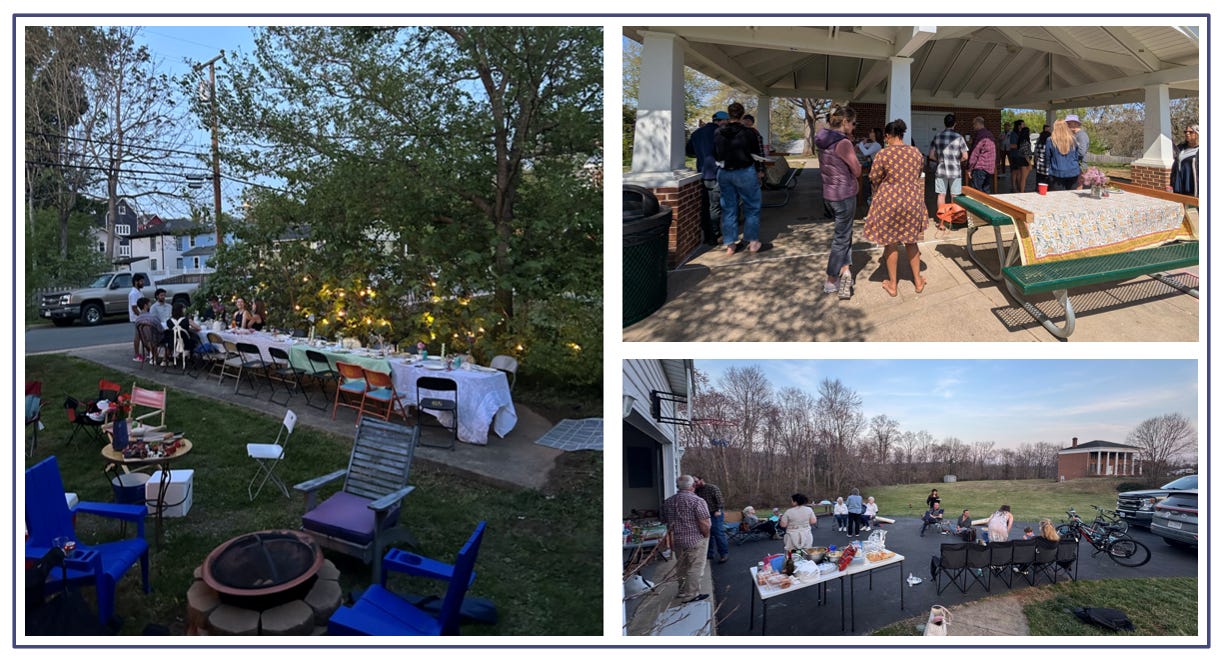
So we put our heads together and asked, “What could this permission structure look like?” Then, we phoned a friend, Elise Granata of GROUP HUG fame, to join us in this exploration, and invited in a small group of local microgrant organizers to help us co-design an approach. Collectively, we dreamed up the next iteration of With Neighbors: this time, to support a nationwide wave of local microgrant initiatives for neighbors to gather with neighbors.
Today, with the generous support of the Hearthland Foundation, we’re inviting you to join in. Start by checking out the neighborhood microgrant toolkit for everything you need to begin organizing your local microgrant initiative. Then sign up to learn alongside others interested in launching these microgrants in the places they call home.
We also think this microgrant experiment is getting at something even bigger. It’s a model for how practices can be spread memetically, with inspiration and support, to align with our vision for a new civic future — one built on local relationships, local participation, and particular places, and one where more people in more places can contribute to strengthening local civic life, more durably over time.
So, consider this piece, co-written by the three of us, a two-fer. It’s an invitation to join our With Neighbors microgrant experiment, and it’s our early attempt to describe the principles and practices that underpin this experiment (and, potentially, many more).
-Sam Pressler of Connective Tissue
Most of our culture — even our beloved civic culture — is downstream of memes.
Just as shows and movies were the fundamental unit of culture of the television era, memes are the fundamental unit of culture of the smartphone and social media era. Today, culture is spread memetically — horizontally, diffusely, and uncontrollably through networks — rather than from the top-down through established, controlled channels.
We had an early “aha” moment when we realized microgrants for neighbor gatherings are a civic meme. They’re irresistible cultural practices — a mix of simple, useful, fun, catchy, and copy-able — that spread organically and can be adapted repeatedly to local contexts. The very irresistibility of the practice makes people want to share it with others and try it locally. Its perceived adaptability, meanwhile, encourages people to apply their own flavor to fit with local culture. This makes lateral diffusion the mechanism for spreading civic memes, where the only limiting factor is people’s appetite to share and adapt the cultural practice.
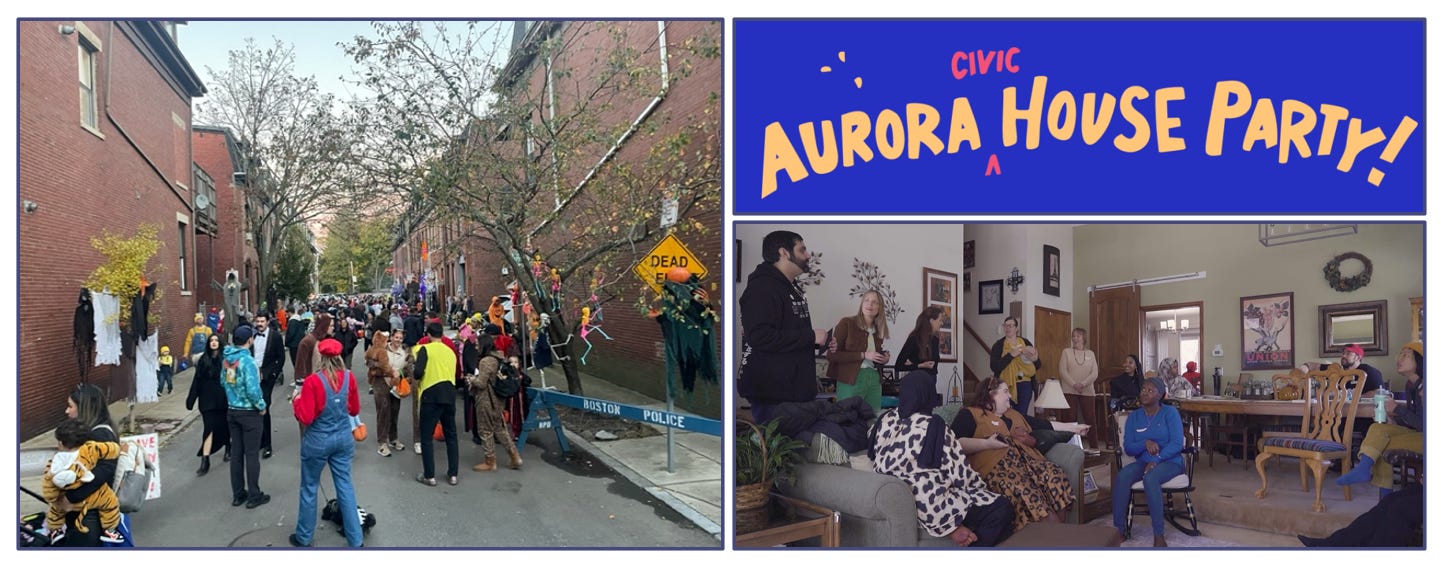
But civic memes don’t just happen; they take some curation. I first heard about microgrants for neighbor gatherings when doing research for the Connective Tissue Policy Framework. I noticed a pattern: from Boston’s microgrants for block parties, to Warm Cookies of the Revolution’s microgrants for “Civic House Parties” in Colorado, people were using microgrants to simply bring neighbors together. The first thing I thought was, “This should be happening in every community.” Then, “Why not try it on for size where I live?”
So I learned from Nathalia Benitez-Perez in Boston and Evan Weissman and Erica Dorn in Colorado. I designed the initiative to fit my local context (and constraints) in Charlottesville. I launched it as a pilot, then documented how it worked, what happened, what we learned, and our lingering questions in this piece. This created coherence to a set of practices that, prior, were not necessarily seen as connected.
I didn’t create the meme. But I did identify it, adapt it, and help spread it. Perhaps my story will turn out to be an early spark in a long, weird, uncontrollable line of others who find microgrants for neighbor gatherings too irresistible not to try where they live.
-By Elise Granata of GROUP HUG
Somewhere between irresistibility and doing the thing lurks believing it can actually happen in your town, too. We’ve all had the experience of pining over a story about stoop coffees or free community CPR classes and thought: sure, that’s easy enough for people who live in [insert walkable/urban/cool/moneyed/politically or demographically homogenous or descriptors like them here] places, but what about where I live, which is not at all like that?
Building belief begins with identifying a first step. That’s where our toolkit comes in. While I love a good toolkit (ask me for my powerpoint roasting toolkits), their power is partly symbolic. Sure, it’s helpful to see exactly how you might fundraise for your microgrant or go about selecting recipients, but what’s more meaningful is that this experience can be broken down into discrete steps at all. It’s not just for a well-resourced, magical other to pull off. How impossible could it be if it has steps?
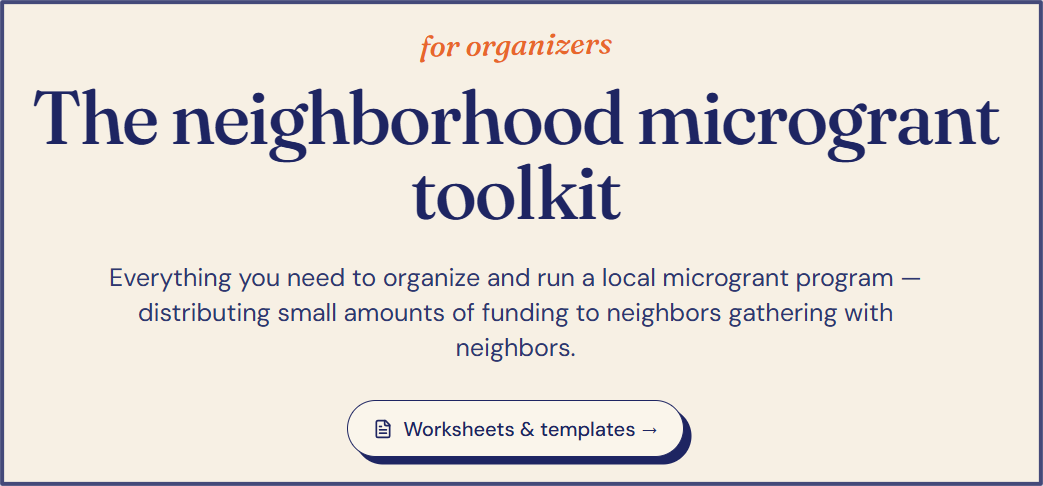
Belief is also moored in knowing you’re not alone. That’s why creating collective identity among organizers — whether you’re seasoned or just beginning (join in here!) — is so motivating. Half of it is simple camaraderie: you’re organizing a microgrant, I’m organizing a microgrant, we’re both scrapping with the same challenges. And as this feeling grows across more organizers from more places and more contexts, the format itself becomes more adoptable. Think: Little Free Libraries. You don’t just have a wooden box of books in your front yard — you belong to a movement all across the world.
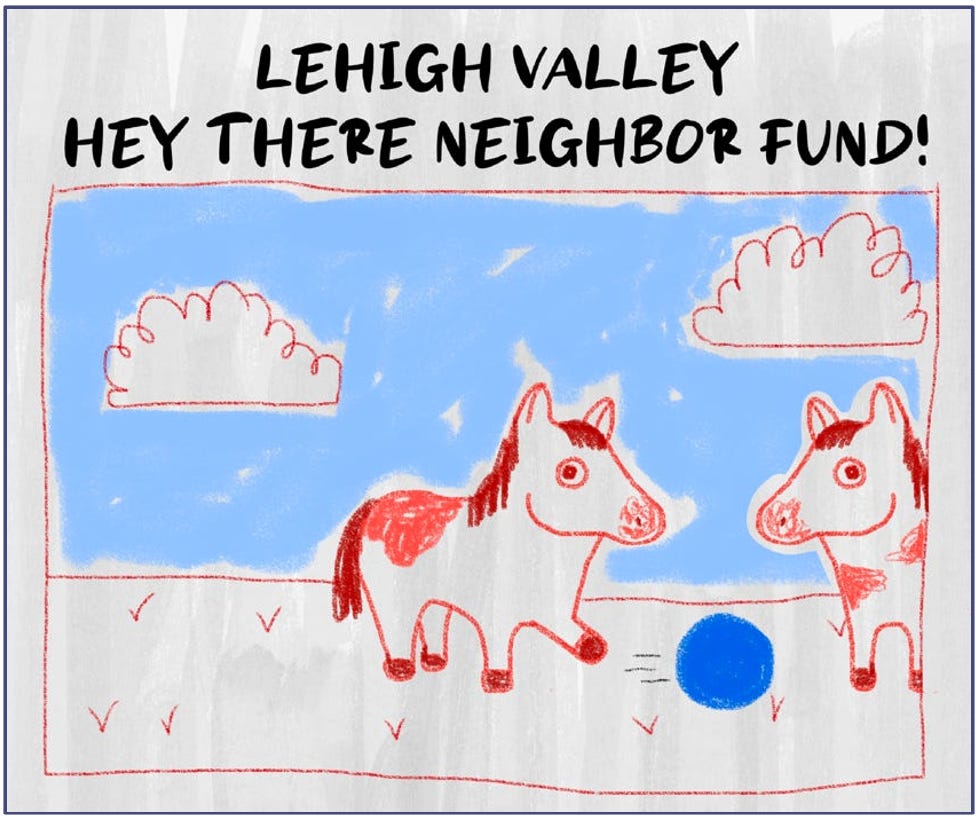
Practicing alongside others gives us role models. We need to see rural organizers and people drumming something up in towns you’ve never heard of and everyday people without a bigger org or affiliation backing them up. Just as the example of Boston dedicating an entire office to civic life might ratchet up our long-term vision for what’s possible, a scrappy flyer design for a microgrant made by a single neighbor in eastern Pennsylvania might remind us that it doesn’t need to be so formal to exist. In my early conversations with microgrant organizers, one of my favorite nuggets to drop was the example of NOFA-VT’s Long-Handled Spoon Dinners. The genius of this intimate dinner format inspired some organizers to get specific, to see a theme as a propulsive creative constraint, and to be less afraid to create something that could only happen where they live.
Diffusion becomes more possible through…actual diffusion, not doubling down on one example crafted in an ideal environment. Formats get better with stress testing alongside others doing the same thing as you: trying it on for size, breaking them in, and hacking them to fit your context.
-By Josh Nesbit of the Relational Tech Project (RTP)
Diffusion, trying it on for size, hacking — these days, this all takes some technology. Yes, the tech of recent decades has often isolated us, homogenized our experience of our places, and seized our attention. But at RTP, we believe we can all ask our technology to do the opposite: to strengthen relationships instead of replacing them, to reflect local cultures instead of flattening them, to facilitate shared stewardship instead of concentrating ownership.
So, we (Tyler Heath, Rich Speeney, and I) are building the tech for these microgrants differently. That means designing for memetic spreading and remixing, and developing the infrastructure for an attributable, open-source civic commons.
We see diffusion more like “remixing” than simple copy-paste replication. Anyone can remix a microgrant system, helping it spread and adapt from one place to another. We’ve already seen this happen among the small group of organizers we’ve been building alongside. After one organizer in Chicago wanted a multi-lingual site and unique landing pages for each language, three other organizers adopted the idea. Specific reflection questions are spreading across programs, facilitated by the tech, and, soon, enabling collective sensemaking of what’s unfolding nationally.
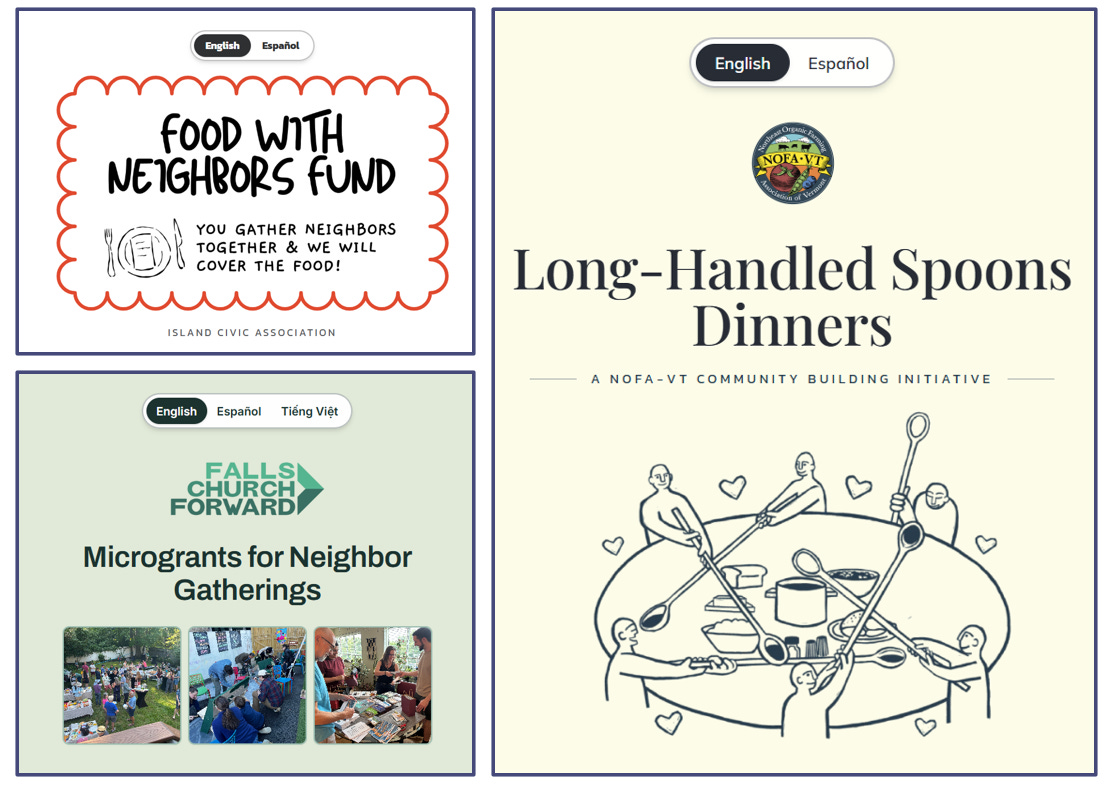
Building together and sharing back what we learn enables us to create an open-source civic commons — one we can all draw from and contribute to. Soon, any microgrant organizer anywhere will be able to access everything from site templates, to question banks, to quality-assured payment rails, all sourced from organizers themselves. Such a commons becomes a living site of shared wisdom — one model informs another, one tool informs the next — which helps strengthen our collective civic practice.
Committing to sharing a commons also commits us to sharing credit where credit’s due. We’re building an attribution system that accounts for the reality that these neighborhood microgrants — like so many of our civic practices — have been inspired and informed by others. So we’re making the lineage of ideas visible through simple things like README files and footer credits. That way, if you host a “Civic House Party” microgrant in your hometown, you can attribute Warm Cookies of the Revolution. Just like musicians give credit to their musical influences, our civic artists can give credit to their civic influences.
It’s not about building the single microgrant system for everyone to use, and then packaging it and selling it back to communities. It’s about having a fire for others to light their kindling, to take back to their own fireplaces.
Our shared civic future can be just that: shared and civic. We can be inspired by what people are doing in other places. We can adapt what they’re doing — with attribution — in the places we call home. We can turn these shared practices into shared learnings, all contributing to a shared commons of civic memes that we all own.
It’s not like we have a viable alternative. More “silver bullet” solutions designed behind closed doors and imposed on communities aren’t the answer. If we’re at the start of a 100-year project of civic renewal, it’ll take millions of people testing, diffusing, adapting, and remixing hundreds of smaller civic practices and memes to realize it.
Microgrants for neighbor gatherings are one such civic meme, and you can be one of those people who adapts it locally.
Dig into the toolkit for steps, templates, tips, and tricks. Sign up to learn alongside others — microgrant curious and microgrant organizers alike. Launch an initiative where you live, and add your local flavor to it. You’ll be taking a small but revolutionary step to strengthen the civic life of your community, and you’ll be joining dozens (then hundreds, then thousands) of others doing the same nationwide.
Every town can have a neighborhood microgrant. We can all make it happen.
No posts
Comments
Nothing yet. Say the first thing.
Sign in to join the conversation.