
When I planned this series about emotions, I knew I wanted to include sibling jealousy and competition.
My son is an only child, and I didn’t want to write about an experience I haven’t lived through as a parent.
I wanted this part of the series to come from someone who could bring both professional expertise and lived experience to the conversation.
That’s why I invited Dr. Amy See, who writes The (Whole) Child, to contribute.
Amy brings two perspectives to this subject.
She is a developmental psychologist and learning support specialist, and she is also raising two sons.
— Debbie
And now, I’ll hand it over to Amy.
AMY
I have two boys.
And if there is one thing I have learned, it is this: the moment one child gets something, be it a new pair of shoes, a party favour from a classmate, even a slightly bigger scoop of ice cream, the other suddenly needs the exact same thing. Right now.
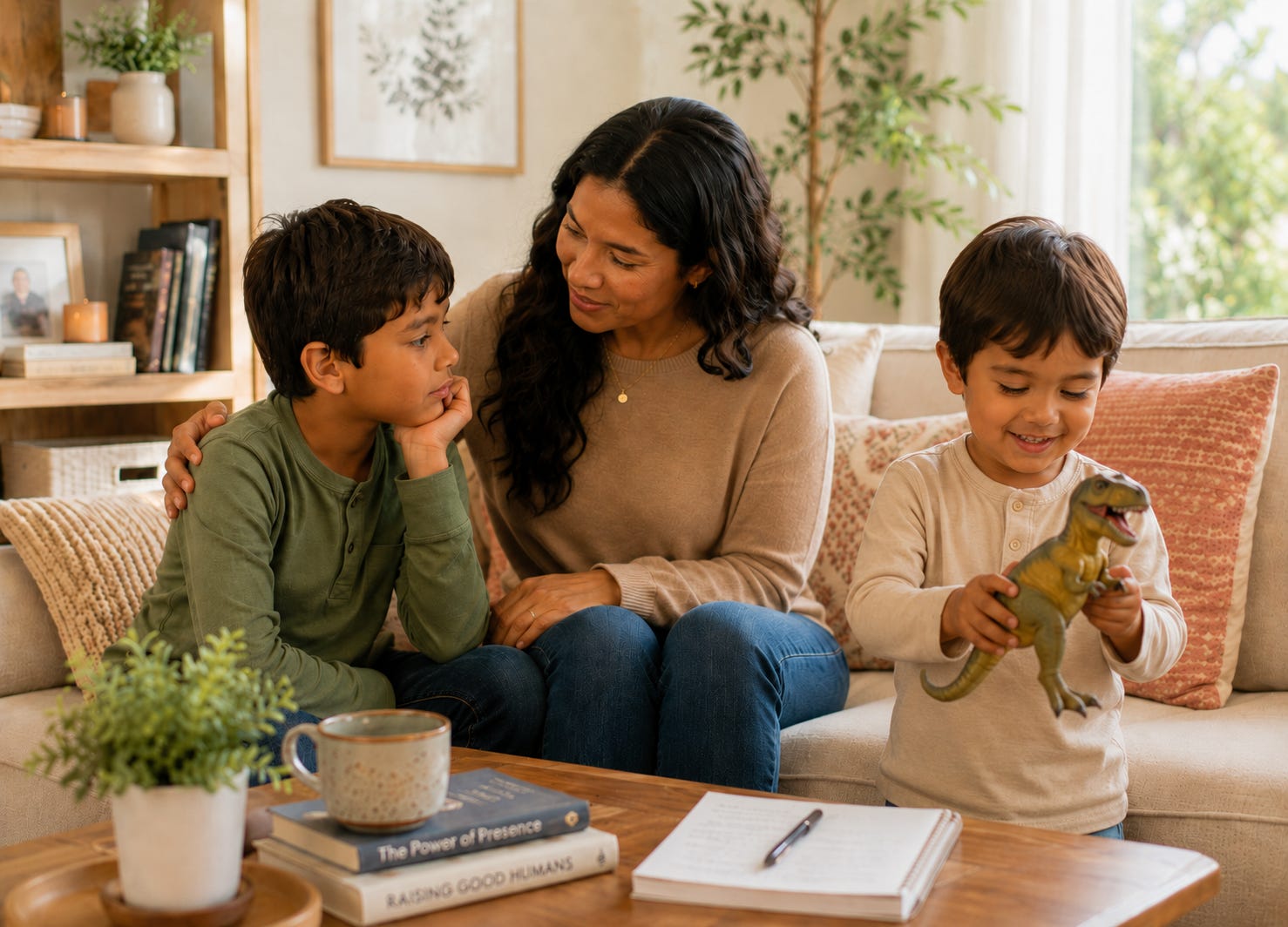
Last week, my younger son came home from school clutching a small plastic dinosaur. A child in his class had a birthday. There were party bags. He was beaming.
His older brother took one look at the dinosaur, and his face changed completely.
“Where’s mine?”
No hello. No “how was your day?” Just, where is mine?
Sound familiar? If you are raising siblings, you have lived this scene a hundred times. One balloon appears, and suddenly you are hunting for a second. One child comes home with a goodie bag, and the other acts like the world is ending. We buy one son new sneakers because he outgrew his old ones, and within minutes, his brother is convinced his own feet hurt.
As parents, our gut reaction is often frustration.
Why can’t they just be happy for each other?
Why do they always have to have what the other has?
Are they just being greedy?
But developmental psychology tells us a completely different story. When we pause and look beneath the surface of the “I want one too” behaviour, we find something much deeper, and much more tender, than a desire for a plastic dinosaur.
When a child sees their sibling receiving something, their brain does not just process the object. It processes the experience. To a child’s developing mind, an empty hand can feel like an empty heart.
Sibling jealousy is a complex social emotion triggered when a child perceives that their intimate relationship or connection with their parent is being threatened. When one child receives an item or special attention, the other child’s brain registers a sudden drop in their own security. Sibling jealousy is defined more precisely as the complex of thoughts, feelings, and behaviours that arise when one child’s close relationship with a parent is threatened by a sibling. At its core, it is about the parent-child bond, not the balloon.
In other words: the child reaching for the dinosaur is not being greedy.
They are checking.
Their nervous system is asking the question it needs answered before it can settle:
Am I still important to you? Am I being left out? Do you still see me?
Sibling jealousy is thought to be a natural reaction to the fear that a younger sibling might take the older child’s place, and researchers suggest this instinctive response could be there by nine months old.
This is not an overreaction. It is biology. And once we understand it, everything changes.
When a meltdown happens, our instinct is often to make everything equal. If one child gets a balloon, we find a second balloon. If one gets new shoes, we buy a matching pair. We exhaust ourselves chasing a perfect mathematical fairness, thinking it will prevent conflict.
But here is the problem: life is not equal. And teaching our children that fairness always means “everyone gets the same thing” sets them up for disappointment — because classmates will get birthday presents they don’t, friends will have privileges they don’t, and their sibling will sometimes receive something they cannot have.
Siblings get on better when there is no favouritism from parents, but favouritism and difference are not the same thing. What children actually need is not equal treatment. It is fair treatment. And fair means: I see you, I hear your feelings, and I will meet your unique needs in a way that makes you feel safe and loved.
Research shows that when differential treatment is explained and perceived as fair, it is not associated with negative outcomes. The key is not to avoid differences, it is to talk about them.
Buying the second balloon is a temporary plaster. The real cure is connection.
Here is what I have started doing in my own home after some trial and error, and what the research supports. It takes practice. But over time, it changes the underlying dynamic.
When your child says, “Where’s mine?” resist the urge to problem-solve, explain, or offer a replacement. Respond to the feeling underneath the behaviour.
Get down to their level. Name what you see.
“You saw your brother get something and you wished you had one too. That makes sense.” “It’s hard to watch your brother get something new when you aren’t getting anything today.”
No fixing. No lecturing. Just acknowledgment.
When a child feels heard, their brain moves out of a threat response and becomes available again. That single step de-escalates more than most parents expect.
Once the feeling has been acknowledged, gently name the deeper thing.
“Sometimes when your brother gets something, it can feel like you are being left out. Like maybe it means something about you and me.”
This is the moment where many children’s faces change. Because you have seen them, not just the behaviour, but them.
Children need to hear, in plain language, that their place in the family is not under threat. Gently separate the object from their worth.
“Your brother needed shoes today because his feet grew. That doesn’t mean he is more special. You are just as important to me.”
This sounds simple. It is simple. And it works — because it answers the actual question they were asking.
Introduce this distinction early and return to it often.
Siblings fight over “equal” because they’re watching for differences. But when we shift the goal to “fair,” we teach them something deeper: Your sibling getting something doesn’t mean you lose something. And your needs are not the same as theirs, and that’s okay.
I often use this phrase:
“Fair doesn’t always mean everyone gets the same thing. Fair means everyone gets what they need.”
Say it in the moment. Point it out in daily life. Read picture books about fairness.
Over time, it becomes part of their internal compass, and it will serve them well beyond the sibling relationship.
You do not need to buy the second dinosaur. But you can hold that boundary with warmth rather than dismissal.
“I’m not going to get you a dinosaur today, but I do want to hear about your day. Tell me something good that happened.”
You are redirecting toward connection, not away from the child.
Older children who are more secure in their relationship with their parents, and who have their needs met, are less likely to display sibling rivalry. Security is built in small, consistent moments, not grand gestures.
Instead of buying the matching toy, spend 10 minutes of uninterrupted one-on-one time with the child who felt left out. Read a book together. Kick a ball. A Saturday morning trip to the bakery, just the two of you. A private joke or a ritual that belongs only to you and them.
When children know they have their own special time coming, they are less threatened by the spotlight their sibling is in right now.
Explicit and implicit comparisons between siblings fuel resentment and competition. When parents’ expectations are too high of the older child, it can lead to more jealousy, but when parents have more reasonable expectations, children are less likely to be jealous and more likely to be positive role models.
Avoid phrases like “why can’t you be more like your brother?” or labelling children as “the sporty one” or “the sensitive one.” It will be hard, I have been there.
Instead, notice and name each child’s unique strengths, separately, specifically, and often.
When you see your children cooperating, sharing, or resolving a conflict kindly, name it. Praise it. Research on sibling relationship programmes has found that teaching parents to strengthen sibling bonds leads to measurable improvements: greater sibling warmth and less rivalry, with effects sustained over months.
I looked at my younger son’s older brother. He was still waiting, face set, for an answer about the dinosaur.
I sat down next to him.
“You saw him come in with something and you wished you had one too.”
He nodded, a little defensively.
“That makes sense. Sometimes when someone else gets something, it can feel like you got left out. Like maybe it means something.”
His shoulders dropped slightly.
“It doesn’t, though. Not about you and me.”
He was quiet for a moment. Then he asked if he could show me something he had made at school.
The dinosaur was forgotten within minutes. Not because I solved the problem. Because I answered the actual question.
Every jealous moment is actually an opportunity, to teach emotional literacy, to set kind boundaries, and to reassure each child that they are loved uniquely.
The stakes are meaningful. Research shows that high-quality sibling relationships serve as protective factors for children’s emotional security and mental health, and that the small daily actions we take add up over time.
Will they still argue? Yes. Will there still be tears over balloons and shoes and birthday goodie bags? Almost certainly.
But underneath all of that, a foundation is being built. A foundation of fairness, empathy, and the quiet knowledge that love does not have to be divided.
It can be multiplied.
And that, I believe, is the real gift we give our children when we stop trying to make everything equal, and start offering genuine connection instead.
— Dr. Amy See, PhD
What does sibling jealousy look like in your home? I would love to hear from you in the comments.
About Dr. Amy See, PhD
Amy is a developmental psychologist and learning support specialist.
At The (Whole) Child, she writes about child development, attachment, and education; translating research into warm, practical insight for parents and educators who want to understand the whole child behind the behaviour.
➡️ Connection Before Correction
The relationship has to come first. A practical guide for parents and educators supporting children who struggle — starting with trust, not strategy.
➡️ It Was Not One Child’s Problem. It Was the Room’s
What happens when a whole group is dysregulated — and why the behaviour you see is rarely the thing that needs addressing.
➡️ He Heard “Ice Cream” From Three Rooms Away
Why your child ignores you four times then appears instantly at the word “playground.” It’s not selective hearing. It’s a brilliant, unfinished brain.
More from Connection Bridge Parenting
For me, the main takeaway from Amy’s post is that jealousy comes from a child’s need for reassurance. They want to know that their feelings and desires matter to us.
With that understanding in mind, I decided to explore the themes of competition and rivalry in the final story of the Silverbrook School Shared Snack series.
The story is called Nico and the Snack That Everyone Loved.
When the children at school start preferring Tommy and Benny’s honey cakes, Nico begins to worry. Eventually, he discovers that the competition between them was based on a misunderstanding and that he doesn’t have to be the best to matter.
Explore the full Jealousy series.
Explore the full library of articles, stories, and parenting resources here.
— Sibling jealousy as natural reaction, present from 9 months: NCT (2025). Sibling relationships and sibling rivalry.
— Sibling rivalry root cause and parental attention: EBSCO Research Starters (2025). Sibling Rivalry.
— Jealousy as threat to parent-child bond: Volling et al. (2002). Emotion regulation in context: the jealousy complex between young siblings. PubMed.
— Individual attention and avoiding comparison: MyWellnessHub (2023). Helping Children Cope with Jealousy: Practical Tips.
— Sibling relationship programmes and outcomes: Nationwide Children’s Hospital. Sibling Rivalry — Helping Hand.
Comments
Nothing yet. Say the first thing.
Sign in to join the conversation.