
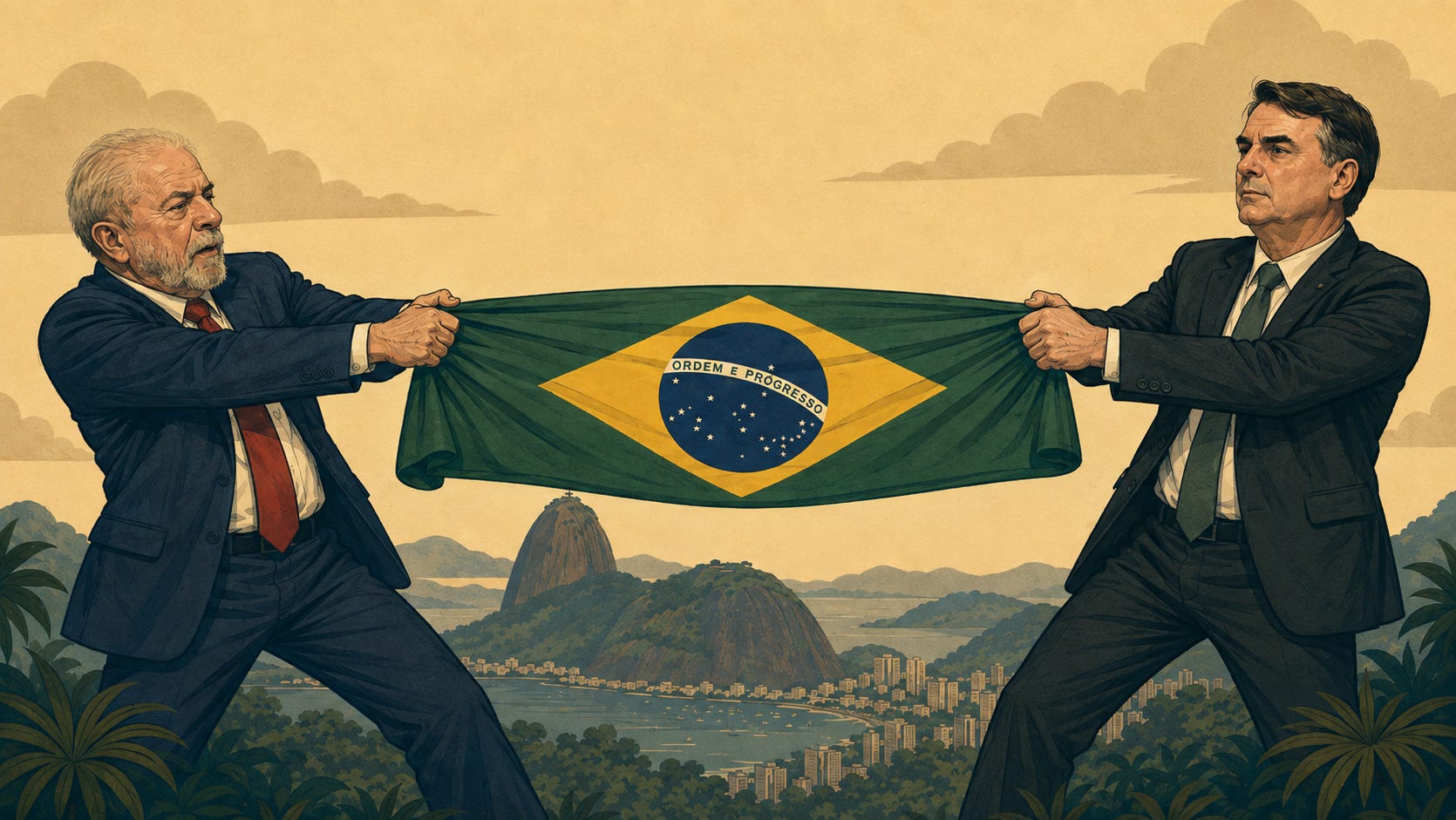
President Lula da Silva’s publicity machine has moved on from euphoric rally speeches and crowd-hugging photo ops. These days, his most viral videos show him working out, flaunting rude health. The “fitness influencer” act looks like a calculated strategy: at 80, project physical and political strength ahead of a campaign pitting him against the “heir to the Patriarch,” 45-year-old far-right leader Flávio Bolsonaro.
This is no ordinary election. Brazil must choose between renewing its trust in Lula’s political project or bringing back the Bolsonaro dynasty. This time without Former President Jair Bolsonaro at the helm, who is serving a 27-year sentence under house arrest for conspiracy and attempting a coup d’état.
This time, the South American giant’s election carries even greater weight abroad. Its outcome would reshape the right’s foothold across the continent’s governments and its sway over key issues: the future of Mercosur, Amazon climate policy, and above all, relations with the United States, China, and the BRICS. In a deeply polarized country whose institutions are under strain, Brazilians are voting on more than the next four years; they’re voting on their democratic credibility and their stance toward foreign interference.

GloboNews@GloboNews
Embaixadora brasileira nos EUA tem visto revogado. Decisão do governo Trump é temporária até resolução de crise diplomática. ➡️ #GloboNewsMais - de segunda a sexta, às 16h, na #GloboNews. Assista na TV e no @globoplay .
8:35 PM · Aug 4, 2026 · 57.4K Views
110 Replies · 36 Reposts · 342 Likes
Our journalism is committed to protecting democratic values, reporting unbiased facts, verifying and contrasting, being independent.
In other words, #InvaluableJournalism
To chants of “Lula, warrior of the Brazilian people” and banners reading “Brazil does not surrender,” the Workers’ Party (PT) proclaimed President Luiz Inácio Lula da Silva as its candidate for a fourth term, his last, he says. But it was a mere formality: on the left, he has always been seen as the only figure capable of taking on this fight.
Backed by a coalition of seven progressive and center-left parties, Lula is running convinced that foreign interests are circling. That’s why, if he stays in power, he’s already naming a priority: investing in defense to protect Brazil’s sovereignty. “I want to be prepared so that no one invades this country to take away the president, as they have done elsewhere (…) I want to be prepared so that no one dares take us for fools. Is that clear?” he told supporters at his massive nomination rally in São Paulo in early August.
Though Lula never named President Donald Trump, the reference was clearly aimed at the U.S. operation against Nicolás Maduro in Venezuela. It echoes other instances of American meddling in support of candidates aligned with its geopolitical goals, all as the “Shield of the Americas” initiative, which shelters right-wing governments, gains strength with new presidents in Colombia and Peru.

El Ciudadano@El_Ciudadano
Los países BRICS concentran entre el 69% y 78% de las reservas mundiales de metales de tierras raras, considerados “vitaminas de la industria”. China lidera con el 40% de las reservas y más del 70% de la producción global. La demanda crecerá entre un 8% y 10% anual hasta 2035,

12:28 PM · Aug 3, 2026 · 891 Views
3 Reposts · 1 Like
Nothing about that bodes well, says Flavia Loss, professor of International Relations at the Instituto Mauá de Tecnología: “Donald Trump threatens American democracy itself, and he cares even less about South American democracies. What interests him is having far-right strategic allies.”
Against this backdrop, Lula made clear he’ll take rare earths and critical minerals seriously. “No Chinese, no American, no Frenchman will touch these resources.” Sovereignty rhetoric plays well on the campaign trail, especially when foreign signals grow louder. Brazil holds the world’s second-largest rare earth reserves, behind only China, though much of that potential remains untapped.
The Trump-Bolsonaro relationship runs deep. The former president—known as “the Patriarch”—built the alliance on nationalist, conservative rhetoric hostile to multilateral institutions. Even after he lost the 2022 election, Trump stood by him fiercely: he baselessly denounced a “witch hunt” against Bolsonaro. He raised tariffs on Brazilian goods to “avenge his friend” when judicial authorities moved to indict him. The backing didn’t stop there, it extended to the Bolsonaro family, which Trump treats as a strategic ally of the international right.
To understand this trend’s advance across the region, Loss points to the influence of the Conservative Political Action Conference (CPAC), the annual political forum founded in the United States. “Brazil opened the most recent far-right cycle in the region when it elected Jair Bolsonaro. That was also part of an international far-right strategy led by Donald Trump. So we ended up strengthening other right wing candidates here in the region, like Javier Milei or Abelardo de la Espriella, because it opened an important precedent for that ideological current, its values and its ideas […] These governments, like Jair Bolsonaro’s, oppose Latin American integration, and that worries me a lot, because it will affect our countries’ cooperation and autonomy from the United States.”
That ‘s not to say Flávio Bolsonaro has it easy. The Liberal Party (PL) leadership backs his bid, but internal disputes, controversies, and a lack of alliances point to premature wear—not least because his political identity is confined to his father’s legacy.
The continental stakes of Brazil’s election were made clear when Argentine President Javier Milei paid an unusual visit to Brazil to back Bolsonaro’s campaign and discredit his rival. Far from de-escalating, Milei doubled down on his attacks against Lula da Silva amid the ensuing uproar: “If there’s anyone who interferes politically in the region, it’s Lula, spreading socialism’s filthy ideas everywhere,” he said in a recent interview with La Nación. Milei leaned on the Lava Jato corruption case that implicated Lula and bluntly called him a “crook, thief, and convict.”

La Nación Más@lanacionmas
💬 "Lo liberaron por una falla administrativa en el procedimiento, no por ser inocente" 🔵 @JMilei ratificó sus dichos sobre Lula da Silva. 📺 En La Cornisa, con @majulluis
1:13 AM · Aug 3, 2026 · 25.9K Views
45 Replies · 13 Reposts · 68 Likes
The Argentine head of State’s outbursts no longer surprise anyone, but when it comes to Brazil, plenty of eyes are watching, China’s among them. President Xi Jinping issued a statement backing Lula’s government under the banner of rejecting “foreign interference.” Yet Beijing has its own interests at play too: Brazil is its BRICS partner, while Argentina opted out of the group.
Political analyst and campaign consultant Marco Bastos sees the spat as evidence that public discourse is eroding as insults become normalized. Still, he notes strong interests bind the two nations, so he doesn’t foresee “a major impact on Brazil’s electoral race or on bilateral relations with Argentina.” Still, for Loss it’s always possible for President Milei to end up “setting aside pragmatism and rationality in the name of a purely ideological agenda.”
A Bolsonaro victory would likely follow that same script. As seen elsewhere in the region, right-wing governments’ first moves tend to target institutional structures; that could mean A) a presidential pardon for Jair Bolsonaro and others convicted over the January 8, 2023, coup attempt; B) a deterioration in trade relations with China, Brazil’s top partner and the main buyer of its agricultural exports; and C) further hardening of hate speech fueled by MAGA-style rhetoric.
Underlying it all is the impact on Latin America as a whole. As Mayara Paixão, Folha’s correspondent in New York, puts it: “if Lula wins, Javier Milei will probably remain Donald Trump’s top ally in the region. If Flávio wins, that changes significantly, especially given Brazil’s political and economic weight, which would make it the White House’s main ally.”
Your contribution makes a difference. Support CONNECTAS’s investigative journalism.
Many factors weigh on the vote, but perhaps the most decisive have less to do with foreign interests circling the country than with which candidate can deliver security and economic stability. Brazilians worry about organized crime’s expansion—illegal mining, smuggling, extortion and money laundering.
It’s not just violence; there’s also social fatigue, especially among a middle class that sees no improvement in its living conditions. The economy has lost the momentum of Lula’s early years in office, but he enters the campaign with numbers in his favor: the International Monetary Fund (IMF) forecasts 2.4% growth this year, driven by domestic consumption, a solid labor market and strong exports. Even so, the IMF expects a gradual slowdown, projecting 2.2% growth for 2027.
Bastos explains that a great deal is riding on this election, and he senses a broader unease, a fear that something could go wrong with the economy. “I’d say Brazil’s fiscal trajectory deserves attention, but it’s not the breaking point the right claims it to be. And the left is right that Flávio Bolsonaro could mean democratic erosion, mirroring Trump’s United States. But there’s a third group, independent voters, who I think look at this whole landscape with great disillusionment over the corruption scandals involving parties and politicians on both the right and the left of Lula’s PT. That’s why they view both candidates’ economic promises with great skepticism.”
The expert adds that this group feels orphaned, since neither option has shown it can address their demands, usually tied to unemployment or poor-quality jobs. “For part of the electorate, this election will be a painful process, almost tedious given the lack of anything new on the board.”
Brazilians face two very different political projects, Paixão says. “On social policy, for instance, one favors a bigger State role and more support for lower-income groups, which is Lula’s, while Flávio’s proposes cutting social programs and a more limited State. There are also important differences in the economic model, of course. Lula bets on higher public spending, while Flávio backs an agenda of tighter spending control and measures more aligned with the market.”
With two months to go, it’s clear the next president will inherit a major challenge. A Nexus poll commissioned by BTG Pactual has the leftist leader at 47% against his opponent’s 43% numbers pointing to a runoff election.

Bloomberg Línea@BloombergLinea_
La ventaja de Lula se reduce: una nueva encuesta lo muestra apenas un punto por encima de Flávio Bolsonaro. bit.ly/4wAN4Ue
12:39 PM · Aug 3, 2026 · 718 Views
On October 4, Brazilians will also elect 27 governors, 54 senators, 513 federal representatives, 1,035 state representatives and 24 district representatives. If no presidential or gubernatorial candidate wins more than 50% of valid votes, excluding blank and null votes, a runoff will be held on October 25.
The octogenarian president, who speaks openly about the passage of time, has already stepped into the ring, eyeing a fourth term. Flávio Bolsonaro, meanwhile, isn’t just after the Planalto Palace, he wants to prove his father’s political project is solid enough to reclaim power and hold onto it, with Donald Trump’s backing. Latin America, for its part, is watching more closely than usual, aware that this time, far more than Brazil’s presidency is at stake.
Comments
Nothing yet. Say the first thing.
Sign in to join the conversation.