
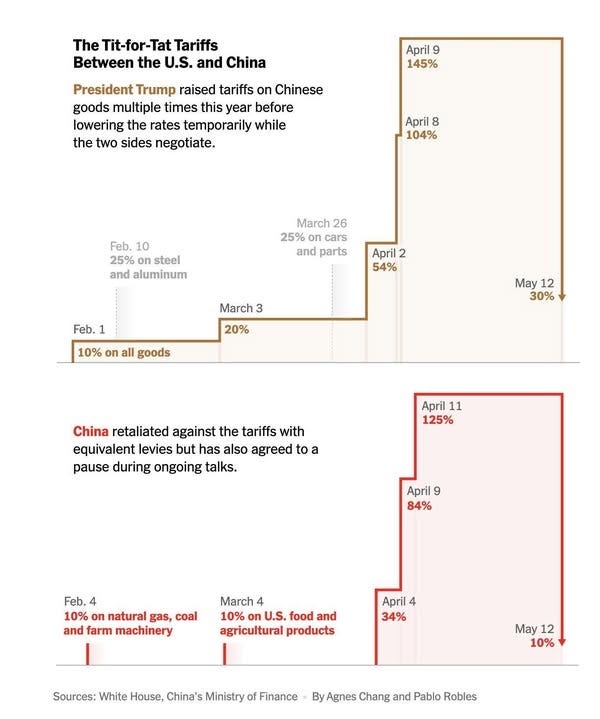
The tit-for-tat tariff escalation between the two biggest economies in the world has suddenly veered toward de-escalation. Both the United States and China withdrew on May 12 following months of retaliatory tax increases, suggesting a possible change toward fresh trade negotiations.
Here’s how the tariff chess match played out:
Feb 1: 10% tariff on all Chinese imports
Feb 10: 25% on steel and aluminum
Mar 3: Tariffs raised to 20%
Apr 2: Spike to 54%
Apr 8–9: Surged to 104% and then 145% 🚀
May 12: Temporary drop to 30%, aiming to open the door for diplomacy 🤝
Feb 4: 10% on agricultural machinery, coal, and natural gas.
Mar 4: 10% on agricultural products and food.
Apr 4: climbed to 34%
Apr 9–11: Made leaps to 125% and 84% 🔥
May 12: Cut to 10%, matching the United States to help to lower tensions. ✍️
“Both sides agree that we share mutual interests… and neither seeks economic decoupling.”
This key statement highlights a shared intent: not to sever ties, but to stabilize economic relations.
The synchronized May 12 tariff rollback signals a cooling of trade tensions.
It reflects both countries’ efforts to avoid economic decoupling in spite of months of forceful policy actions.
This may pave the way for a new round of trade agreements.
There is a positive outlook for export-driven and tech stocks like Apple, Tesla, and U.S. agricultural exporters.
⚠️ Disclaimer: This content is for educational purposes only and is not investment advice. Always do your own research and assess your risk tolerance before making investment decisions.
No posts
Comments
Nothing yet. Say the first thing.
Sign in to join the conversation.