
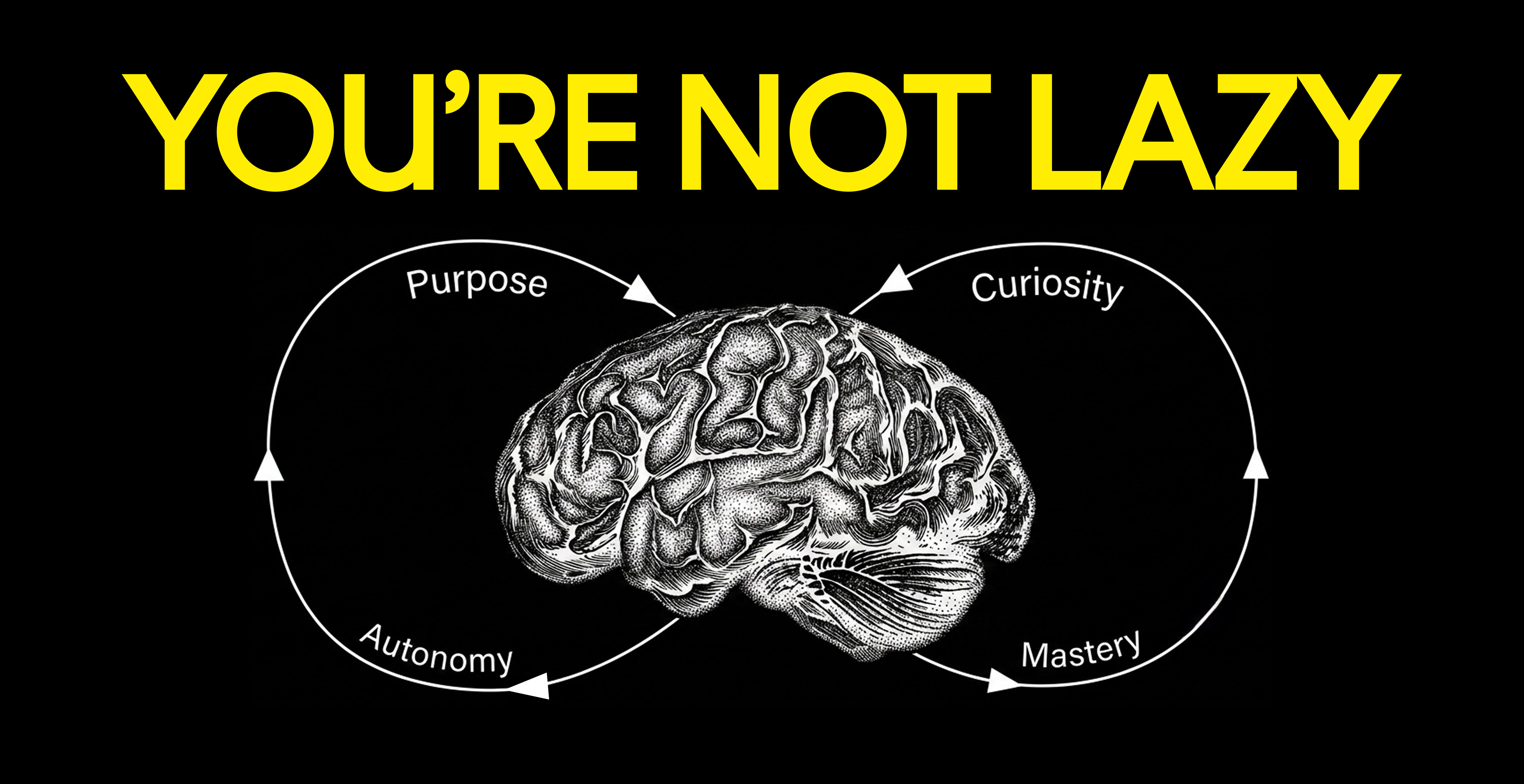
You already know what you should be doing. Learn the skill. Start the project. Study for the exam. You know it, and you still don’t do it.
There’s nothing wrong with you. Your brain is literally built to resist effort. Let me show you how that works, and the three ways to get around it.
There’s one thing that separates the people who do hard things easily from the people who grind through every task.
It comes down to resistance. The ones who struggle feel a wall go up every time they sit down to work. The ones who do it easily barely feel that wall at all.
And here’s what they worked out. The answer was never to push harder and burn through your willpower until the tank is empty.
The answer is to design the task so your brain actually wants to do it. So it stops treating the work like a threat.
Sounds impossible, I know. So let’s start with how your brain handles a hard task in the first place.
You’ve got two systems for getting things done.
The first is your basal ganglia. It runs all your automatic behavior, the stuff you do without thinking.
Brushing your teeth is a good example.
You stand at the sink and your hand just does it.
You’re not calculating the angle of the brush or how much pressure to use or where to start. Driving is the same once you’ve done it long enough. It goes automatic.
But the day you first sat behind the wheel, every tiny move took real concentration.
That’s the second system. Your prefrontal cortex, right behind your forehead. It runs everything that takes conscious effort and real decisions.
Writing an essay. Learning a new skill. Building a project you’ve never built before.
And here’s the catch. Your brain doesn’t like leaning on the prefrontal cortex for too long, because heavy, sustained effort there leads to mental exhaustion. So it protects itself.
"Most of us have two lives. The life we live, and the unlived life within us. Between the two stands Resistance." — Steven Pressfield, The War of Art (2002)
Comments
Nothing yet. Say the first thing.
Sign in to join the conversation.