
I am not going to make you wait to absorb the core of this story. This time, let’s move the other way around. Take the central mechanism first, and then work outward to see where it leads.
What is happening on the honey front is one of the reasons our team believes the IMF forecast for U.S. GDP—even though it already points to weaker growth—may still understate what is coming.
That is not really the IMF’s fault. This is extraordinarily difficult to model. You can estimate tariff rates, trade volumes, price increases and some demand destruction. What you cannot easily predict is how far supply chains will rearrange once countries begin retaliating, supporting domestic producers and replacing American suppliers. And there is certainly no way to model what the oligarchs may tell this administration to do on any given Saturday.
Honey gives us a very simple example of the problem.
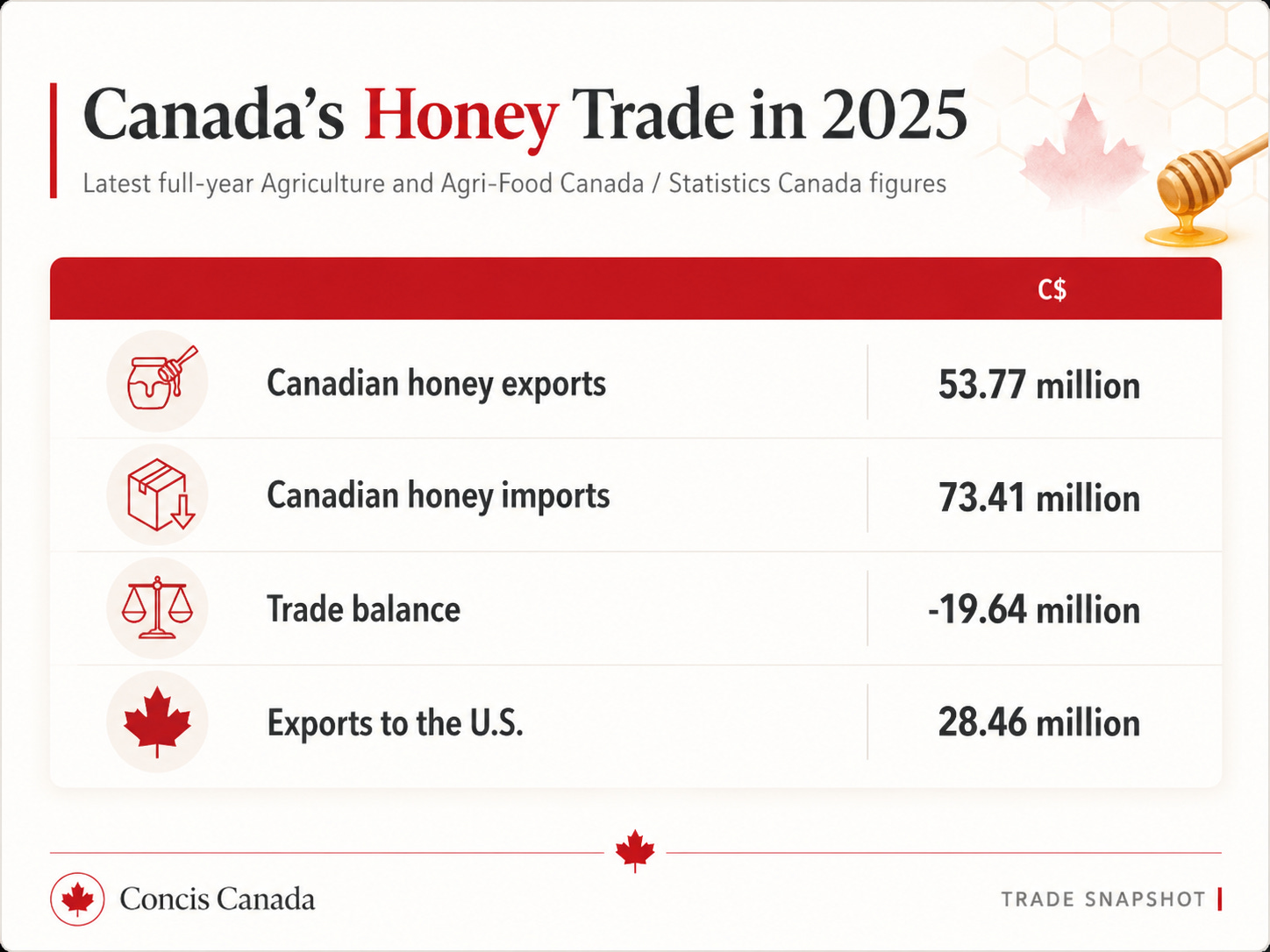
Canada imports more honey than it exports. In 2025, Canadian honey exports were worth about C$53.8 million. Imports were approximately C$73.4 million.
So why on earth would you choose this product for a trade war? Why attack a Canadian export when Canada already imports more of that very product from the rest of the world than it exports altogether?
The United States has now placed a 50% tariff on Canadian honey, and Canada has responded with the same tariff on American honey. That immediately makes the U.S. market harder for Canadian producers and American honey less competitive inside Canada.
But the larger opportunity is sitting beyond American honey. Canada already imports more than C$73 million worth from the world. If Canadian producers begin losing part of their U.S. market, Ottawa has an enormous incentive to help redirect that production home and start replacing some of those foreign imports.
If Ottawa then helps Canadian producers make that transition—while Canadian consumers and retailers shift toward domestic supply—the supply chain begins to rearrange. Canadian honey that might once have crossed the border can remain at home. Imports can gradually be displaced. Producers can invest around a larger domestic market.
Over time, that change can become permanent.
And that is the part Washington appears to keep missing. A tariff does not merely create a temporary price distortion. Used repeatedly, it gives your trading partners a reason to replace you. Do that across enough products, and eventually you are the one left holding the jar.
Someone fairly high up the American tariff-project chain apparently looked at a product that Canada imports more of than it exports and decided it would be a great idea to drag that into the trade war as well.
Canada has now announced the same 50% tariff on American honey coming into the country.
And that means the supply chain is about to start moving.
It is highly likely that Ottawa will provide some support to Canadian producers. But we do not think simply writing cheques will be enough. This needs to become a coordinated substitution project.
Agriculture and Agri-Food Canada should take the lead. The Industry Ministry should be sitting beside it, because financing production, packaging, processing and distribution will be part of the job. The Canadian Honey Council needs to be at the table. So do the major grocery retailers and the organisations representing the wider food-distribution chain.
And they can begin with a very simple mission.
Identify where American honey is occupying the largest amount of Canadian shelf space and start replacing it with Canadian supply.
A one-for-one transfer will obviously not happen overnight. Large supermarket groups will have specifications, contracts, packaging requirements, volumes and distribution standards. Fair enough. Nobody is suggesting that Ottawa simply turn up at the loading dock with a barrel of honey and tell Loblaw to find a shelf.
But that is precisely why the government needs to convene the supply chain now.
Find out what the retailers require. Find out what Canadian producers cannot currently provide. Identify the packaging, processing, warehousing and distribution gaps. Then use government support to close those gaps.
And if a large retailer says domestic producers cannot meet some standard today, write the requirement down and help them meet it tomorrow.
Because one day the oligarchs may come for something sitting on that retailer’s shelves too. At that point, Ottawa can pull out the notes from this meeting and remind everyone why building resilient domestic supply chains mattered in the first place.
The objective is not to bully supermarkets into stocking a product they think is not good enough. The objective is to make sure a Canadian product can meet the retailer’s requirements, reach the distribution centre at the required scale, arrive on the shelf at a competitive price—and then replace the foreign product.
That is where financial support becomes useful.
Do not simply compensate the beekeeper for losing the American customer. Help the beekeeper, packer, processor and distributor acquire a Canadian one. Use this one Canada.
Looks like a good fumble by the other side. When they fumble the ball, never let go. Ever.
What do we think happens if Canada handles this fumble well?
First, Canadian honey begins replacing imports from across the world. It will not happen overnight, and Canada does not need to replace every imported jar. It just needs to steadily redirect domestic production that loses access to the American market back into Canadian stores.
Second, there is a reasonable chance Canadian honey prices come down somewhat over time. That is not guaranteed—production costs matter—but moving more honey internally removes some of the freight, border and international-distribution costs attached to imported supply.
Third, the United States has to replace at least some of the Canadian honey it no longer receives. That means either increasing domestic production or importing more from somewhere else, potentially over much longer supply chains.
Fourth, American consumers end up paying more than they did before. The tariff raises the cost of Canadian supply, alternative imports have to be found, and a supply chain that previously worked perfectly well has now been deliberately disrupted.
And the tech oligarchs do not particularly care. Honey buyers do not pay for yachts.
Concis Canada has fewer than 2,000 subscribers.
That is not scale.
That is where the algorithm decides to dig, bury and landfill the story.
In the current media environment, getting reality in front of people is extraordinarily difficult. Every free subscription expands our reach. Every paid subscription strengthens this desk and gives stories like this the visibility they need.
No posts
Comments
Nothing yet. Say the first thing.
Sign in to join the conversation.