
When the side trying to bring you down fumbles, your job is to make it count. Never let go of that fumbled ball. Ever.
“On January First, 2027, Tariffs on all Cars, Trucks, both large and small, Automotive Parts, and Steel, will be increased to 50%.”
The threatened Canadian sectors are:
Cars
Large and small trucks
Automotive parts
Steel
The 50% rate is scheduled to take effect on 1 January 2027. This is a new layer of tariffs, imposed on top of those unveiled this week.
For what it is worth, the MAGA bullying does follow a logical thread.
First came the coercive ultimatum: sign on to the annexation offer, deepen your dependency on the United States and accept a permanent layer of tariffs.
Canada said no. Be gone.
Then they went back, surveyed the media environment and discovered that the response was not particularly flattering to their bravado. So they escalated: We can hurt you even more. This time, we will target your largest vulnerability by dollar value—and one of the industries most critical to your sovereignty.
Beginning in January 2027, the MAGA administration says it will come for Canada’s automotive and steel industries.
They should have kept their mouths shut. But they did not. From this point forward, it would be on us if we failed to recover the fumble.
We will return to the automotive industry separately, because it is the second-largest Canadian export sector on which the MAGA administration wants to go after. It is an enormous target: nearly $45 billion in Canadian production moved south into the United States in 2025, accounting for almost 12% of Canada’s total exports to the country.
There is a reason why the admin has circled steel.
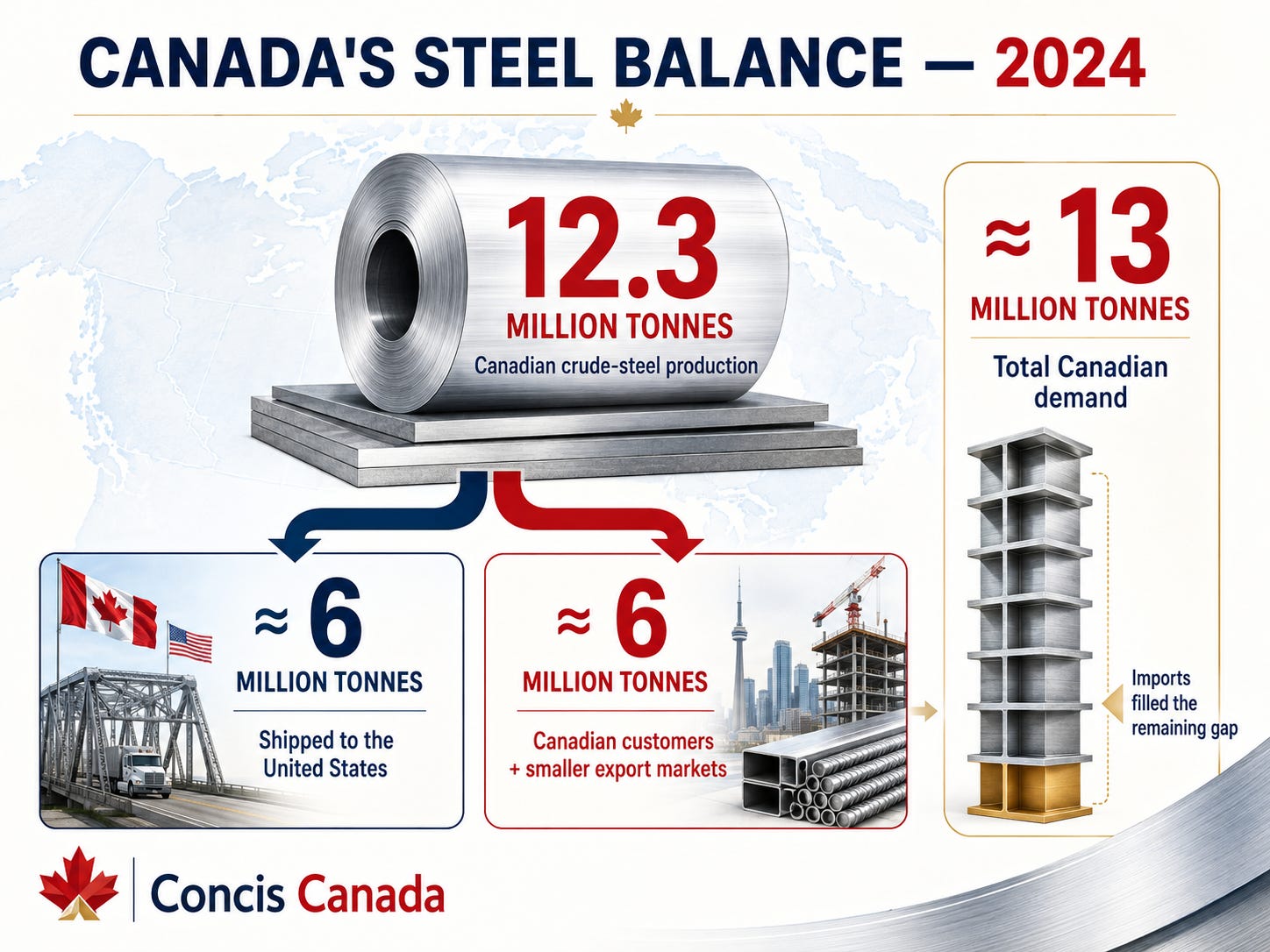
Canada exported roughly half of its steel production to the United States, while also importing substantial quantities of U.S. steel and steel-intensive manufactured goods. The pattern reflected a deeply integrated continental supply chain, but it also meant that a significant share of the higher-value manufacturing using Canadian steel occurred downstream in the United States.
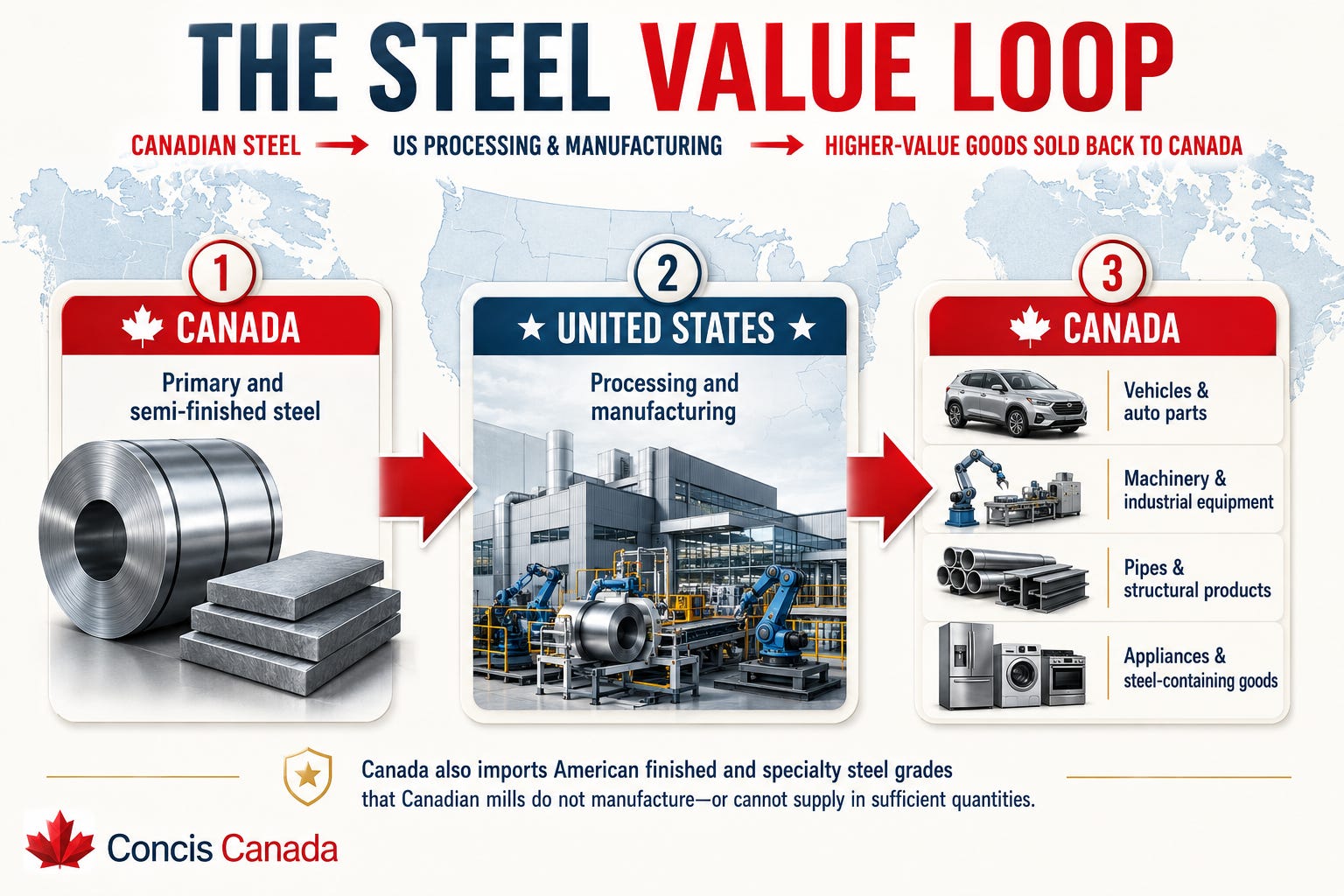
That is a dependency that runs both ways. When one side attempts to weaponise that integration, you arrive at precisely the problem we are facing today.
Why are steel and aluminium so important?
Because they are not merely commodities. They are the foundations upon which a country builds its infrastructure, energy systems and defence-industrial capacity. Without secure access to steel and aluminium, defence production eventually runs into trouble. And replacing that dependency with imports from China is not an option.
Canada’s stated policy should therefore be simple: not one steel mill or aluminium smelter will be allowed to close because of foreign coercion. We take the threat seriously. We understand the immediate challenges. We protect the productive capacity now—and then methodically engineer our exit from the vulnerability.
Steel will be much harder to redirect than aluminium.
Canadian aluminium is benefiting from genuine shortages and elevated European premiums. Steel is entering a world already drowning in excess capacity. Canada cannot simply place every displaced American-bound tonne onto the open market without accepting sharply lower prices.
Global steelmaking capacity reached 2.445 billion tonnes in 2025. Approximately 650 million tonnes of that capacity was already surplus to demand. Another 139 million tonnes is planned by 2028, pushing projected excess capacity towards 745 million tonnes.
At the centre of this problem sits China.
Chinese mills produced 960.8 million tonnes of steel in 2025—approximately 52% of global output. Production declined by 4.4%, but Chinese demand is expected to fall by another 1.5% in 2026 before remaining broadly flat in 2027.
As China’s property sector consumes less steel, its mills are pushing more material into international markets. Chinese steel exports reached record levels in 2025, forcing producers in Europe, Japan, South Korea, Canada and emerging economies to compete against the consequences of China’s domestic demand problem.
Beijing is exporting that problem to the rest of the world.
Canada is therefore being squeezed from two sides. Chinese overcapacity is flooding alternative markets and depressing prices. On the other end, the Trump administration is threatening to close—or make prohibitively expensive—the market into which Canada currently sends roughly half its steel production.
China is making it harder for Canadian steel to go anywhere else. The United States is trying to make it harder for Canadian steel to go where it already goes.
That is the two-front squeeze.
The answer to this two-front attack is organised demand.
That demand can come from Canadian infrastructure and defence procurement; European defence, railway, grid and industrial projects; British and European market access protected from subsidised overcapacity; and long-term purchasing agreements that give Canadian producers something far more valuable than another search for buyers on the spot market.
Polish, German, British, Nordic and Ukrainian rearmament and reconstruction programmes can all become part of that demand. But this will require coordinated barriers against subsidised Chinese steel and deliberate agreements directing Canadian production into allied projects.
Trump’s tariffs can still permanently redirect Canadian steel. But governments will have to build a protected democratic steel market. It will not organise itself automatically.
Infrastructure, railways, construction, capital investment and automobile production can provide the scale. Canada, however, must stop treating automobiles, steel and aluminium, and industrial machinery as separate files. They overlap throughout the same supply chains. Redirection towards Europe, Britain and India must therefore move them together as one industrial package.
Let us use Britain as an example to run this test:
Britain needs steel.
Canada can redirect part of its production there. If downstream steel processing currently performed in the United States can be transferred to Britain, then transfer it. Canada also buys enormous volumes of industrial and off-road engines and power systems from the United States. Open the Canadian market much wider to companies such as JCB Power Systems and Rolls-Royce.
That is targeted redirection accompanied by a reverse flow: Britain buys more Canadian steel, while Canada buys more British machinery and equipment. Both sides gain enough trade to make the new supply chain commercially sustainable.
Then rinse and repeat.
Where that back-and-forth can be built with Britain, build it. Where it can be built with Germany, build it. Do the same with Europe and India—sector by sector, company by company and line item by line item.
Instead of immediately sending billions of dollars in subsidies to steel producers and automakers, send the trade minister to work from Europe, Britain and India for the next six months. Let the deputy remain in Canada and identify every import currently sourced from the United States that a new partner could competitively replace. At the same time, obtain the corresponding list of Canadian products that the partner can absorb.
Begin with one objective: redirect C$1 billion in both directions. Remove C$1 billion from the US-centred supply chain and replace it with a balanced flow through a trusted partner.
Then begin working on the next billion.
Long term agreements Canada.
Long term agreements.
Subsidize the supply chain during the formative years.
This will take time. It will be painful. But the first billion will be the hardest. Once that barrier has been crossed with a country, the second billion becomes easier. Companies establish relationships, logistics routes form, standards align and investment begins following the new flow.
Once a supply chain starts rearranging itself, it eventually becomes very difficult to stop.
Concis Canada has fewer than 2,000 subscribers.
That is not scale.
That is where the algorithm decides to dig, bury and landfill the story.
In the current media environment, getting reality in front of people is extraordinarily difficult. Every free subscription expands our reach. Every paid subscription strengthens this desk and gives stories like this the visibility they need.
No posts
Comments
Nothing yet. Say the first thing.
Sign in to join the conversation.