
A friend of mine, Jed Emerson, is writing a series of posts titled Antidote to Autocracy. This post is a response or an adjacency to his work. However, two posts happened. It is the second of two parts. My understanding of Race and My Racist Ideas was part one.
+++++++++++++++++++++++++++++++++++++++++++++++++++++++++++++++++++
The American story is not a story of freedom. The American Experiment is not an experiment “of the people, by the people, for the people”. The American Experiment is best described as an aristocratic effort to titrate just enough freedom, allow just enough comfort, that fear of losing that comfort motivates us to participate in an inequitable system that permits the survival of the many to serve the pride and gluttony of the few. There have been moments when we have been given our heads and each of those moments have ended with bit and bridle synched and pulled taut.

Race and class in America have a contentious relationship. Not because there is some conflict between the two but because our stories, our mythologies, are written to vilify the protagonist who is too weak to become the protagonist he is supposed to be. Vilify the immigrant who can’t become a captain of industry. Vilify the child who can’t overcome their circumstance. Vilify anyone who can’t become what America permits them to be. Because America is intent on sustaining poverty, because America is intent on racial animus, poverty and racial animus are the levers that American Aristocrats pull. Your whiter skin justifies your hatred for those who are taking your place in line. Don’t worry that the line isn’t moving. Be grateful that you are allowed to wait.
Lyndon Johnson, a southern white man, a good ‘ole boy, grew up in Southern Texas and experienced the Dust Bowl and the Great Depression. Lyndon Johnson is said to have been the critical factor to getting enough votes to pass the Civil Rights Act. I am not going to pretend any historical knowledge of how LBJ understood race and racism or the inner workings of how politicians were convinced to vote for the Civil Rights Act. However, it is clear that LBJ’s actions lead to anti-racist policy. The following is from a Washington Post Opinion by Bill Moyers who worked for LBJ.
We were in Tennessee. During the motorcade, he spotted some ugly racial epithets scrawled on signs. Late that night in the hotel, when the local dignitaries had finished the last bottles of bourbon and branch water and departed, he started talking about those signs. “I’ll tell you what’s at the bottom of it,” he said. “If you can convince the lowest white man he’s better than the best colored man, he won’t notice you’re picking his pocket. Hell, give him somebody to look down on, and he’ll empty his pockets for you.” - Bill Moyers, Opinion | WHAT A REAL PRESIDENT WAS LIKE - The Washington Post
In her book, Masterless Men: Poor Whites and Slavery in the Antebellum South, Keri Leigh Merritt echos LBJ when she writes about how aristocrats set poor whites against blacks in the 1840’s and 1850’s ensuring neither group ever gained power or influence in America.
“Complete with large percentages of slaves and a sizable, disaffected poor white underclass, a constant state of anxiety engulfed much of the Deep South in the years preceding secession,” Merritt writes. An alliance between slaves and poor whites would have threatened “the fortunes, the power, and even the lives of the region’s masters.” Slaveholders would take nearly any step to prevent this interracial alliance from forming, and Merritt argues that the treatment of poor southern whites stemmed in part from the white elite’s efforts to preserve the institution of slavery.
- Steven White, In his review of Masterless Men in the Los Angeles Review of Books
Agustina Paglayan, UCSD scholar, documents in her paper, Education or Indoctrination? The Violent Origins of Public School Systems in an Era of State-Building, how education has always been a tool used to indoctrinate students into racial mythologies to serve existing power structures.
“...during the Early Republic, when a majority of white men could vote, the Founding Fathers’ concern about promoting social order intensified following Shays’ Rebellion (1786–87) and the Whiskey Rebellion (1791–94). To prevent future rebellions, Early Republic leaders proposed educating white people to teach them to express discontent through elections instead of anarchy. These ideas … shaped the first state laws encouraging elementary education in the 1780s–90s. More recently, the Black Lives Matter protests of 2020 triggered many efforts to introduce state legislation promoting “patriotic education” and prohibiting public schools from teaching “divisive concepts” such as institutional racism.”
The Spring 2021 Issue of the MIT Journal Daedalus was titled, Immigration, Nativism & Race in the United States and the introductory essay by Douglass S. Massey, The Bipartisan Origins of White Nationalism, discussed similar themes as it lays out how we got where we are relative to immigration.
… White racial resentment lies at the core of support for the Republican Party today, and … the party’s animus toward Black Americans, actively cultivated since the 1960s, has now broadened to include Hispanics. The rising political agency of African Americans and a changing racial demography together created a powerful status threat to conservative White Americans. As Democratic attitudes moved decisively away from racist, nativist sentiments, the Republican base doubled down to embrace a reactionary politics of White identity grounded in fear. Both the racialization of Latinos around the trope of illegality and the extra-ordinary growth of the Hispanic population were made possible by dysfunctional immigration and border policies implemented in equal measure under both Democratic and Republican administrations. Rather than challenging the narrative of a cross-border alien invasion, Democrats in Congress and the White House co-opted it in the futile hope of pushing Republicans toward support for immigration reform. It was Bill Clinton who promulgated the strategy of “prevention through deterrence” that militarized the Mexican-U.S. border; and it was Clinton who unleashed the formidable regime of mass deportation upon the nation. Barack Obama subsequently increased the number of deportations and Border Patrol officers to all-time record highs.
In 2016, Dr. Ibram X. Kendi published a history of racism in America, “Stamped from Beginning”, where he declared two truths. The first is that there is no state of being that can be described as not-racist, there is a spectrum from racist to anti-racist and the journey in between. The second is that it is not useful to label people as racists when the problem is racist ideas that lead to racist policies and practices. In 2018, Dr. Robin DiAngelo’s book, White Fragility, gave language to the condition of whiteness. DiAngelo contrasted White Fragility with the concept of Racial Stamina. She described Racial Stamina as an attribute that can be built by being in community with people who are not white. White fragility results when you assume that any effort to end racist policies and practices are an attack on whiteness. Both authors got a lot of backlash for their scholarship. DiAngelo was targeted because she is a white lady saying things about race that are anti-racist and Kendi because he is a Black man saying things about race that are anti-racist.
In 2020 Conservative influencer Chris Rufo got a call that he recounted to reporter Benjamin Wallace-Wells in his New Yorker article, How a Conservative Activist Invented the Conflict Over Critical Race Theory.
“‘Chris, this is Mark Meadows, chief of staff, reaching out on behalf of the President (Trump). He saw your segment on ‘Tucker’ last night, and he’s instructed me to take action.”
While the conservative wing of the Southern Baptist Convention had been vilifying Critical Race Theory for a few years, Chris Rufo is credited with popularizing the term. Here is how he describes his work.
“We’ve needed new language for these issues. Political correctness’ is a dated term and, more importantly, doesn’t apply any more. It’s not that elites are enforcing a set of manners and cultural limits, they’re seeking to reengineer the foundation of human psychology and social institutions through the new politics of race, It’s much more invasive than mere ‘correctness,’ which is a mechanism of social control, but not the heart of what’s happening. The other frames are wrong, too: ‘cancel culture’ is a vacuous term and doesn’t translate into a political program; ‘woke’ is a good epithet, but it’s too broad, too terminal, too easily brushed aside. ‘Critical race theory’ is the perfect villain”
- Chris Rufo via reporter Benjamin Wallace-Wells in his New Yorker article, How a Conservative Activist Invented the Conflict Over Critical Race Theory.
This craven effort is part of a larger effort to vilify critical thinking in general. A particularly absurd example of this is the 2012 Texas GOP Platform.
“We oppose the teaching of Higher Order Thinking Skills (HOTS) (values clarification), critical thinking skills and similar programs that are simply a relabeling of Outcome-Based Education (OBE) (mastery learning) which focus on behavior modification and have the purpose of challenging the student’s fixed beliefs and undermining parental authority.”
The first use of the term Critical Race Theory that I found was a 1998 article, “Critical Race Theory: Past, Present, and Future” by Delgado and Stefancic and they used to phrase to describe Derrick Bell’s work, specifically his 1992 work Faces at the Bottom of the Well: The Permanence of Racism (1992). I read Faces around the time that it came out and it was my introduction to the critical study of race in America. I remember being specifically impacted by the story, Space Traders, which was about an alien race that comes to Earth and offers to take all of the Black humans in exchange for technological advances.
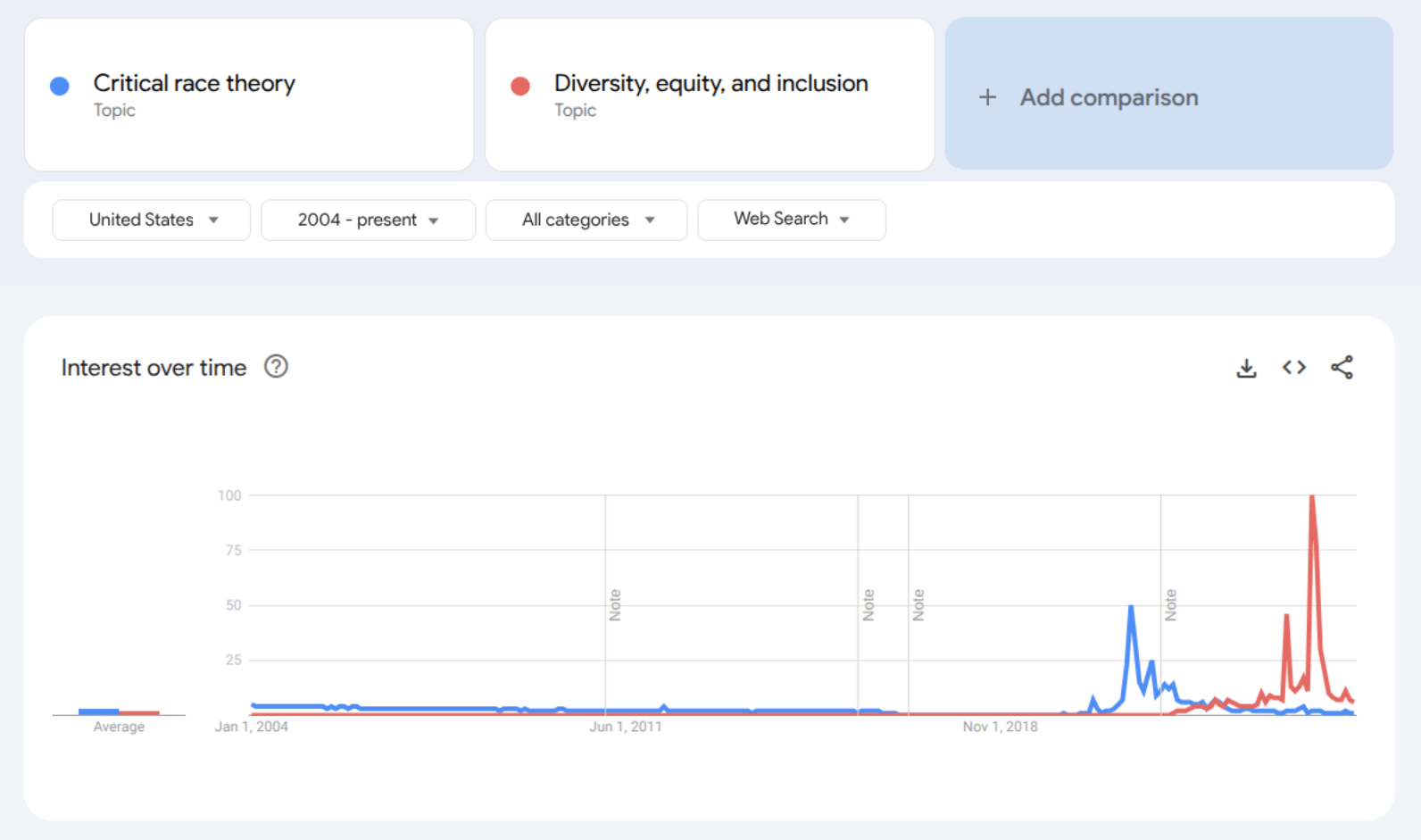
Rufo’s successful campaign against Critical Race Theory lost its mojo during the Biden administration but the Democrats, unable to be what Americans needed them to be, left the door open and MAGA came back with a new villain, Diversity, Equity and Inclusion. A phrase which has been socially engineered by the right as a dog-whistle for what Ronald Regan called “reverse discrimination”. It is worth noting here that Regan also coined the phrase, “Make America Great Again”. (https://www.washingtonpost.com/news/made-by-history/wp/2017/10/10/how-the-reagan-administration-stoked-fears-of-anti-white-racism/)
Just as racist ideas and policies turned the Reconstruction into the Gilded Age and then Jim Crow, would be autocrats wielded their racist ideas and policies to turn Civil Rights into a Second Gilded Age and now they are working on a second Jim Crow. (https://www.hr-brew.com/stories/2025/02/24/a-brief-history-of-the-origins-of-the-anti-dei-movement).
In 1970 Gil Scott Heron released, The Revolution Will Not Be Televised, where he said.
You will not be able to stay home, brother
You will not be able to plug in, turn on and cop out
You will not be able to lose yourself on skag
And skip out for beer during commercials, because
The revolution will not be televised
Gil Scott Heron saw a collective movement where individuals compared their own lives to those around them in an effort to build a collective enlightenment, a revolution. The revolution will not be televised because it doesn’t happen where it can be seen from your couch or from your desk or in any screen.
The first change that takes place is in your mind. You have to change your mind before you change the way you live and the way you move. The thing that’s going to change people is something that nobody will ever be able to capture on film. It’s just something that you see and you’ll think, “Oh I’m on the wrong page,” or “I’m on the right page but the wrong note. And I’ve got to get in sync with everyone else to find out what’s happening in this country.”
- Gil Scott Heron, 6:25 in this Interview
No posts
Comments
Nothing yet. Say the first thing.
Sign in to join the conversation.