
This week’s post is by one of our Student Research Assistants, Nicolas Kuri, who is studying for a BSc in Data Science at Northeastern University London and has been working on Brian Ball’s PolyGraphs project. Many thanks to Nicolas for his excellent work on both the project and this post! And thanks to Brian Ball and David Freeborn for their input.
A long line of work in social epistemology, beginning with Zollman’s studies of the bandit problem1, has shown that the density of a communication network matters for what a community of rational agents end up believing. More recent work from the Computational Philosophy Lab’s PolyGraphs project (Ball et al., 2026) has found that it is not only density but also the topology of the network that shapes collective belief.2 Through these simulations, we have begun asking questions about which other analyses can uncover structural features of significance by conducting simulations across different topologies. In this post we present the results of such an analysis, one centred around the structural features of communities and their modularity.
Real epistemic communities are rarely, if ever, homogeneous: communication networks fracture into clusters (e.g. research groups, schools of thought) that talk densely among themselves, and only sparsely across the boundaries between them. It is this community clustering within communication networks, such as social networks, where we see phenomena like echo chambers emerge. Thus, the natural question is whether this clustering (quantified here as modularity) leaves a fingerprint on the epistemic outcomes of a network. To find out, we tested whether (and how) the number of communities and their modularity relate to their epistemic outcomes across a range of topologies. We wanted to understand how and if the number of communities and the modularity of these found communities have an impact on or are correlated with the epistemic outcomes across different topologies.
To answer this question, we ran roughly 20,000 simulations using the PolyGraphs framework on three network families, namely Erdős-Rényi (ER), Watts-Strogatz (WS), and Barabási-Albert (BA), across five updating operators, and applied four community-detection algorithms to each generated graph.
Community detection mathematically partitions a network into groups so that edges fall preferentially within groups rather than between them. For this, various community detection algorithms exist; as you will see, we chose four of them. In each case, two of their outputs were of our interest: the number of communities and modularity. The number of communities counts how many distinct groups an algorithm finds, while modularity scores how cleanly this group partition separates the network. In this sense, a network with a high modularity is one where the density of intra-community edges is much higher than what we would expect on a random network with nodes of the same degree.
To reduce the contamination of inductive bias, we utilised four complementary community detection algorithms: Greedy Modularity (the Clauset-Newman-Moore agglomerative method; Clauset, Newman and Moore, 2004), Louvain (greedy modularity optimisation with hierarchical merging), Leiden (a refinement of Louvain that guarantees connected communities) and Label Propagation (each node adopts the most common label among its neighbours). Importantly, to keep the comparison clean, we restricted the analysis to 64-node networks.
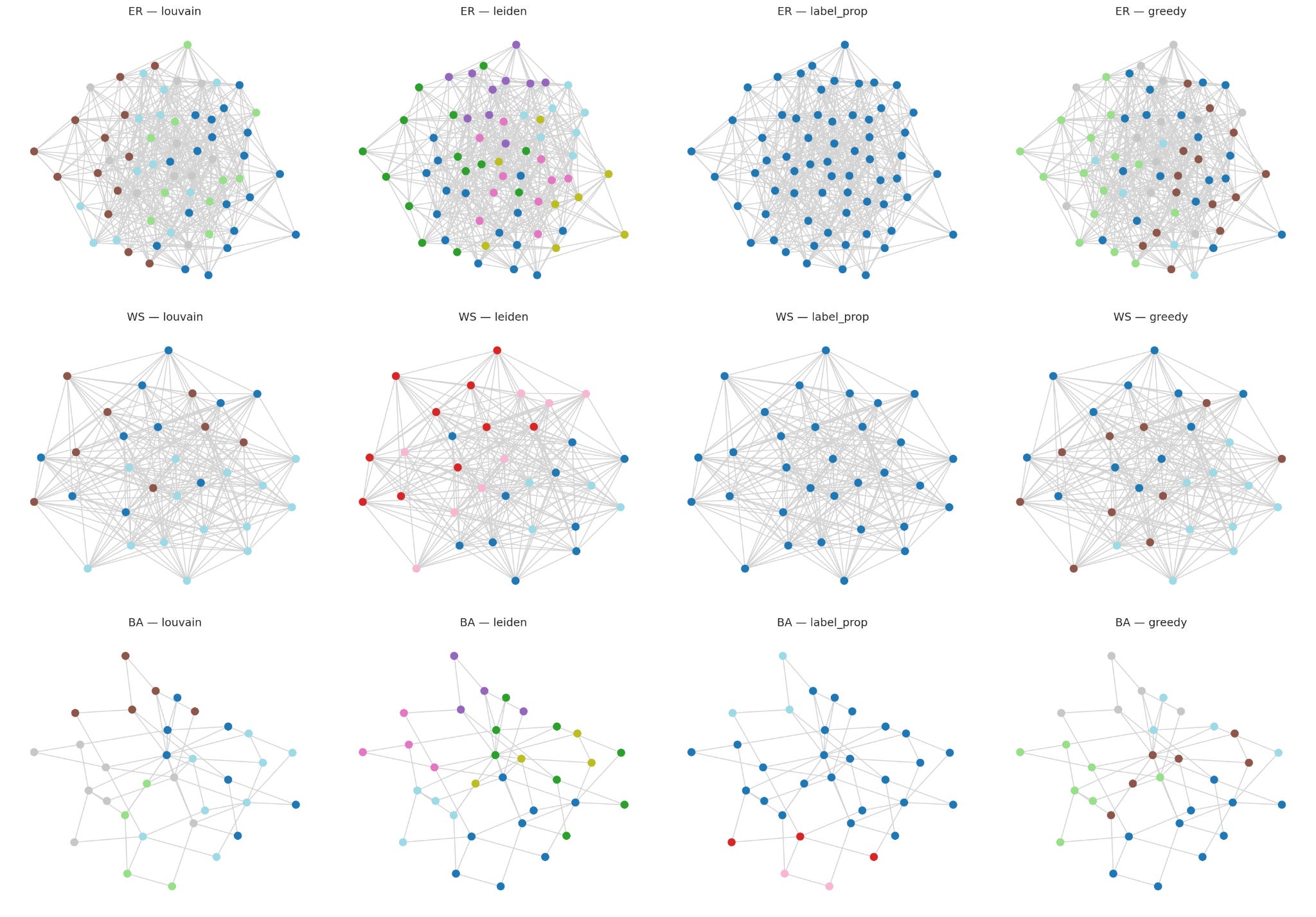
The first substantive finding is that modularity is partially determined by the network family, and in our framework, it is fixed before any communication happens.
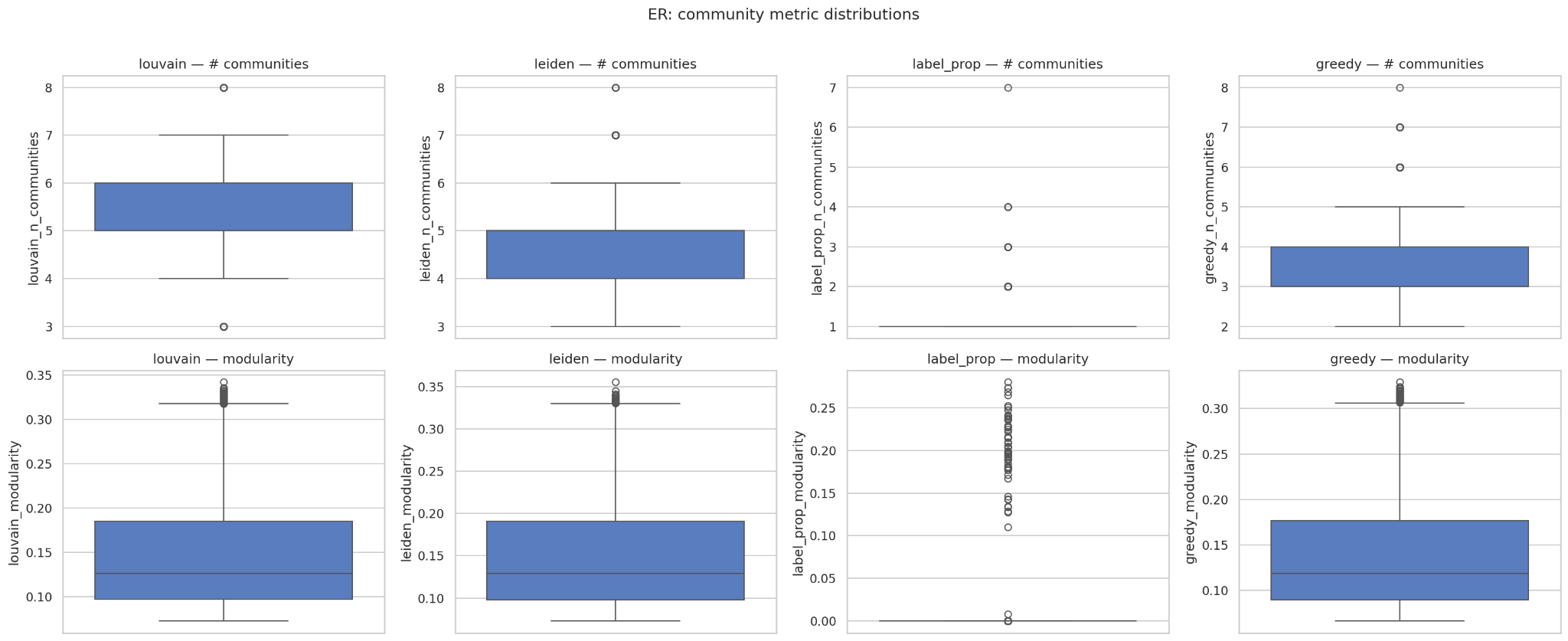
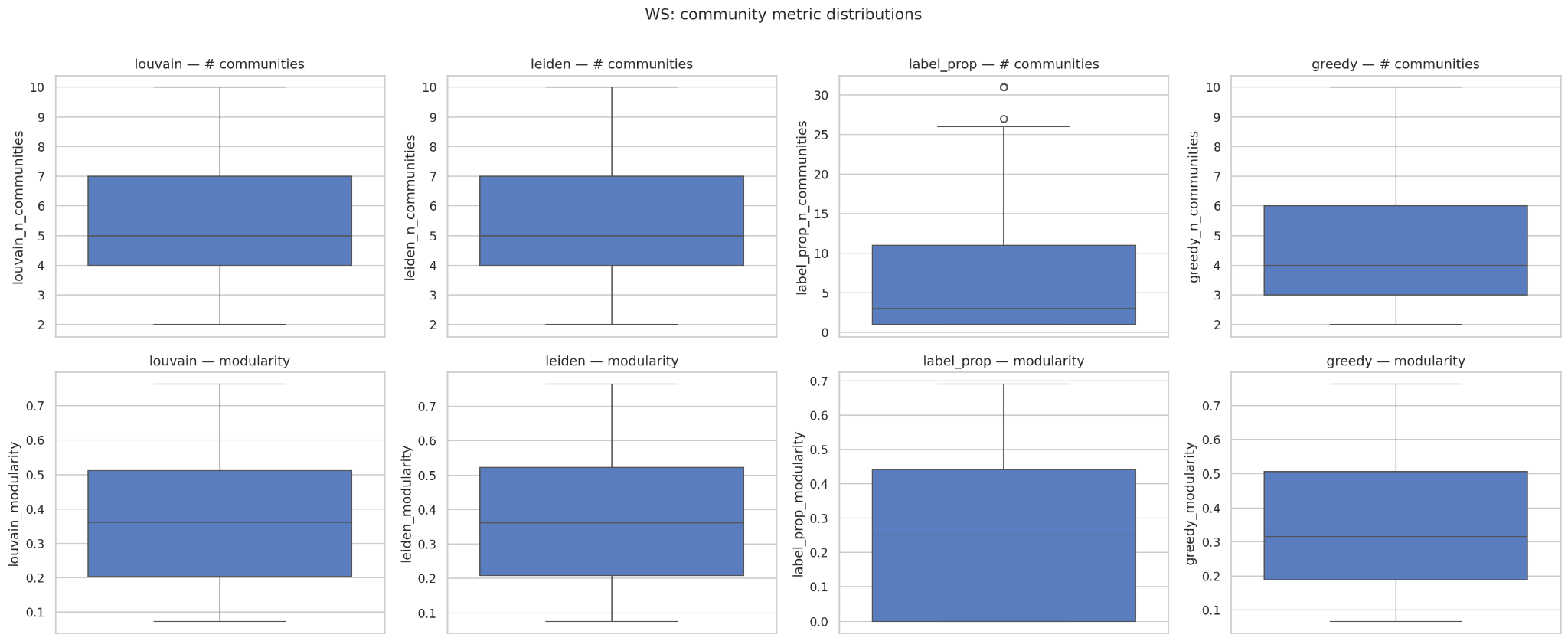
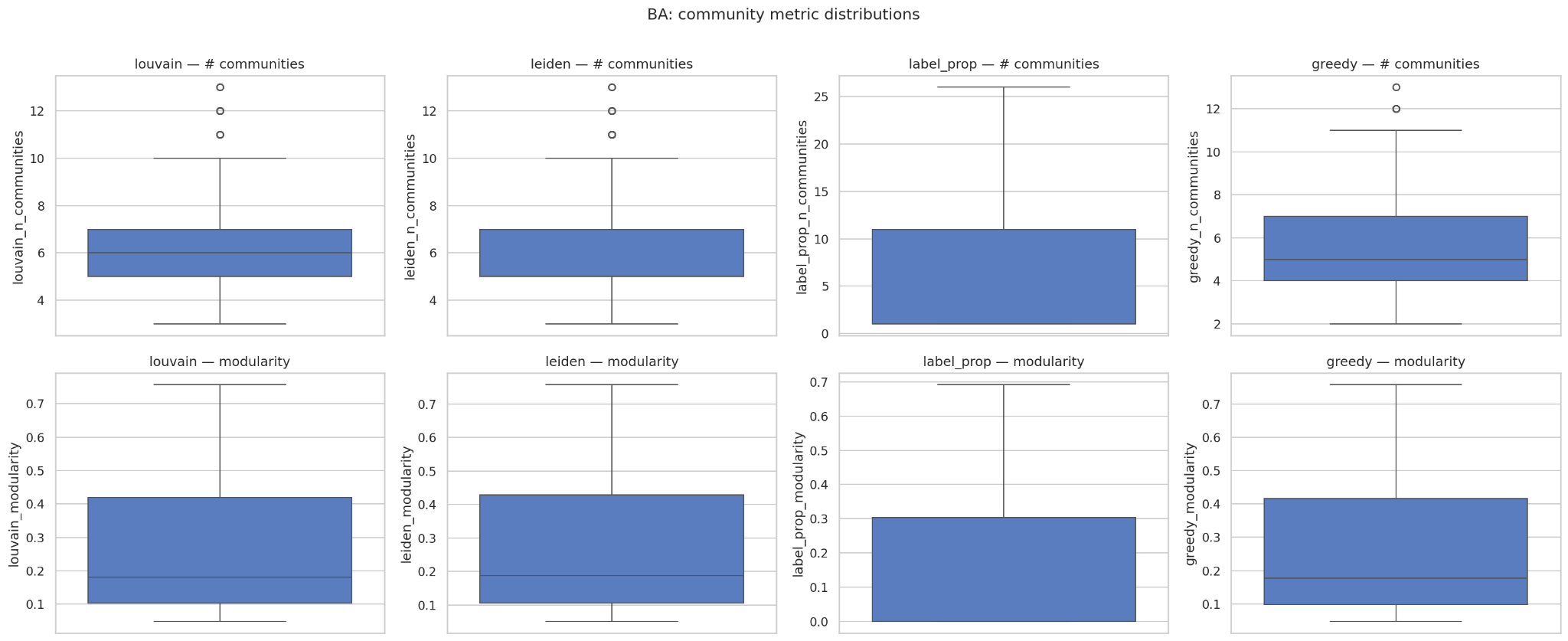
In this sense, the general picture is clear: Watts-Strogatz networks are the most modular, with a mean Louvain modularity of 0.39 (n = 11,595) and a range stretching to 0.76. Their rewired-lattice construction naturally produces tight local neighbourhoods, so even rational agents updating on each other’s signals are embedded in well-defined clusters. Barabási-Albert networks come next, at a mean of 0.29 (n = 5,096) but with the widest spread (0.05 - 0.76). This makes sense, as the modularity of a scale-free graph depends sharply on its preferential attachment parameter, so graphs dominated by a few central hubs can be either tightly or loosely clustered. Erdős-Rényi networks are the least modular, at a mean of just 0.15 (n = 3,487), which is exactly what one expects from a topology that has no explicit clustering mechanism - that is to say, a random graph like this partitions only marginally better than it would if edges were randomly rewired while preserving node degrees.
In terms of our second relevant variable, the number of communities, it is more stable across network families, typically around five to six on the optimisation-based algorithms, which makes modularity rather than community count the more informative structural variable here.
The finding described above could just be a curiosity, however, we later found that modularity is in some way correlated with the speed of convergence of the network.
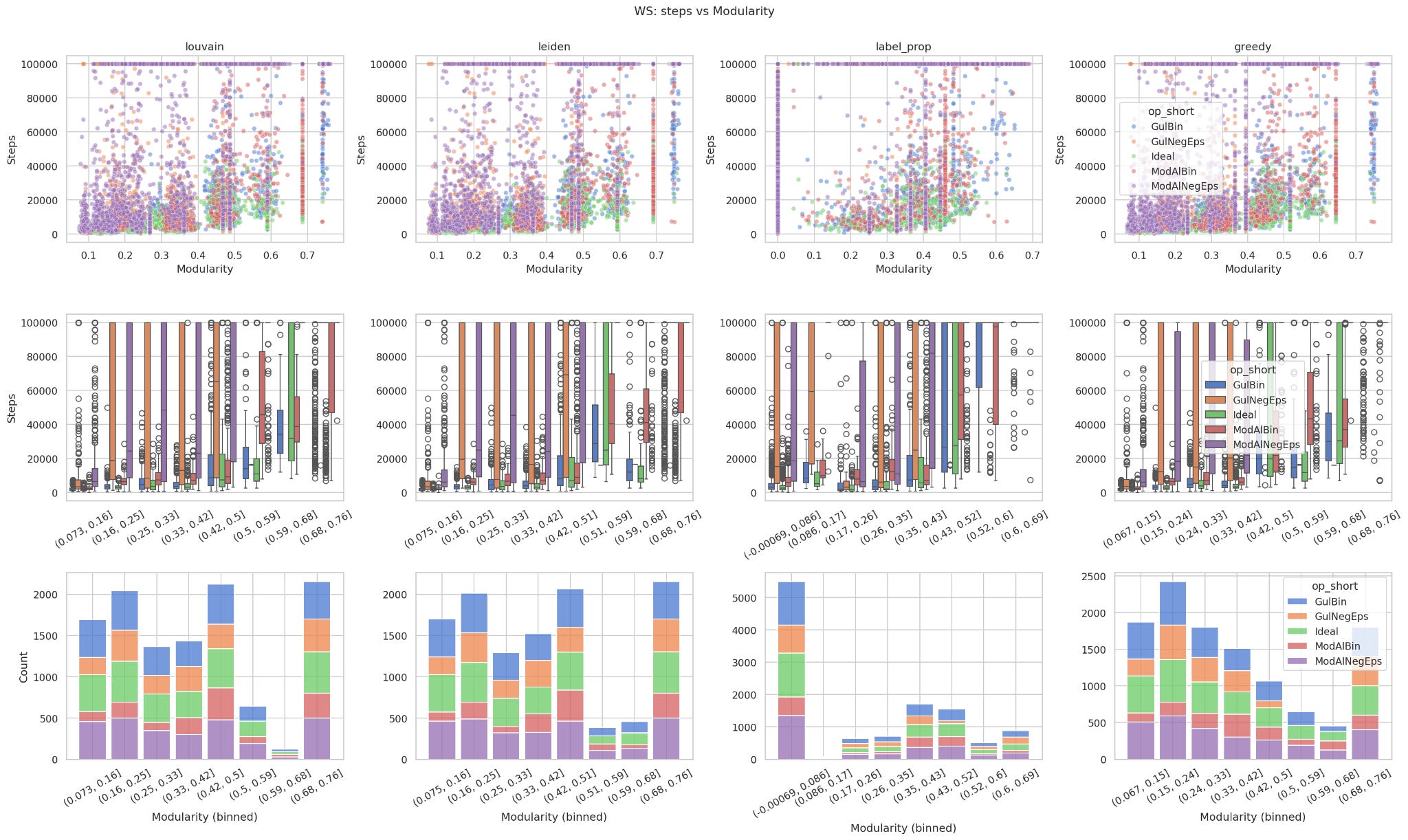
In Watts-Strogatz networks, for example, the relationship is steady. We see that the more modular the network, the more steps of communication it takes to reach consensus, and this holds across every updating operator we tested. This suggests that when a network is made up of tight clusters connected by only a few edges bridging communities, information diffuses slowly across the boundaries, and the whole community takes longer to settle.
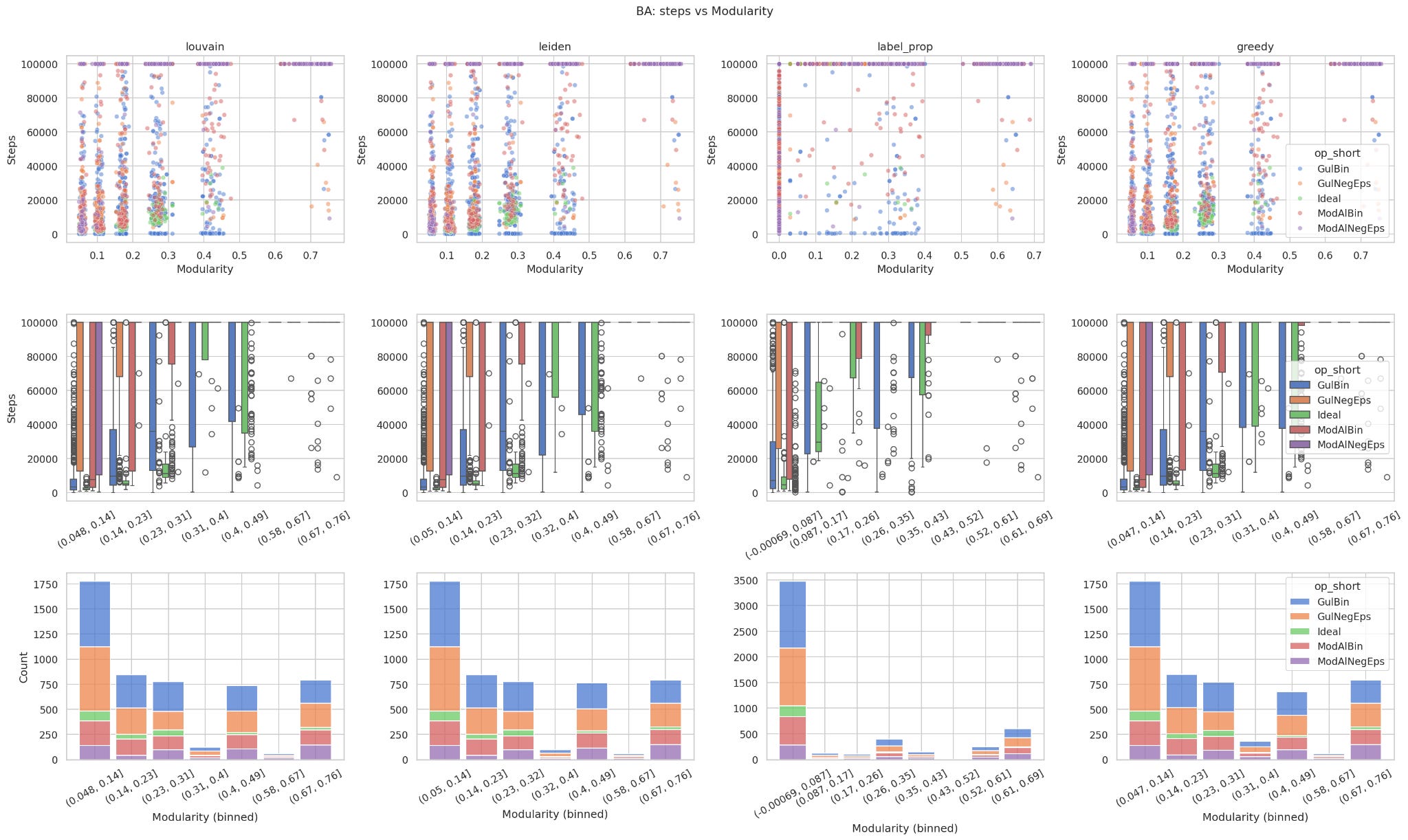
For scale-free networks, we see the same direction as with WS but with a sharper character. Low-modularity BA graphs converge quickly; that is, once modularity climbs past a moderate level, convergence times rise extremely fast. This is an important finding which tells us that the hub structure that makes a BA network efficient when it is loosely clustered becomes a liability when strong communities form around competing hubs.
The most consequential result is that modularity does not only slow a network down: it is also associated with whether the network reaches a clean consensus at all.
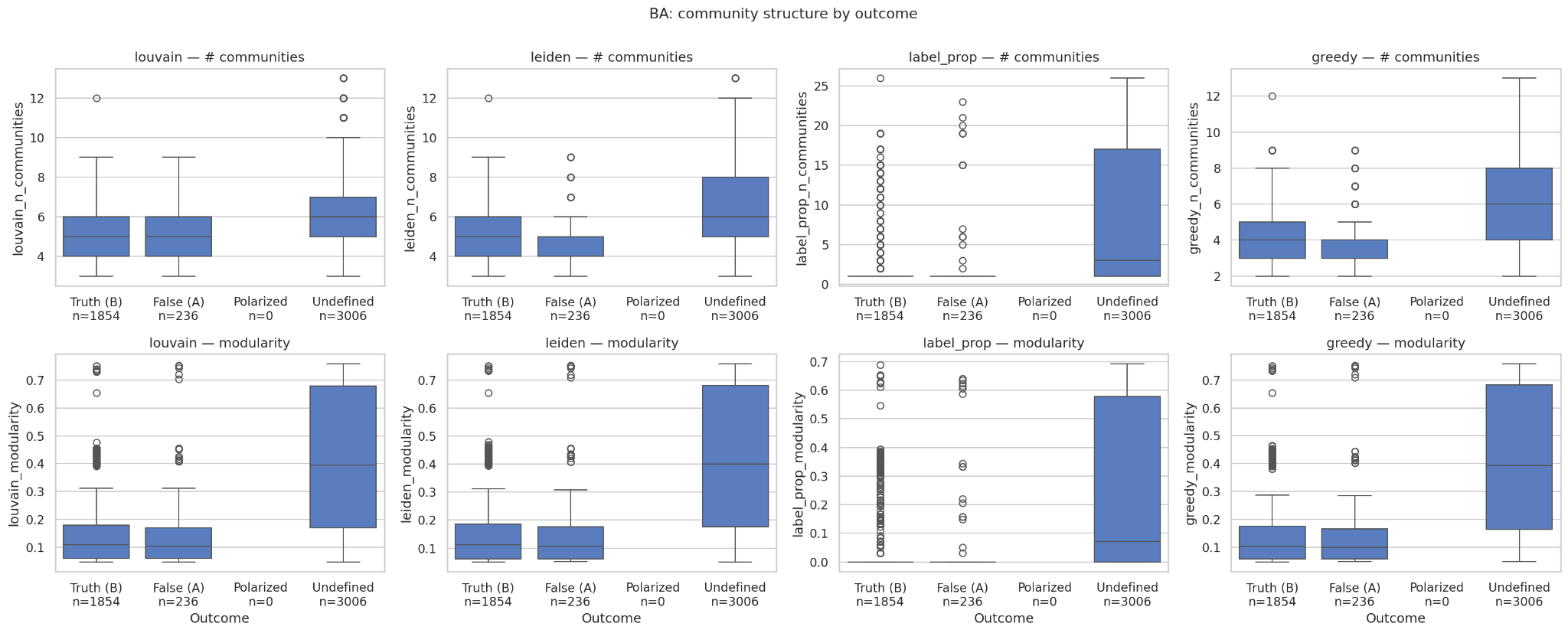
Splitting BA simulations by their final outcome shows that runs reaching either the truth (in this case the ‘B’ outcome, n = 1,854) or a false outcome (‘A’ = 236) cluster at a comparatively low modularity, while runs that fail to resolve, the ‘Undefined’ outcomes (n = 3,006), sit at substantially higher modularity and are partitioned into more communities. In this sense, modularity does not seem to directly impact the accuracy of a network but rather convergence from non-convergence.
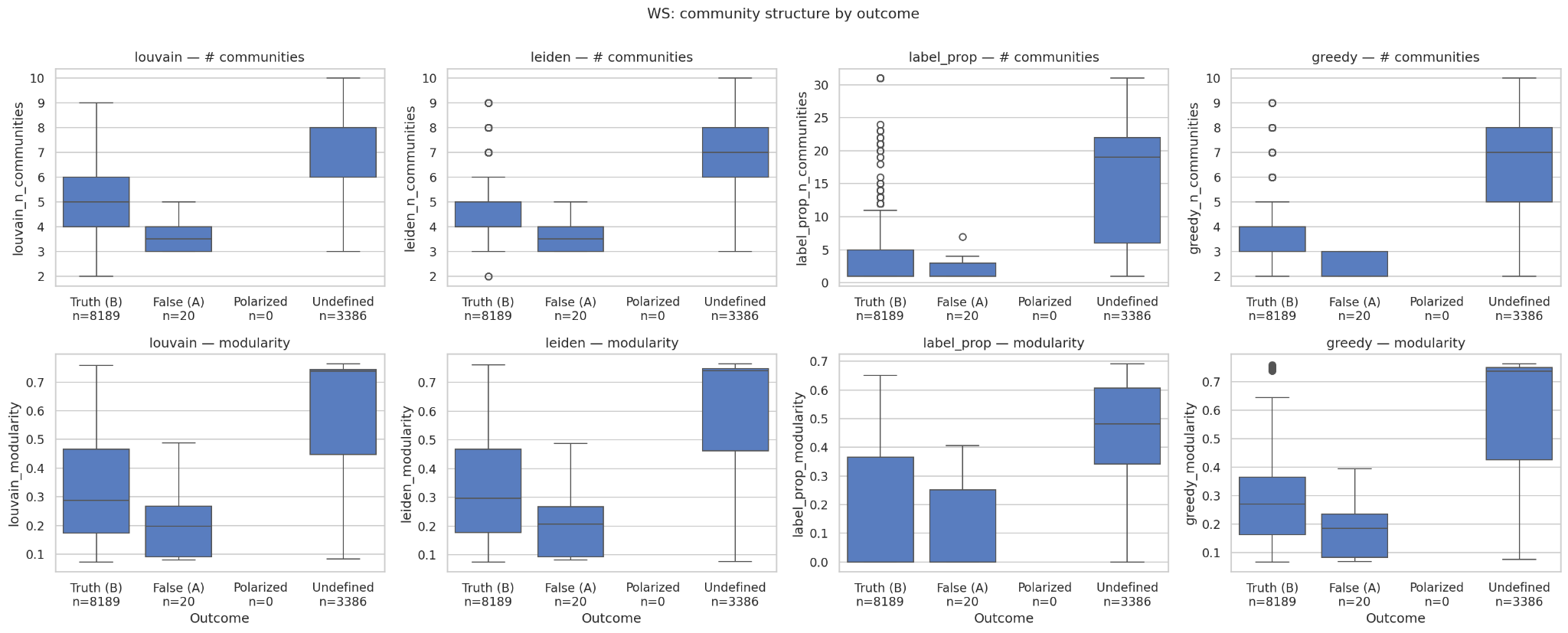
Watts-Strogatz networks exhibit the pattern described above even more strongly. Unresolved runs have a higher modularity and more communities, as seen in Figure 8. In this sense, I hypothesise that a strong community structure with multiple communities can trap agents in local consensus, or in other words, a tightly knit cluster reinforces its own beliefs as the bridges to the rest of the network are too small to shift a locally entrenched belief, and the community as a whole stalls. The key finding is therefore that modularity is (through these algorithms) a measurable structural risk factor for collective epistemic failure, and because in our framework it is fixed by the network’s topology before any communication happens, it can also be deemed a predictive one.
Because every claim above rests on a chosen detection algorithm, it is worth asking whether the choice of algorithm matters.
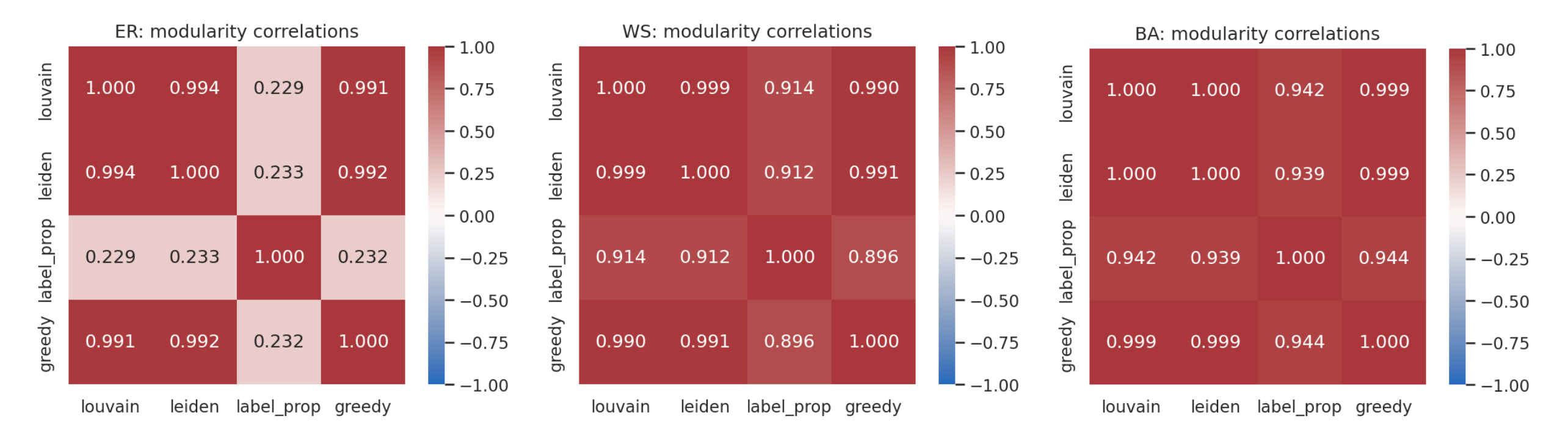
Reassuringly, Louvain, Leiden, and Greedy Modularity agree closely - their modularity scores are highly correlated across all three network families, so we can faithfully claim that the findings are not dependent on a single method. Label Propagation is, however, the exception. Its rule of adopting the majority neighbour label behaves poorly on weakly clustered graphs, especially random ones like ER networks, where it often collapses the whole graph into a single community, unlike the modularity-optimising methods, which found around five. We therefore treat the optimisation based algorithms as the reliable backbone of the analysis and see Label Propagation more as a sanity check rather than a primary algorithm.
In essence, three findings hold up across the simulation set and analysis. First, we see that network kind influences community strength. Recall that WS networks are the most modular (mean 0.39), BA intermediate and most variable (0.29) and ER the weakest (0.15). Second, we see that stronger communities slow convergence, monotonically in WS networks and sharply in BA networks. Finally, the most important finding is that community structure partly predicts outcome. In particular, high-modularity networks are disproportionately the ones that fail to reach consensus. The specific mechanism behind these unresolved runs (that is, whether communities settle into ignorance or remain internally polarised) is something we have not yet characterised. Exploring it further is a priority for follow up analysis. In addition, it is important to claim that the result is robust to the choice of detection algorithm, provided one uses a modularity-optimising method rather than one like Label Propagation.
For the broader PolyGraphs programme, the lesson is that density is not the whole story. Extending our previous findings on topology, we now identify community structure across these networks as also a relevant variable in determining the prevalence of ignorance. As for next steps, it will be useful to understand, through multivariate analysis, how independent density and modularity are from each other. Testing the independence between these two variables would provide evidence to answer whether two networks of identical density but different modularity can differ in how they divide into communities. But most importantly, said division of communities would carry real epistemic consequences for how fast a community of rational agents learns, and for whether it learns the truth at all.
Data: ~20,000 simulations on ER, WS, and BA networks (64 nodes), five operators, four community-detection algorithms. Modularity statistics computed from the Louvain partition unless noted.
Ball, Brian; Koliousis, Alexandros; Mohanan, Amil; and Peacey, Mike (2026) ‘Ignorance in social networks: discounting delays and shape matters’, in Resch, M.M., Herrmann, M., Kaminski, A., Stelzer, M. and Wiengarn, J. (eds.), Trust and Disinformation. Cham: Springer. https://doi.org/10.1007/978-3-031-96790-0_7 [preprint]
Clauset, Aaron; Newman, M.E.J.; and Moore, Christopher (2004) ‘Finding community structure in very large networks’, Physical Review E, 70(6), 066111. https://doi.org/10.1103/PhysRevE.70.066111
Zollman, Kevin J.S. (2007) ‘The Communication Structure of Epistemic Communities’, Philosophy of Science, 74(5), pp.574–587. https://doi.org/10.1086/525605
The bandit problem, specifically the two-armed bandit problem, is a sequential decision problem where an agent must repeatedly choose between an option with a known payoff and one whose payoff is uncertain. At each decision round, the agent only obtains evidence about the option it actually selects; in this way, exploiting the known option comes at the cost of learning about the alternative (Zollman, 2007).
For a previous post on PolyGraphs on this blog, see ‘The Number of Reliable Informants Affects Efficiency of Inquiry in PolyGraphs Simulations’ by Brian Ball. As Brian says there: “PolyGraphs is a Python software package, developed under an APEX Award from the Royal Society, and available on GitHub. It allows us to run computer simulations that investigate how opinions are formed and spread within social networks. In these simulations, rational agents share information with each other, some of which may be unreliable. The simulations allow us to explore philosophically rich questions related to rational belief formation, trust, evidence and the spread of mis/disinformation.”
No posts
Comments
Nothing yet. Say the first thing.
Sign in to join the conversation.