
On June 29, the Supreme Court ruled that the President can fire the leaders of independent agencies at will.1 The case, Trump v. Slaughter, was about two commissioners at the Federal Trade Commission. It did not mention energy. But the two agencies that decide how the AI buildout connects to the grid — and who pays for it — are independent agencies too. The question I am sitting with this week is what this ruling means for the Federal Energy Regulatory Commission (FERC) and the Nuclear Regulatory Commission (NRC), and for the communities already absorbing the cost of this buildout.
For ninety years, a 1935 decision called Humphrey’s Executor let Congress shield certain regulators from being fired over politics.2 The idea was plain: some decisions should turn on expertise and the public good, not on who is in office. That same year, Congress wrote the Federal Power Act, handing a federal commission authority over the interstate grid. The independence and the grid it governs were built in the same moment, for the same reason. This week the Court overruled the decision that protected the first. Chief Justice Roberts wrote that “if anything more is left of Humphrey’s, we overrule it.” The holding was about the FTC. But Justice Sotomayor’s dissent named the agencies she believes are now exposed — among them FERC, with responsibility for managing the Nation’s energy supply, and the NRC, responsible for the regulation of nuclear power.3
Why should a ruling about firing power matter to anyone watching their electricity bill? Look at Philadelphia. PECO has asked state regulators to raise a typical household’s bill by about twenty dollars a month — a 12.5% increase — and among the reasons it lists is the growing demand from AI data centers. In the same period, its parent company booked record profit.4 The question of who pays for this buildout is not abstract. It is the difference between a data center covering the cost of the energy and grid infrastructure it requires and that cost landing on the household down the street. Pennsylvania’s utility regulators have a tool for exactly this — a model tariff that would make large loads carry the costs they cause — but it is voluntary, and PECO is still reviewing whether to adopt it.5 FERC sets the terms one level up, for the wholesale market and the interstate lines. The federal agency writing those rules just lost the protection that kept at arm’s length from the White House.
Eleven former FERC commissioners — chairs appointed over five administrations, from Clinton to Biden — filed a brief, warning that stripping these protections would risk transforming FERC into “a partisan political body whose priorities flip every election cycle.”6 Their warning lands on the timing problem I keep returning to. The grid these rates pay for lasts thirty to forty years. FERC-set rates finance roughly $40 billion in new pipelines and power lines every year. When the people setting those terms can be removed for crossing the administration, decisions built to outlast presidents start getting made on election cycles. The regulators have warned us. This is not a drill.
To be precise about what changed: the ruling does not, by itself, remove anyone at FERC. As one energy-law scholar noted hours after the decision, no commissioner had been removed.7 What is gone is the shield. The question is no longer whether the protection holds. It is what happens the first time a commissioner crosses the President.
The NRC shows us what that looks like in practice. In June 2025 the President fired Commissioner Christopher Hanson without cause — the first such firing in the agency’s history — after Hanson spoke against federal workforce cuts. Weeks later a Republican appointee and a voice for reform, Annie Caputo, resigned a year before her term ended, as a cost-cutting lead was embedded at the agency; people close to her told reporters she left rather than be compromised.8 This is the agency that licenses the reactors, including the small modular reactors, now being lined up to power data centers.
Last month, analyzing Pope Leo’s encyclical on artificial intelligence, I wrote that the buildout suffers from three kinds of opacity: environmental, algorithmic, and governance — the last being the structural absence of the independent oversight the encyclical calls for.9 This ruling deepens that third kind. It is one thing for oversight to be missing from a framework. It is another to remove the independence from the oversight bodies that already exist. A February 2025 order had already begun routing significant agency rules through White House review before they become public; a former NRC chair said it led to less transparency.10 When the people who write the rules can be removed at will, and the rules themselves are written out of public view, the question stops being who holds the pen. It becomes who controls the hand. Justice Gorsuch, concurring, put it exactly: the pen ultimately rests in the President’s hand.11
I want to make it clear: this is not a point about one president. The commissioners who raised the alarm were bipartisan, and the warning is structural. An administration of any party inherits the same power — to favor allied companies, or, as the commissioners put it, to raise energy prices in states that support its political rivals. The impulse to move faster is real and widely shared; even Caputo, the reformer who left, wanted quicker licensing. Pope Leo framed the tension plainly: a slower pace does not mean opposing progress, but answers to the imbalance between the speed of technological growth and the slower development of institutions. Speed bought by removing independence is a different path than speed earned by fixing a slow process. What it takes to reverse direction is its own cost. Capital struggles to finance a thirty-year line on a rule that may not survive the next inauguration.
So where does durable protection live now? Closer to the ground. The same week as the ruling, FERC ordered all six regional grid operators to justify or reform their large-load tariffs within sixty days — a real action, but one issued by an agency whose independence is now in question,12 and even as a senator’s pointed question about who bears the cost when a forecast proves wrong has gone publicly unanswered.13 The more durable moves are in the states. In FERC’s own docket, two governors — Josh Shapiro of Pennsylvania and Glenn Youngkin of Virginia — filed joint comments asking for honest national load forecasts so we stop building on speculation.14 A Democrat and a Republican, at the table together.
Congress could write FERC’s and the NRC’s independence back into law; the Court framed this as a question about the structure Congress designed, which means Congress can answer it. State legislatures do not have to wait at all. They can turn voluntary protections like Pennsylvania’s into binding ones, fund real intervenor capacity so communities are not outmatched by industry counsel, and put enforceable terms in writing before the deals close. The leverage has always been closer to the deal than to the capital. The power ultimately sits with local communities.
The pen moved this week, but it did not disappear. What is unsettled is whose hand guides it next — and whether the rest of us are in the room when the rate that lands on your bill gets written. That room is not the Supreme Court. It is a state docket, a legislative hearing, a town hall, or a comment period with your name on it.
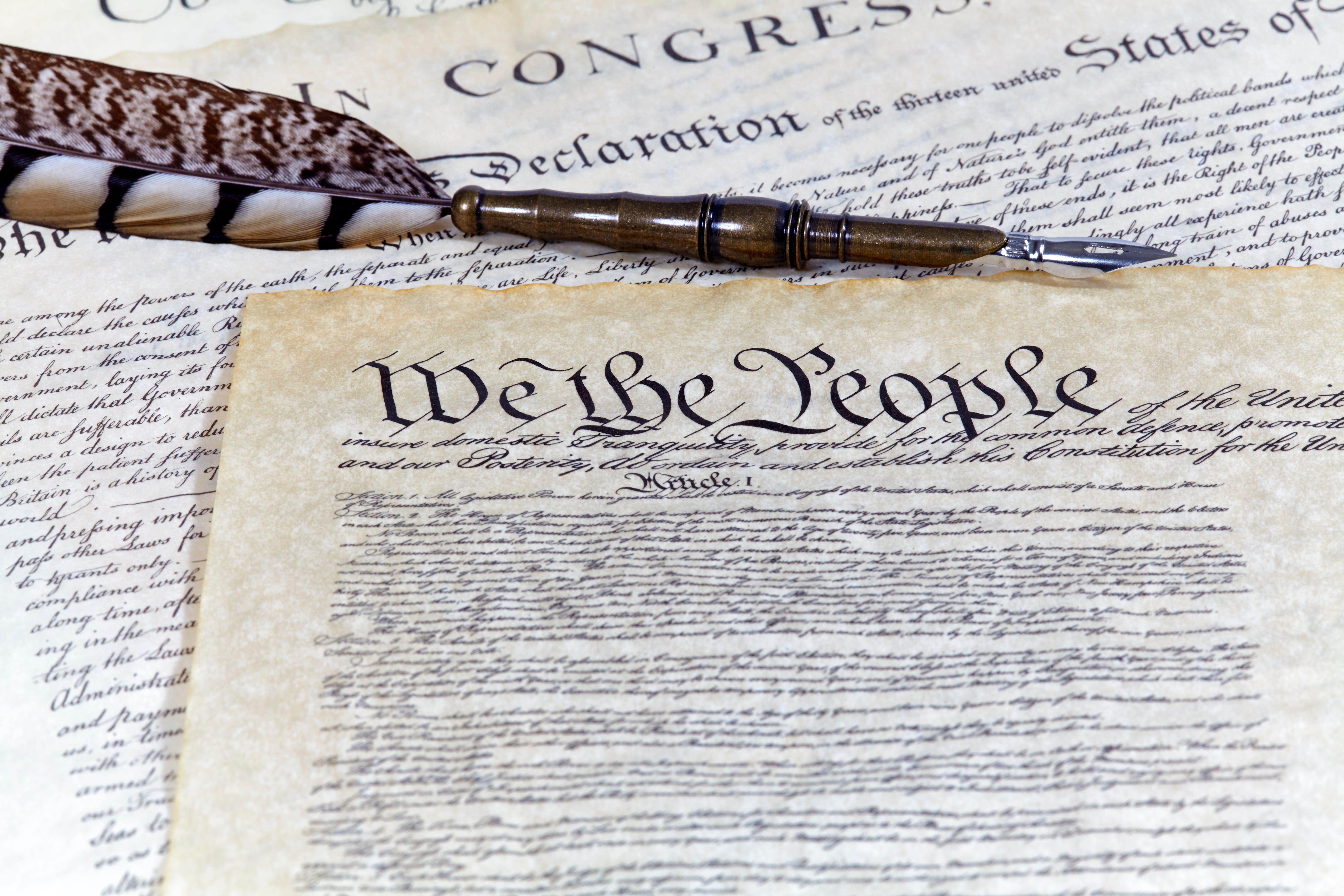
The pen is still on the page — and in a country about to turn 250, it was never meant to rest in one hand. We, the People, matter most.
Trump v. Slaughter, No. 25-332 (U.S. June 29, 2026), 6–3 (Roberts, C.J.). Argued Dec. 8, 2025. The Court held the FTC’s for-cause removal protection unconstitutional and overruled Humphrey’s Executor: “If anything more is left of Humphrey’s, we overrule it.” A companion case preserved the Federal Reserve’s independence.
Humphrey’s Executor v. United States, 295 U.S. 602 (decided May 27, 1935). The Federal Power Act establishing federal authority over interstate electricity was enacted the same year, 1935.
Sotomayor, J., dissenting (joined by Kagan and Jackson, JJ.), Trump v. Slaughter, naming the Federal Energy Regulatory Commission and the Nuclear Regulatory Commission among the agencies “now likely to become purely executive agencies.”
Pennsylvania PUC Large Load Tariff Framework (Docket M-2025-3054271), adopted 5–0 on Apr. 30, 2026 — a non-binding model tariff; PECO is “reviewing” adoption. See “Who’s Holding the Pen on Rates?,” Compound Impact (May 2026).
Brief of Amici Curiae Bipartisan Former Commissioners of FERC in Support of Respondents, Trump v. Slaughter, No. 25-332 (Nov. 14, 2025) (Ari Peskoe, counsel of record). FERC-set rates “finance $40 billion of investment” in pipelines and power lines annually; the brief warns of priorities that “flip every election cycle” and of a President who could “raise energy prices in states that support his political rivals.”
“How the NRC Lost Its Independence,” E&E News by POLITICO (2026); ANS Nuclear Newswire (June–July 2025). Commissioner Christopher Hanson was fired without cause on June 13, 2025; Commissioner Annie Caputo resigned weeks later as a DOGE lead was embedded at the agency.
“How the NRC Lost Its Independence,” E&E News by POLITICO (2026). Executive order (Feb. 2025) requiring “significant” independent-agency rules to pass White House OIRA review before publication; former NRC chair Steve Burns, quoted in E&E News, said it “led to less transparency.”
Gorsuch, J., concurring, Trump v. Slaughter.
Sen. Jon Ossoff (D-GA) sent FERC a four-question letter on Apr. 20, 2026 asking who bears the cost when a load forecast goes wrong, requesting a reply by June 1; the Georgia Public Service Commission pre-empted it on Apr. 27. No public FERC response had appeared as of late June 2026.
Gov. Josh Shapiro (PA) and Gov. Glenn Youngkin (VA) filed joint comments in FERC Docket No. RM26-4, supporting the large-load interconnection framework but urging the Commission to set national standards for regional load forecasts to prevent overbuilding from duplicative interconnection requests. See Ruta Skučas et al., "Summary of FERC Meeting Agenda for June 2026," White & Case (June 16, 2026).
Comments
Nothing yet. Say the first thing.
Sign in to join the conversation.