
Welcome to Compound & Fire, where I’m building wealth the smart way by investing in top-quality businesses that drive long-term shareholder value, paving the path to financial freedom. Join our free Global Quality Investing Discord and Substack community to grow this journey together!
In the world of investing, quality compounders, those reliable businesses that steadily grow earnings over time through smart capital allocation, strong competitive advantages, and consistent execution, have long been favorites among long-term investors. Companies like Constellation Software, Topicus and Lumine, Dino Polska, Kinsale Capital Group, Brown & Brown, Copart, Rightmove, and Kelly Partners Group exemplify this breed. They operate in defensible niches, generate high returns on capital, and have histories of compounding shareholder value at impressive rates.
Yet, as we close out 2025, many of these names find themselves in what can only be described as a stock price recession. Hence, my portfolio this year as lagging behind. Share prices have pulled back significantly from recent highs, often by 10-20% or more over the year, despite the underlying businesses remaining fundamentally sound.
This decline isn’t isolated; it’s part of a broader market dynamic affecting growth-oriented stocks. One key driver has been the lingering effects of elevated interest rates. Even as the Federal Reserve began cutting rates in late 2024 and continued with measured reductions through 2025, bringing the federal funds rate down to around 3.5-4% by year-end, the shadow of higher rates from prior years continues to weigh on valuations.
Higher interest rates increase the discount rate used to value future cash flows, making long-term growth prospects appear less attractive today. For quality compounders, whose value often lies in earnings projected years down the line, this mathematical adjustment can lead to sharp price drops, even if the companies are hitting their operational targets.
But interest rates aren’t the only culprit. Broader economic pressures, including persistent inflation above 2%, slower-than-expected global growth, and sector-specific headwinds, have played a role.
For instance, insurance-related stocks like Kinsale Capital and Brown & Brown have faced multiple compression amid a softening market cycle and pricing pressures in commercial lines. And even tech-enabled acquirers like Constellation Software and Topicus have seen sentiment shift as investors question growth sustainability in a higher-cost capital environment and the impact of AI.
In my view, this pullback represents a healthy correction rather than a sign of fundamental weakness. Valuations for many of these companies ballooned during the low-rate era of the last years, often trading at premiums that left little room for error.
The current environment is pruning those excesses, forcing investors to refocus on true business quality over hype. That said, corrections like this often overshoot, creating buying opportunities for patient investors. With rates now trending lower and economic growth expected to stabilize, I believe it’s time to lean in and buy selectively.
Quality compounders have a proven track record of navigating cycles and emerging stronger, think of how Constellation Software compounded through multiple market downturns since its IPO. The key is to target those with durable moats, aligned management, and clear paths to continued growth, while avoiding overpaying even at discounted prices.
Speaking of selective buying, I’ve made a portfolio adjustment overnight to capitalize on one such opportunity. I’m exiting my position in M&A Research Institute Holdings, the Japanese firm specializing in AI-driven M&A advisory for small and medium enterprises. The decision stems from their recent downward revision to 2026 guidance, which came in well below my already conservative expectations.
I had anticipated an uptrend in volumes starting that year, driven by a rebound in Japan’s M&A market, but the update suggests otherwise. More concerning is the uncertainty around management’s priorities: Are they truly investing for long-term profitability, or are short-term market share gains taking precedence at the expense of margins?
My forecast for their operating profit for the brokerage business of 8.313M Yen appears too optimistic as management expects 5.993M Yen for 2026. This is lower than their 2025 operating profit. Management created additional management layers in order to change the declining situation for the brokerage business. However, this also could create additional complexity and the company is at risk moving from an insurgent to an incumbent.
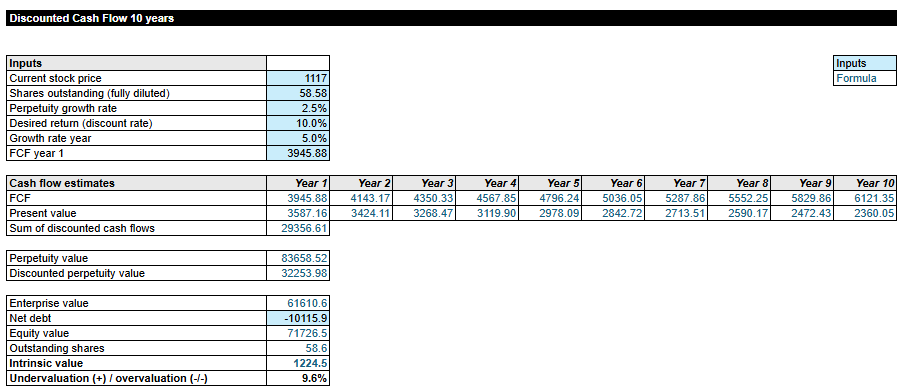
Adding the new expected free cash flow of 3.950M in my model for 2026, the question is what the growth rate is for the free cash flow for the next years. With a declining brokerage business the consultancy business has to grow to offset a decline. It gets more difficult to forecast the growth. With a 5% growth the intrinsic value is 1224.5, not far from the current stock price. It could be they return to much faster growth, but as I can’t really predict and management doesn’t reply on questions I have send. So for me the investment thesis is broken and I have decided to exit my position at 1.111 Yen and to reallocate the capital elsewhere.
That “elsewhere” is Kelly Partners Group (KPG.AX), where I’m increasing my position. KPG, an Australian accounting network focused on owner-operated firms, fits the quality compounder mold perfectly: recurring revenues, high client retention, and their Partner-Owner-Driver model which is unique and has delivered consistent growth since its 2017 IPO. At their 2025 Annual General Meeting in November, management unveiled an ambitious yet grounded 5-year plan, projecting a ramp-up to global scale.
Starting from current levels, they aim for AU$500 million in revenue by FY31, with EBITDA reaching AU$175 million and NPATA to shareholders (net profit after tax and amortization) hitting AU$40 million. This builds on their historical 20.5% compound annual growth rate (CAGR) in revenue since IPO, transitioning through phases of foundation-building, acceleration, and global expansion. The plan emphasizes organic growth supplemented by strategic acquisitions, all while maintaining strong cash generation.
To quantify the opportunity, I ran a discounted cash flow (DCF) analysis based on KPG’s AGM projections. Usingfree cash flow estimates starting at AU$11 million in Year 1 and growing at varying rates (higher initially to reflect the ramp-up, then stabilizing around 18%), a 10% discount rate, and a 3% terminal growth rate, I arrive at an intrinsic value of approximately AU$13.90 per share. This assumes inputs aligned with their plan.
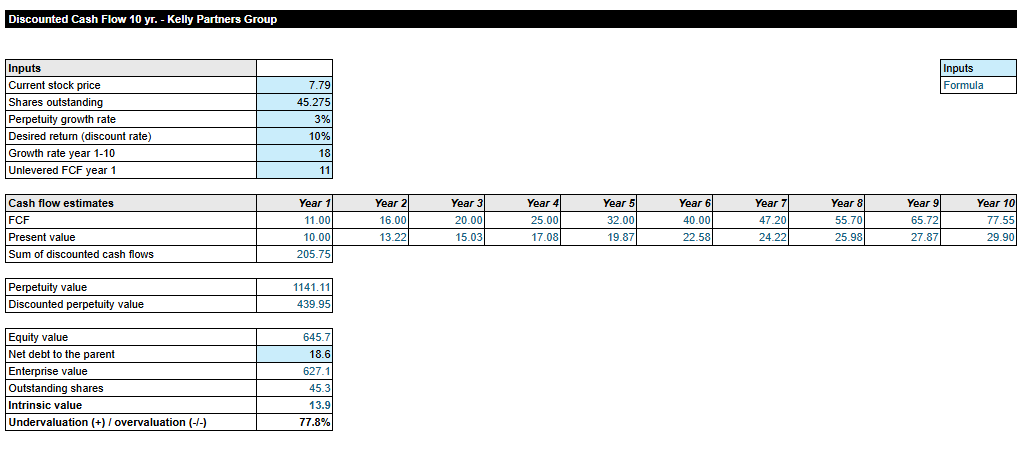
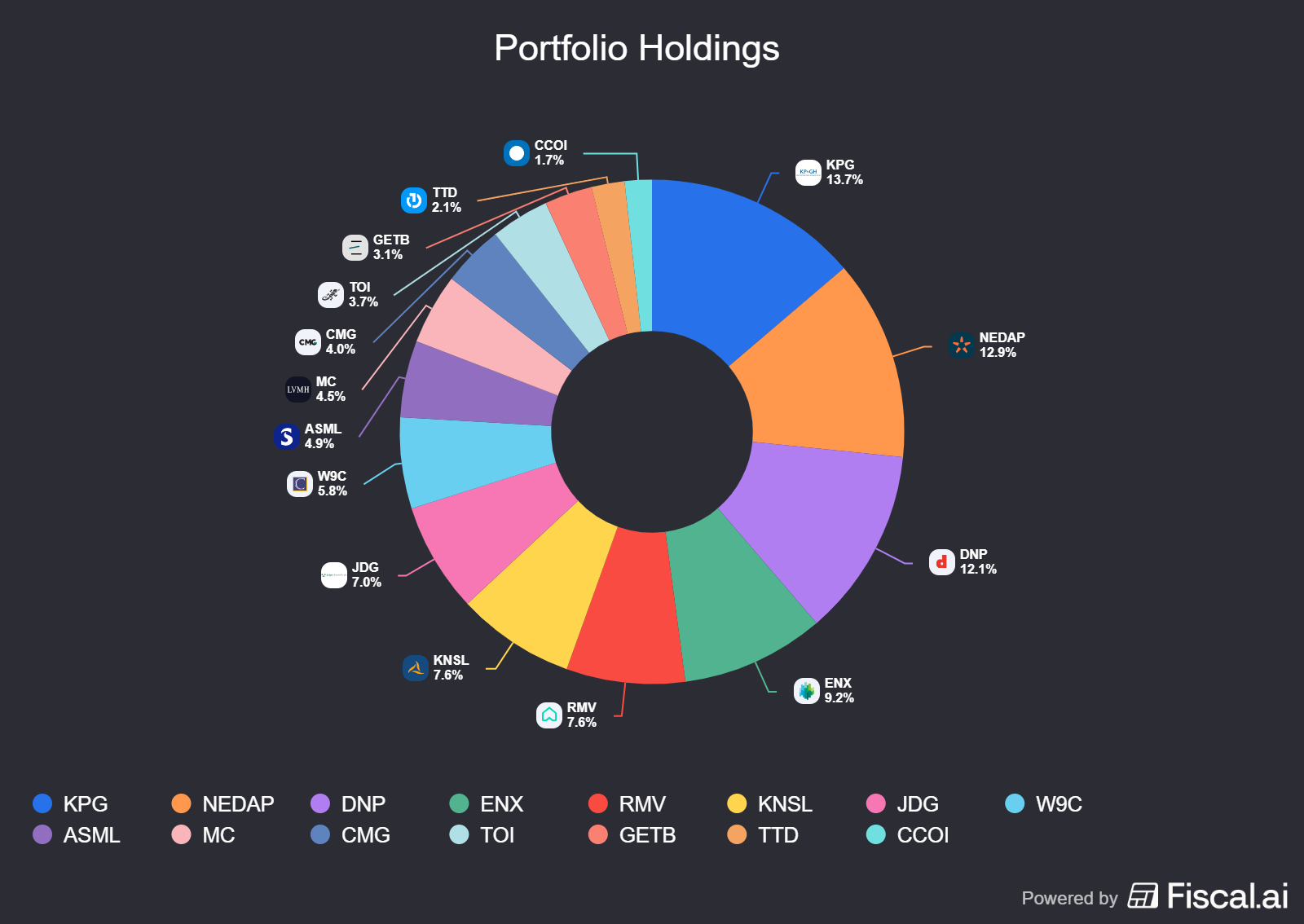
CEO Brett Kelly is known for his optimism, so it’s good to build in a buffer. When applying a 40% margin of safety, it reduces the intrinsic value to AU$8.31 per share. At current prices of AU$7.79, I am essentially buying into KPG’s well-articulated growth plan with more than 40% cushion baked in. For a proven compounder like this, trading at such a discount is rare and compelling. It underscores why, in this price recession for quality stocks, selective buying can set the stage for outsized returns over the next decade. My purchase price is AU$7.85 and my total position size for Kelly Partners Group after this buy is just below 14%.
Next week I will interview Brett Kelly and we will discuss how he used The Founder’s Mentality to structure his business. I am really looking forward to it. Subscribe so you won’t miss it!
As always, this isn’t investment advice, do your own due diligence. But if history is any guide, betting on quality during downturns has paid off handsomely. Stay tuned for more updates, and if you’re new here, check out my previous pieces on compounders like these for deeper dives.
The information in this article is provided for informational and educational purposes only.
The information is not intended to be and does not constitute financial advice or any other advice, is general in nature, and is not specific to you. Before using this article’s information to make an investment decision, you should seek the advice of a qualified and registered securities professional and undertake your own due diligence.
None of the information in this article is intended as investment advice, as an offer or solicitation of an offer to buy or sell, or as a recommendation, endorsement, or sponsorship of any security, company, or fund. The author is not responsible for any mistakes or investment decision made by you. You are responsible for your own investment research and investment decisions.
Comments
Nothing yet. Say the first thing.
Sign in to join the conversation.