
I want to tell you about a study that changed how I think about everything we are doing with AI.
In 2025, The Lancet Gastroenterology & Hepatology published results from a hospital that had deployed an AI polyp-detection system in its endoscopy unit. The system worked brilliantly. Detection rates went up. Clinicians were faster. Patients got better outcomes. Then the system was temporarily taken offline for maintenance.
The gastroenterologists who had worked with it for eighteen months saw their adenoma detection rates fall by twenty-one percent compared to their pre-AI baselines. Not compared to the AI-assisted rates -- compared to where they were before they ever used the system.
These were experienced doctors. They had not become worse clinicians in any conventional sense. They had simply stopped practising the perceptual skills -- the pattern recognition, the sustained visual attention, the discrimination between subtle tissue variations -- that the AI had been doing for them.
The system had not replaced their competence. It had quietly eroded it.
I keep coming back to this study because it is not an edge case. It is the pattern.
Pilots first. NASA and FAA research going back decades shows that pilots who rely on autopilot for extended periods cannot meet basic manual instrumentation standards when the system fails. The degradation is worst exactly when it matters most -- in emergencies. The automation handles routine perfectly. But routine is where manual skill lives. Take away the practice, and the skill atrophies. The irony is brutal: the system justified by human unreliability produces the very unreliability it was meant to prevent.
Then software. A GitClear analysis of 153 million lines of code found that code churn -- the rate at which recently written code gets rewritten or deleted -- doubled after widespread adoption of AI coding tools. Developers were accepting code they did not fully understand, then spending more time debugging it. An Anthropic trial measured a seventeen-point decline in comprehension among junior developers using AI assistance versus a control group. METR found experienced developers were nineteen percent slower on familiar codebases when using AI tools.
The speed was real. So was the understanding deficit.
GPS users lose spatial memory. Spell-check users make more errors without it. Students who use AI writing tools produce more fluent first drafts and weaker second ones. The pattern holds across every domain where it has been studied.
Lisanne Bainbridge named this in 1983. Her paper “Ironies of Automation” has over 4,700 citations now. The core insight: the more reliable an automated system becomes, the less prepared the human operator is to intervene when it fails. The irony is structural, not accidental.
Four decades later, the ironies have not been resolved. They have just gotten faster.
Technical debt is a concept every developer understands. You take a shortcut now, and it costs you later -- in maintenance, in fragility, in the compounding difficulty of every subsequent change.
Competence debt works the same way, but with people instead of code.
Every time your organisation deploys an AI tool that handles a task a human used to do, you gain speed. You also lose a small amount of the human capability that task was building. That loss does not show up on any dashboard. Nobody reports it. Nobody measures it. It compounds silently, in the widening gap between what your people can do with the tool and what they can do without it.
The debt comes due when the tool is wrong. When the AI hallucinates a legal citation. When the model misclassifies a candidate. When the automated analysis misses a pattern that a trained human would have caught -- if that human still had the training.
A Fortune and NBER study of nearly six thousand executives found that ninety percent reported no measurable productivity impact from their AI investments. PwC found fifty-six percent of business leaders say they have gotten “nothing out of” their AI spending. These numbers arrive at the same moment that AI tools are demonstrably making individual workers faster.
That is not a contradiction. It is competence debt at the organisational level. AI delivers individual speed. It does not deliver organisational capability. And the gap between the two is widening because the deployment itself degrades the human judgment, cross-functional knowledge, and institutional learning that organisational capability depends on.
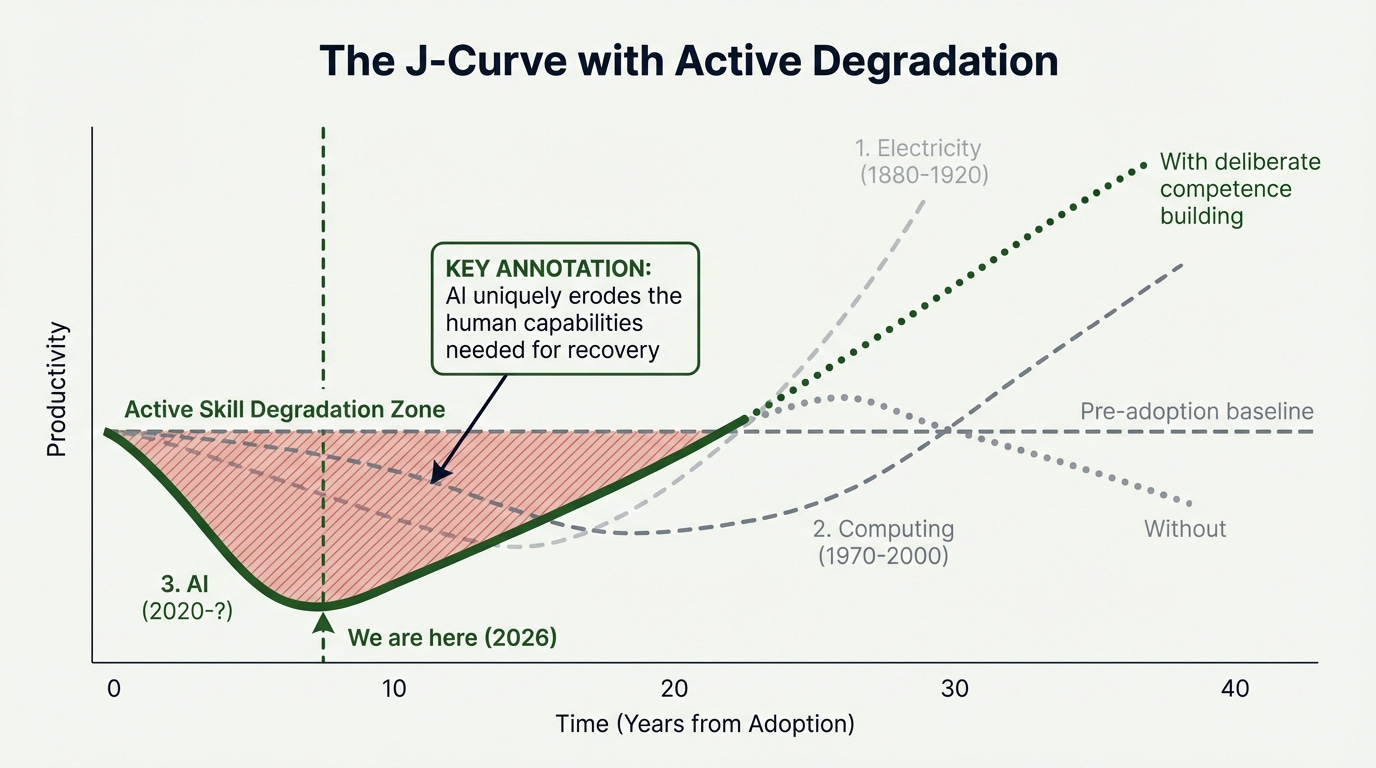
The economic historian Paul David showed that electricity took over thirty years to produce its promised productivity gains. Early adopters bolted electric motors onto steam-era factory layouts. The gains arrived only when a new generation redesigned operations from first principles. Robert Solow captured the same lag for computing in 1987: “You can see the computer age everywhere but in the productivity statistics.”
But here is the difference that matters. Electricity did not make factory workers forget how to use their hands. Computing did not degrade accountants’ ability to reason about numbers.
The AI transition is not merely a lag in organisational redesign. It involves active degradation of the human skills being automated. The trough of the J-Curve is deeper than it has ever been, and the bottom is harder to climb out of, because the human capabilities required to climb are being eroded by the technology that created the trough.
That is why I chose Competence Debt as the name for this publication. Not because it sounds clever. Because it describes something real that is happening right now inside every organisation deploying AI, and almost nobody is accounting for it.
The competence paradox is not inevitable. It is a design failure.
Robert Bjork’s research on desirable difficulties -- among the most replicated findings in cognitive science -- shows that learning conditions which feel harder produce dramatically better long-term retention. Interleaved practice produces sixty-three percent retention versus twenty for blocked practice. The approach that feels less productive is three times more durable.
The implication for AI deployment is direct. The friction -- the struggle, the repeated comparison between your judgment and the machine’s -- that is where competence lives. Remove the difficulty, and you remove the mechanism through which durable capability forms.
Organisations are not designing for this. They are deploying AI to remove friction, measuring the speed gain, and declaring success. The competence erosion shows up months later, in decisions nobody can explain, in errors nobody catches, in a workforce that is faster at producing output and worse at knowing whether the output is right.
This is what I built Twin Ladder to address. Not to slow AI adoption down -- I am not a Luddite, and speed matters. But to ensure the people directing AI systems are getting more capable over time, not less. Six pillars. Four maturity levels. A compliance floor at 52 out of 100 mapped to Article 4 of the EU AI Act.
I will unpack the framework in future posts. For now, the point is simpler: competence debt is real, it is measurable, and it is accumulating inside your organisation right now.
The question is not whether you are taking on competence debt. You are. The question is whether you are accounting for it.
Over the coming weeks in this publication:
The regulatory deadline. Article 4 of the EU AI Act requires “sufficient AI literacy” for everyone deploying AI. It has been enforceable since February 2025. What it actually demands, and why awareness training does not satisfy it.
The HR emergency. Why people teams carry triple regulatory exposure -- Article 4, Annex III high-risk classification, and GDPR automated decision-making -- and why they are the least prepared function in most organisations.
The deskilling research. Deep dives into the clinical, cognitive, and organisational evidence. What the studies actually show, not what the summaries claim.
The framework. How to measure competence debt. How to deploy AI in ways that build capability instead of eroding it. What the assessment data is revealing.
What to do Monday morning. Diagnostics that require no budget, no technology, and no external consultant.
If you are responsible for how your organisation uses AI -- or for the people who use it -- subscribe. Every post is free. I publish weekly on Tuesdays.
The founding cohort of the Twin Ladder assessment is still open. If your organisation wants to measure where you actually stand, reply to this email or reach me at alex@twinladder.ai.
Alex Blumentals is the founder of Twin Ladder, based in Riga, Latvia. He works with organisations across Europe on AI competence strategy.
No posts
Comments
Nothing yet. Say the first thing.
Sign in to join the conversation.