
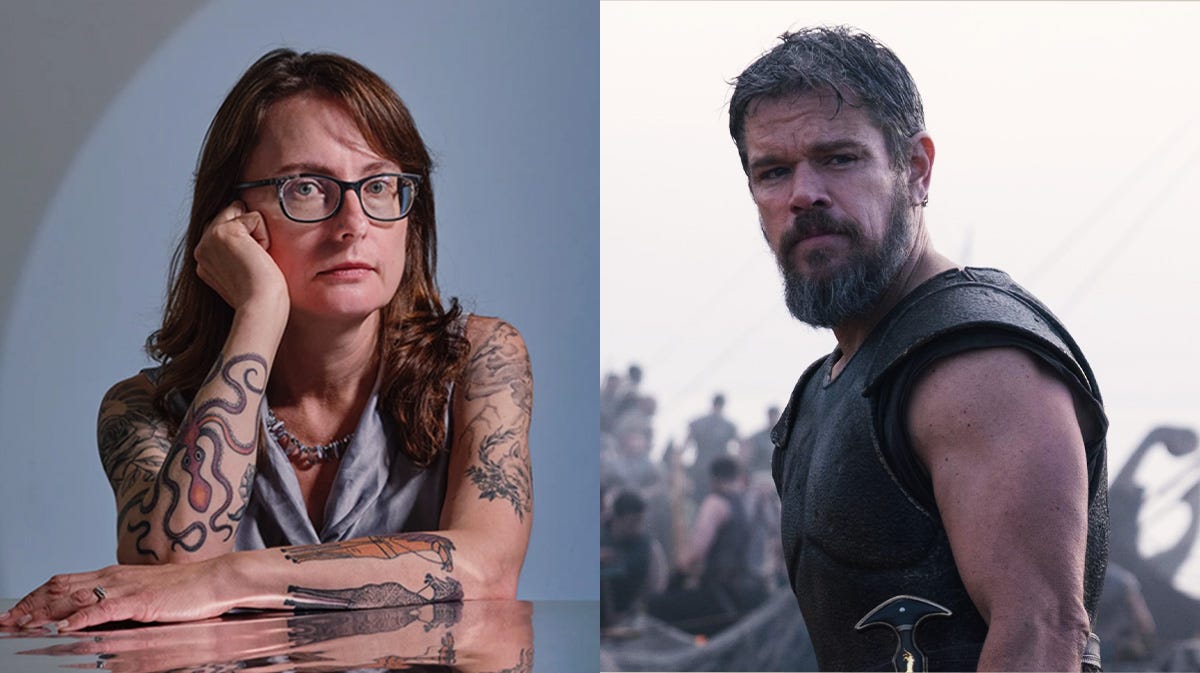
Emily Wilson thinks Christopher Nolan’s Odyssey sucks, and she wants you to know it. First, she panned it in an article in the London Review of Books last week, then made the case again in The Atlantic yesterday.
Both pieces read less like film criticism than as a polemic about adaptation, with Wilson returning to departures from Homer rather than asking whether Nolan succeeds on his own artistic terms. She begins the LRB essay with, “Adaptations needn’t and shouldn’t follow the original with anything like the exactitude of a translation.” Then spends ~4000 words calling out everything she feels doesn’t exactly replicate the poem.
First, some level-setting: Christopher Nolan is often heavy-handed with his themes, his dialogue is often wooden, and his critics point out that he rarely allows female characters to steal the show. Indeed, he’s made a career of the “man getting home” trope.
This is relevant for the same reason Emily Wilson chose to revive Homer in her version of exactitude: a poem containing the same 12,110 lines as Homer’s original, rendered in Iambic Pentameter. Her choice begot other choices. Where Robert Fagles’ translation features lyrical prose, Wilson’s is direct, simple. They are not better or worse. They are different.
Fagles: Tell me, Muse, the story of that resourceful man who was driven to wander far and wide after he had sacked the holy citadel of Troy. He saw the cities of many people and he learnt their ways. He suffered great anguish on the high seas in his struggles to preserve his life and bring his comrades home. But he failed to save those comrades, in spite of all his efforts. It was their own transgression that brought them to their doom, for in their folly they devoured the oxen of Hyperion the Sun-god and he saw to it that they would never return. Tell us this story, goddess daughter of Zeus, beginning at whatever point you will.
Wilson: Tell me about a complicated man.
Muse, tell me how he wandered and was lost
when he had wrecked the holy town of Troy,
and where he went, and who he met, the pain
he suffered on the sea, and how he worked
to save his life and bring his men back home.He failed, and for their own mistakes, they died.
They ate the Sun God’s cattle, and the god
kept them from home. Now goddess, child of Zeus,
tell the old story for our modern times.Find the beginning.
The difference is a creative choice. Wilson’s choice of form limits her ability to explore anything beyond its barriers. It is not better or worse than Fagles’ translation, but it does give the reader a different idea of the poem, a poem that is changed by how it is delivered, as much as anything else.
Just as Wilson chose a preferred form for her adaptation, Christopher Nolan has a preferred form for his. He’s a believer in montage as the backbone of his stories. Through montage sequences, Nolan delivers exposition, character moments, revelations, twists, everything. He chooses this, possibly because it allows him to lean into his strengths (montage, pace) rather than his weaknesses (dialogue).
Nolan’s dialogue is a tool, a vehicle for exposition, more often than not. Rarely, if ever, does he use dialogue to explore character or thematic intensity; those are often explored through montage. The montages evoke the emotional response he’s after through flashback and contrast. They’re also spectacles.
But Wilson doesn’t love the spectacle.
The Odyssey features his usual combination of grandiosity and superficiality. Without a tub of wax for my ears…I was exposed to the full din of thumping sticks, staffs, swords and clashing armour, thunderbolts, crashing waves, grunts, screams, toppling palaces and burning temples.
This was always what you were going to get with a Nolan version of the story. It was always going to be big, spectacular, loud (perhaps deafening), and things would burn. The story would shift forward and back. The theater would hum.
It was always going to be a blockbuster, not a character study. Which is why the conversation must be reframed. It must be looked at on its own terms, not as a thing cosplaying as something else. Nolan’s version is self-assured in its difference, but Wilson judges the film against something it never tried to be.
Wilson wrote on BlueSky: “The oddest thing about the response to this essay is people who say it’s “personal”. You can disagree about some or all of it! I may well be wrong! But it’s not “personal” to analyze a film or other work of art, even negatively. Criticism is more than ‘Hurray!’ or ‘Hiss!”
The issue is, her film criticism is consistently subordinated to her conception of what The Odyssey ought to be. She says Nolan’s version “has none of the stylish sparseness of Uberto Pasolini’s The Return (2024) … that film invited us to wonder what remains of The Odyssey and its hero when stripped down to the sinews and the hungry heart. Nolan gives us an all-inclusive buffet.”
But this is similar to criticising Wilson’s translation of the Odyssey because she chose to render the poem in iambic pentameter instead of prose. It’s a different approach, fundamentally. Criticising the choice isn’t criticism of the art itself; it just signals one’s preference.
The climax of her LRB piece is this: “Its narrative structure is gimmicky. The writing is abysmal. None of the characters has convincing motivation for their actions or words. There are no sex scenes, and all the food looks horrible.”
Like the piece overall, this tells us that Wilson is grading the film on a subjective scale. She’s looking at it as her film, her story, and signalling how she’d allocate the $250M Nolan received to make the film. It tells us more about her than it does Nolan’s film.
For Wilson, Anne Hathaway’s Penelope has “nothing to do except yearn for Matt Damon, for reasons unknown.” But those reasons are clear: Damon’s Odysseus is her husband, the father of her son, and in his person is the security of her position.
Likewise, Benny Safdie’s Agamemnon is “the one in the weird Darth Vader outfit.” But she overlooks that by having Clytemnestra kill Agamemnon when he’s naked and vulnerable—the one time he’s not in full Vader getup—Nolan seems to offer (via montage) that Agamemnon never lived up to the image of the aura-farming automaton strolling into Troy as his men burn it.
Wilson argues, “Slaughtering people with the help of trickery, technology and weapons is presented as bad when the Greeks are killing the Trojans, who have violated xenia, but good when Odysseus is killing the suitors, who have violated xenia.”
She misses that all conflict is downstream from Odysseus’ decision to violate xenia at Troy. The “peoples from the sea” and the suitors both are results of the breaking of Zeus’ law. In Nolan’s version, everything that happens to Odysseus—the Cyclops, Circe, the Laestrygonians—is a consequence of his breaking of the divine order; they are examples of the breakdown between guest and host.
Put simply: Nolan’s rendering of Homer is different. While he hammers home the importance of the host and the guest, an extrapolation of the Greek xenia, Nolan never promised historical accuracy (insofar as a myth can be historically accurate) or a faithful adaptation of the text. It is, after all, a three-hour summer blockbuster trying to adapt a poem that required Wilson 109,000 carefully selected words.
**
What makes this fascinating is Wilson seemingly understands the irony of her critiques, telling Channel 4 in 2018, “a translator always makes choices.”
Instead of judging the film on its terms, she judged it on hers. As is often the case with the critics of her work, Wilson couches her preferences as criticism. While she understands that translation requires artistic choices, Wilson grants herself more latitude as translator than she grants Nolan as filmmaker.
The great film critic Roger Ebert often said a good critic would judge a film on its goal and its execution of that goal. If a film aimed to be a lowbrow comedy, it shouldn’t be judged as high art, and vice versa.
Likewise, as Homer’s translator, Wilson is entitled to critique Nolan against Homer, but her critiques are presented as film criticism. As such, I’d argue she gives insufficient weight to Nolan’s goals as the filmmaker. She instead substitutes her own goals for his.
No posts
Comments
Nothing yet. Say the first thing.
Sign in to join the conversation.