
I don’t really have something new to say right now. I said that Sunday, and I meant it. There are a handful of passages I keep returning to, and instead of feeling like I am exhausting them, I feel as though they are slowly exhausting me. Every time I come back, something I was sure I understood gets opened a little further. Another assumption gets questioned. Another piece of scaffolding comes loose.
I’m curious by nature, so sitting still with something for months and years is somewhat unusual for me. I like learning new things. If I become interested in a subject, I want the books, the conversations, the footnotes, all of it. But I have been learning that there is a difference between gathering information about the gospel and allowing the gospel enough time to work its way through you. Some truths have to be sat with. They have to be allowed to confront the structures we have built around them, and if I’m being honest, there are structures in me that still need to come down.
I joked on Sunday that God seems perfectly comfortable playing Jenga with our theology. He pulls out one piece and lets us look at it. Then another. Some pieces we discover are precious and true and belong in the house. Others were holding up things God never built in the first place. I think that is part of what Paul means when he talks about the renewing of our minds. We are learning to see from somewhere new.
Lately I have been asking one question again and again: What does the Gospel ask me to see?
I have just returned from Florida, where I spent time with my family. Most of them are much better at renovating houses than Larry and I have ever been. We have flipped houses too, but our version is closer to, “That paint looks better. Great. Let’s move on.”
My family is different. They remove walls. They relocate kitchens. They stand in the middle of a house that looks almost unlivable and begin talking about what will be there when they are finished. My brother can point toward a wall that is very much still standing and start describing the room on the other side of it as though he is already walking through it.
I realized while I was with them that he is not ignoring the condition of the house. He sees the rot. He sees the bad layout. He knows exactly what needs to come down. But he is seeing all of it from the perspective of the finished design.
That stayed with me because there is something deeply Pauline about it.
2 Corinthians 5:14–21 (ESV)
“For the love of Christ controls us, because we have concluded this: that one has died for all, therefore all have died; and he died for all, that those who live might no longer live for themselves but for him who for their sake died and was raised.
From now on, therefore, we regard no one according to the flesh. Even though we once regarded Christ according to the flesh, we regard him thus no longer. Therefore, if anyone is in Christ, he is a new creation. The old has passed away; behold, the new has come.
All this is from God, who through Christ reconciled us to himself and gave us the ministry of reconciliation; that is, in Christ God was reconciling the world to himself, not counting their trespasses against them, and entrusting to us the message of reconciliation.
Therefore, we are ambassadors for Christ, God making his appeal through us. We implore you on behalf of Christ, be reconciled to God.
For our sake he made him to be sin who knew no sin, so that in him we might become the righteousness of God.”
There is so much in that passage that I almost don’t know where to begin, but notice where Paul begins: “We have concluded this.” That sentence gets me because Paul has reached a conclusion about what happened in Christ, and everything that follows flows from that conclusion.
One died for all, therefore all died. He died for all. From now on, because of that, we regard no one according to the flesh. God was in Christ reconciling the world to Himself. He was not counting their trespasses against them. And now we have been entrusted with the message of reconciliation.
I told everyone Sunday that, if I am completely honest, I feel like I am still wrestling to come to Paul’s conclusion. I know these verses. I have preached them. But there is a difference between knowing the words and allowing their implications to dismantle your categories.
Almost immediately something rises up in me and says, Wait. Surely we need to qualify this. Surely we need to make sure nobody misunderstands. What about belief? What about repentance? What about sin? What about obedience?
Those are real questions. Paul asks some of them himself in Romans. But I am becoming convinced that we do ourselves a tremendous disservice when we rush to answer the objections before we have allowed the announcement to land.
One died for all. Therefore all died.
Stay there for a minute. Let the weight of that sentence do something to you before you start building a theological escape hatch.
Then Paul says something that I think should profoundly alter the way Christians encounter human beings: “From now on, therefore, we regard no one according to the flesh.”
Something has happened in Christ that changes the vantage point.
This is where my family’s houses came back to me. An architect can stand in the middle of a ruined building and tell the truth about every broken thing without ever allowing the brokenness to define the finished work. That matters because sometimes when we talk about seeing people according to God’s finished work, people hear denial.
Are you saying the walls aren’t crumbling? No. Are you saying sin is not destructive? By no means. Are you saying people cannot live in profound alienation, darkness, addiction, hatred, fear, and unbelief? Of course they can. I know that from my own life.
What I am saying is that I do not want to agree with the ruins over the plans of the Architect. I don’t want to spend my life repainting a wall God intends to remove.
Paul says there is a way of seeing that begins with Christ and then extends toward humanity. He has concluded something about the cross, and because he has concluded it, he refuses to regard people only according to what is presently visible.
This is faith.
Romans 4:17 (ESV)
“As it is written, ‘I have made you the father of many nations’—in the presence of the God in whom he believed, who gives life to the dead and calls into existence the things that do not exist.”
Faith agrees with God. It does not require us to deny what our eyes can see. Abraham was not pretending his body was young, and he was not pretending Sarah’s womb had not been barren. Faith sees another reality because God has spoken.
I wonder how much of life in the Spirit is learning to agree with what God sees before it becomes obvious to everyone else.
This is why Romans 6 has become so important to me. Read what Paul actually says:
Romans 6:6–14 (ESV)
“We know that our old self was crucified with him in order that the body of sin might be brought to nothing, so that we would no longer be enslaved to sin.
For one who has died has been set free from sin.
Now if we have died with Christ, we believe that we will also live with him.
We know that Christ, being raised from the dead, will never die again; death no longer has dominion over him.
For the death he died he died to sin, once for all, but the life he lives he lives to God.
So you also must consider yourselves dead to sin and alive to God in Christ Jesus.
Let not sin therefore reign in your mortal body, to make you obey its passions.
Do not present your members to sin as instruments for unrighteousness, but present yourselves to God as those who have been brought from death to life, and your members to God as instruments for righteousness.
For sin will have no dominion over you, since you are not under law but under grace.”
Look at Paul’s order. He does not begin, “Crucify your old self.” He says, “Our old self was crucified with him.”
When? With Him.
Then Paul gives the instruction: consider it true. Reckon it. Believe it. Live from it.
This is one of the places where I feel God dismantling something in my own thinking. I have been asking Him to expose every place where I have subtly inserted my contribution into what Jesus has accomplished. My faith matters. My response matters. My obedience matters. But none of those things travel backward through time to finish what Jesus accomplished for us on the cross.
I do not believe in order to make the death of Christ true. I believe because it is true.
I used the example Sunday of a prisoner whose pardon has already been signed. The pardon exists before the prisoner receives the news. The messenger arrives and announces, “You are free.” The prisoner’s belief did not produce the pardon, but if he refuses the announcement, he will continue sitting in that cell as bound as ever.
Faith is not our contribution to Christ’s accomplishment. Faith is how we receive and participate in what has been given. That is why Paul can proclaim something enormous and objective in one breath and then say in the next, “We implore you on behalf of Christ, be reconciled to God.”
There is no contradiction there. Reconciliation has been accomplished in Christ, and now the appeal goes out: live in the truth of it. Turn toward the One who has already turned toward you.
This is the part I have been wrestling with as a preacher. If I stay with the finished work too long, will someone hear me saying sin doesn’t matter? Will someone hear, “Just keep sinning”? Will someone conclude there is no response to make?
I know those questions arise because they arise in me too. What is interesting is that Paul knew they would arise.
By the time we arrive in Romans 6, Paul has preached grace with such force that the obvious objection becomes, “So what are we saying? Should we continue in sin so that grace may increase?” Paul’s answer is emphatic: by no means.
But notice what he does not do. He does not say, “Clearly I overstated grace in the previous chapter. Let me back up.” He goes deeper into union. How can we who died to sin still live in it? Don’t you know what happened to you in Christ?
That is Paul’s answer. He does not weaken the indicative. He uses the indicative as the foundation for the imperative.
That distinction matters. The gospel does not begin with what you must do for God. It begins with what God has done in Christ. Then, because it is true, a whole new kind of life becomes possible.
If our preaching never creates Paul’s question, I sometimes wonder whether we have preached Paul’s gospel.
People have asked me, “Are you saying everyone is saved?” I think we have to slow down and ask what we mean when we use the word saved.
Jesus describes eternal life in profoundly relational language:
John 17:1–3 (ESV)
“When Jesus had spoken these words, he lifted up his eyes to heaven, and said, ‘Father, the hour has come; glorify your Son that the Son may glorify you, since you have given him authority over all flesh, to give eternal life to all whom you have given him.
And this is eternal life, that they know you, the only true God, and Jesus Christ whom you have sent.’”
Eternal life is not merely a legal status stored somewhere in heaven. It is knowing the Father. It is participation in the life of God. It is communion. Jesus does not define eternal life primarily as something we possess, but as a relationship we enter into: “that they know you, the only true God, and Jesus Christ whom you have sent.”
This helps me understand how the New Testament can speak so expansively about what Christ has accomplished and still call us to believe. Our participation is required because participation is the very nature of relationship. That does not mean our participation completes what Christ has done, or that God is waiting for our response before He decides what His posture toward us will be. In Christ, God has already moved toward us. He has reconciled, forgiven, embraced, and opened His own life to us. But communion cannot be experienced from only one side. Love can be given without being received, reconciliation can be accomplished while someone continues to live as though they are estranged, and an open door can remain open while someone refuses to walk through it.
So faith is not the price we pay to make reconciliation possible. Faith is our yes to the reconciliation already accomplished in Christ. It is the awakening of the heart to what is true and our willing participation in the life that has been offered to us. This is why Paul can say that God was in Christ reconciling the world to Himself and, without contradicting himself, turn around and plead, “Be reconciled to God.” God has acted. His heart is open. The invitation now is to know Him, trust Him, receive His life, and live inside the relationship for which we were created.
John 3:16–21 (ESV)
“For God so loved the world, that he gave his only Son, that whoever believes in him should not perish but have eternal life.
For God did not send his Son into the world to condemn the world, but in order that the world might be saved through him.
Whoever believes in him is not condemned, but whoever does not believe is condemned already, because he has not believed in the name of the only Son of God.
And this is the judgment: the light has come into the world, and people loved the darkness rather than the light because their works were evil.
For everyone who does wicked things hates the light and does not come to the light, lest his works should be exposed.
But whoever does what is true comes to the light, so that it may be clearly seen that his works have been carried out in God.”
The light has come. God loved the world. God gave His Son. The Son did not come to condemn the world. And yet people can love darkness rather than light.
I don’t feel a need to collapse one truth in order to preserve the other. The tragedy of unbelief is not that it causes God to withdraw His love. The tragedy is that we can live inside a lie about the God who loves us. We can resist the light while the light is shining. We can live as enemies while God is reconciling. We can choose the experience of separation while the heart of God is moving toward us.
I know we can because I have.
This brings me to the part of the message that surprised me most. A few days before Sunday, while I was in Orlando, I heard someone read from Isaiah 53:
Isaiah 53:1–3 (ESV)
“Who has believed what he has heard from us?
And to whom has the arm of the LORD been revealed?
For he grew up before him like a young plant,
and like a root out of dry ground;he had no form or majesty that we should look at him,
and no beauty that we should desire him.He was despised and rejected by men,
a man of sorrows and acquainted with grief;and as one from whom men hide their faces
he was despised, and we esteemed him not.”
I have read that passage countless times, but something about it hit me differently. Why didn’t we esteem Him? Why couldn’t humanity recognize God when God stood among us?
I found myself thinking: because He came in our form.
He entered our humanity. He clothed Himself in the humanity we had come to despise. We were so convinced that humanity was the place of abandonment, separation, uncleanness, and distance from God that when God immersed Himself in humanity, we did not know what to do with Him. We could not recognize Him or ourselves in His form.
John says:
John 1:17–18 (ESV)
“For the law was given through Moses; grace and truth came through Jesus Christ.
No one has ever seen God; the only God, who is at the Father’s side, he has made him known.”
Jesus makes the Father known. That means every image of God we carry must eventually submit to Jesus.
If my theology tells me God is one way, but Jesus reveals Him another way, Jesus wins. He is not God’s kinder representative trying to calm down an angry Father. He is the revelation of the Father.
He comes as the Son of Man, the Representative Man, the Second Adam. In Him we are seeing two things at once: the truth about God and the truth about humanity as God intended humanity to be. In other words, the truth about our original design.
Jesus reveals the Father, and Jesus reveals us.
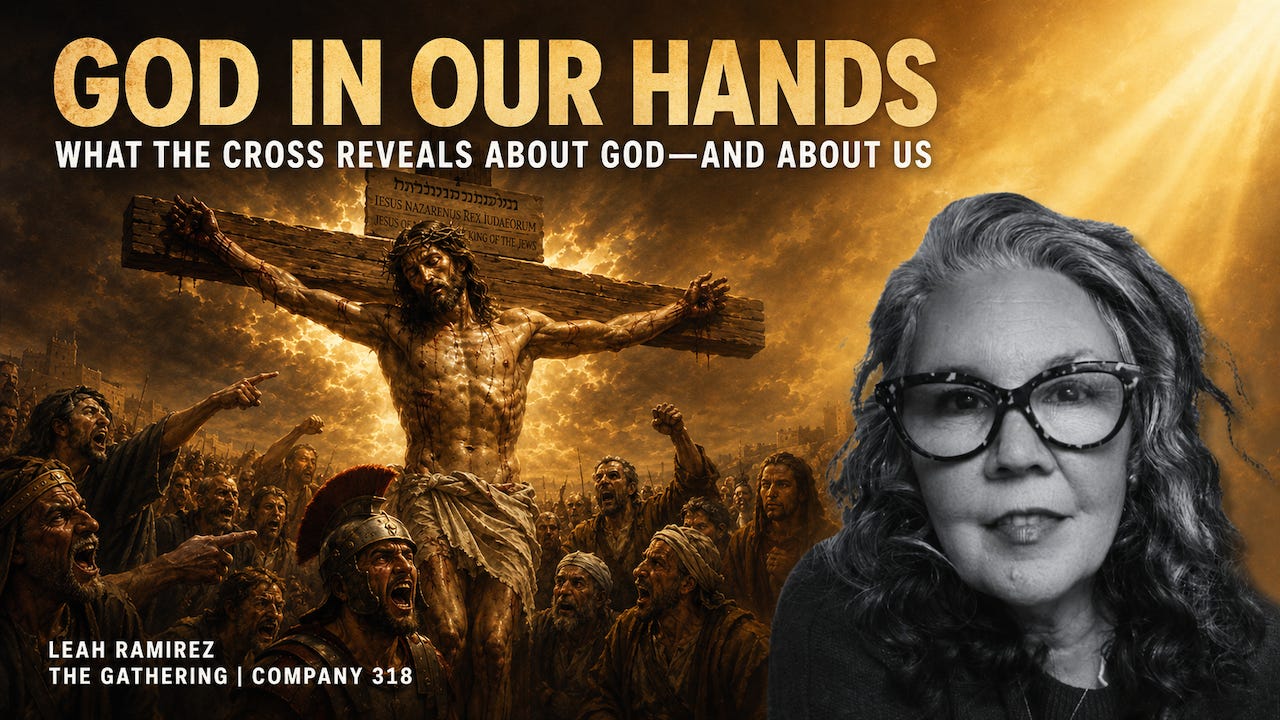
Then we come to the cross, and I want you to look at it again.
Luke 23:33–34 (ESV)
“And when they came to the place that is called The Skull, there they crucified him, and the criminals, one on his right and one on his left.
And Jesus said, ‘Father, forgive them, for they know not what they do.’”
For generations many of us have known the phrase Sinners in the Hands of an Angry God. But when I behold the cross, I see the image reversed.
I see God in the hands of angry sinners.
Who is raging in this scene? Who is mocking, accusing, torturing, and killing? We are.
And while humanity pours its hostility onto God, what comes out of God?
“Father, forgive them.”
This matters enormously to me because the cross does not reveal that Jesus finally convinced an unwilling Father to be merciful toward us. The cross reveals the Father in the Son entering all the way into our hostility and answering it with forgiveness.
Romans 5:8 (ESV)
“But God shows his love for us in that while we were still sinners, Christ died for us.”
God is showing us something at the cross. He is revealing His disposition. He loved us while we were sinners. Paul goes even further a few verses later and says He loves us while we were enemies.
The cross is God’s answer to our accusation about Him. We thought He had abandoned us, so He entered our abandonment. We thought He was distant, so He came near. We thought He was withholding Himself from us, so He gave us His body and His blood. We thought there was hostility in God, and then when we finally got God in our hands and did everything our hostility wanted to do, He refused to become our enemy.
“Father, forgive them.”
I don’t know how to move quickly past that. I don’t want to move past that.
This has been changing the way I think about repentance. I said Sunday that I can tell you from experience that a person can stop selling cocaine without seeing God accurately. I know because I did.
You can clean up behavior and remain deeply confused about the Father. You can stop sleeping around. You can stop drinking. You can stop lying. You can become respectable and go to church while still believing that God is standing far away from you, only tolerating you because Jesus managed to make you acceptable.
Behavior can change without the mind being renewed.
But when we behold Jesus, something else happens. The truth about God begins exposing the lie we have believed, and when I see Him clearly, I begin to see myself clearly too. That is why the kindness of God leads us to repentance.
His kindness is not God pretending sin is harmless. His kindness is what finally makes it possible for me to see sin without hiding. Accusation usually makes us defend ourselves. Love disarms us.
Have you ever been treated with real kindness when you knew you did not deserve it? There is something disarming about that kind of love. Accusation usually gives us something to push against. It makes us defend ourselves, explain ourselves, or harden. But undeserved kindness takes away the argument. Suddenly you are seeing both yourself and the other person more clearly. You see your own failure without needing to hide it, because you are seeing it in the presence of someone who has already chosen mercy.
That is why the kindness of God leads us to repentance. His kindness does not minimize what is wrong. It makes honesty possible. At the cross, we finally see the seriousness of our hostility and the depth of His love in the same moment. We see what is in us, and we see what is in Him. And that revelation is what changes the mind and turns the heart.
That is the cross. It is the goodness of God on display with such extravagance that our hostility finally loses its argument.
Paul tells us plainly. God has given us the ministry of reconciliation.
This is where I have been doing some serious rethinking about evangelism. For much of the church, evangelism has often begun with convincing another person that they are separated from God. But Paul does not say God entrusted us with the ministry of separation.
He says, “In Christ God was reconciling the world to himself, not counting their trespasses against them.” And then, “We implore you on behalf of Christ, be reconciled to God.”
The announcement and the appeal belong together. The announcement is not, “God might reconcile you if you can figure out how to cross the distance.” The announcement is that God has acted in Christ.
Now turn toward Him. See Him. Believe Him. Come into the light. Stop living as though the One who has reconciled you is your enemy.
What would happen if we walked into every conversation carrying that message? What if instead of looking at someone and agreeing with everything broken in their life, we stood with the Architect?
I can see the broken wall. I’m not going to lie to you about it. But I am not going to agree that the wall is the final truth about you.
I am going to agree with Jesus.
There is another consequence to all of this that I don’t think we can avoid. If God refuses to become our enemy while we are treating Him as an enemy, what does the cross ask of us?
Do you have enemies? Of course you do. People may oppose you, betray you, misunderstand you, slander you, or reject you. The question is not simply whether someone has made themselves your enemy.
The question is: Are you seeing yourself as theirs?
Let’s be honest with ourselves, that is much harder.
The gospel requires more than correct doctrine about reconciliation. It calls us to embody the reconciled life. Can I refuse to become your enemy even while you are acting like mine? Can the life of Jesus in me say, “Father, forgive them”?
That takes something stronger than niceness. It takes resurrection life.
Toward the end of Sunday, I asked everyone to think about someone they love who has gone far away, someone who is currently walking in estrangement. Maybe you have a child who walked away from you or from God. Maybe it is a friend. Maybe someone who once knew you deeply now considers you an enemy.
Think about them for a moment. Did their distance make you love them less? Or did something happen in your heart where you somehow became even more aware of them?
You pray more. You wonder how they are doing. You notice their absence. Your heart keeps extending itself toward the distance.
The distance is real, but it isn’t coming from you.
Sunday I found myself wondering: where did we learn to love like that? We are made in the image of God. We love because He first loved us. Could it be that some of the love we experience for people who have gone far away is giving us a tiny glimpse into the Father’s heart?
The prodigal can go to the far country. He can squander everything. He can live as though he has no father. But his leaving does not turn the father into his enemy.
When he comes home, the father is already looking down the road. There is a robe, a ring, and a table. The father does not need the son’s speech to convince him to love.
He was already convinced.
So what is the gospel invitation? I think Paul says it beautifully: Be reconciled to God.
The Father does not need to be persuaded to open His heart to you. Look at the cross. His heart is already open.
Maybe you have lived for years convinced that God stands against you. Maybe your own sin has become the lens through which you interpret Him. Maybe you have assumed your shame tells you more about God than Jesus does.
It doesn’t.
Jesus is God’s mind made up about you, and He has come all the way into our humanity to reclaim what was hidden under all that dirt.
Jesus tells a parable in Matthew 13:
Matthew 13:44 (ESV)
“The kingdom of heaven is like treasure hidden in a field, which a man found and covered up. Then in his joy he goes and sells all that he has and buys that field.”
I have preached this parable for years because I cannot get over the valuation. The treasure is treasure while it is still hidden. Its value is not established by whether it can see itself clearly. The purchaser determines what the field is worth by what he is willing to pay, and he pays the full price with joy.
What if the cross is God’s valuation of humanity?
You may be buried under things that make it almost impossible to see what He sees. He sees. He knows what He made, and He came for His treasure.
So I am not asking you to manufacture some great spiritual response. I am asking you to look. Behold the Son. Let Him tell you the truth about the Father, the cross, and yourself. Then believe Him.
Not because your belief makes His finished work true.
Believe because it is true.
And from there, learn to live.
I am still sitting in these passages. I am still asking the Lord to dismantle anything in me that detracts from what He has accomplished in His Son. I am still finding loose Jenga pieces in places I thought were settled theology, and maybe you are too.
I’m increasingly convinced we do not need to rush out of that process. We can sit here together for a while. We can keep looking at Jesus until the morning star dawns in our hearts. We can let God teach us to see what the Architect sees, and we can ask Him for the grace to agree.
I love walking with you,
Leah
Watch the full Sunday message:
God in Our Hands | What the Cross Reveals About God—and About Us
This is also why I am so excited about the first track of Behold School: ABIDE — The Gospel From Which We Live. Beginning September 14, we are giving twelve weeks to Romans 5–8, not because we need more information about these chapters, but because I think we need time for them to work their way into us.
The curriculum will open at the beginning of each week, with live online Beholding Sessions every other Tuesday and Formation Groups on the alternating weeks. The formation groups will be offered at different times so that people can find something that works with their schedules.
I have been sitting in these passages while preparing for the school, and they are doing something in me. I am expectant about what God will do as we sit in them together.
Learn more about Behold School
If this stirred something in you, I’d love for you to share it with someone and keep the conversation going. We are learning together what it means to live from a gospel this good.
If this stirred something in you, share it with someone you would want to sit across the table and talk about it with. And if you’re reading on Substack, a restack is one of the simplest ways to help these conversations reach people who may need them.
If you want to keep following these conversations around the gospel, union with Christ, beholding, and formation in Him, subscribe to Company 318. We’ll continue working these things out together here.
If you’re in Colorado Springs, we’d love to have you with us at The Gathering. We meet Sundays at 10:00 a.m., and you are always welcome at the table.
If you would like to help support The Gathering/Company 318 and the work we are building together, you can partner with us here:
Comments
Nothing yet. Say the first thing.
Sign in to join the conversation.