
“We are going to cancel our trip. We are just too worried about measles with our baby, and we saw on the news that measles vaccination is really low in that state.”
I have heard this sentiment many times from concerned parents over the past few years. It occurs more often when headlines appear about vaccine coverage, such as those this week covering the CDC’s announcement that kindergartners' vaccine exemption rates nationwide have hit another new record high at 4.2%. Every media outlet covering this announcement led with this concerning trend because it is clean and fits the story of increasing vaccine hesitancy, falling trust, and more vaccine-preventable disease outbreaks. While all of that may be true, it is an unhelpful number for what most people want to know: where outbreaks might occur and what my child’s risk is.
Here is the problem with the national numbers. Measles doesn’t spread across the country; it spreads in small communities. A national or even state vaccination rate tells you almost nothing about the actual risk facing any individual kid or family because vaccination rates cluster at the hyper-local level. A state can be comfortably within the 95% target herd immunity threshold for preventing a measles outbreak, while still containing multiple local pockets of coverage below 60%. Those local pockets are where measles outbreaks start and spread, not across the entire state. My own state’s data shows this exact pattern.
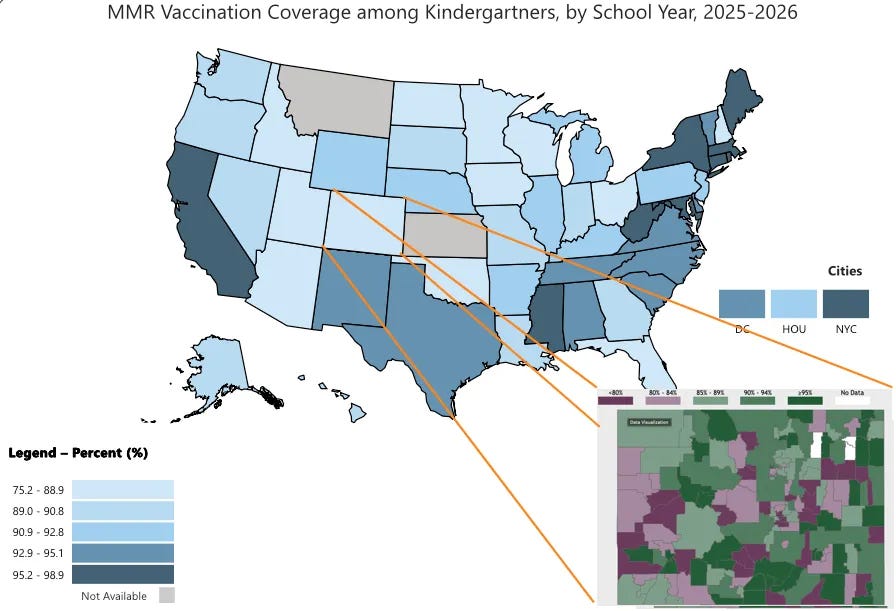
I have seen this play out with parents in my own practice. The national and state numbers may be actively reassuring parents who shouldn’t be reassured and alarming parents who don’t need to be. A parent who reads about a state’s lower Kindergarten vaccination rate may unnecessarily worry about their child’s risk and avoid travel. I have had parents who are so concerned about traveling to a state with a low vaccination rate that they change plans until I point out that the vaccination rate in the specific community they are traveling to within a low-vaccination state is actually higher than in their own community. On the other hand, a parent may be sending their kids to a school with a very low vaccination rate but have no idea, because the state- or county-level number masks it.
The topline national numbers are important for recognizing trends. But it is not helpful for most families and individual communities, as it lacks context and can be misleading. It would be like saying the average national temperature this week is 82 degrees and rising year over year for a decade. Maybe that is a useful trend to monitor, but someone in 111-degree heat in Phoenix and someone in 72-degree heat in northern Minnesota are not having the same experience.
So, what is actually helpful? Sub-county-level data, such as zip code and school-level data. In most states, this level of data exists, but it may not be publicly reported, may be buried in hard-to-find places, or may be overly complex. Each state and community is different, and good efforts are underway to make this data more useful and accessible.
A study published this week in Nature Medicine illustrates this problem. Researchers built a nationwide vaccination database from 45 states, 50,000 schools, 13,000 districts, and 3,000 counties, dating back to 2013, to model measles transmission risk at the school level. They found that measles vulnerability in schools increased significantly after the pandemic, with the share of unprotected students nationally doubling, but those vulnerabilities remain clustered and relatively invisible in our current data monitoring at the national, state, or even county levels.
This is important beyond individual families. Our data shapes our collective response. If health departments and policymakers respond to a topline number, they may reach for topline solutions, such as a statewide messaging campaign not tailored to any specific community, or a general call to restore confidence in vaccines that falls only on the ears of people who are already confident. These efforts aren’t wrong, but they can be a poor match for a problem that is concentrated rather than diffuse.
I am concerned that rising exemptions and declining vaccination rates across the country create more opportunities for preventable diseases. And these trends need to be studied and reported on. But it feels like we have the same conversation every time the CDC releases new school vaccination data. There is shock at the topline numbers, even if they moved only a little, and then a return to baseline attention until next year. But the actual addressable risk is in local communities that people never consider with this topline-only framing.
If you want to know whether your kids, patients, or community is at risk and what you can do, ask your school or health department. If that isn’t readily available, make it clear to your leaders that this is the information you need.
-DH
Community Immunity is written by Dr. David Higgins, MD, MPH, a practicing pediatrician and public health physician whose work focuses on vaccine delivery, health policy, and communication. This newsletter is where he writes about vaccines, public health, and community. When he’s not seeing patients or writing, he’s coaching youth soccer or exploring the Colorado outdoors with his family. Find him on LinkedIn, Instagram, and Bluesky.
This newsletter is free for everyone. However, if you want to support the work that goes into creating it, a paid subscription means a lot.
No posts
Comments
Nothing yet. Say the first thing.
Sign in to join the conversation.