
When I was a child, I was hospitalized with rotavirus. I was old enough to remember it—the smell of the exam room, repeated needle sticks in attempts to place an IV, and days on end without eating or drinking normally. That experience is, in part, why I became a pediatrician who focuses on vaccines. There was no rotavirus vaccine when I was a child, but children now shouldn’t have to go through what I did.
The rotavirus season is underway, with rising rates across the U.S. Rotavirus is a common cause of severe diarrhea and vomiting in infants and young children. Before vaccination, it caused up to 70,000 hospitalizations in the U.S. every year, mostly in children under five, due to rapid and severe dehydration. Since routine rotavirus vaccination began in 2006, hospitalizations have dropped by roughly 80%.
Media coverage has highlighted the seasonal rise in rotavirus infection. However, the scale of this season deserves context: the 8.1% positivity rate (as of April 24) has surpassed last year’s peak of 6.8%. But historical post-vaccine peaks have reached as high as 27%, with a median around 14%. Although wastewater monitoring data also show increased levels of the virus, we don’t have historical trends to compare with. It is not clear that this season is unprecedented.
Social media posts have blamed the current “surge” in rotavirus cases on vaccine hesitancy and refusal, with some directly claiming rotavirus is spiking primarily because parents aren't vaccinating. And media coverage implicitly points to hesitancy as the primary explanation for low rates. I understand the instinct to raise awareness about vaccine refusal. But the data don’t clearly show refusal is the primary driver of current trends, and that framing risks obscuring the less sensational but more likely reason for low rotavirus coverage: poor access and real barriers imposed by our fractured health system on families.
Rotavirus vaccination rates have declined in recent years, with national coverage at 74%. However, rotavirus vaccination coverage has always been lower than that of many other routine vaccines, long before RFK Jr. became Secretary of Health and Human Services, recent federal health policy shifts, or the COVID-19 pandemic. While coverage is down from a peak of 77% in 2018-2019, rates are similar to those in the mid-2010s, with a modest 1-3 percentage-point dip in recent years. The most recent national rotavirus coverage data cover children born in 2021–2022, so we don’t yet know what happened to vaccination rates in this season.
Here’s the nuance that isn’t being reported: Rotavirus vaccination coverage is much more susceptible to access and logistical barriers than that of many other vaccines because it is front-loaded and time-sensitive. Infants need to receive the first dose of the vaccine before 15 weeks and complete the entire series (2 or 3 doses, depending on the vaccine brand) by 8 months. There is no opportunity to “catch up” if they miss visits. If a child loses Medicaid coverage, can’t find a pediatrician, or isn’t able to get in on time, they can catch up on a measles vaccination months later, but not for rotavirus. Among children on Medicaid who start the series, some studies have found that only 1 in 2 complete it, and completion is higher with the 2-dose vaccine than with the 3-dose. That pattern cannot be explained by hesitancy alone, but it becomes clear once you account for logistical and timing constraints.
Compare rotavirus vaccine coverage with measles vaccine coverage (MMR) at 24 months of age, which has consistently been 15-18% higher.
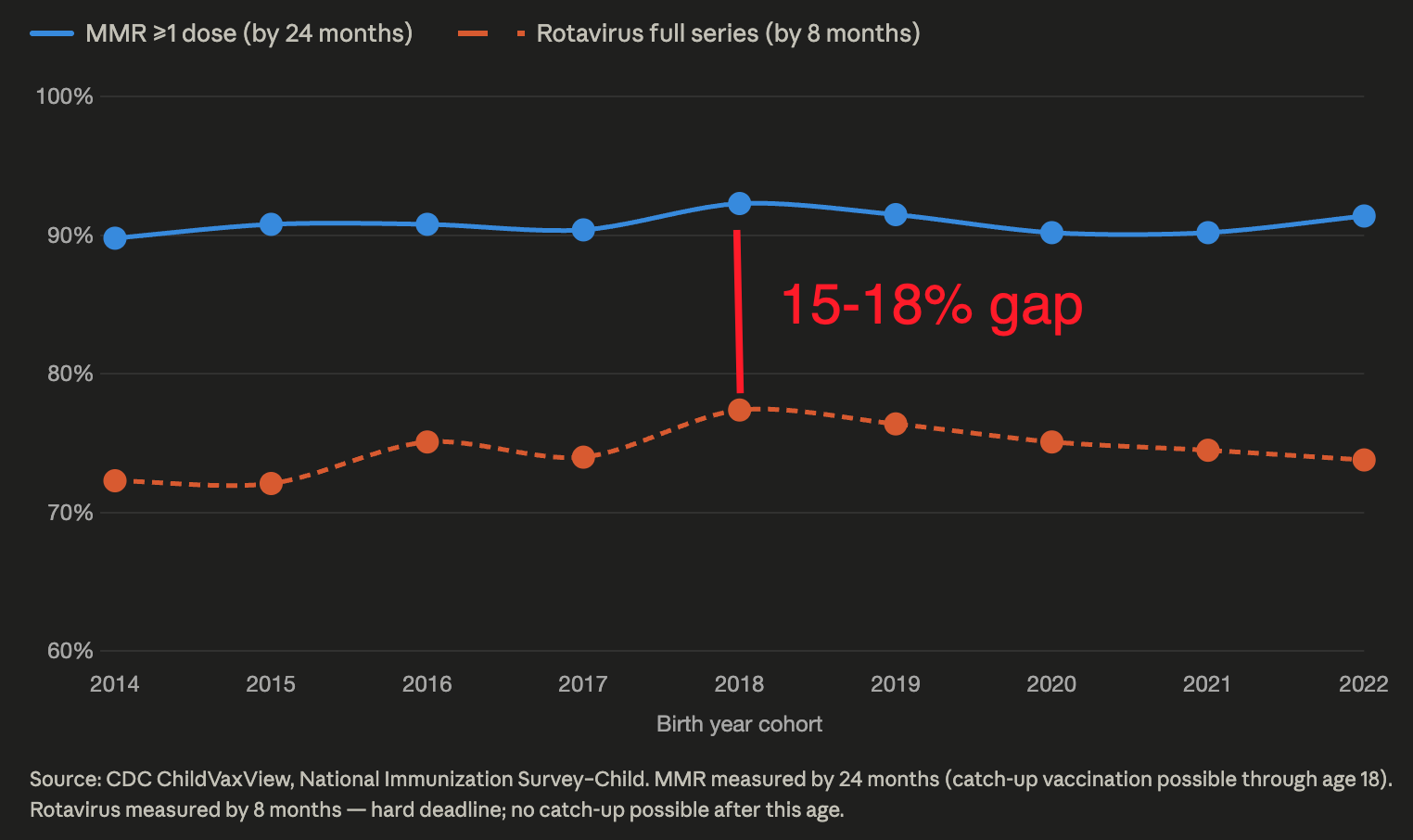
What’s going on here? Is there significantly more hesitancy toward the rotavirus vaccine than the MMR vaccine? There isn't good evidence for it, and I don't see it in my clinic. The persistent gap in rotavirus coverage is a signal of access challenges, not attitudes.
This matters because the diagnosis determines the response. If I treat a disease I haven't properly diagnosed, the treatment won't help. Similarly, if the dominant narrative says vaccine refusal alone is driving low rotavirus coverage, we will invest in the wrong interventions. Media campaigns and myth-busting on social media will not help the family whose Medicaid lapsed between the 2- and 4-month visits, or the family that moved and can’t find a pediatrician who accepts new patients before the 8-month window closes.
If rotavirus vaccine coverage data for 2023–2025 arrive and the trend continues lower, the dominant narrative will likely be hesitancy. But what about the 4.6 million children who lost Medicaid during the unwinding, when projections suggested that nearly three-quarters of disenrolled children would still be eligible? What about the infants who aged out of the rotavirus window while their family was navigating a paperwork problem? They will show up as unvaccinated. They may be labeled vaccine-hesitant when they are not.
These barriers do not fall equally. Among the most recent national data, children living below the federal poverty line complete the rotavirus series at 61%, compared to 79% for those above it, an 18-percentage-point gap, compared to just 4 points for MMR in the same data. Children in rural areas complete the series at 71%, which is also significantly lower. And the rotavirus poverty gap has been widening in recent years. The structural factors that make a front-loaded, time-sensitive vaccine hardest to complete are concentrated in the communities already carrying the greatest burden of preventable disease.
Vaccine hesitancy is real and plays a role. A national survey of pediatricians found that parental deferral, general vaccine safety concerns, and doubts about whether the rotavirus vaccine is even necessary are genuine barriers. But misapplying it as the central problem only serves to protect the status quo. That refusal narrative shifts all the blame onto parents, instead of acknowledging the responsibility we all have to address systemic barriers that disproportionately affect the most vulnerable communities.
The goal is to make sure no child goes through what I did. In addition to improving confidence in vaccines, this means ensuring Medicaid continuity to prevent coverage gaps, protecting the Vaccines for Children program, improving access to primary care, enhancing reminder systems and standing orders at well-visit appointments, and integrating with WIC and home-visiting programs. It requires understanding why vaccination isn't happening, rather than assuming we already know.
Last week, I wrote about a misleading POLITICO poll that suggested vaccine skepticism and concerns about vaccine safety were now the norm in America. The rotavirus refusal narrative is a similar error in a different form.
I had a lot of engagement with last week’s piece. STAT news republished it, and I was a guest on several podcasts to discuss the dangers of this misstep. Since then, POLITICO changed the headline on the story to “Many Americans express doubt about vaccines, POLITICO Poll finds,” with a correction note stating, “An earlier version of this report's headline misstated the poll's findings on the number of Americans skeptical of vaccine safety due to an editing error.” I am glad they changed the headline; however, I still see the headline message spreading, and my concerns with the substance and potential harm of the poll remain.
If you want to hear more, you can listen to this week’s Paging America podcast (starting at 43 minutes) or BBC’s More or Less here. It’s only 9 minutes and is worth your time.
Thanks, as always, for being part of this community.
-David
Community Immunity is written by Dr. David Higgins, MD, MPH, a practicing pediatrician and public health physician whose work focuses on vaccine delivery, health policy, and communication. This newsletter is where he writes about vaccines, public health, and community. When he’s not seeing patients or writing, he’s coaching youth soccer or exploring the outdoors with his family. Find him on LinkedIn, Instagram, Substack Notes, and Bluesky.
This newsletter is free for everyone. If you want to support the work that goes into it, a paid subscription means a lot.
No posts
Comments
Nothing yet. Say the first thing.
Sign in to join the conversation.