
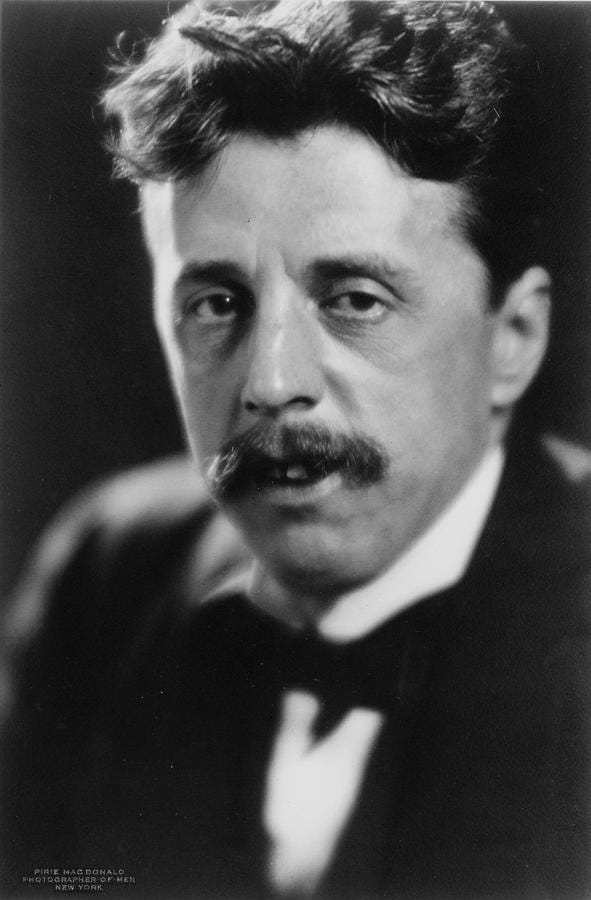
Here is the opening of Section X of Arnold Bennett’s self-help essay ‘How to Live on 24 Hours a Day’.
Art is a great thing. But it is not the greatest. The most important of all perceptions is the continual perception of cause and effect—in other words, the perception of the continuous development of the universe—in still other words, the perception of the course of evolution. When one has thoroughly got imbued into one’s head the leading truth that nothing happens without a cause, one grows not only large-minded, but large-hearted.
A little later, Bennett writes:
And, my dear sir, perhaps you happen to be an estate agent’s clerk, and you hate the arts, and you want to foster your immortal soul, and you can’t be interested in your business because it’s so humdrum.
Nothing is humdrum.
The tremendous, changeful picturesqueness of life is marvellously shown in an estate agent’s office. What! There was a block of traffic in Oxford Street; to avoid the block people actually began to travel under the cellars and drains, and the result was a rise of rents in Shepherd’s Bush! And you say that isn’t picturesque! Suppose you were to study, in this spirit, the property question in London for an hour and a half every other evening. Would it not give zest to your business, and transform your whole life?
You would arrive at more difficult problems. And you would be able to tell us why, as the natural result of cause and effect, the longest straight street in London is about a yard and a half in length, while the longest absolutely straight street in Paris extends for miles. I think you will admit that in an estate agent’s clerk I have not chosen an example that specially favours my theories.
You are a bank clerk, and you have not read that breathless romance (disguised as a scientific study), Walter Bagehot’s “Lombard Street”? Ah, my dear sir, if you had begun with that, and followed it up for ninety minutes every other evening, how enthralling your business would be to you, and how much more clearly you would understand human nature.
He goes on to advise that Novels are excluded from “serious reading”, a sentiment many people will object too but which is worth taking seriously. (Previously discussed here.) Instead, he wishes for people to read poetry.
Imaginative poetry produces a far greater mental strain than novels. It produces probably the severest strain of any form of literature. It is the highest form of literature. It yields the highest form of pleasure, and teaches the highest form of wisdom. In a word, there is nothing to compare with it. I say this with sad consciousness of the fact that the majority of people do not read poetry.
I am persuaded that many excellent persons, if they were confronted with the alternatives of reading “Paradise Lost” and going round Trafalgar Square at noonday on their knees in sack-cloth, would choose the ordeal of public ridicule. Still, I will never cease advising my friends and enemies to read poetry before anything.
I am currently working through Pope’s Iliad, rather intermittently because of travel and other things. It is one of the major neglected works of English Literature and reading one book in the morning before anything else makes that day a good one.
Bennett’s whole essay is well worthwhile and is not very long.
One of the other great works of this sort is J.S. Mill’s November 1868 letter to Florence May, which I reproduce here, without endorsing his selection—or ordering—of the works of literature.
Dear Madam—
I am very glad to find that you enjoy Buckle’s History, & I suppose from what you say, that you would like to enter into a course of reading that would be a good preparation for historical & social philosophy.
Something must depend in this course on the number of hours you can give to reading every day, & on the quickness with which you are in the habit of reading. But in any case I would strongly recommend three things. First, to read every book (with few & special exceptions) straight through from the title page to the last word. 2. To read a fixed number of pages of such reading as is taken for work, every day. I do not recommend hours, but 20, 50, or 100 pages. To read the working reading of the day as early as circumstances will admit in the day: but never, unless on some very rare exceptions, to go to sleep without having read it. 3. To fix so small a quantity of reading for work, as shall never be a burden, nor weary the mind, nor interfere inconveniently with other occupations; & to fill in the many gaps of time which will be left unoccupied by this rule, with light reading, amusing & agreeable, which has the advantage of being attractive when you are tired, of being able to put aside for days together when you are otherwise occupied, & which at the same time if well chosen may end by filling the mind with a fund of valuable knowledge as to the habits & ideas of past times & foreign countries.
I recommend, therefore, dividing your reading into four courses, which shd be carried on simultaneously: the first two of them to consist of books, some small portion of which shd be read invariably every day, & every word of which shd be read steadily through. The third course shd consist of books from which you can select portions if you like, which are comparatively light reading, but which shd be read because they are standard books the knowledge of which is necessary to any thorough knowledge of the progress of the human mind & of the history of manners. These need not be read every day if time is wanting, yet it might be a good rule to read some of them every day whenever there is time before taking up the still lighter or more exciting literature of the 4th course.
The fourth course shd consist of those chefs d’œuvre of literature which are sure to be interesting, as well as of whatever modern books you find tempting & agreeable without fatiguing the mind. For I think it of great value to acquire a habit of constant reading in order to acquire in time the power of reading quickly, & I am convinced that this cannot be done with safety to the health of those who eschew light literature. To those who mean to spend their life in study, light literature is a necessary relief, while as I have already said, it is by no means without good results. I think that in it newspapers magazines & reviews may be very usefully included, if you find them agreeable reading; but even the most valuable articles in periodical publications ought to be read for pleasure, & not as part of the work of the day, because they do not fit in to a steady course of reading.
I inclose a list of books for the four courses, which I have put in the order in which I think it would be good to read them. The first course shd have the freshest part of the day, as it requires thought; & the two first courses shd if possible be read in the order in which I have put them down. The last two need not necessarily be read in this order, but it is very desirable that in reading them you shd ascertain & [note in?] your own mind while reading, the date at which they were written, so as to observe as you read the changes of ideas & manners.
I have not put down any books in any foreign language, because unless there is any foreign language you read with as much pleasure & fluency as English, I think it waste of time at present to read its literature. But if there is any such language, it would be well to let me know, because in that case I could perhaps point out useful books in each course to read in it, supplying some want which cannot be supplied in English.
I
Berkeley’s Principles of Human Knowledge
Berkeley’s Three Dialogues
Berkeley’s Essay on Vision
Hume’s Essays concerning Human Understanding
Brown’s Lectures on the Human Mind
Mill’s System of Logic
James Mill’s Analysis of the Human Mind
Bain’s Senses and the Intellect
Bain’s Emotions and the Will
Bain’s Study of Character
H. Spencer’s Principles of Psychology
II
Grote’s History of Greece
Hooke’s Roman History
Plutarch’s Lives
Merivale’s History of the Roman Empire
Gibbon’s Decline & Fall of the Roman Empire
Hume’s History of England
Hallam’s Middle Ages
Macaulay’s History of England
[James] Stephen’s Lectures on the History of France
Prescott’s Ferdinand and Isabella
Robertson’s Charles V
Robertson’s America
Motley’s United Netherlands
Schiller’s Thirty Years War translated
III
Spenser’s Poems
Massinger’s Plays
Bacon’s Essays
Milton Paradise Lost, Comus, Lycidas, L’Allegro, Penseroso, Sonnets
Dryden’s Poems—Æneid
Pope’s Poems—Iliad & Odyssey
Spectator
Clarissa Harlowe
Sir Charles Grandison
Rasselas
Rambler
Goldsmith’s Poems
Goldsmith’s Citizen of the World
Gray’s Poems
Cowper’s Poems
Ellis’s Early English Prose Romances
Sydney’s Arcadia
Coleridge
Wordsworth
Shelley
Keats
IV
Shakespeare
Don Quixote
Gil Blas
Fielding’s Novels
Vicar of Wakefield
Sterne’s Sentimental Journey
Percy’s Reliques of Early English Poetry
Lamb’s Selections from the Dramatists
Mrs Radcliffe’s Mysteries of Udolpho
Mrs Radcliffe’s Romance of the Forest
Miss Austen’s Novels—Sense and Sensibility Pride and Prejudice &c.
Scott’s Poems
Scott’s Novels
Comments
Nothing yet. Say the first thing.
Sign in to join the conversation.