
Lately, Cara and I have been reflecting on where we are now—not just as homeschoolers, but as women who have lived with these ideas for a long time.
Many of us are somewhere in the middle. Some have graduated children. Some still have children at home. Most of us have been living with Charlotte Mason’s philosophy for well over a decade. And after all these years, we’ve noticed something: this philosophy has become less something we study and more something woven into who we are.
Charlotte Mason writes in Home Education that “the following of a method implies an idea, a mental image of the end or object to be arrived at.” When many of us first began homeschooling, it was easy to focus mostly on the immediate questions: How do I do narration? How do I teach Plutarch? Am I doing this right?
But years later, something shifts.
We’re no longer stressed about learning how to read Plutarch with our children. We just read it. They just read it. And then one day we begin noticing references to Plutarch everywhere—in literature, essays, conversations, history—and realize we’re experiencing what Charlotte Mason called “the science of relations.” One idea connects naturally to another. Knowledge grows outward and inward together. The world itself feels richer and more alive.
Of course, we still care deeply about education. We still love artist study, composer study, Shakespeare, living books, nature study, and rich ideas. We still find ourselves discussing educational philosophy and children as persons because, honestly, we’re all still a little nerdy in the best possible way.
But the wind’s in the east, and we find ourselves asking new questions like, “What’s next?” and “What is the vision for the next 20 years?”
As we plan Year 9 of Common Place Quarterly, we’re hoping to explore these ideas. What does it look like when these ideas become part of your family culture after your family is grown? What does a rich intellectual and spiritual life look like after years of pouring outward into your children?
At the same time, we know there are younger mothers just beginning this journey. We hope CPQ continues to give you confidence and encouragement for where you are, but also, now, a glimpse of where a living education can lead over time.
Because part of the vision Charlotte Mason meant us to see from the beginning is not simply a method for schooling children, but a lifelong education in learning to live fully awake to the world. And those of us in the middle? Our eyes are wide open.
: ) Mariah
If you’d like a thoughtful place to begin this month:
Revisit The Science of Nature issue
Read Considering the Commonplace in our New Beginnings issue
Read Shifting Perspectives in our Expect issue
Read Falling Upon our True Selves in our Way of the Will issue
Read Charlotte Mason and the “Things” of History in our Things issue
Read Why Love of Reading is Not the Goal in our Habit of Reading issue
Read Mapwork in the Creative Process in our Method issue
Start with just one. : )
Atmosphere: heading to print
Science of Relations: in layout
Enough: articles in copyedit/beginning layout
Year 9 writers and columns being finalized
Subscribers enjoy each quarterly issue plus our full digital archive of back issues—
there are 29 of them and counting!
We’re happy to share that our Home Education read-along recordings are returning this month after a quiet pause last year. We’re slowly reading (or re-reading) through Volume 1, and have created a free companion bookmark to help readers follow along.
Whether you are brand new to Charlotte Mason or many years into the journey, you are warmly welcome to join us!
Plutarch presents us with fully human heroes. He may respect Cato the Elder while disagreeing with his acquisitiveness, opinions of Greek Literature, and the treatment of slaves. Plutarch’s strong disapproval doesn’t eclipse his admiration of this Roman leader’s strengths. Our great biographer can even admit that Alexander was Great, while disapproving of him killing a close friend in a drunken rage, or burning Thebes to the ground in retaliation. He admires their virtues and abjures their vices, though he often chooses to highlight their virtues to encourage us more by what we should pursue rather than what we should avoid. He also reports events, choices, and conversations as accurately as he can, rarely condemning openly in the life itself, often saving the strongest condemnation for the comparison. He set up a parallel structure to promote comparison but doesn’t make all the judgments for us. Plutarch seeks first to understand, and only then to judge tentatively based on what he knows.
Are we able to do the same? Can we look back through four hundred years of American history—or sixteen hundred years of British history—and find flawed heroes from whom we can learn something? If there is no eternal standard of virtue, will our heroes shift and disappear as so many lines in Tetris? If our heroes must shift as the times change, what do we value higher than change itself?
Plutarch for the Modern Age, written by Tom Cox, from our Balance issue
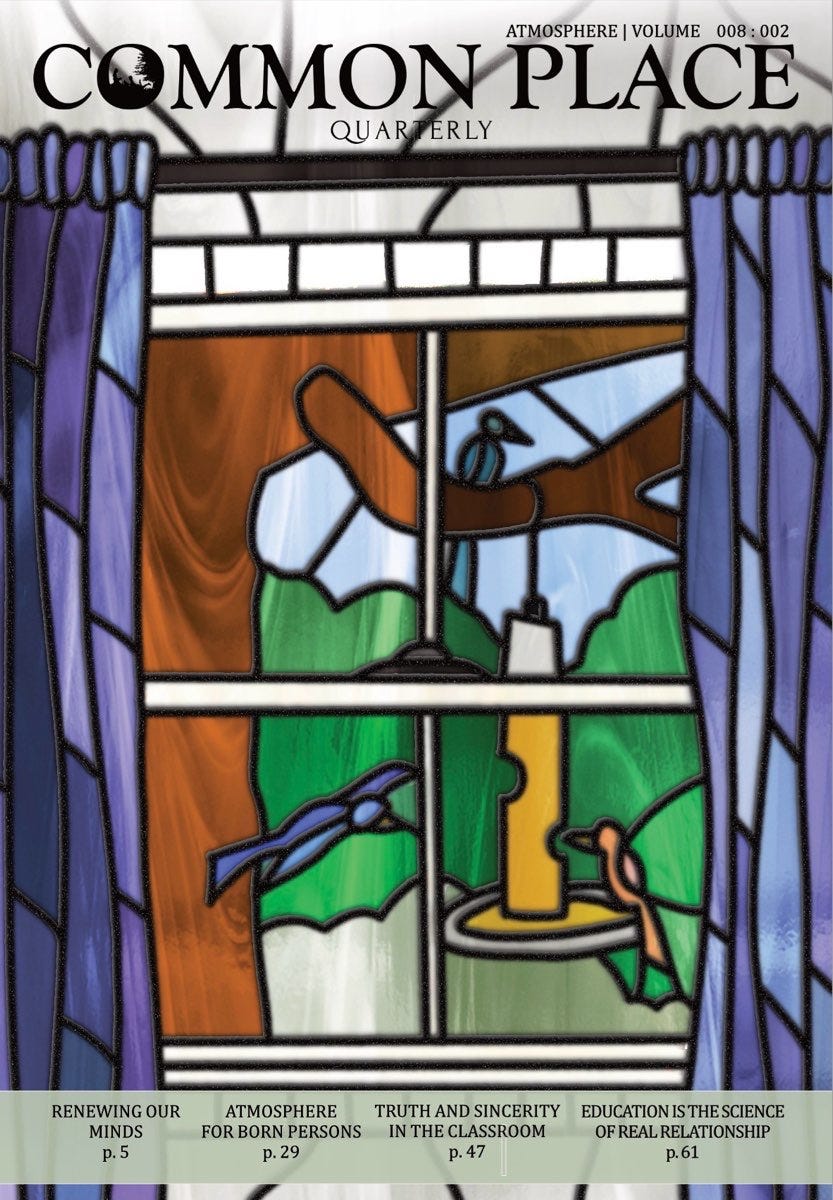
Finishing touches are getting put on our Atmosphere issue before it heads to print! We will explore this idea “to all its ends” through the main articles:
In Renewing Our Minds Through Atmosphere and Attention in the Midst of Anxiety, Jessica Diaz, MSW, explores how homeschooling mothers can navigate anxiety with wisdom drawn from Charlotte Mason, Scripture, and modern neuroscience. Connecting concepts like neuroplasticity, attention, and attachment, she offers encouragement and practical insight for cultivating a peaceful learning atmosphere that nurtures both parent and child. This thoughtful article reminds us that the renewal of our minds is both a spiritual and tangible process, shaping the atmosphere we bring into our homes and lessons each day.
In Atmosphere for Born Persons, Jennifer Losh reflects on Charlotte Mason’s principle of atmosphere through the lens of God’s calling on both parent and child. Drawing from 26 years of homeschooling experience, she encourages mothers to embrace their unique assignment with confidence, cultivating patience, peace, presence, and trust as they nurture an environment where children can grow and flourish. This thoughtful article offers wisdom and encouragement for creating a home atmosphere that honors each child as a person known and loved by God.
In Truth & Sincerity in the Classroom, Sara Timothy explores Charlotte Mason’s vision of an educational atmosphere rooted in authenticity, humility, and the shared pursuit of knowledge. Drawing on insights from C.S. Lewis and Mason’s writings, she challenges educators to move away from child-centered performance and toward meaningful engagement with ideas, positioning both teacher and student as fellow learners. Filled with practical applications for classrooms and homeschools alike, this article offers a compelling look at how an atmosphere of truth and sincerity fosters intellectual vitality and moral health.
In Education Is the Science of Real Relations, Karen Glass explores how Charlotte Mason’s principle of atmosphere calls us to offer children a natural, rather than artificial, experience of the world. Examining Mason’s warning against “despising” children by underestimating their capabilities, Glass argues that authentic relationships, meaningful responsibility, and real moral choices are essential for the development of character and virtue. This thoughtful article highlights how an atmosphere grounded in reality prepares children to engage wisely with the world, others, and their Creator.
Subscribe to get on the ship list for this issue!
The 2026 CMI Conference is coming, and we can’t wait to gather with you on scenic Lookout Mountain, GA! Mark your calendars for July 23-25, 2026 at Covenant College, where this year’s theme, “Faithfully Present: A Call to Attentive, Relational Education in the Midst of a Distracted Age,” will inspire, equip, and refresh your heart and mind. Embracing simplicity and humility, we’ll explore what it means to offer an education marked by attentiveness, consistency, and love.
Prepare to immerse yourself in community, hands-on learning, and thoughtful discussions. We hope participants--including teens ages 13 and older! -- will leave the conference excited to incorporate Charlotte Mason’s insights into their rhythms of life. We can’t wait to see you on Lookout Mountain!
Can’t attend the conference in person but want to dig into these ideas together? Join us for a new online conversion series called Friends and Fellow Labourers. Each themed conversation will have a live component, discussion forum, and additional resources. It is our intention that these relational small groups will explore conference topics while better emulating the in-person experience. Join us for one or all four!
Prepare to immerse yourself in community and thoughtful discussions. We hope participants will leave each session excited to incorporate Charlotte Mason’s insights into their rhythms of life. We can’t wait to see you in class!
Set Your Feet is an annual Charlotte Mason Retreat in Ohio. This year we are meeting in Columbus, Ohio on July 17-18. Our featured speaker is Abby Wahl from Scholé Sisters. Read more and register on our website below.
Do you have a Charlotte Mason conference coming up? Send us the information at mariah@commonplacequarterly.com, and we will share it in our monthly newsletter!
Reading: How I Discovered Poetry by Marilyn Nelson, A Great Deliverance by Elizabeth George, and we finished the first book of This Country of Ours for the first time ever in our homeschool history (so proud. Third time really is a charm.)
Making: a hand-bound planner. I am practicing a new-to-me method of binding that allows me to add in additional sections if I want to later.
Learning: how to hammer flowers. Hint: I am very, very bad. I have to get very, very good by July when I teach a workshop on it at the local Homeschool Convention in Phoenix.
Watching: a bit of this, a bit of that. I am really just biding my time until the new Ludwig airs. But I am also looking forward to the remake of Little House on the Prairie.
Eating: tiny cut-up carrots while I work
Drinking: coffeeeeeee and smoothies (because, summer!)
Thinking about: what makes a good book good
Reading: Thrice the Brinded Cat Hath Mew’d by Alan Bradley and Wives and Daughters by Elizabeth Gaskell
Making: plans to lock in at the gym for the summer. I have goals.
Eating: pulled pork street tacos with salsa verde
Learning: to eat more. Who knew it was a problem to skip meals in your 40s?
Watching: not much lately, been outside a lot
Drinking: water
Thinking about: a list of home projects I am hoping to accomplish this summer
Comments
Nothing yet. Say the first thing.
Sign in to join the conversation.