
This is the second of three talks given by Mariah Kochis at the 2026 Feast of Ideas Retreat. Her plenary talks focused on Homeschooling Through the Storms.
Today we’re going to get a bit nerdy. But first: a backstory. Some years ago, our son began having some difficulties, and after a lot of appointments, we found out he was autistic and in autism burnout. We were put on a two-year wait list for Occupational Therapy, but I realized we could not wait for two years. We needed help now. At that point, I became a homemade OT, researching day and night and beginning to apply what I read in our days. It helped immensely. What I found through that process were ideas that echoed Charlotte Mason’s educational philosophy, which added a layer of familiarity to the unfamiliar, and I realized that if I had had this information earlier, even with my neurotypical children, it would have made me a better mother. I hope it’s encouraging and helpful to you, too.
As we turn from the storms of the external to the storms that arise within—the subtle turbulence of our children’s and our own inner lives—we enter the heart of what Charlotte Mason calls education as an atmosphere. In Volume 6 of Home Education, she writes, “It is there, about the child, his natural element, precisely as the atmosphere of the earth is about us. It is thrown off, as it were, from persons and things, stirred by events, sweetened by love, ventilated, kept in motion, by the regulated action of common sense” (Vol. 6, p. 96). This atmosphere is not simply the physical environment of the homeschool; it is the emotional, relational, and spiritual climate that surrounds the child and the mother. It is the invisible current that carries attention, shapes habits, and lays the foundation for learning. To neglect it is to invite dysregulation, anxiety, and fractured attention—storms that no timetable or method alone can control.
“Education is an atmosphere.”
When I began homeschooling, I thought atmosphere was IKEA decor and candles–it took me a while to mature to the point where I understood it’s the state of our souls as mothers, and the emotional climate of our homes. I began to ask myself, “What atmosphere am I bringing with me into the room?” Being the parent of a neurodivergent child, on top of the high stress our family has lived in on and off over the years, I feel like I am in a constant state of jaw-clenching. Every grunt from my child or ping of my phone has had me on edge. These are things that I have had to work really hard to understand and work through because everyone in my home, least of all myself, could sense them. The atmosphere of the home and homeschool matters not only to the child but to the whole family.
So where do we begin?
Charlotte Mason emphasizes that “a mother must know what she is about” (Vol. 2, p. 76). What does it take for a mother to know what she’s about? Charlotte Mason tells us that it’s understanding an educational philosophy and knowing your “born persons.” This requires an awareness that the anxiety, tension, or internal distraction in ourselves is immediately felt by the child. Dysregulation is reciprocal: a child’s nervous system reflects the tone, attention, and emotional state of the parent, just as the parent’s system responds to the child. This means that our own anxieties, unresolved frustrations, or hurried pace can unintentionally hinder, despise, or offend the child’s personhood—violating the first principle of respecting each child as a born person. The small internal storms of the mother—worry over school, life circumstances, financial stress, or past failures—can ripple outward, subtly altering the atmosphere. A calm, attentive, and intentional mother cultivates safety and engagement, whereas internal chaos can escalate the child’s emotional brain into fight, flight, or freeze states.
This is true for all families, but it becomes even clearer in a neurodivergent household.
Dysregulation and anxiety manifest neurologically in ways that directly affect learning. Modern neuroscience demonstrates that when a child’s emotional brain—the amygdala and limbic system—is activated by stress, their prefrontal cortex goes offline. Executive functions such as reflection, reasoning, memory, communication, and attention are suppressed. Mona Delahooke, in Beyond Behaviors: Using Brain Science and Compassion to Understand and Solve Children’s Behavioral Challenges, uses the metaphor of a house of social-emotional development to describe this process.
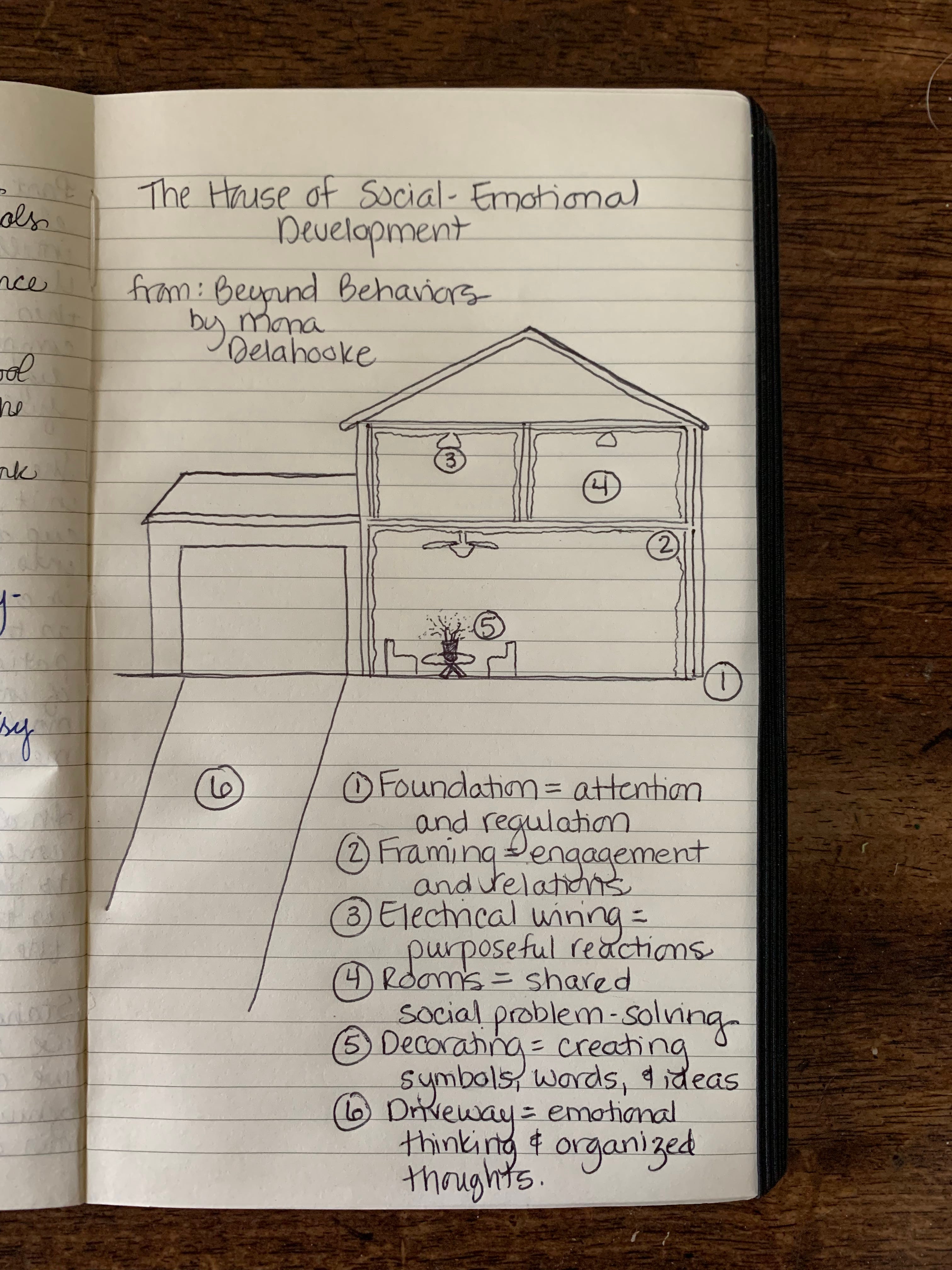
The foundation is regulation and attention, without which the framing (engagement and relationships), wiring (purposeful reactions), rooms (social problem-solving), decoration (symbols, words, ideas), and finally the driveway into the world (organized thoughts and emotional thinking) cannot be constructed. If the foundation is unstable, the rest of the house is compromised. This concept parallels Mason’s insistence that the regulated action of common sense—the atmosphere—is the starting point for every child (Vol. 6, p. 96).
Reflection Question: As you think about your home, where do you see the atmosphere supporting your child’s engagement, and where might tension or anxiety be interfering with learning?
Understanding the centrality of regulation reframes how we interpret challenging behaviors. A child who is dysregulated is not being defiant or manipulative; their nervous system is signaling that the environment is overstimulating or that internal resources are depleted. Recognizing this allows us to respond with grace, rather than reaction. Mason teaches that the Great Recognition, the divine cooperation with the Holy Spirit, is not purely academic, but “in the direction, teaching, and training of the child.” Our cooperation requires our intentional presence, and as we touched on yesterday, the deployment of a thinking love—attentive, discerning, and responsive engagement.
Reflection Question: Think of a recent time when a child became dysregulated. What signs did you notice in their body, face, or voice? How did your own responses influence the course of the interaction?
Co-regulation is the bridge between dysregulation and learning. It is the practice by which the parent or caregiver provides stability, calm, and connection until the child’s nervous system can self-regulate. Wikipedia defines co-regulation as “a continuous unfolding of individual action that is susceptible to being continuously modified by the continuously changing actions of the partner. (emphasis mine)” In practical terms, this is not a formula, but an ongoing, responsive, relational, flowing engagement. It reminds me of the images we considered yesterday of waves and algae. Charlotte Mason’s insistence that education is an atmosphere calls for this responsiveness: the parent’s attentiveness, tone, and presence become instruments for stabilizing the child’s attention and emotions so that learning can happen.
It can feel overwhelming when a child becomes dysregulated. We may assume that once the emotional storm has hit, we are powerless, that lessons must be abandoned, or that discipline and strict adherence to rules are the only options. But Charlotte Mason reminds us that we are not helpless. The parent is called to observe, guide, and cooperate with the child’s growth, while never hindering, despising, or offending the born person entrusted to our care. She says, “The choicer the plant, the gardener tells us, the greater the pains must he take with the rearing of it: and here is the secret of the loss and waste of some of the most beauteous and lovable natures the world has seen; they have not had the pains taken with their rearing that their delicate, sensitive organisations demanded.” V. 2, p.76.
Dysregulation is not a sign of failure–it’s simply a signal that the child’s nervous system, body, or emotions have been overwhelmed and they don’t yet have the skills to fix it alone. We do not need to respond with punishments or fear, nor do we need to wield Scripture in ways that shame or demean. Instead, Mason’s principles, alongside modern understanding of social-emotional development and co-regulation, give us tools to respond intentionally, patiently, and wisely. This only aids in a mother’s love. We can adjust the atmosphere, scaffold attention, and provide supportive rhythms that help a child regain regulation. We can return to the difficulty in a calm moment to troubleshoot and problem-solve. In these moments, knowing what we are about–how to observe, respond, and set up conditions for learning– transforms chaos into opportunity. Dysregulation becomes not a wall, but a signal for guided support, for deepened connection, and for teaching a child how to navigate their own internal storms.
Knowing we are not helpless opens the door to practical strategies that can guide a child back to regulation, preserve the atmosphere of the home, and keep attention and learning possible. These tools are ways of cooperating with the child’s natural capacities and with the work of the Spirit in formation. When a child becomes dysregulated, the goal is not to force compliance or push through lessons, but to restore safety, connection, and attention to the foundation of the house so growth can continue.
Here are some practical tools for co-regulation:
Change the Scene: Step outside, take a short nature walk, or shift rooms. Movement, fresh air, or simple sensory shifts can recalibrate the nervous system.
Offer Sensory Input: Engage in heavy work—activities using large muscles such as carrying weighted objects, wall push-ups, or gentle pushes and pulls. These inputs calm the nervous system, improve body awareness, and restore balance.
Connect Before You Correct: Before redirecting behavior, offer presence and warmth through calm tone, gentle eye contact, or physical reassurance. Establish connection first; instruction or redirection comes second.
Lower the Demands: Temporarily reduce expectations, provide declarative language (“I notice your hands are tight”, “I wonder…”), or allow breaks. This is obedience to the child’s personhood, not permissiveness.
Body Doubling: Grab some of your own work to do and sit quietly next to them to get it done. Sometimes, another calm nervous system nearby is all we need to be able to stay regulated.
Notice Early Warning Signs: Observe flushed cheeks, clenched fists, tight limbs, or a furrowed brow. One of the early signs my son exhibits is getting fidgety with his pencil. Early intervention prevents escalation.
Reflection Question: Which co-regulation strategies have you seen naturally emerge in your home? Which might you practice more intentionally?
These strategies are not only for the child; they are equally vital for the mother’s regulation and attention. Miss Mason speaks to the fact that an anxious or overstimulated parent cannot provide a stabilizing atmosphere. “...if their parents are anxious and perturbed, children feel it in the air” (V6, p.97). Tools for the mother include mindful pauses, short prayers, deep breathing, grounding routines, or brief moments of reflection, as discussed yesterday. We’ll discuss this further in the next talk. Knowing what you are about includes monitoring your own nervous system, anticipating moments of stress, and using intentional strategies to preserve your presence and calm. Have you ever considered which elements of a Charlotte Mason education help you? There is a reason poetry and hymns, fairy tales and artist study, are things I won’t miss in our homeschool–it is for me, too. And yes, locking myself in the bathroom to eat a piece of chocolate in peace definitely counts.
Reflection Question: When did your own anxiety last impact the learning environment, and how might pausing or using a personal regulation strategy change future interactions?
Sensory diets are another practical way to support attention and regulation consistently. They can easily become part of the child’s feast, a way to include natural pauses, or be a fun point of connection for the whole family. Who doesn’t want to have a pillow fight before lessons begin to get some of that proprioceptive input in? From deep pressure to swinging to spinning to chips and guac with Shakespeare, we have grown in our understanding of sensory needs and seen a huge improvement in the calm in our days with a sensory diet. The Sensational Brain website defines a sensory diet as: “A group of activities that are specifically scheduled into a child’s day to assist with attention, arousal and responses. The activities are chosen for that child’s needs based on sensory integration theory. The use of specific types of input; proprioceptive, tactile, visual auditory, vestibular, gustatory, and oral motor are introduced during various times of the day and assist the brain in regulating attention and an appropriate level of arousal. These different types of input cause a release of neuro-chemicals that can last up to two hours, depending on the type of input and intensity. A sensory diet is designed to keep a flow of these neuro-chemicals steady in the brain throughout the day for improved learning.” They have a kit on their website that I ordered when our youngest was in autism burnout, and I can’t recommend it enough. It can be used to help the child take ownership of their needs and can be adapted in many ways. Please come find me later if you’d like to get more information. I’d be happy to share more.
Reflection Question: Would a sensory diet help the atmosphere of your home?
Once regulation is re-established, attention can be cultivated. Mason emphasizes that attention is not merely concentration but a cultivated habit that allows the child to fully engage with living ideas. Attention requires an atmosphere that is secure, calm, and consistent; a dysregulated environment undermines it, while a stabilized atmosphere promotes it. In effect, attention is cultivated on that bridge between co-regulation and learning. For neurodivergent children, attention is often fragile and highly responsive to environmental cues. Charlotte Mason’s principles are already set up to accommodate many of the struggles our children may encounter with attention. Narration and observation encourage children to recount or reflect on what they notice, read, or experience. This trains attention naturally over time. Short, varied lessons also provide focused increments, allowing the child to experience frequent success and not grow weary.
We can also:
Minimize Distractions: Remove excess noise, clutter, or competing stimuli to help the child orient to the task at hand.
Use Natural Pauses: Allow breathing room in our timetables; allowing digestion time alongside the feast will encourage both working memory and attention.
Model Focused Engagement: Children mirror our attention. Our calm, deliberate presence sets the tone for theirs. Do handiwork, keeping, or other elements of the feast alongside them. As Laurie Bestvater says in The Living Page, “Do education with your children, not to them.”
Provide Visuals: When listening to stories, there is often a disconnect that leads to struggles with comprehension. Providing a visual can help the child pay attention better. Don’t overthink it–doodling stick figures on a whiteboard is sufficient. Model it for them until they grab hold of the idea.
Reflection Question: How does your home environment currently support or undermine your children’s attention? Which adjustments could make the biggest difference?
Lastly, Charlotte Mason reminds us that the education of the child belongs ultimately to God:
“The great recognition that God the Holy Spirit is Himself, personally, the Imparter of knowledge, the Instructor of youth, the Inspirer of genius.” (V.2, p.270-1)
This spiritual perspective encourages us to anchor our educational practice in faith: trusting that the child is formed by the Creator, guided by His Spirit, and that our work, though imperfect, as they say, participates in a divine process. From this perspective, the storms of anxiety, dysregulation, or scattered attention are not failures, but opportunities to exercise faithfulness, patience, and a thinking love.
Reflection Question: How might viewing your homeschool and your child’s development as a partnership with God change your approach to moments of dysregulation or distraction?
Attention, co-regulation, and atmosphere are not separate instruments; they interact dynamically. The nervous systems of the child and the parent are in constant dialogue. A mother who regulates herself and models regulated attention pours a house foundation from which the child can learn and build. Conversely, a dysregulated parent or chaotic environment destabilizes the child’s attention and learning, making home a very unpleasant place to be and learning miserable.
Miss Mason says in Home Education, “...the mother must devote herself for a few weeks to this cure as steadily and untiringly as she would to the nursing of her child through measles” V1, p.120
And in Parents and Children, she says, “He observes that great men have great mothers; mothers, that is, blest with an infinite capacity of taking pains with their work of bringing up children.” V2, p.19
It may take you more than a couple of weeks, it did for us, and I don’t know that we will ever feel as if we have this infinite capacity. Often, we feel ill-equipped, tired, and like there is no end in sight, especially in a home with special needs, but we can pray for the Lord to increase our capacity. He is faithful to answer our prayers. The drowning will turn into treading water, which will turn into feeling like there is a bottom under our feet, and some days we will be able to touch it. We’re anchored in Christ, and as we continue to learn more about brain science and neurodivergence, we have tools. These things can guide us only to become better guides, philosophers, and friends.
Reflection Question: What kind of guide, philosopher, and friend do you want to be? Consider this, write it down, and put it in a place you can return to again and again.
Here’s a slide of helpful books I’ve read over the years that have helped me better understand these ideas and tools.

Let’s pray:
Lord, Thank you for the children You have placed in our care and for the work you are doing in their hearts and ours. Teach us to walk gently, to notice the small signs of need, and to respond with patience, wisdom, and love. When storms arise within our own spirits, steady us. Help us to remember that we are not alone in this work—that your spirit is the One who guides, comforts, and forms. But also strengthen us in this work. Help us to not grow weary for our children’s sake. Amen.
No posts
Comments
Nothing yet. Say the first thing.
Sign in to join the conversation.