
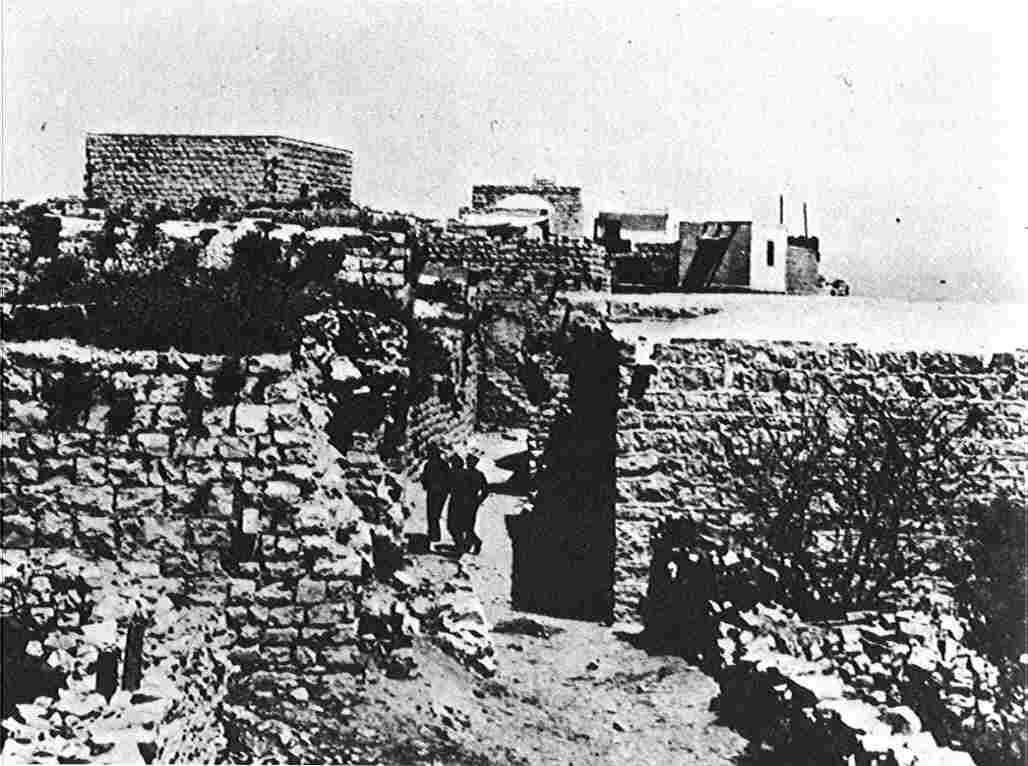
On Friday, April 9, 1948, Zionist paramilitary forces comprised of units from the Haganah, Irgun, and the Stern Gang initiated an ethnic cleansing operation targeting the Palestinian village of Deir Yassin. For those in the village, this very well may have come as a surprise, as the community had been known in part for its peaceful relations with nearby Jewish communities, and had even been said to have driven away Arab fighters who had attempted to take refuge within it amid the ongoing Zionist terror campaigns that had begun to escalate rapidly across historic Palestine.1 Unbeknownst to the villagers, these units had been tasked with the liquidation of the Palestinian population, numbering around 700 people in total. In the ensuing hours, a massacre would take place that would forever be etched into the memory of those across the region.
The village was helpless as Zionist footsoldiers went from house to house terrorizing all those they found. A UN report submitted in the following days detailed the events, noting that women and children were stripped, lined up, photographed, and then slaughtered by automatic gunfire. Testimony from the descendants of survivors indicates that as these events transpired, those same soldiers took to haphazardly firing automatic weapons into homes across the village, even going so far as to drop grenades in through windows as they went about their tasks. Some residences, even those containing families within, saw satchel charges of dynamite placed outside the home doors, slaughtering those inside with unimaginable brutality. At least one woman, who was nine months pregnant at the time, was taken by the militiamen who cut open her womb and left her to die.2 Testimony from survivors also recalled one father being forced at gunpoint to throw his son into the burning furnace of a bakery in the village. When he refused, he was beaten before being forced to watch his son being thrown into the furnace, burned alive by the invading settlers.
By the end of the massacre, an estimated 250-300 men, women, and children were killed. Those who survived the initial massacre either fled or were used as celebratory trophies, paraded in a triumphal procession around the Jewish communities of Jerusalem by Zionist settlers before being executed.
British investigator Richard Catling, who attempted to interview women and girls who had survived the massacre shortly after it occurred, noted a difficulty in persuading them to give any testimony at all regarding what had happened to them, stating:
I interviewed many of the womenfolk in order to glean some information on any attrocities committed in Deir Yasseen but the majority of those women are very shy and reluctant to relate their experiences especially in matters concerning sexual assault and they need great coaxing before they will divulge any information. The recording of statements is hampered also by the hysterical state of the women who often break down … whilst the statement is being recorded. There is, however, no doubt that many sexual atrocities were committed by the attacking Jews. Many young schoolgirls were raped and later slaughtered. Old women were also molested. One story is current concerning a case in which a young girl was literally torn in two. Many infants were also butchered and killed.3
The news of the massacre at Deir Yassin quickly spread through communities across Palestine, in no small part due to Zionist efforts to weaponize it as a means of coaxing Palestinians to leave their villages and towns under the threat of being caught in the next massacre. It was likely no difficult to imagine such a possibility, as Deir Yassin was far from an isolated incident. Haganah units carried out other massacres in Nasr al-Din, ‘Ain al-Zeitouneh, al-Bi’na, al-Bassa, Safsaf, and even Hula in neighboring Lebanon, to name just a few examples.4 Unsurprisingly, many would choose to flee rather than risk experiencing such horrors.
For Zionists, this history is celebrated as their Independence Day.
Deir Yassin was one notable event in a larger multi-year series of Zionist paramilitary operations, which would later be called the Nakba by Palestinians, or “the catastrophe”. A catastrophe it was, as 750,000-800,000 Palestinians would be ethnically cleansed from over 530 cities, towns, and villages across historic Palestine, with another 10,000-15,000 estimated murdered by Zionist forces. Around 75% of the Palestinian population was thus made landless in the span of just a couple of years, expelled and made to live in refugee camps within and outside of Palestine. They and their descendants have since that point been barred from returning by Zionists in the name of maintaining more favorable demographic outlays that ensured settler majorities in occupied land.
For Zionists, this history is celebrated as their Independence Day.
This week, Israelis across the colony came together to celebrate the founding of their colony. For these settlers and their Zionist supporters around the world, it marks the culmination of decades of preparations and struggle in Palestine that had been undergone by early settlers to establish a new homeland for the Jewish people. As they would tell it, their settler movement reclaimed the land of their ancestors, and in 1948 staved off annihilation in a victory against Arab militants from Palestine and across the region before declaring independence from British colonial rule. The narrative, comprised of the David and Goliath storytelling that the colony has regularly deployed to describe its actions in the years since, is one of liberation, joy, and triumph.
David and Goliath: Theological History Turned Settler Colonial Propaganda
·
June 17, 2025
Few underdog stories are better known around the world than that of David and Goliath. David, a shepherd and harpist who was the youngest son of Jesse (an Ephrathite from Bethlehem), found himself tasked with bringing food to his brothers and the commander of their unit on the frontlines of a standoff b…
For millions across the region, however, the founding of the colony is intrinsically tied to the decades of colonial violence that led up to its establishment and the constant violence that has existed since. Since its founding, Zionists settlers have fought tooth and nail to expand their territory and continue the attempted annihilation of all those living upon the land they seek to occupy.
Maximal control of land with minimal people upon it has been the cornerstone of Israeli doctrine, one that communities in Palestine, Egypt, Lebanon, and Syria know all too well as the colony has spent years attempting to extend its borders across the region at large. Whether it be the expansion of the Zionist project within historic Palestine in attempts to “finish the job” and occupy all land in the 1948 and 1967 territories, multiple invasions of Lebanon and attempted occupation of land in the south of the nation, the occupation of Syria’s Golan Heights and an ever increasing amount of territory within the so-called Syrian buffer zone, or the temporary occupation of Egypts Sanai Peninsula, the existence of the colony has meant the oppression of millions.
Beyond the occupation of land, the existence of the colony has also meant widespread devastation for the region as U.S. and Israeli forces advance their joint interests in an effort to maintain military, political, and economic hegemony across the Middle East. For these forces, ensuring that actors in the region are exhausted, destabilized, and weak has been a primary goal, with horrific results for those millions caught in the crossfire. It is hard to find a nation anywhere in the region that does not know of someone whose life was altered by the occupation, sometimes permanently, even within the borders of U.S. client states like the UAE, Saudi Arabia, Qatar, and others.
All of this violence has enabled the project to survive and even, at points, thrive. Over the years, it has become a vital part of the larger imperial arms industry, a tech hub, a tourist destination, and, for many, a nation like any other, albeit one that has made its fair share of mistakes along the way. This view has been the result of a decades-long public relations campaign seeking to normalize the colony’s existence and garner sympathy for it among those around the world, particularly within the imperial core.
These efforts and celebrations, however, do not change the reality of the colony, nor do they make the reality of those living under its boot any less violent. From its very foundation, the colony has been sustained by the mass suffering of millions. It is an entity that is sustained through suffering and colonial violence that intrudes into every element of the lives it seeks to conquer. This naked violence is far from the liberatory fantasy of the Zionist narrative.
Why then, do so many celebrate? The answer lies in who is truly included in celebrations of “independence”. No doubt, the removal of British colonial oversight made the efforts of Zionists easier, even if the British government had for years worked to facilitate their interests and foster the development of their colonial project. They rid themselves of a sometimes mildly inconvenient manager, one that still stood by them for years to come, alongside new imperial benefactors who would bolster their project and safeguard it when needed.
For Palestinians and those countless others across the region, however, this independence was never meant for them. The violence they continue to face in their daily lives is done in pursuit of the liberation of the settlers from opposition to their colonial goals, and nothing more. For Zionists, the liberation of the colony can only be truly safeguarded through the annihilation of the land’s original inhabitants. Anything approaching liberation and independence for Palestinians and others is seen as a threat for this very reason.
Israelis will tell you every year that what they celebrate is the liberation of their people from foreign colonial rule, an independence that has allowed them to chart their own futures. What they truly celebrate, however, is death. True celebration can only be held upon their colony’s last day, as it is only then that millions across the region will truly begin to be free.
Sayigh, Rosemary. “The Uprooting.” The Palestinians: From Peasants to Revolutionaries, Zed Books, New York, NY, 2017, pp. 76
Sayigh, Rosemary. “The Uprooting.” The Palestinians: From Peasants to Revolutionaries, Zed Books, New York, NY, 2017, pp. 77
Assistant Inspector Richard Catling, cited in Collins and Lapierre, O Jerusalem! (Simon and Schuster, New York, 1972), p. 276.
Sayigh, Rosemary. “The Uprooting.” The Palestinians: From Peasants to Revolutionaries, Zed Books, New York, NY, 2017, pp. 76
Comments
Nothing yet. Say the first thing.
Sign in to join the conversation.