
Cyber espionage across the Association of Southeast Asian Nations (ASEAN) has shifted from opportunistic, high-volume phishing toward targeted, highly covert Advanced Persistent Threat (APT) campaigns. Driven by regional geopolitical competition over South China Sea sovereignty, infrastructure development contracts, and military modernization initiatives, state-aligned threat actors maintain persistent access within ASEAN diplomatic channels, defense ministries, telecom backbones, and critical energy infrastructure.
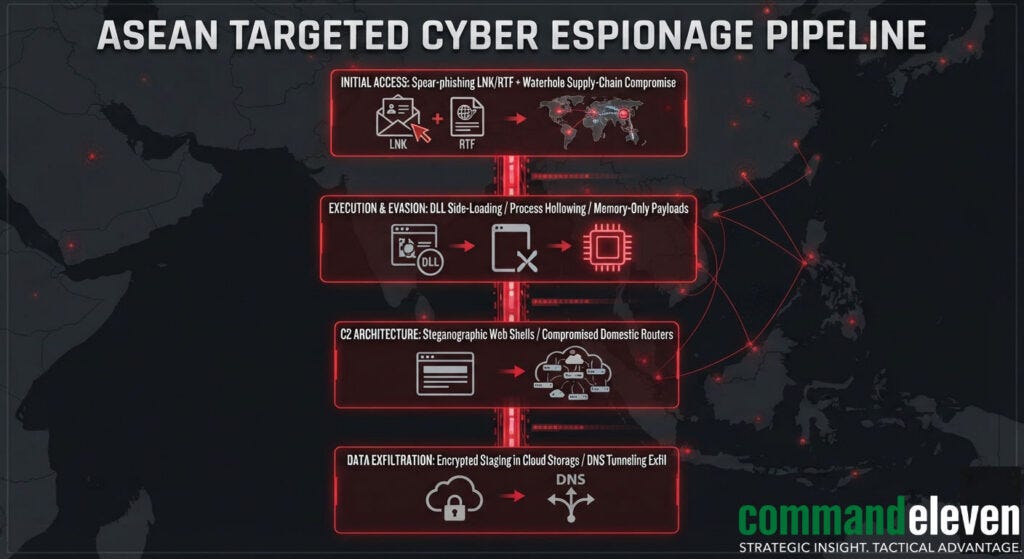
This technical paper audits the tactics, techniques, and procedures (TTPs) deployed by major regional APT clusters,primarily PRC-linked threat groups (e.g., Mustang Panda/TA416, Naikon, UNC4191) and Vietnamese-aligned entities (e.g., OceanLotus/APT32),targeting state networks across the Philippines, Vietnam, Indonesia, Malaysia, and the ASEAN Secretariat.
State-aligned cyber operators maintain specialized intelligence collection mandates aligned with their sponsor states’ strategic objectives.
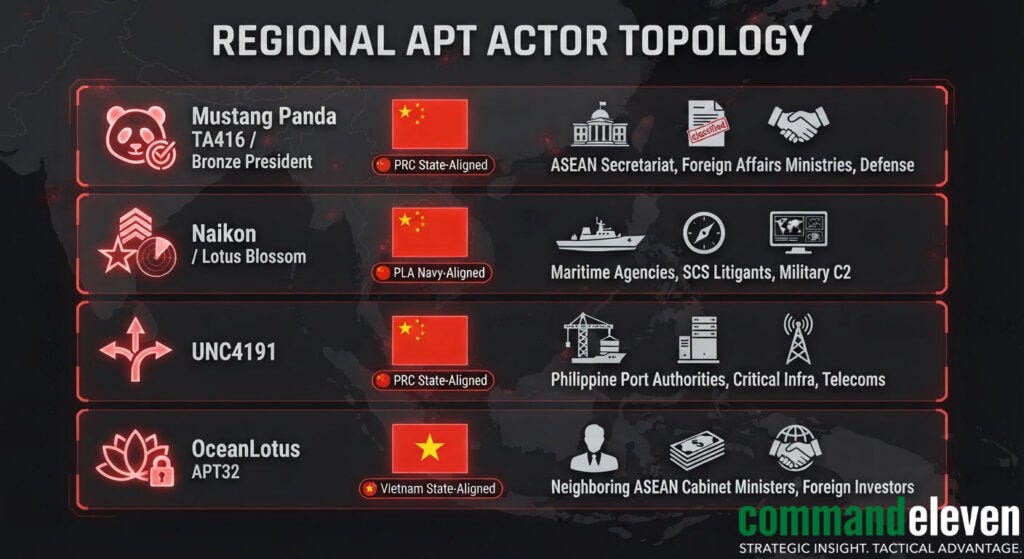
Mustang Panda specializes in long-term intelligence gathering against government entities, foreign ministry networks, and diplomatic missions across Southeast Asia:
Primary Objective: Infiltrating diplomatic communications regarding SCS policy coordination, ASEAN summit agendas, and bilateral infrastructure loans under the Belt and Road Initiative (BRI).
Signature Infrastructure: Utilizes compromised domestic small-office/home-office (SOHO) routers across the region as proxy nodes to mask C2 traffic origin points.
Naikon focuses on maritime intelligence collection, targeting military forces, coast guards, and maritime law enforcement agencies in nations bordering the South China Sea (Philippines, Vietnam, Malaysia, Indonesia):
Primary Objective: Theft of naval vessel positioning logs, maritime radar procurement specifications, joint military exercise plans (e.g., Balikatan), and EEZ oil exploration survey data.
Threat actors target ASEAN state infrastructure using a dual-track entry approach: direct spear-phishing tailored with political lures, and supply-chain compromises leveraging trusted third-party software vendors.
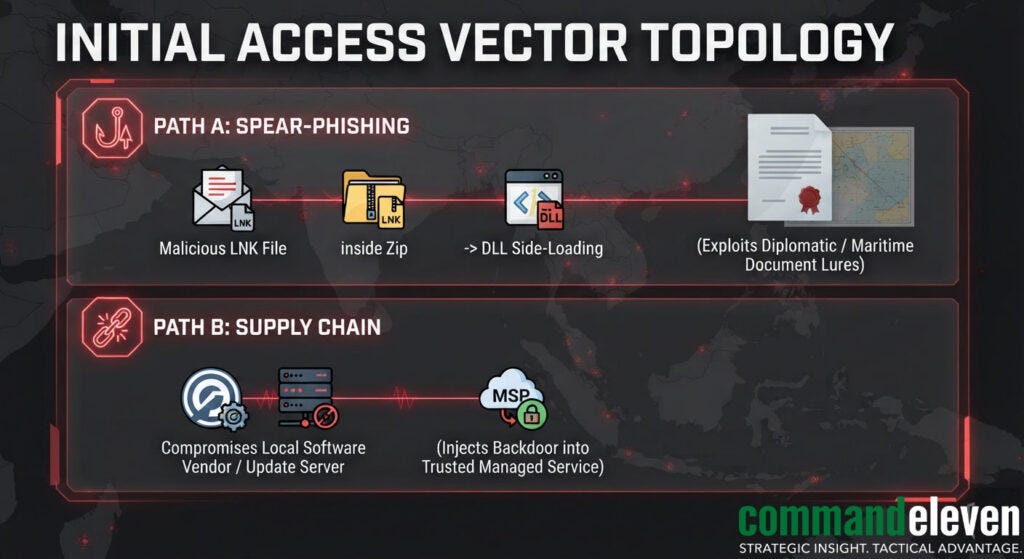
APT groups execute spear-phishing campaigns delivering malicious archive files (.zip, .rar, .iso) containing shortcut files (.LNK) disguised as official government PDFs or policy briefs:
LNK Execution Chain: The user opens a lure document named ASEAN_Maritime_Security_Draft.pdf.lnk.
PowerShell Invocation: The .LNK file executes an embedded, obfuscated PowerShell script targeting the Windows Command Processor
Decoy Dropper: The script drops a legitimate decoy document to the %TEMP% directory while silently writing a malicious payload and a legitimate signed binary to a hidden system path (e.g., C:UsersPublicLibraries).
To bypass hardened boundary defenses at major foreign ministries, threat actors compromise the software update servers of local IT contractors providing managed services to government agencies:
Trojanized Update Packages: Attackers inject backdoor DLLs into legitimate software updates (e.g., tax filing software, digital certificate management tools used by local civil service departments). When municipal or federal nodes download signed update binaries, the backdoor executes with elevated system privileges (NT AUTHORITYSYSTEM).
Once inside a target node, regional APTs deploy living-off-the-land (LotL) techniques and execution chains designed to evade Endpoint Detection and Response (EDR) software.
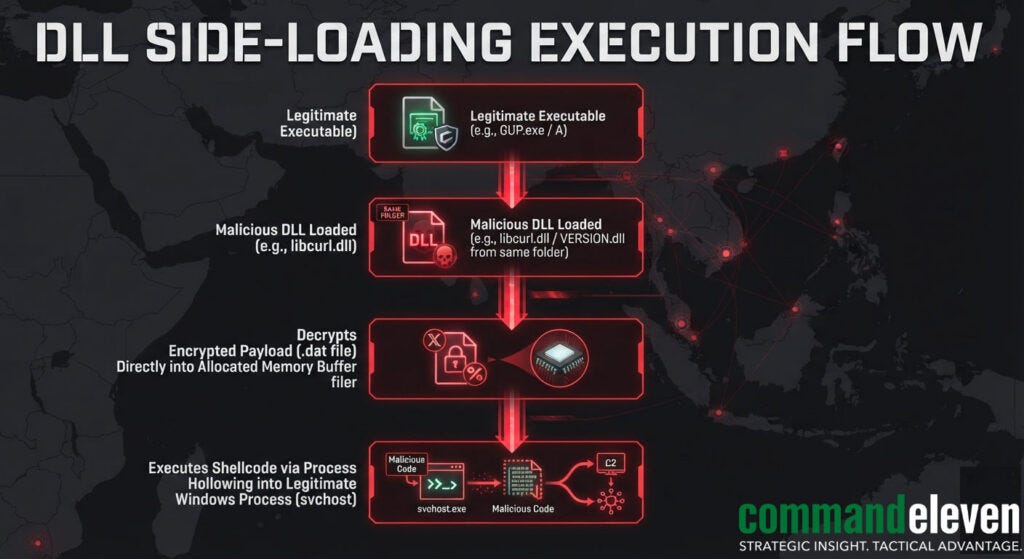
Threat actors utilize DLL side-loading to execute unsigned malicious shellcode through trusted, digitally signed applications (e.g., Notepad++, Google Update, or anti-virus utilities):
Exploitation Process: The attacker drops three files into the same directory:
A signed, legitimate executable (signed_app.exe).
A malicious DLL (target_dependency.dll) carrying the exact export function names expected by signed_app.exe.
An encrypted payload file (data.dat).
Execution Trigger: When signed_app.exe launches, the Windows loader prioritizes loading target_dependency.dll from the application’s current working directory over system directories. The DLL’s DllMain entry point reads, decrypts, and executes the shellcode stored inside data.dat directly in memory without writing an unencrypted binary to disk.
To prevent detection by behavioral EDR agents, the loaded shellcode executes process hollowing:
Process Creation: Spawns a suspended instance of a native Windows process (e.g., C:WindowsSystem32svchost.exe).
Memory Unmapping: Unmaps (NtUnmapViewOfSection) the legitimate code section from the target process’s virtual address space.
Shellcode Allocation: Allocates new execute-read-write (PAGE_EXECUTE_READWRITE) memory pages inside the target process space using VirtualAllocEx.
Context Thread Resume: Rewrites the process entry point to point to the injected shellcode payload and resumes execution using SetThreadContext and ResumeThread.
C2 networks supporting ASEAN espionage campaigns utilize multi-tier proxy architectures and covert exfiltration channels designed to blend seamlessly with normal enterprise web traffic.
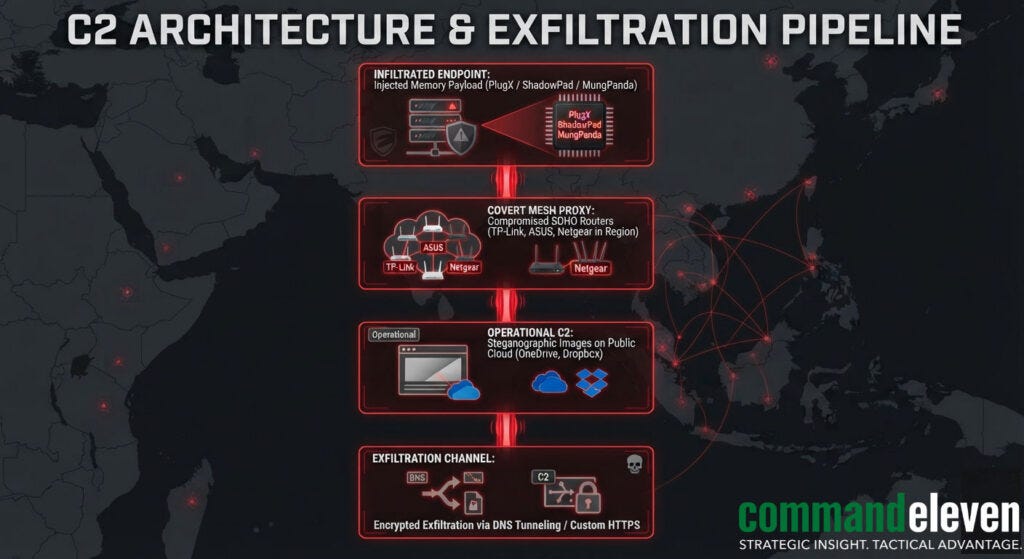
Steganographic Payloads: Advanced malware strains (such as customized variants of PlugX or ShadowPad) pull C2 instructions embedded within innocent-looking image files (.png, .jpg) hosted on legitimate public platforms (e.g., GitHub, Imgur, or cloud storage APIs).
Decoding Logic: The malware reads the pixel data array, extracting command strings hidden in the Least Significant Bits (LSB) of the image’s RGBA color channels
This ensures that network perimeter security devices record traffic as standard outbound HTTPS requests to trusted web services, bypassing domain reputation blocking.
When outbound web traffic is restricted by strict air-gapped or proxy-controlled defense networks, APT malware falls back to covert DNS tunneling to exfiltrate staged data:
Data Encapsulation: Sensitive files are compressed, encrypted using AES-256, and encoded into Base64 or Hexadecimal strings.
Query Construction: The payload splits the encoded data string into sub-63-character chunks, appending them as subdomains to an attacker-controlled authoritative DNS domain
Exfiltration Loop: The infected node sends a recursive A or TXT record lookup query to the internal enterprise DNS resolver. The internal resolver forwards the request across the internet to the attacker’s authoritative name server, which logs the sub-domain string, reassembling the exfiltrated data file on the receiving C2 server.
Cyber operations across ASEAN have expanded beyond diplomatic intelligence gathering to include operational technology (OT) and Industrial Control Systems (ICS) reconnaissance inside power grids, telecom networks, and commercial port authorities.
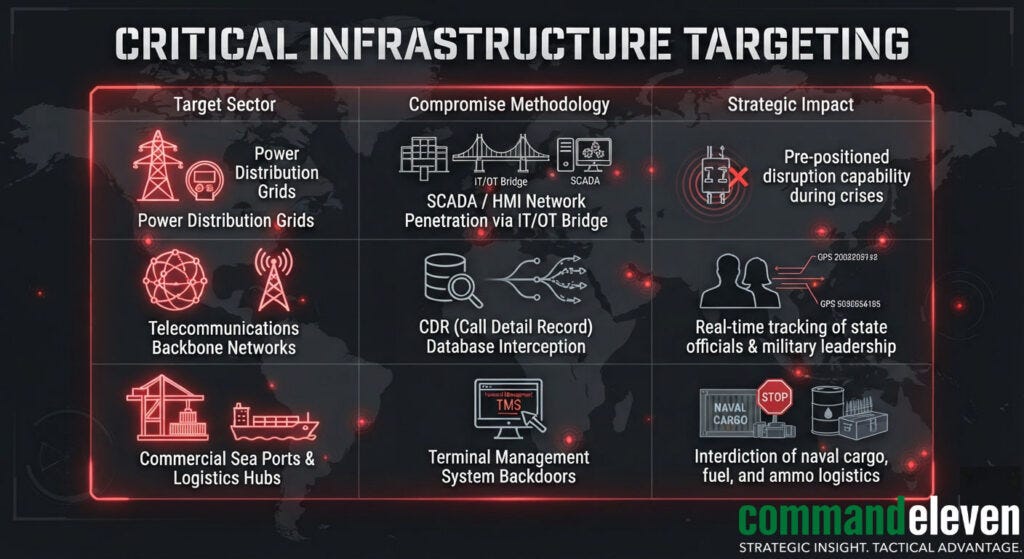
IT/OT Network Traversal: Threat actors breach IT corporate networks of state power generation monopolies in the Philippines and Vietnam, using credential harvesting utilities (e.g., Mimikatz) to pivot across dual-homed jump hosts into operational technology (OT) zones.
ICS Reconnaissance: Attackers map Human-Machine Interfaces (HMIs) and Programmable Logic Controllers (PLCs) controlling substation circuit breakers. This pre-positioning allows state sponsors to execute coordinated localized blackouts during political or military crises.
Call Detail Record (CDR) Theft: APT groups maintain long-term backdoors inside regional telecommunication providers. By querying internal CDR databases, actors extract real-time metadata,including cell tower geolocation logs, IMEI numbers, and SMS message metadata,targeting defense ministers, military commanders, and foreign diplomats.
The post ASEAN Cyber Espionage Topologies & APT TTPs Analysis appeared first on CommandEleven Intelligence.
No posts
Comments
Nothing yet. Say the first thing.
Sign in to join the conversation.