
As a sex and relationship therapist, I have studied, philosophised and agonised over the inner workings of sexual desire for years. I’ve racked up over a thousand hours listening to clients ask all variations of “why don’t I want sex anymore?” and “is there something wrong with me?”.
Throughout sessions, we start to turn over stones to see what’s been hiding underneath. Along the way, we find many detours like the accumulation of disconnects that happened with partners over intimacy, a lifelong struggle with performing or being perceived, and internalised messages about what it means to be a good partner or to be ‘good at sex’. Sometimes we find plain old boring sex, but many times we tend to find an overall disconnect to aliveness, creativity and play.
This comes with a thousand disclaimers that sexual desire is a multi-layered system. Sexual desire can and will change throughout your life, and it is subject to a world of different factors including hormonal changes, sexual pain, relationship conflict, trauma, stress and grief.
While these aren’t to be ignored, I am honing in on the specific two-way relationship and feedback loop that exists between creativity and sexual desire so that before you self-diagnose yourself with low sexual desire and try a whole bunch of supplements for a quick fix, ask yourself: where is creativity and play in your life?
My partner who happens to be an artist sent me this text the other week that inspired this post as it clicked something into place for me that I’d been unknowingly grappling with for years in my work as a sex therapist. It is yet another thing that I cognitively knew and understood long before I felt it.
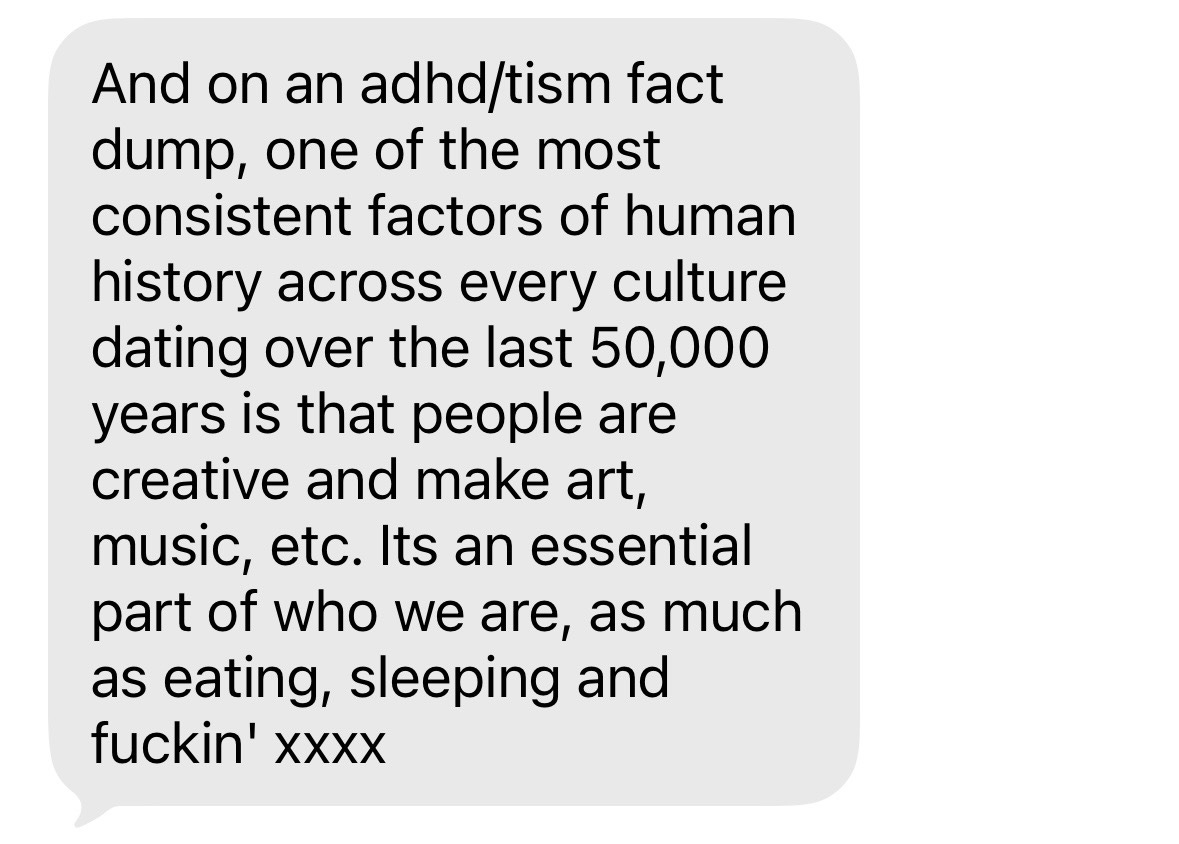
As someone who has historically lived in the world of evidence-based research and hates trying something new unless I’m immediately good at it, watching my partner’s relationship with his creative practice has taught me much more about eroticism than any self-help book.
What is sexuality and eroticism if not self-expression and letting yourself be witnessed? What is creativity if not one and the same?
Creativity in this context isn’t about being artistic and ‘good at art’. It’s in trying a new recipe, wearing something that feels like you, taking the scenic route, writing terrible poetry or flirting for no reason.
Creativity is the willingness to make something that didn’t exist before. In this way, sex and sexual desire is also exactly that. It asks “what could we create together in this moment?”.
Both sex and sexual desire demand an imagination and curiosity that we tend to lose touch with in long-term relationships as the honeymoon period ends, routines start to kick in and things start to get more comfortable. Yes, sex starts to get more repetitive but that’s also only the tip of the iceberg.
I could throw worksheets and resources at my sex therapy clients, and I could draft up step-by-step plans to rebuild intimacy and connection for them but to do so, would be another quick fix if it didn’t address what was going on below the surface. It would become another performative task on our already never-ending to-do list.
Emily Nagoski popularised the concept of the emotional floor plan in her latest book, Come Together. This concept uses the analogy of a house floor plan to explain how our various different emotional states (like care and play) can be connected and can be used as doorways or hallways into other emotional states (like lust and seeking). Erika Moen does a wonderful job of explaining and illustrating the emotional floor plan concept further here if you’re interested.
This concept is incredibly helpful because it acknowledges that sexual desire doesn’t exist in a silo or exist solely within the realm of the bedroom. It would take us much further if we stopped asking “how can I make myself want sex more?” as if asking “how do I get from Point A to Point B?”, and instead we asked “when was the last time I was whimsical and playful?” and “when was the last time that I felt anything other than numb?”.
We can turn to children to remind us of what creativity and play look like. Children naturally play, invent, pretend and explore and by no means are they ‘good at it’. They want everything and apologise for nothing.
This is part of what makes the early stages of dating so intense for many of us as we invent new traditions, we imagine what could be and we explore new parts of ourselves together. With time and with age, we tend to lose touch with these instincts as we shift gears to prioritise efficiency, performance and certainty over much else.
It’s no surprise that there is no desire to be found here as I often say that “there’s nothing sexy about rushing”.
Instead we do our jobs, we tip tap away on our keyboards and phones, we scrape through the day and we collapse in front of the big screen with our little screen in hand. When we fall into these traps, our worlds start to feel much smaller, restricted and colourless. Then we blame and shame ourselves for not experiencing sexual desire as if it appears on command.
As years go by and many arguments later, what also starts to happen in the realm of intimacy is that couples start to become afraid of trying. It comes out as “it feels too awkward”, “it’s just been too long”, and “it’s supposed to feel natural”. To which I say, “your bodies know what to do”.
Of course, I totally validate the very real sexual impacts of sensory issues, sexual pain, chronic health issues, postpartum, gender dysphoria, hormonal changes, and the like. However, when we’re talking about a return to creativity, play and touch, your bodies know what to do. It’s typically all the other brain noise and expectations about how we ‘should’ look or what we ‘should’ be doing that get in the way.
I’ve written many a Substack about desire acting as a moving mirror and a compass for what we want. It points us somewhere and asks “what could happen here?”. Whether you’re planning a holiday, daydreaming about a kiss with your crush, planting a garden or decorating a room, it is this warm buzz and forward motion of desire that co-exists alongside imagination, anticipation and awe.
When we allow ourselves to take that leap, we learn that it is infinitely more important to try and try again than it is to do it perfectly. I think of this quote I heard from the podcast Boysober where the host Hope Woodard attends Clown School and shares her unexpected emotional journey of learning how to forgive herself through the art of clowning: “Be so stupid that it’s beautiful and be seen in it. The fool is inextricable to being human”.
To let ourselves want and imagine is inherently erotic and brave.
In a world of 5am ice baths, red light therapies and 20-step skincare routines, it is incredibly sexy of you to build a life that is creative, whimsical, curious and erotic.
Creativity makes us loosen our grip on the need for certainty. As any creative practice from watercolour painting to sex will show you, the joy is in not knowing exactly what will happen. It simply demands that we go slow enough to stay present with it, as opposed to rushing to control it. It is as much a practice of patience and self-compassion as it is of consistency and returning to what has always been here.
When we talk about mental health wellness, this is also reminding us that ‘healing’ isn’t following a rigid program to create a perfectly regulated nervous system and to remove any sort of friction in your life. It’s the long overdue return of belly laughs, play, daydreaming and wanting. These are the undervalued cues that your nervous system feels safe enough to expand and stretch, rather than simply survive and perform.
The creative life is an erotic life, and eroticism has always been bigger than sexuality and how you have sex. It’s feeling awe at the ocean, losing track of time while cooking, creating a ritual out of your Monday evenings, it’s adorning your body with as many colourful patterns and textures as you like.
It’s trusting that your body knows what to do.
Comments
Nothing yet. Say the first thing.
Sign in to join the conversation.