

This is a long newsletter due to 4 recipes, so it might be truncated in your email. You can click on "View entire message," to view the entire post.
💫💫💫💫 If you like this post, can you kindly hit the ❤️ at the bottom? It sure does help spread the word! 💫💫💫
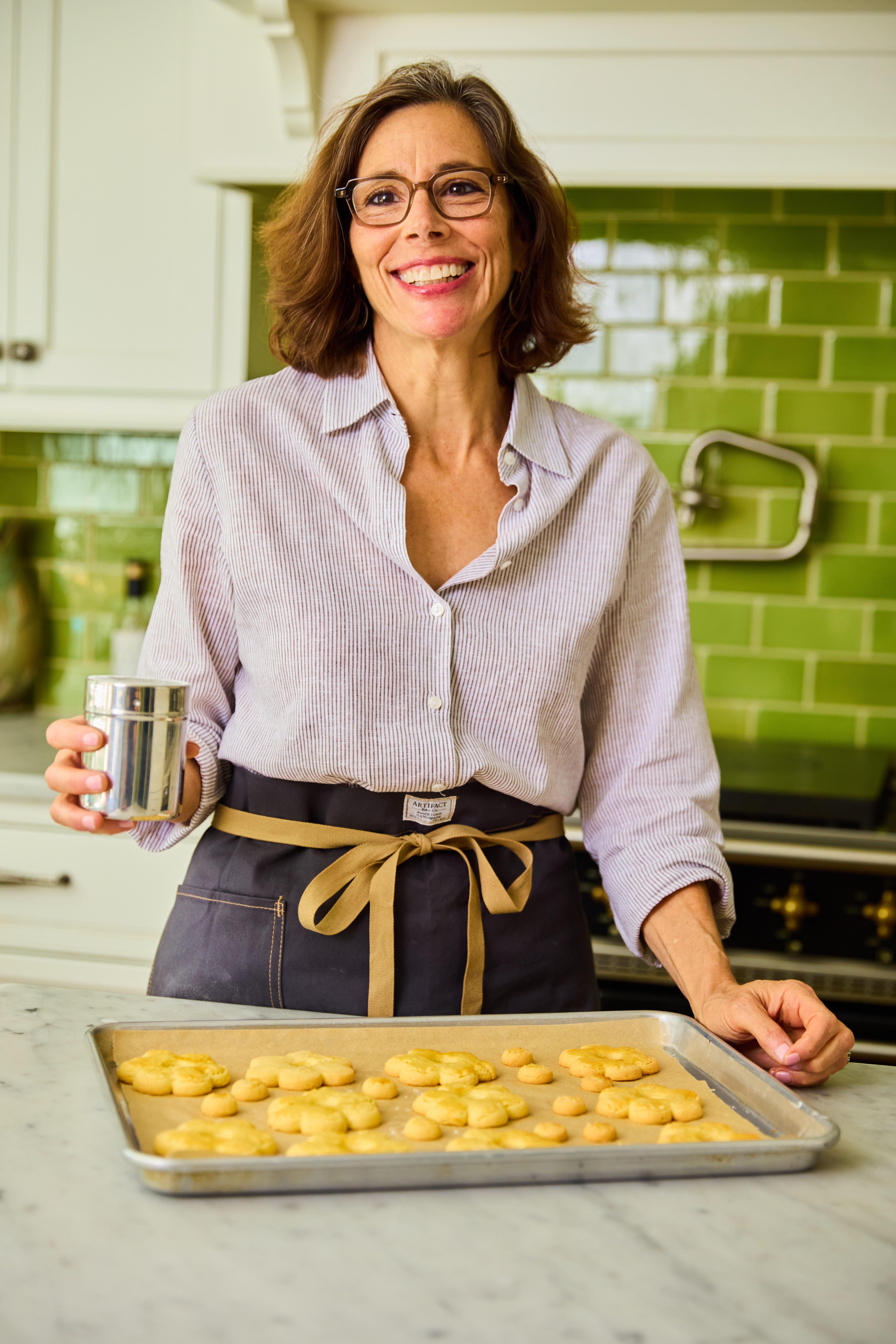
I first met Domenica Marchetti in 2017 when she was kind enough to do a Q&A with me in DC, when my first book Back Pocket Pasta came out. She is a true authority on Italian cuisine and I am constantly impressed by her knowledge and recipes. I was very honored that she took the time to interview me, the wet-behind-the-ears author I was at the time.
She is also the author of nine (!) cookbooks and writes one of my favorite newsletters called Buona Domenica, which she brilliantly posts on Sundays. The name translates to Good Sunday… hence today’s delivery.
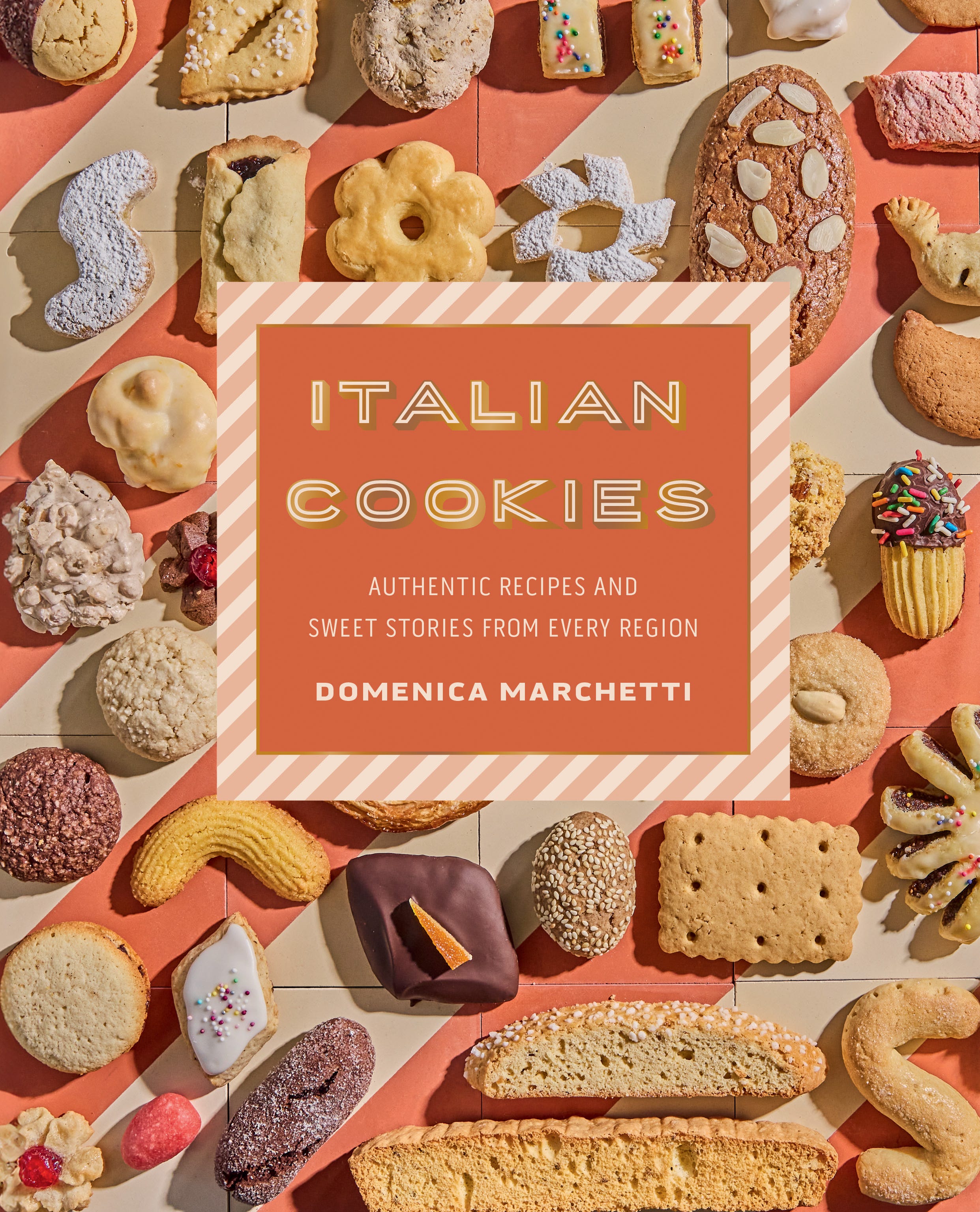
Domenica’s latest book Italian Cookies is a deep dive into all the cookies of Italy’s regions and it is, of course, incredible. Neither of us considers ourselves a “sweet-tooth,” however there are so many recipes in this book that are up my alley, starting with today’s dessert course Sbrisolona (Big Crumble Cookie) hailing from Lombardy and Emilia-Romagna.
We got to chatting a few weeks ago and thought it would be fun to do a collaborative Q&A post. My answers to her questions appear over on her newsletter and hers on mine. As we continued to talk we thought it would also be fun to create an Italian summer menu sharing recipes from both of our books. Her husband Scott was also kind enough to write up wine pairings to include. Can this newsletter get any better today?!
I am so pleased to share Domenica’s thoughtful and lovely answers below, as well as a perfect four-course summer menu that transports you to wherever you’d like to be in Italy.
Please read on for some joyful things. And, don’t forget to grab yourself a copy of Italian Cookies, the holidays are only four months away, and these are the kind of recipes you’ll want to make with or for your family and friends. I know I do.

💫💫💫💫 If you like this post, can you kindly hit the ❤️ at the bottom? It sure does help spread the word! 💫💫💫
What inspired you to write a book dedicated to Italian cookies? I know we both don’t identify as “sweets people,” and yet you managed to write a book that even I want to bake from! I And, do you have any family memories attached to the “culture of cookies”? For instance, lingering around a table after Sunday lunch or baking with your mother? I could be projecting here...
You are so right. I’ve always considered myself more of a savory tooth than a sweet tooth, although after working on this book I’m no longer sure that’s the case! I never expected to write an entire book devoted to Italian cookies. I had written a small book called Ciao Biscotti some years ago and that was enough for me, or so I thought. But speaking as a consumer, I have always loved cookies. I did grow up with the tradition of baking cookies during the Christmas holiday with my mom and my sister. This was in New Jersey, not Italy. But we didn’t make Italian-American style cookies because my mom, who was born in Italy, was not familiar with them. She made pizzelle and a fried cookie filled with chopped nuts and honey called calcionelli, and very buttery hazelnut crescents dipped in powdered sugar. When we were little my sister and I were tasked with shelling all the nuts for her Christmas baking, which sounds horrible but now I look back on it with nostalgia...I guess! As we grew older we started picking out recipes from Gourmet Magazine’s annual cookie issue and other magazines that we wanted to try out. These weren’t necessarily Italian. The mocha pecan balls from a 1990s issue of Gourmet were among my favorites.
It wasn’t until 2018 that I really started to pay attention to cookies in Italy. One day in Genoa, I bought a bag of flower-shaped butter cookies called canestrelletti— very plain looking, no frosting, no piping, no sprinkles. But when I took a bite I was sure it was best butter cookie I’d ever tasted. I don’t know why, but I decided on the spot that I needed to know more about it. So I looked on the back of the package for where the cookie was produced—a town called Torriglia in the hills outside of Genoa—and so I went there. And I found that this cookie, the canestrelletto, had a history dating to the 15th century and a whole incredible backstory. There are at least eight bakeries in this town of 2000 people that bake canestrelletti to very strict specifications and distribute them throughout the city of Genoa and the region of Liguria. In recent decades it’s been an economic boost for the town. From there, I started finding out about more Italian “cookie towns,” as I call them. And so I started traveling to these towns, visiting bakeries, talking to the bakers, and seeing the great history and diversity that exists in the world of Italian cookies. Each one seemed to have an incredible story. That’s when I knew I wanted to turn my research into a book.
I am always so impressed by your deep knowledge of Italy’s different regions. I know your family comes from Abruzzo. If you had to pick a few favorite ingredients from that region, what would they be? Most importantly, what is your favorite cookie from there?
I love this question! Abruzzo is a lesser-known region, but it has an incredibly varied and delicious cuisine, thanks to its location. It is situated mid-calf on the boot of Italy and stretches from the Apennine mountains out to the Adriatic coast. So you have hearty mountain—think grilled lamb, porchetta, and spaghetti alla chitarra with mixed meat ragù— to the rich selection of seafood from the Adriatic Sea. In between, there are olives, wine grapes, legumes, incredible sheep’s milk and cow’s milk cheeses, and vegetables that grown in the foothills and high plains. One favorite ingredient has to be the saffron that grows in the Navelli plain. It is known as “oro rosso,” or “red gold,” and it is deep and smoky and earthy. I put it in my pasta dough, in soups, in sauces. I especially love it in seafood stews. Lamb is another favorite food, along with mutton.
For centuries, Abruzzo survived on a pastoral economy and lamb, mutton, and castrato are staples, served skewered and grilled (arrosticini), in ragù, and also in really delicious savory stews. Finally, I have to mention two of my favorite cheeses: sheep’s milk ricotta, especially when it is just made and still warm and wobbly; and scamorza, which is slightly aged, sometimes smoked mozzarella. It’s often grilled and served blistered and gooey. It’s possibly my favorite thing in the world.
When developing the recipes for this book, was there a moment when you had to “translate” a recipe that only ever existed in someone’s hands and memory into something the rest of us could actually follow? And did anything get lost (or gained!) in that translation?
I can’t say I had exactly that experience, but I had a few that were similar. In the case of the aforementioned canestrelletti di Torriglia, I spent some time with a woman named Paola Rosazza Battore, who is the designated baker for her family’s grocery, which has been open since the late 1800s. She did not share her recipe with me (this was the case with several of the bakers, perfectly understandable, as we are talking about their livelihood). But she let me watch her make dough and stamp out cookies as we talked. I had already tried my hand several times at making canestrelletti but was always slightly disappointed in the texture—they were not as crumbly and buttery as the ones from Torriglia. The recipe only calls for four ingredients: flour, butter, sugar, and egg yolks, so what it came down to was quality of ingredients and technique. As I watched Paola, I saw the order in which she mixed the ingredients together and the way she mixed them, and I had an ‘aha’ moment. I went home and followed her technique, which, among other things, involved beating together the sugar and egg yolks at length. and then adding butter, rather than the other way around—sugar and butter then egg yolks—as we do in the U.S. This proved to be the key to unlocking that recipe.
What are your three desert island dishes/foods? And, which Italian island would you take them to?
Spaghetti alle vongole: the purest, most pared-down version: good pasta, fresh clams, garlic, olive oil, peperoncino and parsley. Parmigiana di melanzane (eggplant parm): this takes care of the main course and the contorno and also checks my comfort food box, which I will need if I am alone on a desert island! Key lime pie, deep dish, graham cracker and pecan crust, super tart filling, mounds of whipped cream piled on top. Plus coffee and wine, naturally.
As for the island: I would have to go with one of the Tremiti islands, off the Adriatic coast. They belong to Puglia but aren’t too far from Abruzzo. They are on the side of Italy to which I am sentimentally attached, and they still seem a bit under the radar, meaning Stanley Tucci hasn’t yet visited LOL. Second choice: Stromboli, a volcanic island and one of the Aeolian islands off the coast of Sicily.
THE MENU
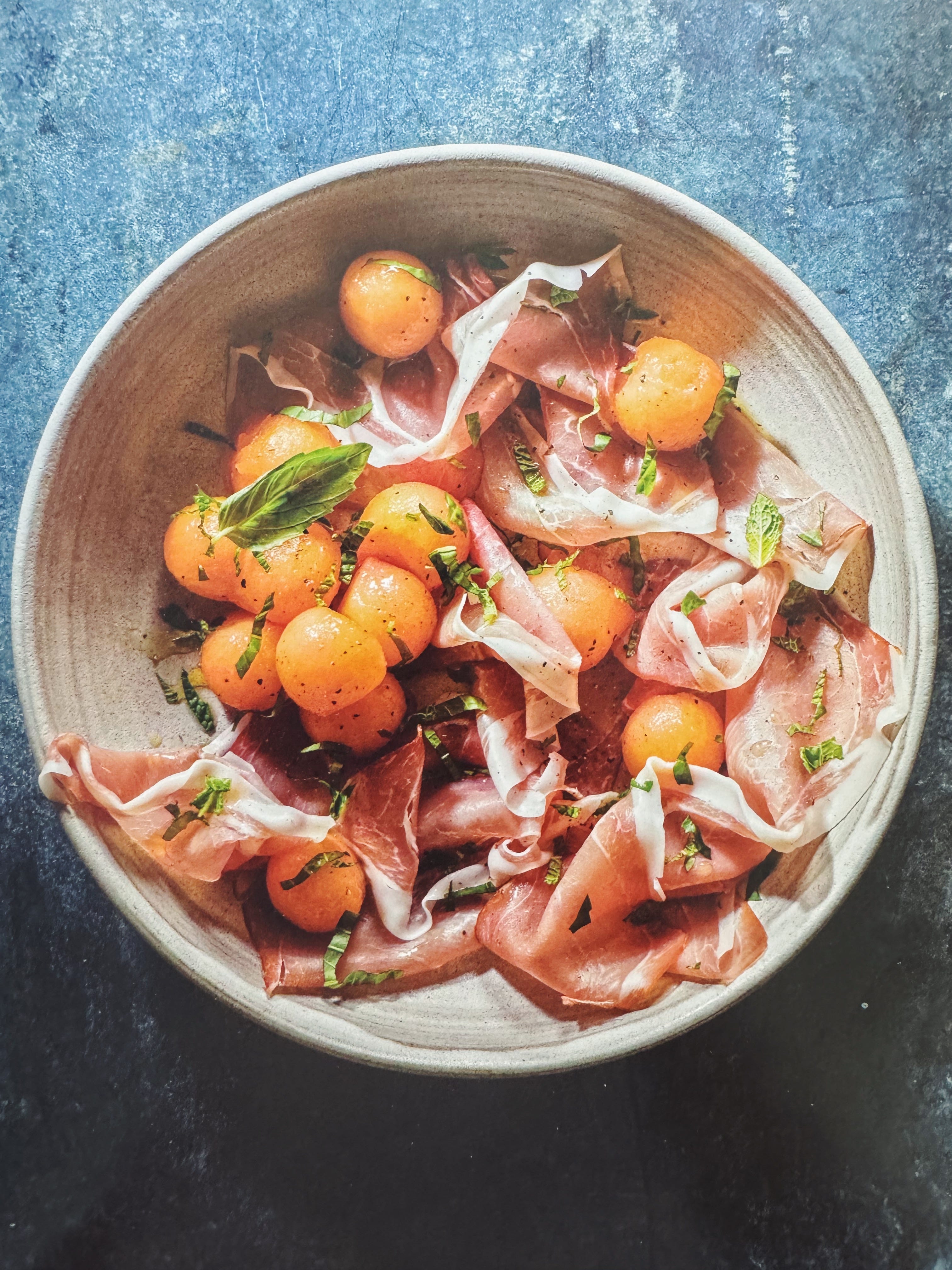
Prosciutto and Quick-Pickled Melon
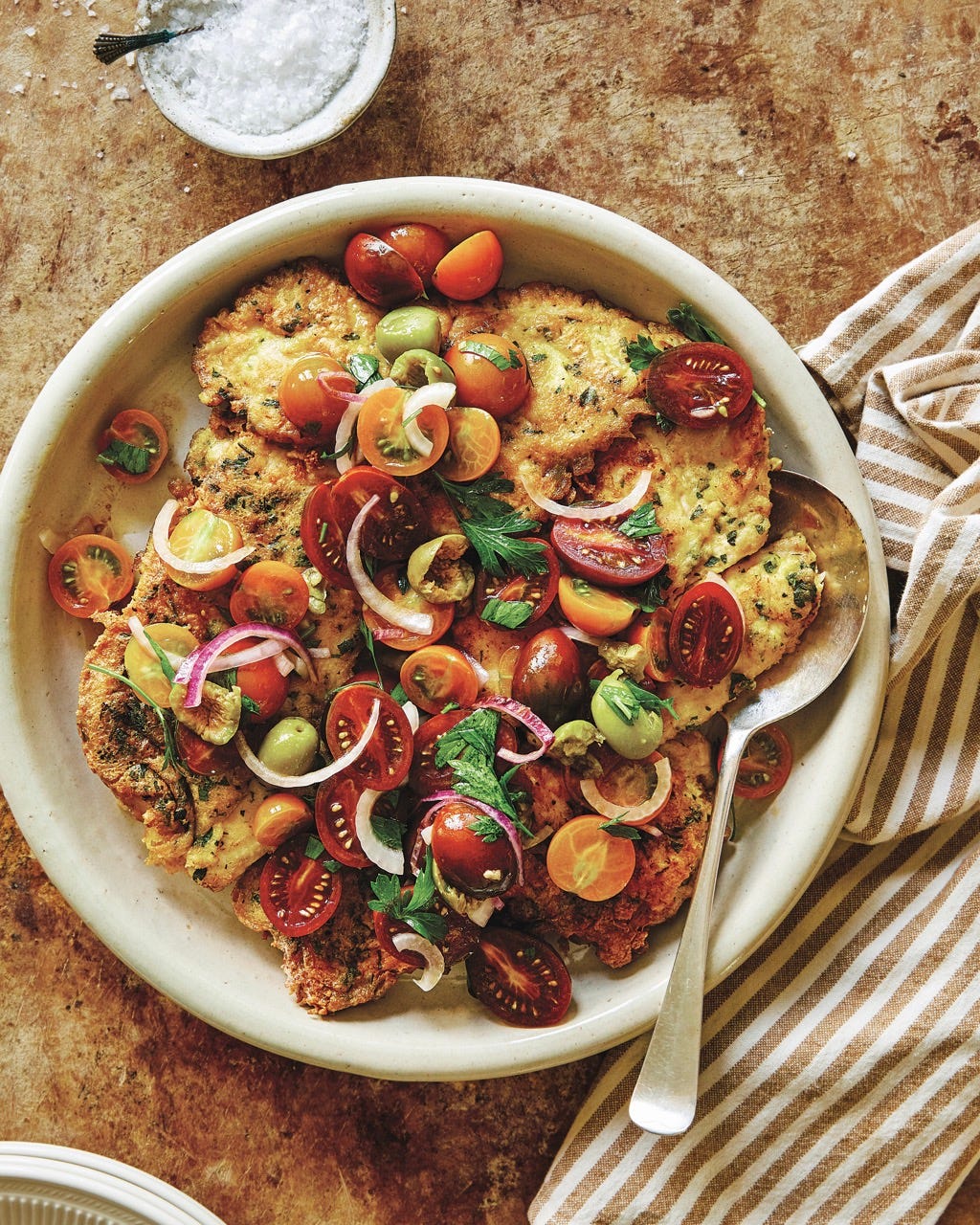
Battered Pecorino Cutlets with Sungolds and Crushed Olive Salsa
Summer Squash Salad with Toasted Pine Nuts and Blue Cheese
Sbrisolona
💫💫💫💫 If you like this post, can you kindly hit the ❤️ at the bottom? It sure does help spread the word! 💫💫💫
Prosciutto with Quick-Pickled Melon - Domenica
Battered Pecorino Cutlets with Sungolds and Crushed Olive Salsa - Colu
SERVES 4
TIME: 40 minutes
Chicken cutlets are upgraded and battered in an egg and cheese mixture that is almost Francese-like and deeply savory. The cutlets shallow-fry until they are golden, and the bright tomatoes and olive salsa that they’re topped with gives them a nice jolt of acidity. I call for Sungolds here, which are readily available in the summertime. If you find yourself in another season, grape or cherry tomatoes will
also work well.
INGREDIENTS
For the chicken:
2 boneless, skinless chicken breasts (about 12 ounces/340 g each)
Kosher salt
3 large eggs
⅓ cup (30 g) grated pecorino cheese (I like Locatelli)
¼ cup (10 g) finely chopped fresh parsley
Freshly ground black pepper
1 cup (125 g) all-purpose flour for dredging
⅔ cup (160 ml) extra-virgin olive oil, for shallow-frying
Flaky salt
For the salsa:
2 pints (600 g) Sungold or other small, pretty tomato varieties, halved
1 cup (155 g) Castelvetrano olives, crushed with the side of a knife and pitted
1 small red onion, thinly sliced
¼ cup (13 g) parsley leaves
¼ cup (60 ml) olive oil
2 teaspoons sherry vinegar, plus more to taste
Kosher salt and freshly ground black pepper
Flaky salt, for serving
METHOD
With a sharp knife, starting on a fat side of the breast, slice each chicken breast horizontally in half to get 2 cutlets each, or a total of 4. Place a piece of parchment or plastic over top of the chicken and pound with a mallet or a rolling pin until they are about ¼ inch (6 mm) thick. Season with salt.
In a wide shallow bowl, whisk together the egg, pecorino, and parsley and season lightly with salt (the pecorino is salty already) and black pepper. Add the flour to another wide shallow bowl.
Line a plate with paper towels and have near the stove. In a 12-inch (30 cm) skillet, heat the oil over medium heat until it shimmers. Test to make sure the olive oil is hot enough by adding a few pinches of flour—when they sizzle, you’re ready.
Working one at a time, dredge a cutlet in the flour, shaking any excess off, and then dip into the egg and cheese mixture and add to the pan away from you. You should be able to get 2 in the pan at once. Cook until the outside is golden and the chicken is cooked through, 3 to 4 minutes per side. Transfer the chicken to the paper towels and sprinkle with flaky salt. Repeat with the remaining 2 cutlets, adding a bit more oil if the pan is looking dry.
Make the salsa: In a large bowl, combine the tomatoes, olives, onion, and parsley leaves. Stir in the olive oil and vinegar and season with salt and pepper. Taste and adjust with more vinegar and salt as needed.
Transfer the cutlets to a large platter and spoon the salsa over top and finish with a few pinches of flaky salt.

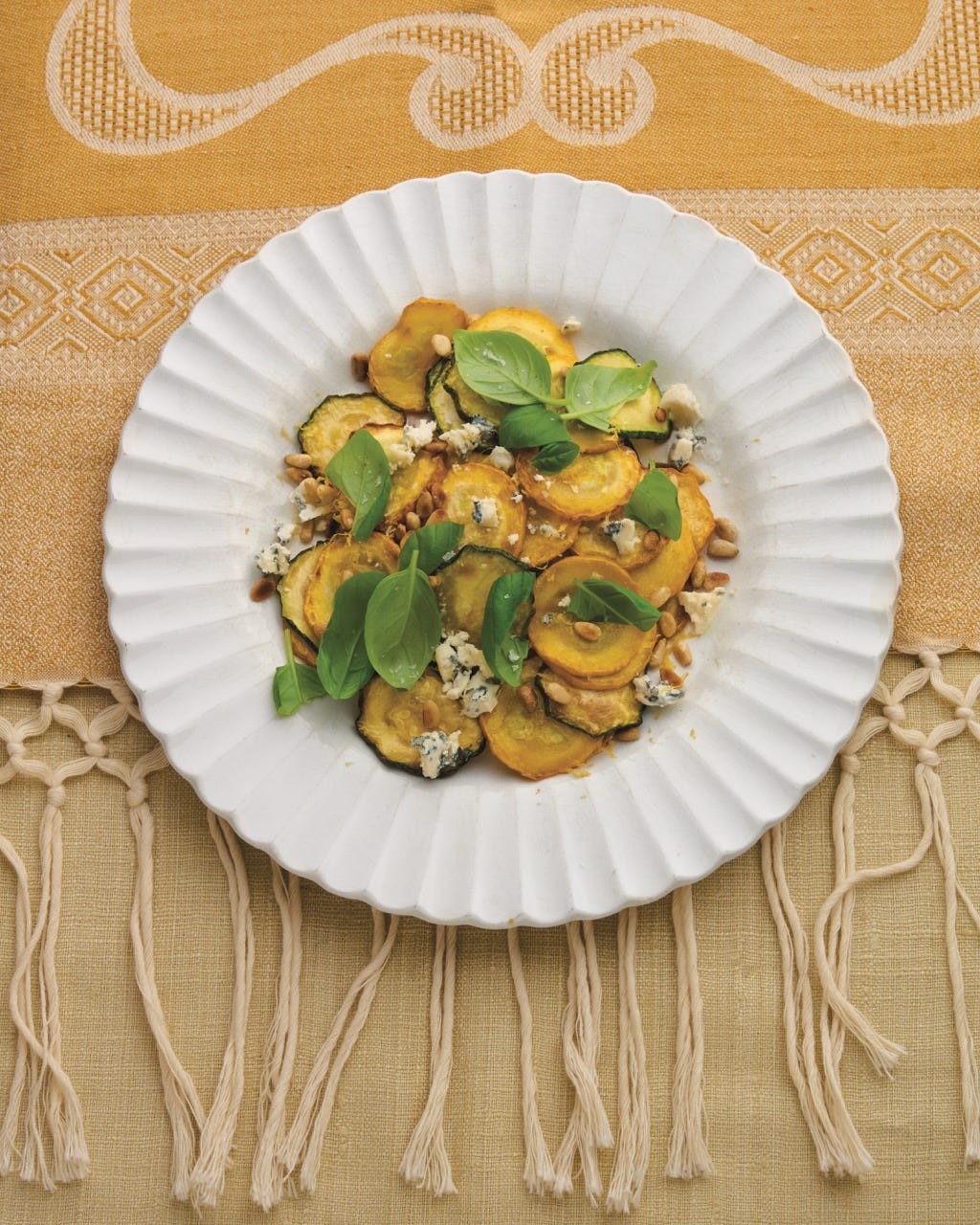
Summer Squash Salad with Toasted Pine Nuts and Blue Cheese - Colu
SERVES 4
TIME: 40 minutes
On a late-August afternoon, our friends Scott, Alice, and their daughter Vera came by for a visit and a swim, and of course I felt the need to put out snacks. As one is usually overwhelmed by the amount of zucchini piling up (myself included), I wanted to utilize it, but also make it feel special. I did so by sautéing it until golden and topping the zucchini with toasted nuts and crumbly cheese, and as it was summer, clearly a showering of basil was necessary. The squash can be fried and left at room temperature earlier in the day, but I would wait to garnish it until just before serving. One of my favorite ways to entertain this time of year is to make a number of vegetable salads such as this that can be served at room temperature. When guests arrive, all you need to do is fire up the grill and cook one thing, be it fish, steak, or otherwise and let the sides steal the show. They’ve waited all year to do so, so let them enjoy their time.
INGREDIENTS
4 tablespoons (60 ml) extra-virgin olive oil
2 pounds (910 g) assorted zucchini and summer squash, cut into rounds
¼ inch (6 mm) thick
Kosher salt and freshly ground black pepper
1½ tablespoons pine nuts
Grated zest of 1 lemon
2 ounces (55 g) good-quality blue cheese
Small fistful of basil, torn
METHOD
Line a plate with paper towels and have near the stove. In a 12-inch (30 cm) skillet, heat 2 tablespoons of the oil over medium heat until it shimmers. Working in batches so as to not crowd the pan, add about half of the squash and cook, flipping frequently, until it begins to soften and turn golden in spots, 5 to 8 minutes. Season with salt and pepper. Transfer the squash to the paper towels to drain. Repeat with the remaining 2 tablespoons oil and remaining squash.
While the squash cooks, heat a small skillet over medium heat. Add the pine nuts and toast, stirring often, until they are aromatic and golden in spots,3 to 4 minutes. Transfer to a small bowl.
Transfer the squash to a platter and top with the lemon zest and pine nuts, and scatter with the blue cheese and the basil. Taste and adjust seasonings with more salt if needed.
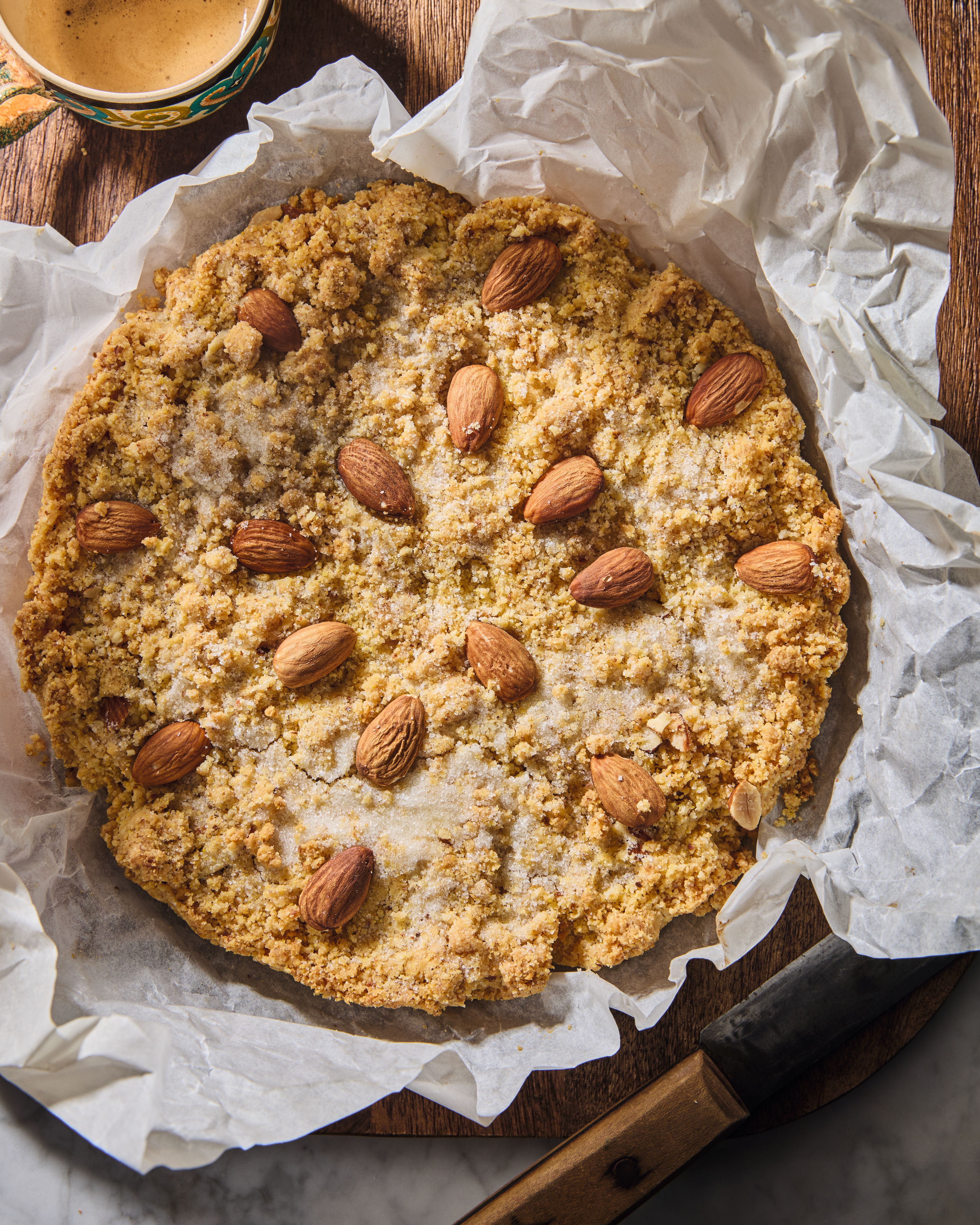
Sbrisolona - Domenica
Big Crumbly Cookie
This giant crumbly cookie is a specialty of Mantua, in Lombardy. But I first tasted it at a cooking class at the home of a chef from Parma, in Emilia-Romagna, where it is also popular. This makes sense, as Parma is just about an hour south of Mantua, and popular cookies tend to travel beyond their place of origin.
Also known as torta sbrisolona, the name of this cookie roughly translates to “crumbly cake.” It comes from the verb sbricolare, which means “to crumble.” The cookie was once upon a time prepared by farmers using simple ingredients that they were likely to have on hand—flour, cornmeal, sugar, a little lard or butter, and almonds. It was eaten as a snack to revive them after a long morning of work.
When assembling your sbrisolona, resist patting the sandy dough into the pan too firmly. It needs to be loosely packed in order to yield that fall-apart texture that makes it so irresistible. Once baked, is customary to break this cookie into irregular pieces for serving, though you can cut it with a knife for a neater presentation.
MAKES 1 LARGE COOKIE, TO SERVE 8 TO 10
3/4 cup (105 g) whole raw almonds, plus a handful more for decorating
1/2 cup (100 g) sugar, plus 1 tablespoon for sprinkling
3/4 cup (100 g) unbleached all-purpose flour
2/3 cup (100 g) fine cornmeal (do not use coarse cornmeal or polenta or your cookie will be grainy and tough)
Finely grated zest of 1 lemon
3 1/2 ounces (7 tablespoons; 100 g) cold unsalted butter, cut into 1/2-inch (12-mm) cubes
1 large egg yolk
1 teaspoon pure vanilla extract
1/4 teaspoon fine salt
METHOD
Preheat the oven to 350° F (180° C). Line an 8-inch (20-cm) springform pan or cake pan with parchment. The easiest way to do this is to crumple up the parchment with your hands and then insert it into the pan; once crumpled, it’s easy to make the parchment fit.
Reserve 10 of the 3/4 cup (105 g) almonds and put the rest into the work bowl of a food processor fitted with the metal blade. Add the 1/2 cup (100 g) sugar and process until the nuts are very finely ground, almost like almond flour. Take care not to overprocess or you will release the oils from the almonds. Pulse in the flour, cornmeal, and lemon zest.
Distribute the butter around the inside of the work bowl and pulse briefly to break it up into small pieces. In a small bowl, whisk the egg yolk with the vanilla and salt and pour this in through the feed tube of the food processor. Pulse until the mixture begins to look like damp sand. Pinch a small handful; it should clump together lightly. Toss in the reserved 10 almonds and pulse briefly to break them up a bit.
Remove the blade from the food processor. Scoop up handfuls of the almond mixture, lightly clumping it together, and spread it evenly into the parchment-lined pan. You can pat it lightly, but resist the urge to pack it in. Once it’s all in the pan, sprinkle with the 1 tablespoon sugar and decorate it with the handful of whole almonds.
Bake the sbrisolona for 30 to 35 minutes, until the center feels firm and it is lightly browned on top and around the edges. Set the pan on a wire rack to cool completely. Once cooled, remove the sbrisolona from the pan by unlatching the ring (if using a springform pan), carefully lifting out the parchment (the edges will crumble easily), and transferring the sbrisolona to a plate. Break or cut into pieces and serve. Store leftovers in an airtight container for up to 1 week.
WINE PAIRINGS
For the zucchini and chicken cutlet dishes, Scott recommends Vermentino from Liguria, a dry white wine with crisp acidity and flavors of citrus, peaches and green herbs.
For the Sbrisolona, he suggests an Italian passito, wines made with partially dried grapes, such Recioto della Valpolicella, which comes from the Veneto, or Vin Santo, from Tuscany.
I hope you enjoyed this newsletter as much as I enjoyed putting it together! Have a beautiful week!
With love,
Lu x
Comments
Nothing yet. Say the first thing.
Sign in to join the conversation.