
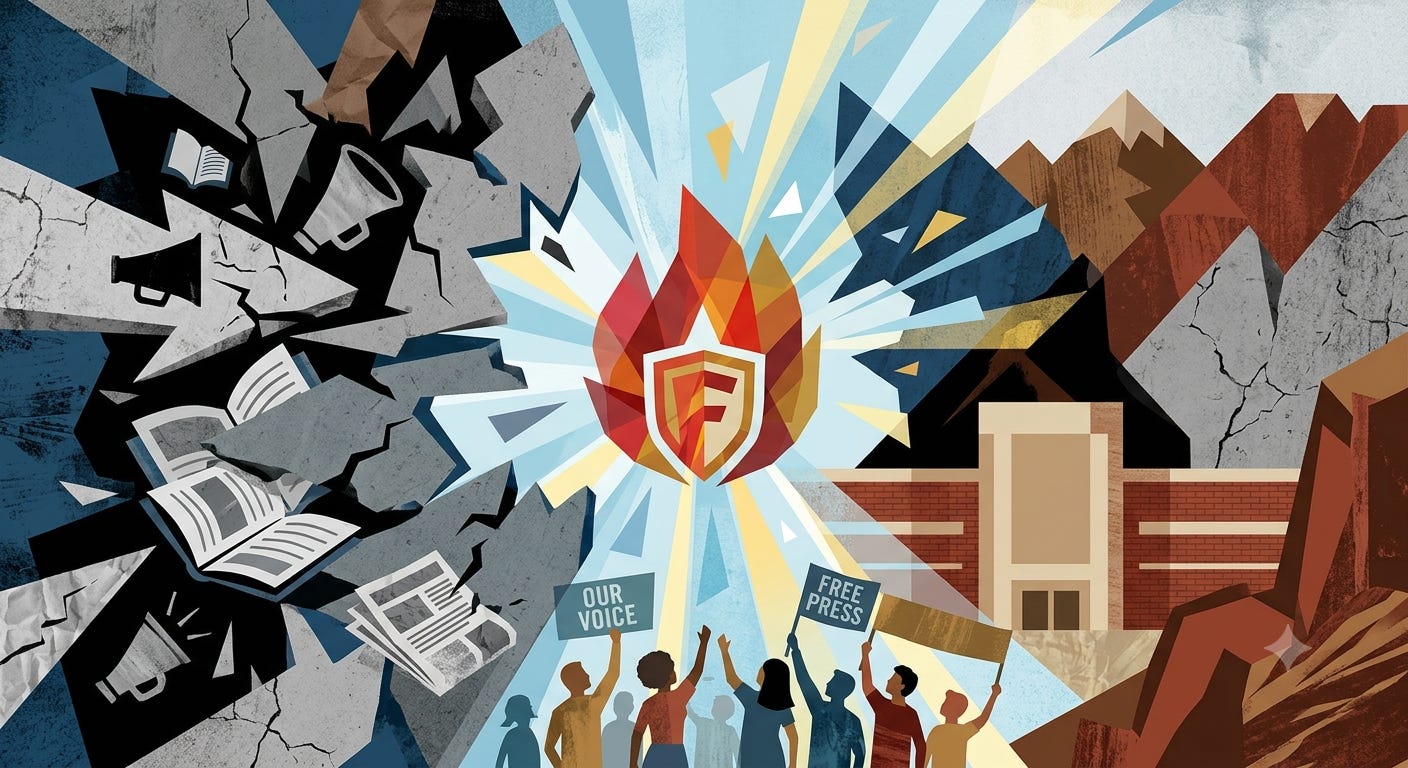
The national free speech group FIRE said this week it is concerned and disappointed with Grand Junction High School.
As this newsletter reported in June, current and former journalism students there have complained about the school’s sidelining of a media advisor. They said they are worried about censorship and threats to press freedom.
This week, they found an aggressive national ally that has a history of impactful intervention.
On Tuesday, Marie McMullan, the student press attorney for the Philadelphia-based Foundation for Individual Rights and Expression, sent a letter to the superintendent of Mesa County Valley School District 51.
Behold the opening salvo from the letter:
FIRE’s Student Press Freedom Initiative is concerned about reports that Grand Junction High School’s former Orange & Black Newspaper adviser Steve Fox was removed because of the paper’s coverage. We are also disappointed that the school failed to respond to our open records request. As you know, Colorado’s New Voices law prohibits public schools from reassigning an adviser for acting to protect student expression, and the Colorado Open Records Act requires that agencies answer requests within three working days. Accordingly, we echo student journalists’ calls to reverse Fox’s reassignment and ask that the school district fulfill our open records request pursuant to Colorado law.
The letter goes on to detail Fox’s meetings with the principal and assistant principal about his reassignment. It alleges the principal mentioned, among other things, “complaints about the publication from a lot of stakeholders.”
In the letter, McMullan said FIRE submitted an open records request to learn more about Fox’s reassignment. “After receiving no response, FIRE sent a follow-up email on June 30,” she wrote. “As of the date of this letter, the school district has not responded to either request.”
Days later, on July 15, the school responded, sending 20 pages of emails between Fox and others, and declining to provide nearly 100 more that it chose to withhold.
McMullan said FIRE is taking the opportunity to learn more about the situation, “especially once the school district responds to our substantive concerns addressed in our letter.”
Elsewhere in FIRE’s letter to the school district, McMullan explained Colorado’s New Voices law.
Passed in 1990 and updated in 2020, she pointed out that the New Voices law “specifically safeguards public school employees facing retaliatory dismissal, suspension, discipline, transfer, and reassignment for protecting the expressive rights of students.”
The school district “must reverse Fox’s reassignment,” FIRE’s letter to the superintendent reads.
For his part, Fox, the former media advisor at Grand Junction High School, told this newsletter that he is “100 percent convinced” his reassignment is retaliation for student content.
He described the Orange & Black as not antagonistic or overly critical of the school, but he said it doesn’t pull punches in its coverage and has at times published stories that the administration likely did not appreciate.
Callie Berkson, a spokesperson for Mesa County Valley School District 51, said in a statement last month that while the school cannot comment on a personnel matter, the district is committed to student voices and student journalism.
“Personnel decisions are not made to limit or censor student expression,” she said. “The Orange & Black has a long and valued history at Grand Junction High School, and we remain committed to ensuring students continue to have opportunities to report, write, and share stories that are important to their school community.”
The district spokesperson didn’t have anything to add this week following FIRE’s intervention.
While news about the situation at Grand Junction High School has reached the attention of a national free speech group, it has not really made the news agenda for local outlets on the Western Slope.
Robust coverage about allegations of government censorship, opaqueness, and potential First Amendment violations can offer clarity — particularly when governments dispute such claims.
Media attention also can bring broader scrutiny to matters of public interest and ensure public institutions and officials whose salaries are supported with tax dollars are acting in the best interest of the public.
Steve Zansberg, a prominent First Amendment attorney who represents the state’s news organizations, said in an email that he is not aware of any tests of Colorado’s New Voices law since lawmakers updated it six years ago.
Asked if he is considering a lawsuit at Grand Junction High, Fox said that he’s currently going through the labor union grievance process, but that a legal option could be on the table.
➡️ This newsletter is proudly sponsored by The Colorado Health Foundation. As a proud funder of Colorado Media Project, the home of Press Forward Colorado, the CHF understands that healthy communities need a healthy news ecosystem.
This year, The Colorado Health Foundation is working to combat disinformation and misinformation, and helping nonprofits build media literacy.
🗣 Explore the latest findings from our 2026 Pulse Poll, which surveyed 2,240 Coloradans, for potential story ideas.
The Colorado News Collaborative called our annual Pulse Poll a “trove of information useful to reporters.” Get in touch to see how the data might be useful for any stories you are pursuing — or to learn about potential ideas for some. ⬅️

Colorado’s liberal attorney general, Phil Weiser, who is also the state’s Democratic nominee for governor, is no stranger to intervening in the actions of Big Business.
He has successfully blocked a merger between two Colorado grocery store chains. He has helped temporarily block two local TV giants that own local news stations in Colorado from consolidating.
Now, the former telecommunications attorney has joined a lawsuit to stop an even bigger media acquisition.
This week, he joined a coalition of a dozen other attorneys general in a legal challenge to a $110 billion purchase of Warner Bros. Discovery, Inc. by Paramount Skydance Corporation.
The proposed merger would marry two of the country’s five major basic cable companies and two of the Five Families of Hollywood film distributors.
Such a move would “eliminate competition between Paramount and Warner Bros. and inflict substantial harm on movie theaters, basic cable distributors and, ultimately, audiences nationwide,” the AG’s office said in a statement.
“More concentration in motion picture production and in the cable network sectors threatens harm to consumers and to a robust marketplace of ideas,” Weiser said.
Localizing the national impact, the attorney general noted that Colorado is welcoming the Sundance Film Festival to Boulder next year. That major event previously took place in Park City, Utah.
“We are acutely aware that preserving competition in the motion picture industry will help ensure the distribution of a wide variety of the best films to movie theatres,” Weiser said. “And as reflected by our challenge to the Nexstar/Tegna merger, we are also committed to ensuring that cable and satellite platforms can offer consumers the best possible packages of basic service by preserving competition in the basic cable TV environment.”
To hear more about what motivates Weiser to challenge these kinds of deals, and more about how he feels about Colorado’s news and information environment more broadly, listen to an interview he gave with this newsletter during his recent successful primary run for governor.
This week’s newsletter is supported in part by the Regional Air Quality Council, the Front Range’s lead air quality planning organization. The RAQC is a great reporting resource for stories about ground-level ozone, the Front Range’s most pressing air quality issue each summer. Visit RAQC.org to learn more and sign up for our newsletter. To learn more about ground-level ozone and the simple steps your audience can take to protect their health and reduce their emissions, visit the RAQC’s SimpleStepsBetterAir.org.
This week, multiple Colorado journalists offered mea culpas to varying degrees about how they covered the recent Democratic primary for U.S. Senate.
The race that pitted State Sen. Julie Gonzales against incumbent John Hickenlooper was close. Hickenlooper won by roughly 50,000 votes, or 5.62%.
The tight margin left thoughtful, self-reflective journalists discussing how they should have given it more attention and, in some cases, apologizing for not doing so.
“You deserved better,” Denver’s 9NEWS anchor Kyle Clark said on air this week. While he had invited both candidates on his show for in-depth interviews, he said he pretty much left it at that.
“Had I realized that this race was so competitive, I would have tried to organize a debate — there was no debate in that race,” he said. “And I would have spent more time covering their policy differences rather than focusing so much on other races.”
So, how did Clark, a sharp journalist who has covered Colorado politics for many years, get it so wrong?
He said he understood there was anti-incumbent anger surging through the electorate this year, but he “expected” Hickenlooper’s decades of experience and his “relative goodwill among Democrats” to give him more of a cushion. He said he underestimated the ability of Gonzales to put together a strong ground game without a sizable war chest.
“I missed on this one,” he said on his nightly newscast. “Badly.”
On social media, Clark also engaged with users.
“Underdog candidates ask for debates in every cycle,” he responded to one. “Then journalists individually determine what we have the time and resources to pull off, usually focusing first on the races expected to be most competitive. That’s where I messed up.”
Last week, Colorado Newsline reporter Chase Woodruff had been the first journalist to publicly admit that he felt he whiffed on his coverage of the race — one he said in which Hickenlooper had sought to successfully deploy an “oxygen-deprivation strategy.”
One data point about that might be revelatory from coverage by Colorado Public Radio.
Ryan Warner, who hosts the statewide Colorado Matters public affairs show, interviewed Gonzales for a broadcast that aired one month before Election Day. His show made a point to note that “while Hickenlooper granted a short interview to CPR News earlier in the primary campaign, his campaign said he was too busy for an extended interview with Warner.”
Like a televised debate with 9NEWS, an in-depth interview with Warner for his show’s large audience is a kind of must-do for candidates willing to make the case for their candidacy to a broad section of the electorate.
Elsewhere on the post-election self-reflection train was longtime Westword editor Patty Calhoun.
She appeared on City Cast Denver this week, where host Bree Davies brought up Woodruff’s thread. Calhoun echoed that while “we in the media” recognized an anti-incumbent wave, they didn’t “recognize it as much.”
Calhoun agreed with Clark that there should have been more debates among Gonzales and Hickenlooper. As for Westword, she said, “We were looking much more metro than statewide and that was where the big difference was, I think.”
The Westword editor acknowledged that there are fewer reporters covering these races than in times past, which leads to being judicious about coverage. She said she doesn’t think Gonzales would have won had there been more coverage, but it might have been closer.
For her part, Davies said City Cast Denver did interview Gonzales, but around the time she first announced her candidacy last year.
“We’ve never been able to get Hickenlooper on the show,” she said.
✍️ Help keep this newsletter free | Fill out this 30-second survey
I’d love to learn more about what you do and why you subscribe to and read “Inside the News in Colorado” each Friday.
Please fill out this quick poll to help me better understand this newsletter’s subscribers and share that information with the organizations that support it. It should take 30 seconds and aims to help keep this newsletter free. ✍️

💰 Colorado Media Project, which underwrites this newsletter, has announced a new grant opportunity for local Colorado newsrooms. “The 2026 Closing Colorado Coverage Gaps Grant provides flexible support to newsrooms serving Colorado’s BIPOC, linguistically diverse, and rural communities,” the organization states. “These grants provide general operating support to newsrooms with strong, existing relationships in these communities, helping them build on those relationships with their audiences and strengthen their editorial coverage of issues vital to the communities they serve.”
🚩 Heads up: a site called The Badger is saying it “publishes hometown newspapers devoted to local communities—reporting on the meetings, decisions, and stories that shape where you live” including Boulder, Denver and the Eastern Plains. And it’s asking readers for money. Published items do not come with bylines, there is no public-facing transparency about who is behind it or how the items are produced. Multiple Boulder journalists have been using the term “AI slop” when discussing it. Items do cite primary sources.
💵 Democratic Gov. Jared Polis and the Colorado Creative Industries division of the Colorado Office of Economic Development and International Trade this week announced 12 recipients of a Community Revitalization Tax Credit. One of them is Colorado Public Radio, which got $1.5 million for a “new statewide downtown headquarters, which will provide the public with access to candidate forums, podcast tapings, live interviews and musical performances. Additional features include a cafe, conference rooms, and space available for use by community organizations and nonprofits, expanding access to professional and creative spaces and amplifying voices across Colorado.”
🆕 Chris Ballantine, 40, has been named CEO and publisher of Ballantine Communications, which owns and operates three Southwest Colorado newspapers including the Durango Herald. He “has played a behind-the-scenes role in the company for many years,” the paper reported.
⛰ The Knight Foundation’s Constructing for Community Connection conference in Boulder this week “brought together about 130 people from across the local media landscape — community newspapers, nonprofit news organizations, digital startups, and online news outlets that have stepped in where local newspapers have disappeared,” Mark Segal wrote for Philadelphia Gay News.
✈️ ≠ 🚁Multiple news organizations across the country and the world reported that a “plane” had crashed into a reservoir while battling a wildfire in Colorado. The Associated Press and others reported it was a helicopter.
📰 The Revolutionist, a socialist West Slope newspaper profiled by this newsletter last year, has been out of print since April as it restructures “to democratize the workload and editorial process,” while publishing online, I’m told.
🎙 While the Red County Blue Nation podcast in small Custer County “has only a few dozen active listeners each week, the podcast has managed to become central to local politics,” Wet Mountain Tribune editor Jordan Hedberg wrote this week in a head-shaking story about some local yappers.
📡 KRCC is celebrating its 75th anniversary this year, “marking three-quarters of a century as a public radio voice for Southern Colorado.”
🎸 Milwaukee Magazine has published an eight-page feature package by Colorado State University journalism professor Kris Kodrich about his more than half-century of experiencing and covering Summerfest, the world’s largest music festival. Kodrich “continues to head back to his hometown every summer to listen to great music on the shores of Lake Michigan,” he wrote in a recent email.
🇮🇱 Nicole Zedeck, a Colorado journalist, “arrived in Israel to pursue a dream; months later, she was among the first reporters inside Kfar Aza after October 7,” Howard Blas wrote for the Jerusalem Post.
💼 A longtime southern Colorado “digital/web pro” is on the hunt for his next post (full-time or freelance) after winding down a federal communications consulting contract. Jayson Peters, who describes himself as a veteran of newsroom tech, social and production teams and says he grew up on a copy desk, also teaches online media and web design at the college level. He says he is a WordPress CMS specialist with UX design and project management training. “Filling out job applications is nowhere near as exciting as helping to solve your journo-tech problems,” Peters said. Find him online at jaysonpeters.com. (Editor’s note: Jayson didn’t pay me for this, but I’m considering a journo job board in this space if it makes sense in the future.)
👀 As national media descend on Colorado to report on Victor Marx, whose former GOP rivals in the governor’s race called a con man, one of the state’s most prominent journalists said that while he can’t imagine the stories “change votes in Colorado” they “do make it uncomfy for the local media outlets that are ignoring or sanewashing some of Marx’s wilder claims.”
⚙️ The Denver Post is hiring a legislative reporter it will pay $36 per hour and a breaking news reporter it will pay $28.68. Axios Local is looking for part-time reporters in Colorado and will pay $27-$45 per hour.
I’m Corey Hutchins, manager of the Colorado College Journalism Institute, advisor to Colorado Media Project, and a board member of the state Society of Professional Journalists chapter. For more than a decade, I’ve reported on the U.S. local media scene for Columbia Journalism Review, and I’ve been a journalist for longer at multiple news organizations. Most recently, I’ve been contributing to Harvard’s Nieman Journalism Lab and The Conversation. I also write the twice-monthly Community Newswire newsletter for the Center for Community News at the University of Vermont. The nonprofit Colorado Media Project is underwriting this newsletter, and my “Inside the News” column appears at COLab. (If you’d like to underwrite or sponsor this newsletter, hit me up.) Follow me on Bluesky, reply or subscribe to this weekly newsletter here, or e-mail me at CoreyHutchins [at] gmail [dot] com.
No posts
Comments
Nothing yet. Say the first thing.
Sign in to join the conversation.