
Welcome to Punch List, Collision’s shiny new vertical about trends impacting the built world.
FIFA took the car parks away first. To stage the World Cup final, organizers stripped the parking at MetLife Stadium in New Jersey, then left the state to work out how to move 80,000 people per match to a venue built for season-ticket holders who mostly drive.
New Jersey Transit was handed a $48 million bill and floated a $98 fare to cover it, while FIFA booked an estimated $11 billion from the tournament. The stadium, FIFA could borrow; the region around it, not so much.
This cost equation is about to be applied again using the same model, but at roughly four times the scale. Welcome to the 2028 Olympics, Los Angeles—hope you survive the experience.
It’s perhaps hard to imagine there are any unturned stones among the potential World Cup storylines, but this seems to be one of them. It also may represent the event’s most significant legacy in terms of infrastructure and the built environment.
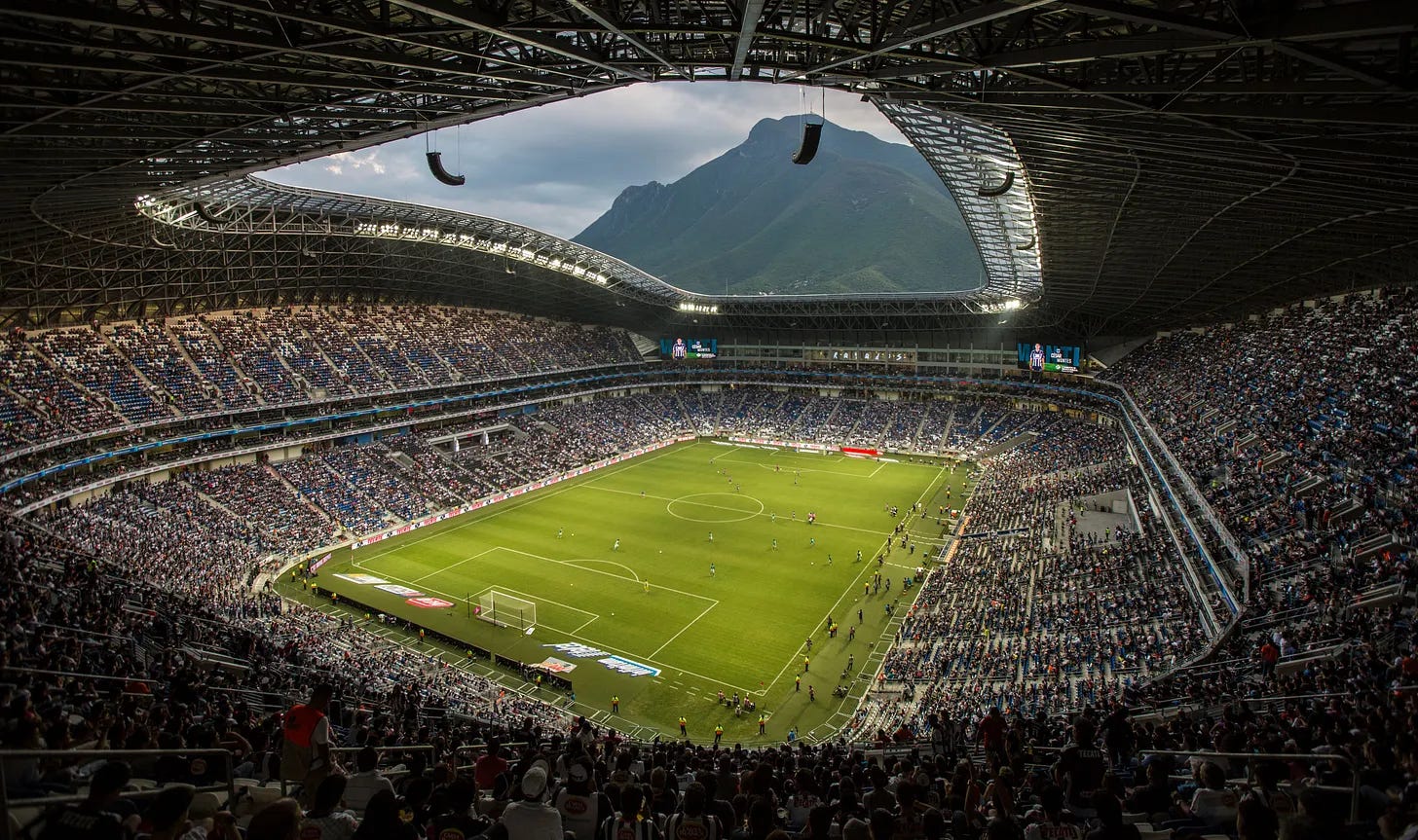
For the first time in World Cup history, nothing was built. CONCACAF’s 2018 bid promised zero new sporting or civic infrastructure—hosting games in existing NFL, MLS, and Liga MX venues with temporary seating and a month of branding.
It was a deliberate correction to the white-elephant arenas left behind in Brazil, South Africa, and Qatar. The brief for 2026—and LA2028 after it—was blunt: stop building monuments.
A policy of reuse, however, could create consequences wholly unintended, as the tournament’s carbon cost continues to be tallied and urban planners grapple with how they’ll solve their Olympic-sized problem in under 24 months.
The reuse-first logic behind both events is sound, and (almost) no built-world professional needs persuading that adaptive reuse beats a trophy build. But what 2026 established is narrower and more awkward: reuse solves the problems that sit inside the property line, and only those.
Capacity is one of them. Mexico City’s Azteca had already been rebuilt and renamed, with upgrades that will outlast the tournament by decades; Toronto’s BMO Field bolted on demountable stands it will unbolt now the crowds have gone. Both worked, because a stadium’s seat count is a building-level problem with a building-level fix.
The distance between that building and the people trying to reach it, however, is not. Neither is the surface they play on, or the heat they play in—the 2026 pitches and kick-off times were inherited from American football, and no amount of overlay changed what those venues were designed for.
In other words: you can retrofit a stadium but you cannot retrofit the assumptions it was built on, and the largest of those assumptions has been how everybody gets there.
The no-build model was also sold partly on sustainability, and on the embodied carbon it delivered. Nothing was poured, quarried, or manufactured, meaning nothing got abandoned afterwards.
Then the tournament moved teams and supporters across a continent for a month and became, by most estimates, one of the most travel-intensive World Cups on record. Because of that, the level of carbon emissions, even by conservative estimates, has not been avoided but rather transposed from the built structure over to the human journey.
These are lessons Los Angeles 2028 organizers will be keeping a close eye on. It’s also an endeavour that will be much harder to repeat at scale.
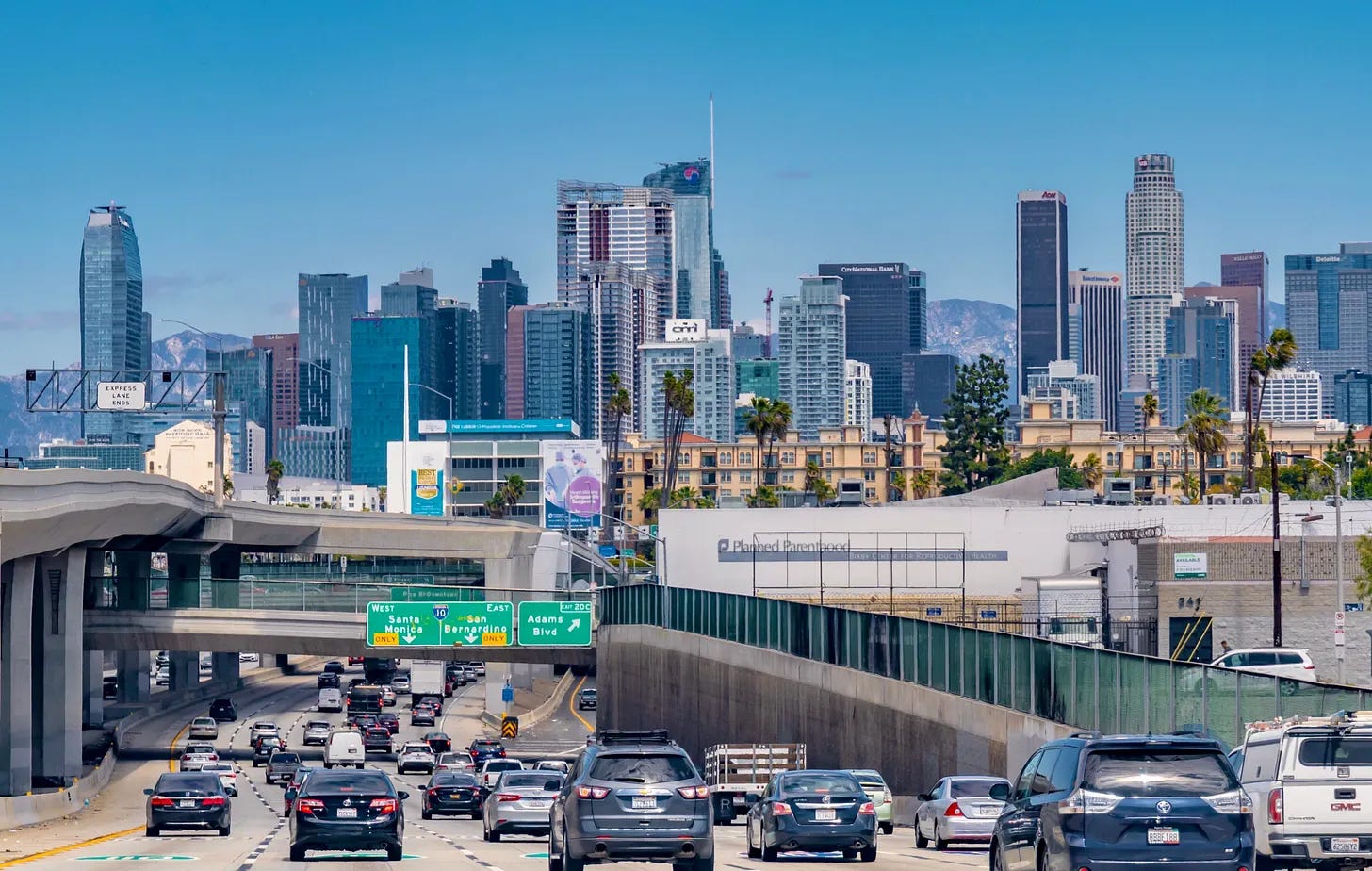
The upcoming Olympics will be the first summer games since 1948 to feature no new permanent venues—and, if organizers get their way, there will also be no cars.
Every ticketed spectator, at more than 40 venues, will arrive by public transport in a region where barely 2% of miles are traveled on transit today.
Olympic organizers saw the recent World Cup matches as a chance to reintroduce a car-dependent city to a transit network most of its residents never go near. Its transit authority stood up 15 shuttle lines and ran around 200 buses; a single match generated more than 30,000 shuttle journeys and close to 50,000 on the rail network.
Set that against the target for the Olympics, though, and it’s like putting a doberman adjacent to an elephant. For 2028, organizers expect to borrow roughly 3,000 buses—about 15 times the World Cup deployment—across a far wider venue map.
Viewed through this lens, WC2026 still represents a timely sortie in reconnaissance, despite covering a fraction of the ground 2028 will have to tread.
A huge complicating factor for LA2028 organizers is that it’s attempting to accomplish all this without the budget. The city is carrying a billion-dollar budget deficit, and of the $3.3 billion it requested in federal funding it has so far received 5.2%. The venues, being borrowed, cost comparatively little.
The system that connects them is the expensive part, and also the part nobody can retrofit in 24 months. It is currently unfunded. It also highlights that for all the benefits of reuse, the costs—in both money and carbon—still land, albeit in a different place.
For anyone weighing a repurposing strategy—a stadium, a scheme, a portfolio — that is the transferable lesson, and it’s not a comfortable one.
Reuse is cheaper, greener on paper, and close to immune from the white-elephant trap that swallowed Brazil and Qatar. It also takes the hardest problem off the balance sheet—where it can be modelled and financed—and onto the street, where it cannot.
The stadiums were always going to be fine. They were fine before FIFA arrived and they are fine now it has left. What 2026 left unresolved is everything between them. Los Angeles has agreed to answer that question in public, at Olympic scale, on a deficit.
You can rent a stadium. Whether you can rent a city is an experiment that’s about to play out.
Comments
Nothing yet. Say the first thing.
Sign in to join the conversation.