
“Now when they saw the boldness of Peter and John and realized that they were uneducated and ordinary men, they were amazed and recognized them as companions of Jesus.” -Acts 4:13
They weren’t recognized by their credentials, but by how they carried themselves. That matters now just as much as it did then.
How do you decide what you are going to live for? We know the things that won’t complete us: our career, our image, etc. but what do you actually want to live for?
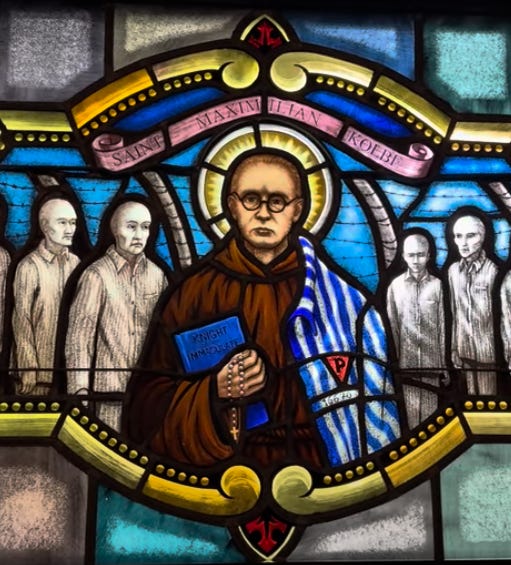
Let’s look at Maximilian Kolbe. He didn’t just profess his beliefs, he built his life around them.
What most people don’t realize about his story, was that he was about 12 years old when one of his mentors challenged him: What will become of you?
Later that year, he experienced a vision by the Blessed Virgin Mary offering two crowns: one white, symbolizing purity, and the other red, meaning martyrdom. Not knowing at the time of the extent of which these would mark his life, he accepted both.
Think about that for a second.
A 12-year-old boy, willing to enter into martyrdom, not fully understanding what it would cost him, but saying yes. That interior yes is what the rest of his life was built on.
He took intention into the life he lived, joining the Franciscans, living with hundreds of friars, in one of the largest monasteries at the time. He also started one of the first Catholic radio shows and then running a faith based magazine, hoping to bring his passion for media to as many souls as possible.
As he sorted through the passions that meant a lot to him, he entrusted each major step to the Lord, glorifying him all the more.
But it didn’t stop there. At what most men would consider the peak of their life’s work, living in the monastery, having his radio station, running a print that reached hundreds of thousands, he walked away from all of it.
He felt called to Japan, starting his own monastery. It made no earthly sense, but he was confident in what the Lord had for him next.
It was only after all of this that he was prepared for his final sentence: his voluntary act in Auschwitz.
Living about eleven weeks at the camp, assigned prisoner number 16670, he didn’t just endure the suffering, he served those suffering with him.
The guards at Auschwitz welcomed prisoners by telling them the only way out was through the crematorium. Men would be worked to death, hauling stones, clearing reeds, digging trenches from sunrise until after sunset. Beatings were routine. Rations were barely enough to sustain a child, yet Kolbe shared the little he had.
At night, when the barracks went dark, he didn’t lie down. He moved from bunk to bunk in the silence, checking up on his peers. Men would crawl across the floor just to be near him, to confess, to be consoled, to feel like a human being just for a moment.
Kolbe never expressed anger. He never expressed despair. Not once, by any account. And he always showed up for those who needed him.
That’s not stoicism, toxic masculinity, or toughness in the way the world means it. That’s a man whose interior life was so anchored that nothing on the outside could move it.
Eleven weeks of hell and he was still giving himself away.
The moment he will ultimately be most remembered for.
A prisoner had escaped. In retaliation, ten men from Kolbe’s block were selected to die by starvation in an underground bunker. No food, no water, until they were gone. A man named Franciszek Gajowniczek was among them. He cried out for his wife and his children. And without hesitation, Kolbe stepped out of formation and asked to take his place.
The SS officer in charge was astonished that anyone would volunteer to die.
In the bunker, Kolbe did what he had done his whole life, he served. He led the men in hymns. He heard their confessions. He prayed aloud. The guards, hardened by years of cruelty, noticed the cell felt different. Instead of wailing, there was singing.
Sure enough, Kolbe outlasted everyone. After two weeks without food or water, he was the last one still conscious, kneeling and praying, when they finally came to end it. On August 14th, 1941, Maximilian Kolbe was killed by a lethal injection. He was 47 years old.
Gajowniczek, the man he saved, carried that weight for the rest of his life. He survived the war. He was in the crowd in Rome in 1982 when Pope John Paul II declared Kolbe a saint. He lived until 1995. Fifty-four years of life that were bought by another man’s death.
What I hope to convey by telling his story is that St. Maximilian Kolbe had a simple mission across his entire life, and it was only over time that it began to make sense. He recognized, even at an early age, that his life was different.
The crowns he accepted at 12, one white & one red, he wore both. Every day of his life, and finally in that bunker.
But the question isn’t really about Kolbe…
You’re life too, is different.
What would it look like for you to be identified as a companion of Jesus?
May God bless you this day,
-CB
Comments
Nothing yet. Say the first thing.
Sign in to join the conversation.