
One of my favorite things in the world is looking at houses for sale. I LOVE houses.
I spend hours and hours at websites like OldHouses.com drooling over classic homes and imagining what it would be like to decorate them or have a studio there.
I about had the vapors when I saw the Ellen Glasgow house in Richmond, VA was for sale.

Drool.
Not only is it right on Main Street across from The Jefferson, the hotel which serves one of the finest afternoon teas in North America, but it is the house of one of the South’s most important writers.
That you probably never heard of.
In 1942, she won the Pulitzer prize for her 1941 novel In This Our Life. It was later adapted into a film starring Bette Davis, Olivia DeHavilland, George Brent, and Billie Burke, best known for playing Glenda the Good Witch of the North in The Wizard of Oz film.
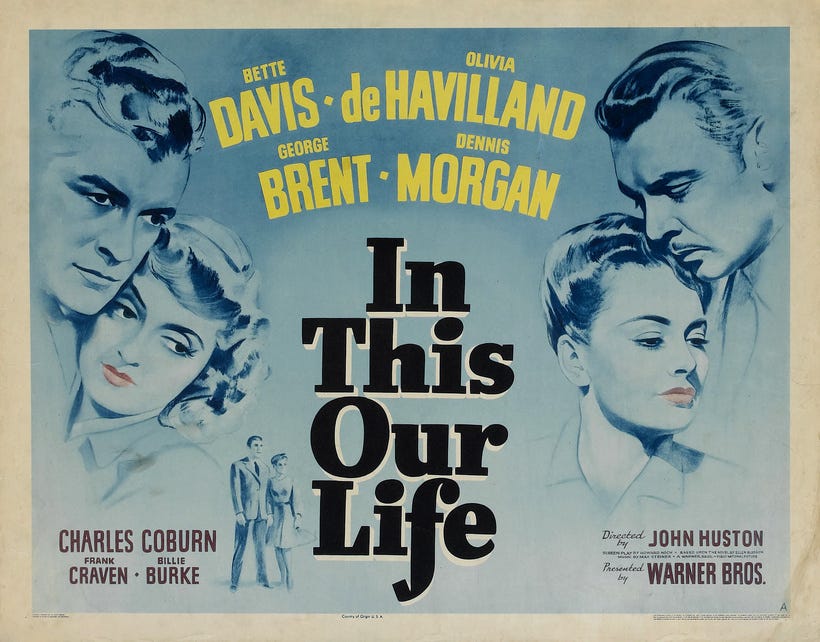
The rather grim and thoughtful novel was hacked into an uneven melodrama, which is sort of what happens to books gone Hollywood, but In This Our Life is notable in that a central theme of the story -which you’d never know from this film poster - was racial discrimination.
A young, promising, well educated black man, Parry Clay, is framed for a crime by the spoiled socialite belle Stanley Kingsmill played by Bette Davis. Stanley manipulates with her charm and privilege, and tries to convince Parry to take the rap for her, claiming she can use her connections to get him a light sentence for the crime and a lifetime of support when he gets out of the hoosegow.
The movie was released only a year after the novel was, which is lightning fast in terms of contract to screen. It was not approved for foreign release by the War Office because of its themes of racial discrimination.
The racism as presented in the film is a sideline to the stories of the sisters, and the movie softballs many of the novel’s messages. The novel took the point of view of the family patriarch.
Bette Davis is cartoonishly over the top as Stanley. It is said she hated the adaptation of the book, was a nightmare on set, and insisted on handling her own wardrobe and makeup. Frankly, she looks terrible in it and is a decade too old for the part. That she made those makeup and clothing choices is baffling to me.
While watching her film The Star, the tale of a washed up actress desperate to nab a young, glamour girl role, I was reminded of Bette’s performance in In This Our Life. In an audition scene during The Star, Bette attempts to play a seductive ingenue. Her coquette attempt is painful to view. On seeing the dailies, the Star bursts into tears at how she appears on screen. I’ve often wondered if Bette based this performance in the audition scene on her role in In This Our Life: her mannerisms and affectations are almost identical. At times in Our Life she seems authentic and present, but mostly she’s just hard to watch. It’s amazing that just a few years later she will soar in her role as Margot Channing in All About Eve. And even more amazing that only a few years earlier, she was spot-on in Jezebel.
By contrast, DeHavilland is pitch perfect. Understated, and steady, she’s a lovely contrast to Bette.
On the plus side, it was Davis who spotted the actor Ernest Anderson who was then a waiter, and got him the audition to play Parry. He won the National Board of Review Award that year for his very first performance.
For whatever it’s worth, none of the actors seem even remotely Southern.
Ellen Glasgow was a very popular novelist in her day, and with a Pulitzer, obviously, very well regarded. Her novels of the South, and especially the inner lives of Southern women, were unique and important records of social mores and changing times.
Southerners, their lives and environment, are not of interest to most Americans these days outside of sideshow stereotypes from alligator hunters to Honey Boo-Boo.
I swear to God, I had a well known writer ask me if I lived like Honey Boo-Boo when I appeared at the Brooklyn Book Festival.
If I lived like Honey Boo-Boo, I’d have knocked the cad on his keister for that remark.
Glasgow is a kind of Edith Wharton of the South. Her novels are quiet and tense. The world that created them still exists, but again, most people want lurid Southern poverty porn and monster truck tales these days, so you’d never know unless you lived here.
Ellen Glasgow was also very progressive in her time, but what passes for progress 100 years ago looks pretty dated now. Many people are unforgiving of anything or anyone that doesn’t stand up to relentless Twitter scrutiny.
Glasgow is a much better writer, but she reminds me of another progressive author, Fanny Hurst, enormously popular and a best seller at the same time. She hobnobbed with Ellen Roosevelt and campaigned for human rights causes. Hurst wrote a series of melodramas, many of which were adapted into films such as Imitation of Life. Adapted twice actually, the first starring Claudette Colbert, and later with Lana Turner. A very progressive tale in its day, but eyebrow-raising now.
Anyway, this is an Ellen Glasgow quote I love. Apparently, she foresaw Twitter.

I can relate.
And this one. I might put this on a t-shirt.
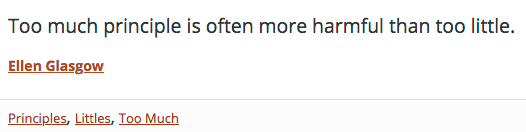
Here’s a corker.

Ellen Glasgow never married, and frequently stated she was a better creator when “love was over”. I suspect she’s right. One of her fiances ran off with the Queen of Romania, and who needs that kind of real-life drama when you’re trying to finish a book.
Anyway, Ellen Glasgow’s writing is beautiful and quietly clever. You can find many of her books on Amazon.
If anyone knows where to get a few million dollars, pop it my way so I can buy that house and start an art school. Thanks.
Just kidding. Kinda.
Comments
Nothing yet. Say the first thing.
Sign in to join the conversation.