
I’ve been reluctant to wade into any discussion about population and immigration, since this is the chosen territory of the right. But if leftists refuse to engage on these important topics, we cede the ground to our opponents. The rise of the far-right is to a considerable extent due to the failure of the left to offer a credible, meaningful response to the many problems confronting ordinary people. Many significant cultural changes have simply been bulldozed through, accompanied by arrogant dismissal of those who question them or call for less haste. The professional-knowledge class has a dreadful habit of believing that its cultural preconceptions are innately correct and that anyone else who doesn’t adhere to them is a barbarian. The left can’t continue to simply try to impose its cultural concepts on everyone or just ignore difficult issues. We have to come up with an interpretation of the world as it is, and a narrative and ideas about how we could make it better – and this interpretation and narrative must make sense to ordinary working people.
So, I’m going to talk about population. Note, I’ll also mention immigration, but only as a contributor to population. There is an important conversation to be had about cultural and social aspects of immigration, but that’s not my purpose here. As with some of my previous posts, my main concerns here are with the way that resources are allocated, scarcity is defined, economic growth is fetishised, and the way that the present democratic system deals with all of them.
The approaches of nearly all Australian governments today and in the past to the issue of national, state or even local population are characterised by two consistent elements: an emphasis on economic growth and a reluctance to engage in democratic discussion about the topic. In relation to the first, it is presumed to be axiomatic that a growing population is good for the economy. As for the second, the economy nearly always trumps democracy, rendering democratic debate needless, according to political elites; in addition, it is presumed (often for good reason) that discussions about population will descend into shouting matches about immigration, so it is better to avoid them. I don’t think we should accept either of these premises.
Because immigration makes up about 73 percent of population growth in Australia, discussion about population and economic growth can often become dominated by views about immigration. I’m not interested here in the ethnic or cultural backgrounds of immigrants – I have zero interest in Pauline Hanson’s reactionary-nostalgic monoculture concept.
For most of the mainstream political class, including the spokespeople of the main business organisations, population growth, and its subset immigration, is a good thing because it increases demand for products and services, including that great driver of Australian economic activity, housing production, and its derivative industry, interior (and, increasingly, exterior) decorating, thus increasing economic growth. Note, however, that there is a difference between GDP growth and growth in GDP per capita. In Australia, since 2000, real GDP growth has averaged between 2 and 3 percent. But per capita GDP growth has tended to be considerably less – closer to 0.5 percent. Business leaders and their political representatives don’t particularly care about the GDP per capita figure because they’re interested in how much money their businesses make – and the more customers, the more they make. The per capita figure only matters to the rest of us because the higher the population growth the more people there are to share the economic output with. Of course, a higher population might also mean more businesses competing for the new income, but new migrants will not, in general, be able to quickly build businesses that are able to compete with established ones, and certainly not with the big ones that dominate key sectors of the economy and really benefit from increased population numbers – like supermarkets or home renovation stores.
It is common to hear from business and political elites that we need population growth for a well-functioning, growing economy – not only to drive demand, but for skilled workers and to avoid labour shortages. This sounds superficially reasonable. But consider what is actually being said here. If a growing population is needed for a functioning economy, then there can be no limit to the size of the population – or the economy stops functioning. Australia’s population is currently 27.6 million and is growing at an annual rate of 1.5 percent. At that rate, the population will be 55 million in 2074, around 80 million by the end of the century and about 200 million by the middle of next century. Does anyone think that is a sensible population size for the driest continent on earth, where a fraction of the land mass is suitable for urban living? If you don’t believe that is sensible or possible, then you must accept that the current economic system is also not viable, since, we are told, the one goes with the other.
If you don’t believe it is possible for the population to grow forever, then you must believe that we need a different sort of economic system. I presume that even the biggest believers in the idea that we need a growing population for a healthy economy don’t actually believe that the population can grow forever. So, they can’t truly believe that population growth is necessary for economic wellbeing. Possibly they believe that we can still grow the population and defer the problem of an alternative economic system for a while longer. But what would be the optimum population size before we start having the discussion about a different economy? Why don’t we start a discussion about a different economic system now? What would the economy look like if it weren’t reliant on population growth? Is it the case that not only is endless population growth not possible, but endless economic growth is also not possible?
This is not an abstract issue. It plays out at all levels of government. The Victorian Government’s Plan Melbourne envisages Melbourne having a population of 8 million in 2050. The current Melbourne population is 5.5 million. That’s a 45 percent increase in 24 years, or 1.9 percent per year. At that rate, the population doubles every 37.9 years. So, in 2088 the population will be over 17 million. When does it stop? If not now, why not? Does the government intend for population growth to stop at 8 million? Why 8 million? Why not 6 million, or 7 million? How will it stop the growth at 8 million? Is the 8 million figure just a convenient one that coincides with the year 2050? Given the approach appears to be “predict and provide” – that is, we predict the population will get to 8 million in 2050 and we’ll just plan to provide for such a population size – what is the predicted size in 2100? Or does predict and provide only work up to a certain population size – and what is that population size, and how is it determined?
We can see from all this that the idea that a growing population is important to a growing, functioning economy is highly problematic. It should be subject to far more debate and scrutiny that it gets. But population size is almost never subject to proper democratic debate. When discussing population, the mainstream tends to limit the terms of the debate to the relationship between population and the economy. The right likes to introduce other variables – migration and race. We should reject the latter. But there are other issues that should also inform our considerations. Is there an optimum size for urban areas? When does a city become too large to function well? Is there a certain lifestyle that most people want to protect and is it compatible with huge cities? What is the relationship between city size and sustainability, between city size and inequality? There are many more questions to ask.
In relation to Plan Melbourne, how many Melburnians know it exists? How many people feel they have been consulted on it? How can this experiment in transforming a heavily car-dependent city into a functional megacity occur? Do we have the right public transport? The Plan places much store in the Metro Tunnel, but this is nowhere near enough. Melbourne’s roads are already gridlocked for large parts of the day, particularly on weekends. It is increasingly difficult to move around. The bay beaches, especially during hot summer days, are already reaching saturation level. How will they handle a population with another 3 million, especially when most are not accessible by public transport? How much further can the outer suburbs, car dependent, thin on collective infrastructure, devoid of social capital, extend? Could there be a better way of providing homes and communities than the cookie cutter, black roofed single house and (increasingly small) garden estates, with big-box retailing fronted by a car park as the community’s centre, and a private school or two of varying religious denominations? What are the long-term ramifications of continuing to jam ever more people into these increasingly far-flung property developments?
One of the problems with having a sophisticated discussion about population is that mainstream Australian politics has tended to view population policy as ideally a matter for bipartisan agreement. It is very common in mainstream discourse to hear “bipartisanship” spoken of as an unalloyed good thing, something that it would be great for political parties to aspire to. Bipartisanship typically means the main parties deciding not to debate an issue, not opening it up for democratic contest. Foreign and defence policy are nearly always treated this way. Population policy is too. But at times of lower trust in political institutions, bipartisanship can also appear as an example of the political elite colluding against the people. When it does, it contributes to further declines in trust and to the rise of outsider parties, especially when voters don’t feel they were included in the discussions that led to the consensus position.
I think this is precisely the position in which we now find ourselves. The big party bipartisanship on population and the economy appears to a growing number of people like a conspiracy against ordinary people to produce big cities with all their attendant growth pains and long-term problems, simply to deliver more profits for property developers and businesses more generally, while undermining lifestyles and undercutting wages. Then along comes the far-right, led by Hanson, dragging Angus Taylor in her wake, to lay all the blame on migrants. Given the general populace has never been invited by mainstream politicians into any discussion about population and urban size, why are we surprised that people might be tempted by a simple explanation that blames complex issues to do with infrastructure provision, suburb design, transport planning, employment, sustainability, community, social conditions etc on migrants and their purported reluctance to “live by our values”?
The essence of the neoliberal project was to reduce democratic control over the economy, replacing it with “market forces” and forms of re-regulation to protect them – especially more stringent regulation of unions. The inevitable outcome of this was a narrowed range of issues subject to “legitimate” democratic contest – nearly all of them of a cultural nature: sex, race, immigration, speech. But people are increasingly sick of being told that large numbers of issues that affect their everyday lives should be left up to technocrats, professional politicians, private businesses and “markets” to determine. One of those issues is population policy. It’s time we had a democratic discussion about it, and everything that flows from it – including the nature of our economy and the nature of economic growth – before people like Pauline Hanson make such democratic discussion impossible.
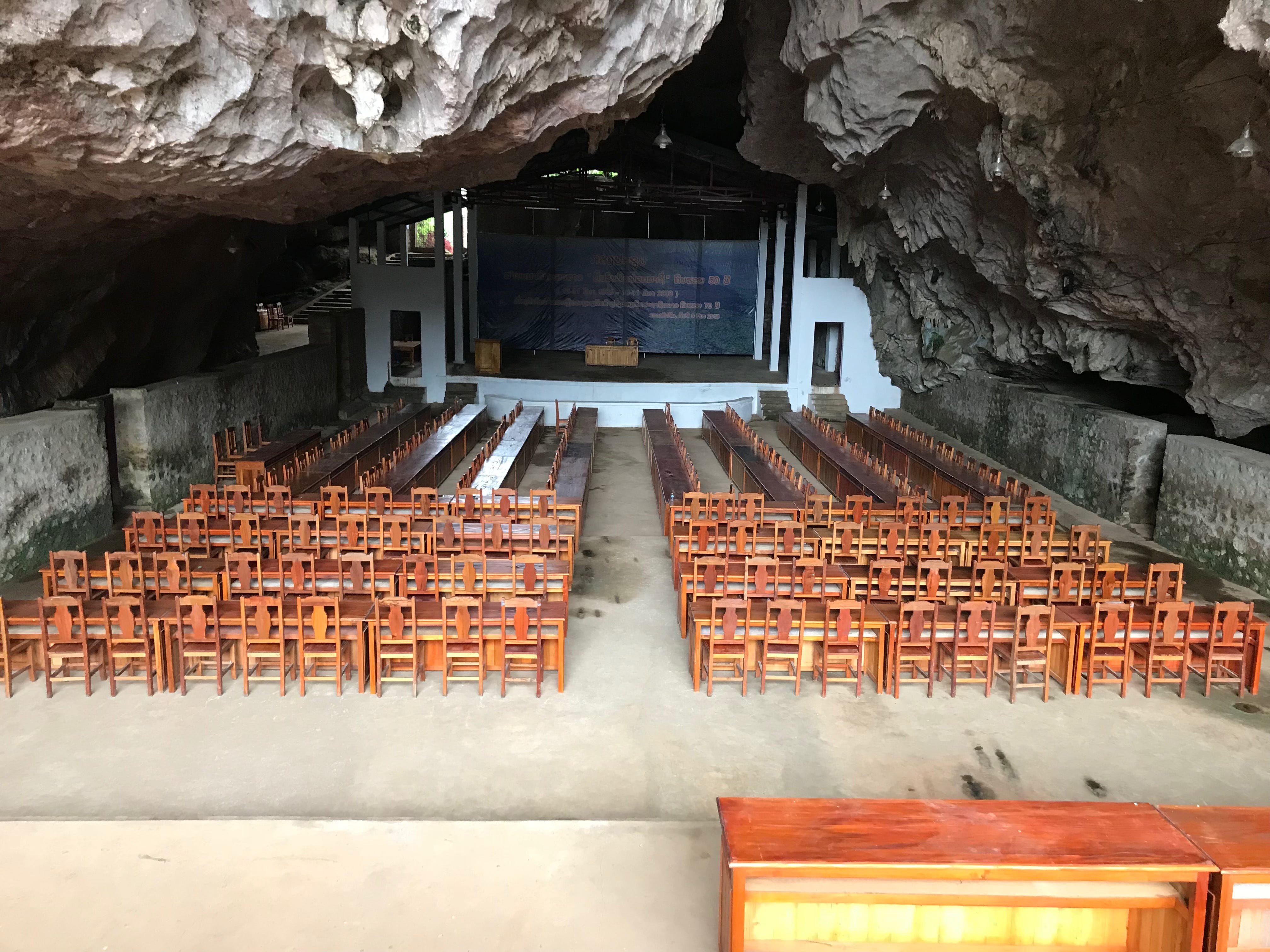
This is an image of the Theatre Cave in Vieng Xai, once the base area of the Communist Pathet Lao during the years of the American War in Vietnam. Hundreds of limestone caves were used by the Pathet Lao for shelter while the region was subject to relentless US bombing. I was very fortunate to spend some time working in Vieng Xai some years ago, and it is a place that means a lot to me.
Comments
Nothing yet. Say the first thing.
Sign in to join the conversation.