
Reading a Substack article by Arundhati Roy about the Cockroach movement in India, I was reminded of the recent visit to Australia of the Indian Prime Minister, Narendra Modi.
The Cockroach movement is a youth-led protest movement that was ignited by exam and admission paper leaks and corruption in India’s education system, but has grown to express wider discontent, especially among the educated young about the corruption, repression and oligarchic tendencies of the Modi regime. In the initial stages of the protests, Surya Kant, Chief Justice of India, dismissed the students as “cockroaches and parasites”. Within days, a satirical social media page establishing a Cockroach Janata Party had spurred the protesters to coopt the word, disarming its potency while exposing the way that the political elite views so many ordinary Indian citizens.
Roy describes the Cockroach march on Delhi and the government and police response:
And as they marched, they stripped away any remnants of the velvet glove that masks the government’s iron fist and exposed the current regime for what it is and always has been. A fascist iron fist. A confederacy of brutes with no capacity to understand the history and the diversity of the country which it governs. People who only know how to hate, but have no idea how to love. Or think.
The Modi government’s penchant for authoritarianism, sectarian violence, Hindu supremacy, and anti-democratic actions is well known. The fact that the Australian Prime Minister, and the Victorian Premier, Jacinta Allan (now ex-Premier), would welcome him to Australia and share the stage of a political rally with him is disturbing enough (a few words about this at the end of this piece). But it’s not my principal concern here.
The right-wing conspiracy theory that centre-left governments bring migrants into the country to provide a solid block of electoral supporters is nonsense. What it obscures, as so many right-wing tropes do, is a reality that is almost equally as disturbing as the fiction. What Albanese and his Victorian counterpart are doing is cynically using a migrant community for political gain, while, and this is the worst part, trashing principles that they claim to be defending. In this case, while claiming to be the great defenders of multiculturalism, they undermine its fundamental meaning. Let me explain.
We know why Albanese panders to Modi whenever the Indian Prime Minister visits Australia. He is trying to foster a strong ALP vote among Australians of Indian origin. The recent Albanese-Allan-Modi rally in Melbourne was designed to win over the large Indian vote in the western suburbs of Melbourne, the electorates of which are under threat from the One Nation surge in the coming Victorian election.
There is nothing inherently wrong with Australian politicians reaching out to particular migrant or ethnic communities to understand the issues that affect them in an attempt to win their votes. Different components of multicultural societies have different interests and needs, which will usually vary across time. The needs of new arrivals usually change the longer they are settled in the country. The needs and interests of the Greek-Australian community are very different to what they were in the 1960s, for instance. At the same time, everyone living in this country has unifying needs and interests that cut across ethnic and community differences: the need for good work, for proper social welfare, functioning, accessible health and education systems and so on.
But the Albanese-Allan-Modi rally was not fundamentally about Australian politicians trying to connect with Indian-Australian voters about their interests as Australian citizens. By trying to portray themselves as allies of Modi and trying to bask in some of his reflected glory, Albanese and Allan were seeking to mobilise the remnant Indian political allegiances of Australians of Indian origin for their own political gain. Allan made this explicit when she said:
Let me say this to Victoria’s great, strong Indian community…you are welcome here. Your children will never have to choose between being proudly Indian and proudly Victorian because in this state you can be both.
This is not multiculturalism as I understand it. Multiculturalism is not about migrants maintaining multiple allegiances to different political states, which is the meaning given by Allan saying this at a rally for an Indian politician. Isn’t it about the construction of a new, radically different, nation in Australia, a nation not defined by the connection of blood and soil, not by an attempt to define national boundaries in terms of ethnic groups? Isn’t the point of multiculturalism to say that, whatever your cultural or national background, we come together in Australia to forge a nation by means that we will determine through democratic political contest, in its broadest sense? (I don’t mean just through elections. I mean through the full range of democratic activities, some of which might call into question the current system of parliamentary democracy.)
Multiculturalism means, surely, that it is not cultural or ethnic background that should determine political views, or commitment to democracy or the fundamental character of the nation. What multiculturalism says is that it doesn’t matter where you came from – you can help shape the political institutions, structures and character of the country you are now in.
The paradox of multiculturalism is that it says that you can maintain some form of your cultural identity while agreeing to jettison any claim that it should be a determining factor in your political engagement. This is where the right gets it both correct and wrong. There is something inherently true about the old, usually right-wing, demand: “don’t bring the conflicts of your old countries here”. Yet the right is wrong in that it gives priority to only one cultural inheritance – the British. The right is contradictory, demanding that migrants abandon culture and ethnicity as a basis for political identity, yet insisting on British culture and ethnicity as the basis of Australian political identity. The promise of multiculturalism is surely that out of an amalgam of different cultures something new can be born. But this requires, contrary to what Premier Allan said, abandoning commitment to the political culture of the old country – the UK, India or anywhere else. To be politically present in both this – for you – new land and your former land is, whatever it is, not multiculturalism. Multiculturalism is different to Allan’s multi-nationalism.
Multiculturalism is presently subject to the greatest threat it has faced in decades. Hanson is mobilising broad strands of discontent to advance a fantasy of monoculturalism that would require untold violence to implement. Multiculturalism is not a problem-free concept. It demands forms of tolerance and acceptance that are not always happily extended by some subcultures. It is sometimes used to excuse forms of minority (sometimes majority) cultural expression – often with a religious origin – that are intolerant of other communities. It is sometimes used as an excuse for the majority to avoid offering the same opportunities to minority communities, often while espousing good intentions.
But for all its and our failures, the multicultural project that I have described here is still worth pursuing. There is no going back to Hanson’s nostalgic fantasy because such a past never truly existed – although the nation was undoubtedly far less multicultural in the 20th century than it is today. But we have to be aware that it is, in a very real sense, an experiment, one that has been very rarely tried anywhere or any time in history. Pointing out that there have been many cases in the past of places where people from all sorts of cultural backgrounds co-existed – such as in entrepot cities on trading routes – is hardly relevant. Rarely, if ever, did any of these places extend full political and citizenship rights to all who lived there.
What we are trying to do, I submit, is rare and fragile. Acknowledging the original sin of British colonisation and the immense damage it caused to Aboriginal people and cultures, we are nevertheless trying to build a new form of political nation that is no longer built on race, blood, soil or one cultural inheritance. There are very many on the right who want to see the project fail, and are actively working towards that goal. It doesn’t help when those who should know better – like Albanese and Allan – are undermining it from within.
Postscript
That there is very little critique from any quarter about these Modi rallies taking place on Australian soil is rather odd.
Inviting the President of the genocidal Israeli state. Welcoming the fascist Indian Prime Minister. Strengthening a military alliance with the world’s most aggressive nation, also run by a far-right authoritarian bent on destroying its fragile, decrepit democracy. When do such actions become more than just a series of discrete events and instead take on a pattern that reveals an underlying ideological affinity?
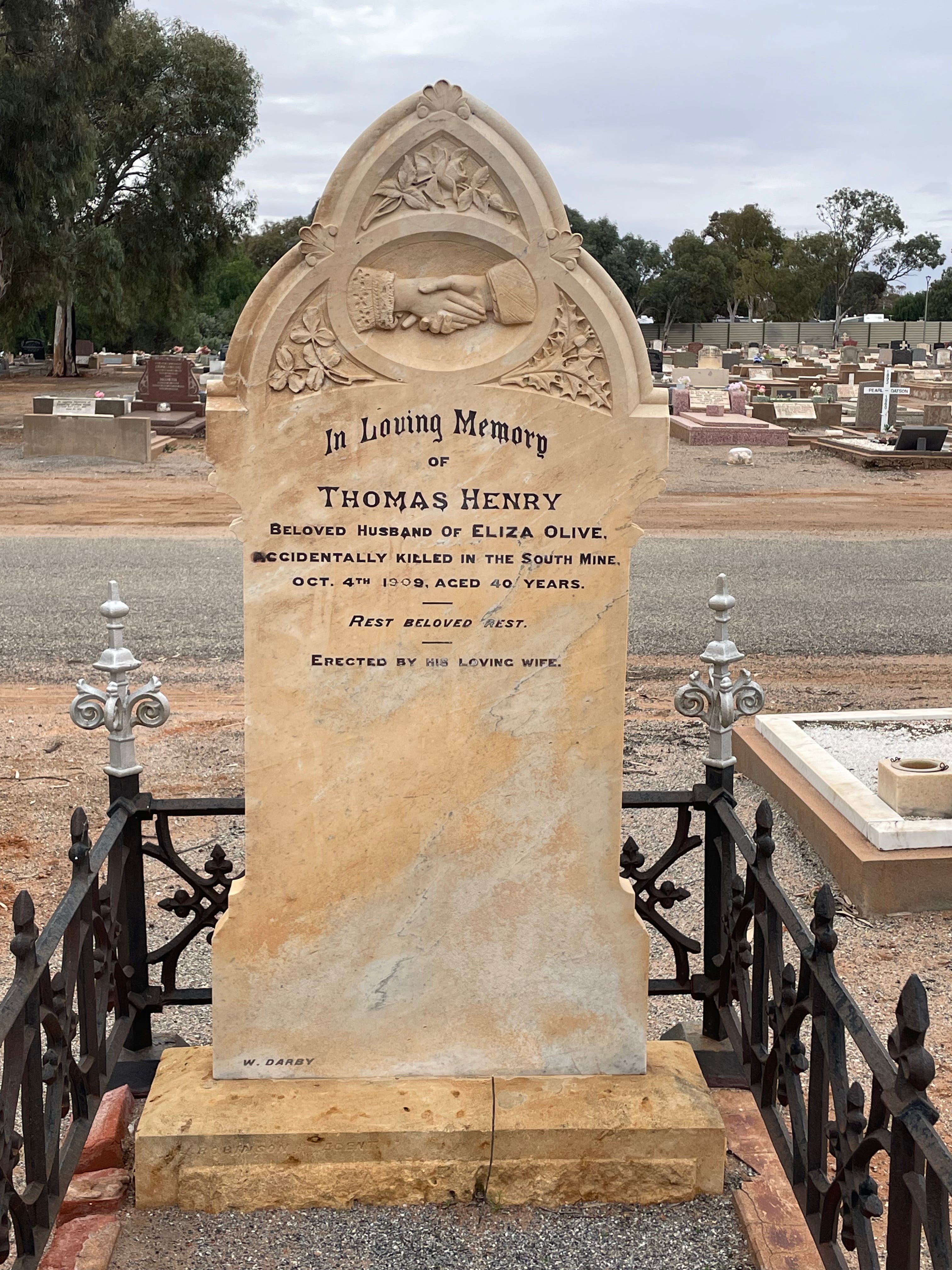
I was in Broken Hill again recently and visited the cemetery. This headstone really struck me, not only as a testament to the terrible toll taken on workers in the city’s mining industry over the course of almost 150 years, but for the clasped hands instead of religious iconography. A similar motif appears in a stained glass window in Broken Hill Trades Hall, suggesting that Thomas Henry was probably a good union man.
Comments
Nothing yet. Say the first thing.
Sign in to join the conversation.