
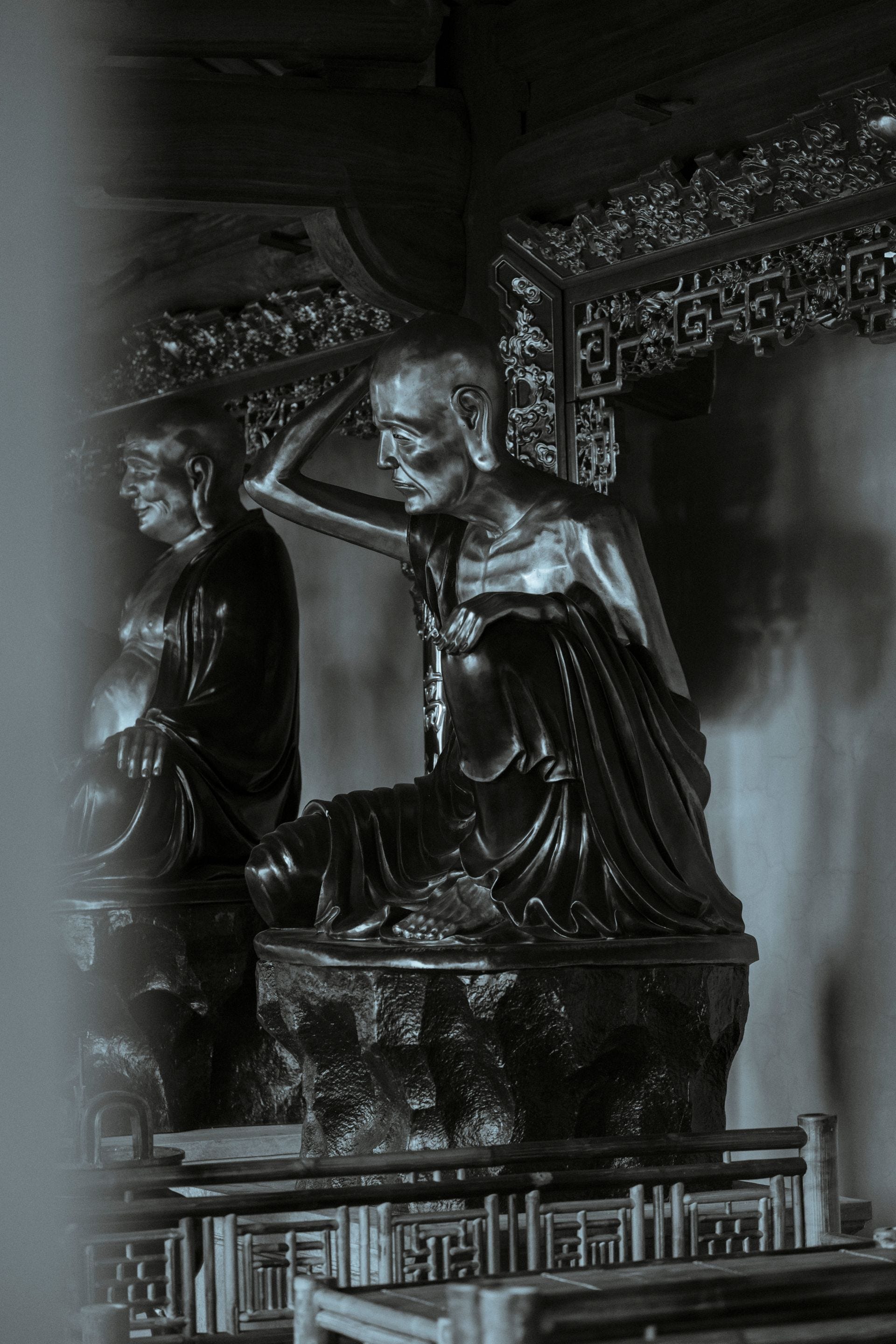
The air in Wat Rong Khun was thick with the scent of incense and frangipani, a cloying sweetness that clung to the back of the throat. For the villagers of Ban Mai, it was the smell of peace, of piety, of the gentle cycle of merit-making and rebirth. For Surat, a boy of eleven with eyes that saw too much and a heart that felt too deeply, it was the smell of a lie.
Luang Phor Somchai was the heart of the temple, a man whose serene smile and soft-spoken words had guided the community for decades. His saffron robes were always immaculate, his shaven head gleaming under the tropical sun. He was a master of the Dhamma, his sermons weaving intricate tapestries of morality and karma that left his listeners feeling cleansed. But Surat had seen the flicker in the old monk’s eyes. A flash of something cold and calculating that vanished as quickly as it appeared, like a snake sliding back under a rock.
It began with the children—the orphans. The temple was a haven for them, a place where they were given food, shelter, and an education. They were the temple’s quiet, dutiful shadows. But over the past year, a peculiar change had come over the older ones. They grew silent, their gazes distant, their movements unnervingly precise. They no longer played. Their laughter, once the temple’s most precious sound, had withered and died. They were hollow, like beautiful, perfectly painted dolls.
Surat had always been a curious boy, more observant than his peers. He noticed that these particular children were the ones Luang Phor Somchai would summon to the back of the temple. They would file in, one by one, through a heavy teak door that was always kept locked. They would emerge an hour later, pale and silent, and never speak of what transpired. The monk’s explanation was always the same: advanced meditation techniques—a special path to enlightenment for the most devoted.
Surat didn’t believe it. He had once hidden in the lotus pond at night, peering through the high, barred window of that secret room. He’d seen the flickering candlelight, but he’d also seen shapes. Strange, monstrous shapes moving in the gloom, their shadows stretching and contorting on the walls. He’d heard chanting, a low, guttural drone that was nothing like the melodic Pali verses of the temple’s daily rituals. He’d heard a child’s soft whimper, abruptly stifled.
But it was the other events that truly chilled the village’s blood. Firstly, the headman, a man known for his stern but fair rule, was found dead in his rice paddy. His face was frozen in an expression of pure, unadulterated terror, and his body was covered in a rash of horrific, suppurating boils, as if something inside him had rotted and burst forth. The official cause was a rare and aggressive tropical disease, but Surat had seen the headman at the temple just two days before, robust and healthy. The headman had been arguing with Luang Phor Somchai about a new temple tax, his voice raised in anger and disrespect.
Then came the incident with the schoolteacher, a beautiful and outspoken young woman from Bangkok who had criticised the monk’s archaic methods. She was found wandering in the jungle, babbling incoherently, her mind completely shattered. Her body was unmarked, but her spirit was gone. She stared at the world with vacant, doll-like eyes, a mirror of the children.
The most shocking was the death of the wealthy merchant, who had donated a vast sum of gold and jewels to build a new ordination hall. He was found in his locked home, drowned in a shallow bowl of holy water. The image was so incongruous, so utterly bizarre, that the city authorities were baffled. But Surat knew. He knew the victims were all people who had, in some way, slighted or challenged Luang Phor Somchai. And he knew the children were the instruments of this vengeance. He had seen them in the dead of night, slipping back into the temple compound, their robes damp with dew, a strange, glassy emptiness in their eyes. The newest one, a boy named Noi who had been brought to the temple just a week prior and had since become one of the hollow children, had blood under his fingernails the morning after the merchant’s death.
Driven by a terror that gnawed at his very soul, Surat decided he had to see what was in that room. He had to know what Luang Phor Somchai was doing to them.
The opportunity came during the night of the full moon, a night of powerful spiritual energy. The villagers were all in the main hall, chanting the evening prayers. Surat slipped away from his sleeping mat, his heart hammering against his ribs like a trapped bird. The temple grounds were bathed in an eerie silver light. He crept to the back of the temple, the teak door looming before him like a gateway to hell.
He had pilfered the key from the monk’s personal quarters, a heavy iron thing that was cold and rough in his sweaty palm. With a trembling hand, he pushed it into the lock. It turned with a soft, resonant click that seemed to echo in the silent night. He pushed the door open, and a wave of stale air, thick with incense and something else—something metallic and foul—washed over him.
The room was smaller than he’d imagined, its walls lined with shelves. But these shelves were not filled with sacred texts. They were filled with jars. Dozens of them, made of dark, unglazed clay, sealed with wax and bound with cords of human hair. A shiver of pure, unadulterated horror raced down Surat’s spine. In the centre of the room, on a low wooden table, was a large, ornate basket woven from rattan.
With slow, deliberate steps, his bare feet silent on the cool stone floor, Surat approached the table. His hand reached out, trembling, and he lifted the lid of the basket.
The smell hit him first. A rotting, sweet, decayed smell that made him gag. He looked inside. And his world shattered.
Inside the basket was a small, desiccated corpse. A child. His skin was black and leathery, his eyes closed as if in deep sleep. He was wrapped in red and gold cloth, and around his neck was a talisman made of bone and hair. He was surrounded by offerings: rotting fruit, small coins, and half-burned candles.
Surat stumbled back, a scream stuck in his throat. He looked at the jars on the shelves with new, terrified eyes. He opened one. Inside, a child’s finger, preserved in a murky fluid. Another jar held a lock of hair, a tooth, a scrap of bloodstained cloth. He understood now. These were the remains of the village’s deceased children, the ones who had died from fever or accidents. Their souls were supposed to have been freed, to have been reborn. But Luang Phor Somchai had stolen them. He had trapped their souls in these objects, these kuman thong. He had bound them to his will, creating an army of vengeful, invisible spirits.
And the living children were the receptacles. The hollow ones who now walked the temple grounds, their own souls suppressed or driven out to make room for these powerful, restless ghosts. He would call one of the spirits, bind it to a living child, and send them out to do his bidding, to murder his enemies with terrifying efficiency. The spirit, burning with a child’s need for love and obedience to its ‘father’, would do anything. The flesh-and-blood child was just a puppet, a vessel.
And then, with a jolt of absolute, gut-wrenching terror, Surat realised his own fate. He was an orphan. He was a child. And he was filled with a rebellious spirit, a soul that resisted the monk’s control. He was not a future vessel; he was a threat. A loose end that needed to be tied.
A soft footstep behind him. Surat spun around.
Luang Phor Somchai stood in the doorway, the silvery moonlight from the temple courtyard casting half his face in a soft glow and the other half in deep, impenetrable shadow. The serene mask he wore for the villagers was gone. His features were sharp, predatory, and his eyes held no warmth, only the cold, calculating light of pure evil.
“Ah, Surat,” he said, his voice a gentle, honeyed purr. “I was wondering when you would come. Your curiosity is… strong. It is a valuable quality. But it must be… directed.”
Surat tried to run, but his legs were like stone. He couldn’t move.
“You see,” Luang Phor Somchai continued, stepping into the room, his saffron robes brushing against the jars. “The path of the Dhamma is a long and arduous one. To reach true enlightenment, one must accumulate vast stores of power and merit. My way is simply… faster. I gather the spirits of the dead, those poor, confused children who cannot find their way to rebirth. I give them purpose, a new home, a new life. I become their father.”
He gestured to the jars, a look of paternal pride on his face. “And in return, they serve me. They protect this temple, this village, from those who would seek to do it harm. They are my hands, my eyes, my righteous vengeance. Are they not perfect?”
He looked at Surat, his eyes gleaming in the candlelight. “You, my boy, are a special case. Your spirit is so bright, so strong. A perfect home for my most powerful child. The one I have been saving.”
He picked up the final jar, the one in the darkest corner. It was smaller than the others, wrapped in a black cloth. He removed the cloth. Inside was a perfectly preserved newborn infant, its tiny hands clenched into fists, its face frozen in an eternal, silent scream.

“This was my own son,” Luang Phor Somchai whispered, a flicker of genuine, terrible grief passing over his face. “Born of a sin I committed when I was a young man. His mother died in childbirth. He was born dead. I knew then that he was special, that his spirit was too powerful for this world. I preserved him, bound his soul to this world. He has been waiting for a vessel strong enough to contain his power, and a soul that is pure enough to let him in without resistance.”
He started a slow, mesmerising chant, his voice rising and falling as he wove a web of dark magic around Surat. The boy felt his mind growing foggy, his will dissolving. He felt a presence, cold and malevolent, pressing against the edges of his consciousness. It was the spirit of the dead infant. It was trying to get in.
In a last, desperate act of defiance, Surat focused on the most powerful object in the room: the sacred Buddha image on a small altar. He strained his mind, picturing the serene face, the gentle compassion. He tried to pray. But his prayer was not to the Buddha. It was to the spirit of the dead infant itself.
‘Help me,’ he pleaded in his mind. ‘You were a child too. You were trapped. Don’t let him do this to another. Don’t let him use you to hurt me. You can be free. I can help you be free.’
A flicker. A moment of hesitation in the cold presence. The monk’s chanting hit a sour note.
Surat saw it then. A tiny, translucent figure hovering by the jar, its face a miniature, weeping mask. It wasn’t a monster. It was a child. A lost, frightened child.
Luang Phor Somchai saw the change too. His eyes widened in fury. “No!” he snarled, breaking the chant. “You are disobeying your father! You are mine! I gave you power!”
Surat concentrated with all his might, his own soul shining like a beacon. He didn’t try to fight the spirit. He offered it a choice. A path out. “He is a liar. A thief. He steals your freedom and calls it love. You are not his son. You are you.”
A sound like a window shattering echoed in the room. The ghost of the infant let out a silent, piercing wail and shot away from Surat, its form dissolving into a million glittering particles of light. One by one, the lids on the other jars began to rattle and shake. A dozen other wispy figures, the ghosts of the trapped children, began to appear, rising like smoke, their tiny faces no longer monstrous, but filled with a profound and terrible grief.
They turned as one and looked at Luang Phor Somchai.
The monk shrieked, his composure finally shattering completely. “No! You are mine! I command you! You will obey me! You will listen to your father!”
But they were no longer his children. They were the children he had murdered and enslaved. And they had been waiting for this moment. They swarmed him, a silent, shimmering cloud of righteous fury. The monk’s chants turned into screams of agony. He clawed at the air, his body wracked with invisible blows. The jars on the shelves shattered one by one, their macabre contents spilling onto the floor. The room was filled with a deafening, psychic scream of liberation.
And then, as suddenly as it began, it was silent. The ghosts were gone. The spirits of the children, freed from their imprisonment, had passed on to the next life. The room was still. Luang Phor Somchai was on the floor, his eyes wide with fear, his body broken. He was not dead from physical wounds. He had been torn apart from the inside. His soul, the black, corrupted thing that had dared to play god, had been ripped to pieces by the very souls he had sought to control.
Surat stood in the middle of the carnage, trembling but unharmed. He looked at the basket, at the ruined jars, and then at the shrunken, pathetic body of Luang Phor Somchai. He saw it then. A faint, shimmering thread, an umbilical cord of dark energy that connected the monk’s body to the basket. It was still pulsing, still holding something in. A piece of his son, perhaps. A final, desperate anchor.
Surat walked over to the basket. He took the talisman from the dead child’s neck and pressed it into the monk’s dead hand. He then placed his own hand over the talisman and, with all the compassion he could muster, sent a final prayer. Not one of hatred, but one of release. He prayed for the soul of the infant, and for the soul of the man who had perverted so much for so long. He asked for the cycle to end.
The shimmering thread snapped. A faint, cleansing light, a pure, golden glow, emanated from the basket for just a moment, and was gone.

Surat walked out of the secret room. The morning sun was beginning to rise, painting the sky in hues of orange and pink. The smell of incense and frangipani was different now. It was just a smell. The temple was quiet. He went to the main hall, where the other orphans were beginning to stir. Their eyes were no longer hollow. They were confused, frightened, but alive. Their own souls had returned.
Surat, a boy of eleven, had just walked through a nightmare and emerged with the truth. He looked at the serene face of the gold Buddha statue, and for the first time, he understood the true meaning of compassion. It was not a passive, gentle thing. It was a weapon, a shield, a force that could break the darkest of chains. The story of Luang Phor Somchai’s evil was not over, but its chapter in this temple was. And the world, once again, was a little less dark. Surat had his own path to walk now. He had a secret, and a terrible burden of knowledge, but he was no longer a child. He was a keeper of the light in a world that so desperately craved the dark.
The END
FREE for the Next 5 Days
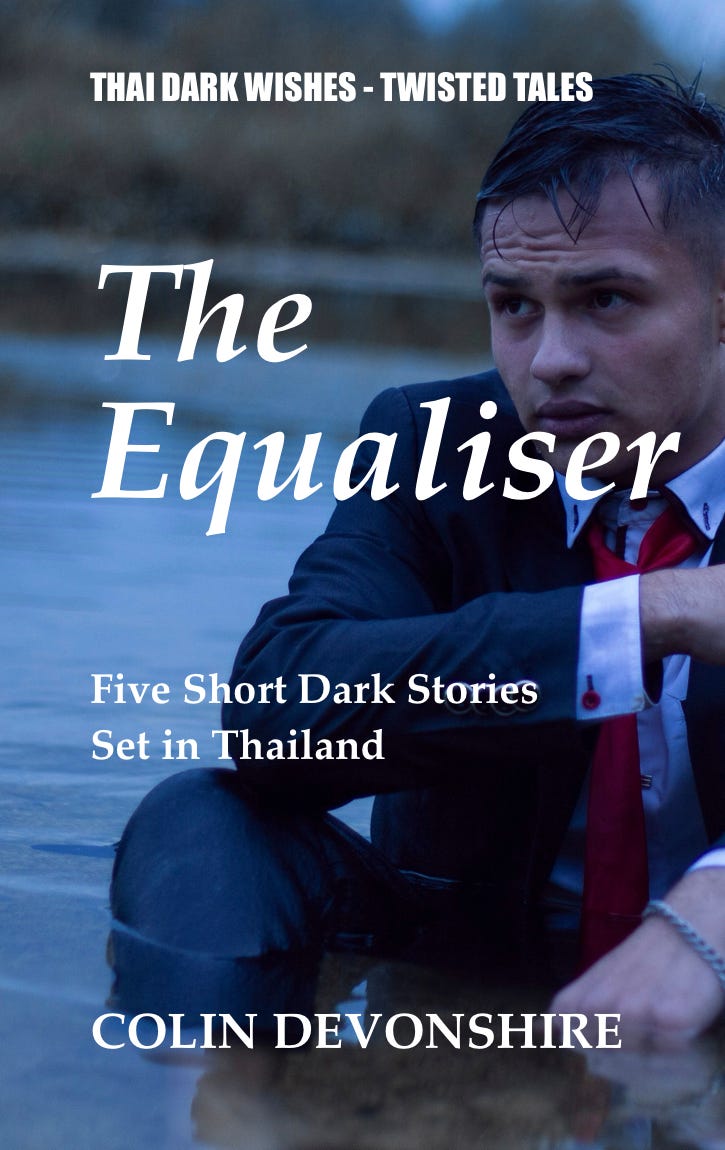
The Equaliser
Five dark stories. Five unforgettable endings.
Set in Thailand, where revenge, betrayal and superstition often walk hand in hand.
Download your FREE copy on Amazon before the offer ends.
Comments
Nothing yet. Say the first thing.
Sign in to join the conversation.