
In the end, it wasn’t even close. Looking back on the campaign, I am now very confident that Zack Polanski will be the next leader of the Green Party. And while I’m less certain about the outcome of the deputy leader contest, I am reasonably confident in calling it for Rachel Millward and Frank Adlington-Stringer.
Now let’s rewind 4 months(!) - back to mid May, it looked like there were going to be tight contests for the leader, so it’s worth taking a whistlestop tour of the campaigns to see how I think we ended up with a clear winner. I’ll also look at some of the challenges the new leadership team will step straight into.
In the period since the General Election, with Labour comprehensively failing and Reform’s rise seemingly unstoppable, the Greens had attracted negative press from the left-wing commentariat for supposedly underperforming. While I argued at the time that this was not a truly objective assessment, I would now add a caveat - it is now clear that the last year has not seen enough new thinking emerge.
Going into the election campaign, the party had not developed a comprehensive response to the challenges and opportunities of a political landscape transformed by the rise and rightward push of Reform, the collapse of the Tories, the political vacuum that is the LibDems, and the ongoing rightward drift of an already-failing Labour government.
Most of the focus in social and traditional media is on the contest for the leadership, as there is an implicit assumption that the leader role directs the party. This is not true of the Greens, with the leadership roles being really more like principal speaker roles.
This explains why there was (with one important exception) basically no disagreement on policy amongst the leader (and deputy leader) candidates. Instead, the focus of the leadership campaign was on how to be the best communicator of the party’s principles and policies, and how to convince the electorate (i.e. Green Party members) of that.
My view of the Green Party membership is that it can be roughly split into four groups:
Fully committed activists who live and breathe the party - and I’d estimate are c. 5% of the membership, and virtually all will vote in the leadership election.
Members who provide occasional to moderate active support (leafleting, canvassing etc.), mostly around elections - I’d estimate a further 10-20% of members, and most will vote in the leadership election
Social media supporters - active online but not on the doorstep. Hard to gauge numbers. Many will vote in the leadership election.
Passive members - pay their dues, vote (mainly) Green, they make up the majority of members. They are relatively unlikely to vote, and if they do, it will often be on minimal information (mainly just the candidate statements, name recognition and key endorsements).
Over the last decade, turnout has fluctuated between 15% (2020) and 30% (2016). I believe that we will see turnout this time to be towards the top end of that range. On that basis, and assuming an electorate of c. 67,000, the winner will need c. 8,000-10,000 votes.
As anyone who joined by 31-Jul could vote, there was a clear benefit to a candidate to have both an outward-facing campaign that attracts new voters into the party (as they will be almost certain to vote, and will specifically vote for the candidate that convinced them to join), as well as an inward-facing campaign.
Carla Denyer and Adam Ramsay delivered a successful joint leadership from 2021 through to last year’s General Election, helping deliver unprecedented electoral results for the Greens. But ahead of the start of the leadership election, there had been signs of strain in their relationship, for example on the issue of trans rights.
Zack Polanski had also been Deputy Leader since 2022, and through his social media, support of local party campaigns and in his role as a London Assembly Member (since 2021), he had built a reputation as a good communicator and effective campaigner.
The credible candidates for leader could only really come from:
The outgoing leadership team;
The other MPs;
London Assembly Members;
Prominent councillors.
This was simultaneously both still a small pool, and yet a bigger and more defined pool than in previous elections, where someone not holding elected office could stand for and even win a leadership role (e.g. Natalie Bennett, Jonathan Bartley or Amelia Womack - all of whom were the best candidates at the time).
Having been a co-leader from 2018-21, I thought it unlikely that Siân Berry would stand again. As quickly became apparent, London Assembly Members and prominent councillors realised they lacked the platform to take on the leader role, and so those who did stand contested the deputy leader role. This left three MPs (Carla, Adrian and Ellie Chowns) and the outgoing Deputy Leader (Zack).
Zack Polanski was first out of the gates, announcing his bid for Leader on 05-May. Carla Denyer announced she would not be re-standing just 3 days later. Ellie Chowns and Adrian Ramsay then announced their joint bid a week after Zack.
Immediately, it was clear that Zack and his team had done a lot of thinking and planning. He quickly lined up media appearances, had strong messaging and social media ready to go, and quickly built and engaged a large supporter base, e.g. through “friend [phone] banking” to directly engage members.
It also became clear that Ellie and Adrian were not as ready with their campaign, and probably had to launch earlier than they had expected. They led early with an endorsement from Caroline Lucas (16-May), and I think were planning to run a campaign similar to those which had been successful in previous election campaigns.
Zack initially struggled with, er, “misinterpretation” of his positions by reporters - e.g.
and:
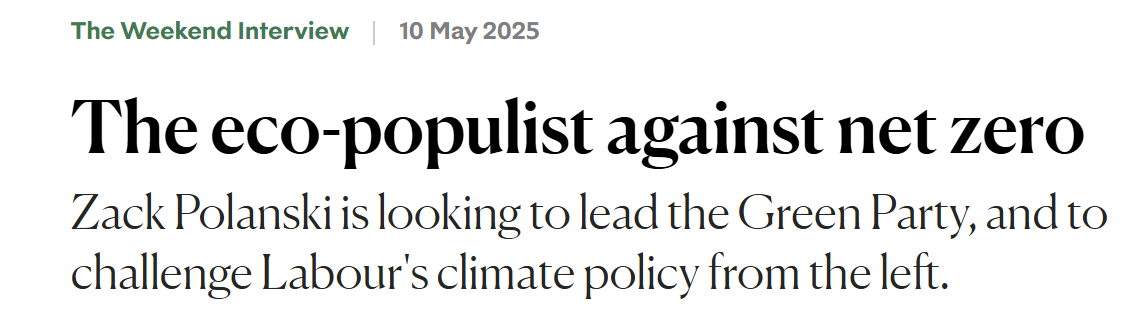
But good to see that Zack learned and avoided any further issues like this over the remainder of the campaign.
Ellie and Adrian’s main “misstep” was to never properly clarify whether they fully supported the Green Party's Trans Rights policies. This lack of an unambiguous position, especially given the issues with Adrian’s interview in April, was a red line for many Greens (including myself). Whether this proves to also be a red line for the “silent majority” of members will become clear when we get the results.
A later misstep by Adrian was not to have dealt with being a landlord in advance, and instead to had to try and explain the situation afterwards. He has a strong record of voting for renters’ rights, but that is always going to be lost in the noise of a “scandal”, and would have been better either divesting himself of the property, or if that wasn’t possible, having arranged to donate profits etc. to charity (or something of that ilk).
Zack had clearly identified the rising tide of concern and anger at the seemingly unstoppable rise of Reform and the absence of any solutions from a timid, technocratic and increasingly amoral Labour government. His approach - that Greens needed to be unequivocal in their support for those suffering the impacts of austerity, the cost of living crisis, discrimination etc., and also take on those who are causing it (Labour) or threatening to make it much, much worse (Reform).
Initially, he didn’t always recognise/communicate that without first achieving environmental sustainability, there can be no sustainable social justice - e.g. in an early (07-May) interview with Owen Jones, he listed his priorities as: 2 child benefit cap, NHS and housing. All important issues, but by selecting only them, he was not communicating the Greens’ holistic understanding that they are undeliverable in a collapsing ecosystem.
Zack soon adjusted his messaging, which arguably reached its peak with this video - achieving over 2 million views across social media.
I asked a couple of people who are broadly sympathetic to the Greens but don’t follow our social media what they thought of this video:
Is it effective?
1 - Quite ‘hard hitting‘ message so effective in grabbing your attention. Bit doomy/dark throughout esp. at the start both visually and in the message, brightens a bit towards the end, but left feeling overall message was anger about wealth/social inequality, not sure what ‘solutions’ he's suggesting to solve the problems are coming from though. Defensive headline at the end, very dark.
2 - I think it is probably effective in its goal of getting him to be leader of the Greens
Is it the message/values you think of the Greens as embodying?
1 - I wouldn't say this is automatically what I'd think a Green party promo would be like. It's more angry than hopeful (which obviously is the point), I wondered where the environment angle was but he sort of answered the question towards the end, but it came across more like a typical leftwing-Labour message than Green. Not that I wouldn't associate what he said with the Green party, but focus on environment/climate change I would expect to be more prominent. I guess this may be more likely to resonate with voters who feel strongly about social inequality and democracy under threat etc.
2 - Aligns with my model of the Greens as environment plus strong liberalism, idealism plus fairly radical tax & fiscal policy.
Do you think Zack comes across as a good leader for the Greens?
1 - Possibly, hard to say just on this video. Certainly passionate but I'd need to see more in a debate/interview etc.
2 - He presents pretty well on TV, radio, YouTube etc. If I was a member voting I’d also be thinking about his ability to organise and actually lead, and come up with good policy, not just be a good face / talking head, but I suspect I’m an outlier here
Would it make you more or less likely to vote Green?
1 - Not sure. Strong message but bleak and nothing on policy which is boring but I'd say important to make a view.
2 - I don’t think that is aimed at making me vote Green, it’s for an internal party election. It doesn’t change my view of what Greens stand for (although, surprised it doesn’t talk about climate change at all), but I guess I was slightly less enthusiastic about the Greens as the governing party when they had two co-leaders, it made me think they’d never be able to make any hard decisions in actual power
Ellie and Adrian focused on building on our approach to-date, while acknowledging that the Party needed to build capacity, fundraise, improve social media etc. For me, the real differences in their approach were as follows:
Core to their argument was that to maximise visibility, it was important (critical even) to have the party leadership in Parliament. A decade plus ago, I would have wholeheartedly agreed (it was Caroline Lucas’s voice in Parliament that first brought the Greens to my attention). But the media landscape has changed, and I think our target voters are less likely to be paying attention to traditional media and Parliament.
Preference to not introduce a harder, more attacking style to at least some of our comms. Again, much as I continue to prefer to be where possible conciliatory and positive in our comms, I think the political landscape is more confrontational, and to defend our values we need to make targetted use of harder messaging.
Much deeper fundamental understanding of the risks we face, that the Greens have the best answers, and how we should position the Party - but they did not communicate that effectively to a wider audience.
After the first month of the campaign, they recognised (12-Jun) that they had been caught short by Zack’s campaign, especially on social media, but their campaign did not manage to catch up, and if anything, fell further behind.
I first met Zack in late 2018, when I was London Regional Coordinator, and he stood in the internal election to select the Green Party’s 2020 candidates for Mayor and for the London Assembly. He had only recently become active in the party, but through diligent and effective campaigning, he went from a standing start to end up beating well-known, long-standing London Green activists. He achieved 3rd place on the London Assembly List, and hence got elected as a London Assembly Member. This was my first experience of Zack’s combination of a resolute focus on winning, effective campaign planning, and charisma (but I have to balance that a little by noting he did not initially disclose The Sun article to the Regional Party).
In the time since then, through his campaign to become Deputy Leader, his support to local parties in their election campaigns, his work in the London Assembly, and now this campaign for Leader, Zack has built formidable communication and campaigning skills. He identified that, as the insurgent candidate, he needed to get the early mover advantage, build momentum quickly, and ensure that a more “traditional” Green Party leadership campaign could not just steamroll him through name recognition and “celebrity” endorsements.
While it certainly helped that the wider political landscape, and our relative lack of progress over the last year, made this more of a change than continuity election for the Greens, that does not take away from Zack’s effective communication both to existing party members and to potential members, combined with a highly effective campaign team (notably Naranee Ruthra-Rajan). I now rate him and his team as some of the best at this kind of communications and campaigning in any UK party.
Against this, Ellie and Adrian started on the back foot, had no strategy to neutralise / beat Zack’s comms and organisational advantages (not even achieving more endorsements than Zack), and capped that with their ambiguity on support for Trans Rights.
The format of the election campaign is overlong (although that was exacerbated by Zack needing to start early). On reflection, I feel the die was cast within the first c. two months - the latter two months did not add much to the process. Specifically, nothing really tackled or threw light on the big questions:
While it was good that we had a lot more press attention for this contest than any previous one, it was mainly quite superficial and demonstrated that most journalists’ lack any real knowledge of the Greens.
There was no independent polling, message testing etc. to help understand how effective each of the proposed approaches to comms etc. might actually be.
There was no forum for really analysing the challenges facing the party, the kinds of voters we need to win over, or the vision/options for scaling etc. - neither leadership nor GPEx hustings really covered it, and only a few articles touched on these questions.
Towards the end of the campaign, the New Left Party started to become more real, but there was still not much debate as to what it might mean for the Greens, why our values and policies are the right ones for these critical times, and hence how we should respond to the NLP.
The whole discussion was too England-focused. We are part of a global movement in response to global, existential issues - but this was barely discussed.
We are going to do most of this all again in 2026. If Zack has been successful, then I don’t think a credible candidate will stand for leader, but nevertheless the election process will be at least three months and will be a distraction for the leadership team.
So we should aim to make the process faster (especially nominations and voting, as these can now be done electronically) - I’d say make it two months.
I also think some budget for polling on how candidates are perceived by the wider public would be beneficial.
Finally, the campaign spending limits are comically low and should be increased.
For Zack specifically, I hope he can materially improve on this:
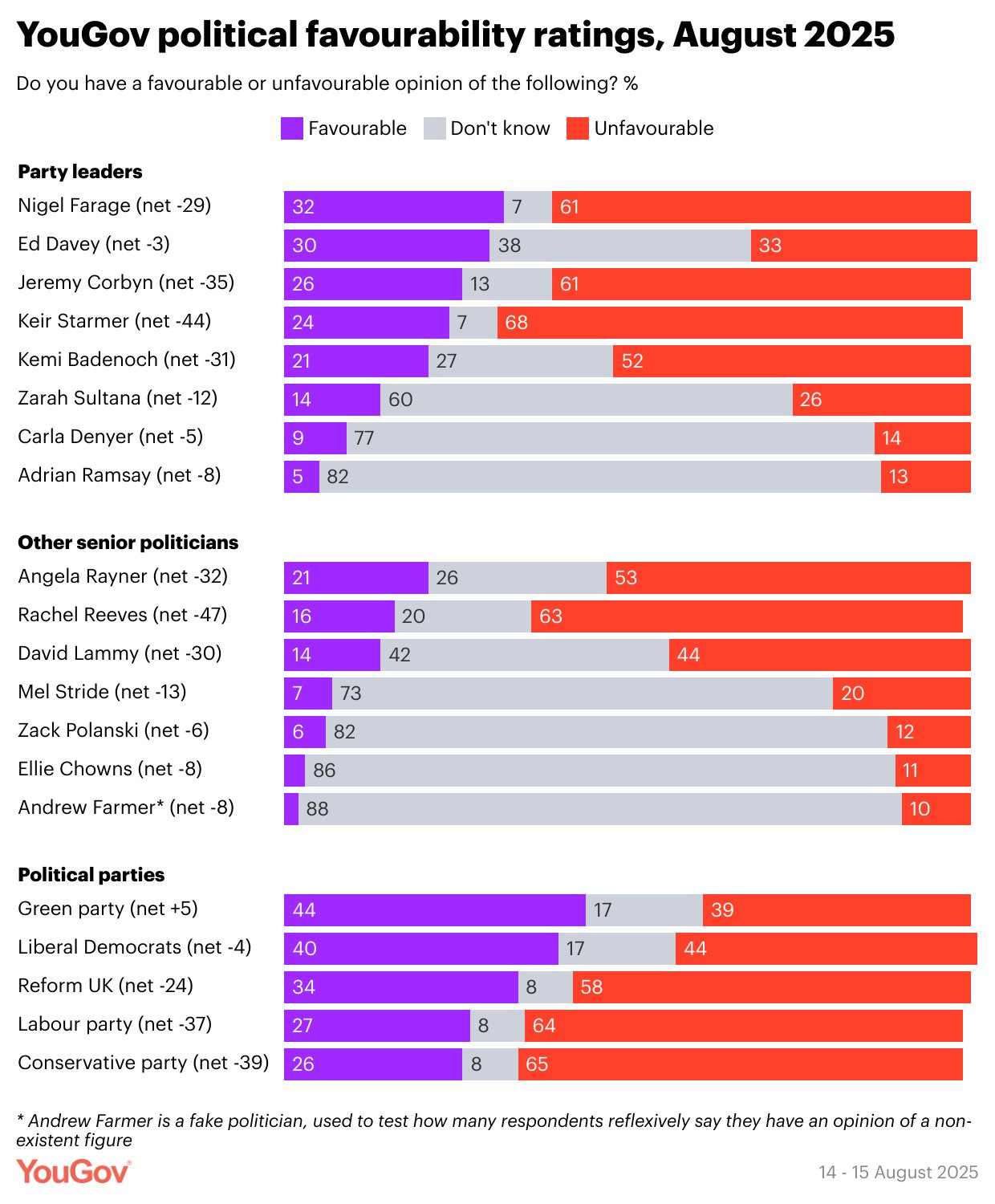
My main concern stemming from Zack’s campaign is the seeming shallowness of its roots. I worry that the temptation will be to cleave to top-down, disempowering “solutions” that actually accelerate environmental collapse - e.g. promising huge amounts of housebuilding rather than redistributing the already ample property wealth, or huge amounts of new spending on the NHS, and that all we need for all that is a little bit of extra tax on the most wealthy. The reality is that we need to prioritise what remaining carbon budget we have on achieving zero emissions ASAP, on adapting to the locked-in damage from emissions to-date, and on achieving a truly socially just and sustainable world. It’s important to give people hope, but it’s wrong to give people false hope.
Additionally, while I agree we need to take a much stronger line with the far right, we must not lose our values of inclusiveness, avoiding negative campaigning for the sake of it, and be really clear that when we do take a tough line, it is only where absolutely needed to defend our Core Values.
So Zack will have c. 9 months to prove that this approach is working, otherwise I expect we will see a credible challenger and the opportunity to change course.
The first thing we need is for the winners to be magnanimous in victory and the losers gracious in defeat. The UK is facing climate and societal breakdown, and we need to bring the party together quickly so that we can focus our energies on winning hundreds of new councillors and our first Senedd seats in the 2026 elections, as well as defeating as many Reform candidates as possible.
Much of what I’ve read makes me think the NLP view themselves as the rightful custodians of “the left”, and that we have just been keeping the seat warm for them. So we also need to be ready to stand up to the NLP, hold it to account in the same way we would any other party - it is far too early to tell whether its values will align with our Core Values, and there is too much at stake if they don’t. We also need to be ready to answer difficult practical questions, such as people trying to be members of both parties, or a push for us to stand aside unilaterally in the 2026 elections (I went through that in the 2017 General Election - let’s not do that again!)
More generally, we need to properly assess our strategy for the next couple of years - building on Target-to-Win, (somehow) getting hold of more money, growing our membership quickly, rebuilding our digital platforms, and radically improving our social media and comms.
The traditional parties are increasingly disconnected from the huge challenges facing people and planet, as demonstrated by the historically unprecedented fragmentation of the century-long Tory-Labour duopoly. Having transformed its success over the last 5 years, the Green Party now has an unprecedented opportunity to demonstrate that its values, solutions and people are those that frustrated and disenchanted voters are seeking.
And a final aside, we are still on track to make canvassing software available to local parties in October - more on this over the course of September.
No posts
Comments
Nothing yet. Say the first thing.
Sign in to join the conversation.