
As set out in my previous article, 2025 was a transformative year for the Green Party. And while the headline impacts in terms of membership and polling are well known, the internal dynamics of the party and the wider Green politics ecosystem are rarely discussed. This is particularly important now, as we will need our internal governance, processes, and systems to step up, avoid the mistakes made in the 2015 Green Surge, and instead rapidly and effectively realise and steer the unprecedented levels of time, money and opportunity that we now have available to us.
So ahead of a look at what the party needs to do in 2026, I wanted to set out what happened within and around the party in 2025, which I’ve now split into two articles - the first giving some context and then looking at some of the “softer” issues like party culture, how we managed the membership surge, and how we are doing in terms of an external but party-focused media, think-tanks etc.
I joined the Green Party of England and Wales in May 2013, and became an active member the following summer. This has included time as a Local (Southwark) and Regional (London for 6 years) Coordinator, plus I have attended almost all the Conferences since 2015 and have volunteered for several key national party projects.
When I first became active, I soon found out that the party had multiple related problems/constraints, notably:
A Constitution designed in the two decades ago, when membership was in the low thousands, where volunteers governed and ran the Party, and where everything was expected to be done through periodically meeting up in the same physical space.
Digital tools that were difficult to use and had minimal functionality (notably a customised version of CiviCRM).
A culture more like a pressure group, with only a few local parties that really focused on winning elections.
Over the decade through to 2024, the party has made:
Good progress on culture:
A transformed activist culture where winning elections is valued and prioritised.
An emerging focus on getting Green policies implemented where we can (e.g. where we are part of the administration of a Council).
But with more to do around the relative lack of engagement from the wider membership.
Some progress on Digital Tools:
In 2019, CiviCRM was replaced by Action Network, which added a lot more pressure-group engagement and supporter activation functionality, but was not a membership management system and did not support canvassing (resulting in a plethora of local party management and canvassing solutions, most of which are onerous to run and have questionable data protection).
Implementation of a forum-based platform (“Green Spaces”), which provided a basic, members-only space for communication.
Not enough progress on the Constitution and governance
Multiple attempts to re-write it to support the much larger membership, embrace digital platforms and update the heavy burden placed on the volunteers elected to the Green Party Executive and Green Party Regional Council, none of which have been adopted in their entirety, in part because of the need to get a two-thirds majority to change the Constitution
A number of more tactical changes have been made over the years (e.g. to improve the quality of Policy Development) but these have barely kept pace with the increasing challenges posed by the transformed scale of the Party.
Conference has also become (in my view) less effective at delivering good debate and decisions, and while we get through more debates now than we did a few years ago, Conference once/twice a year also cannot keep up with the pace of change and with the volume of motions that members now want to discuss.
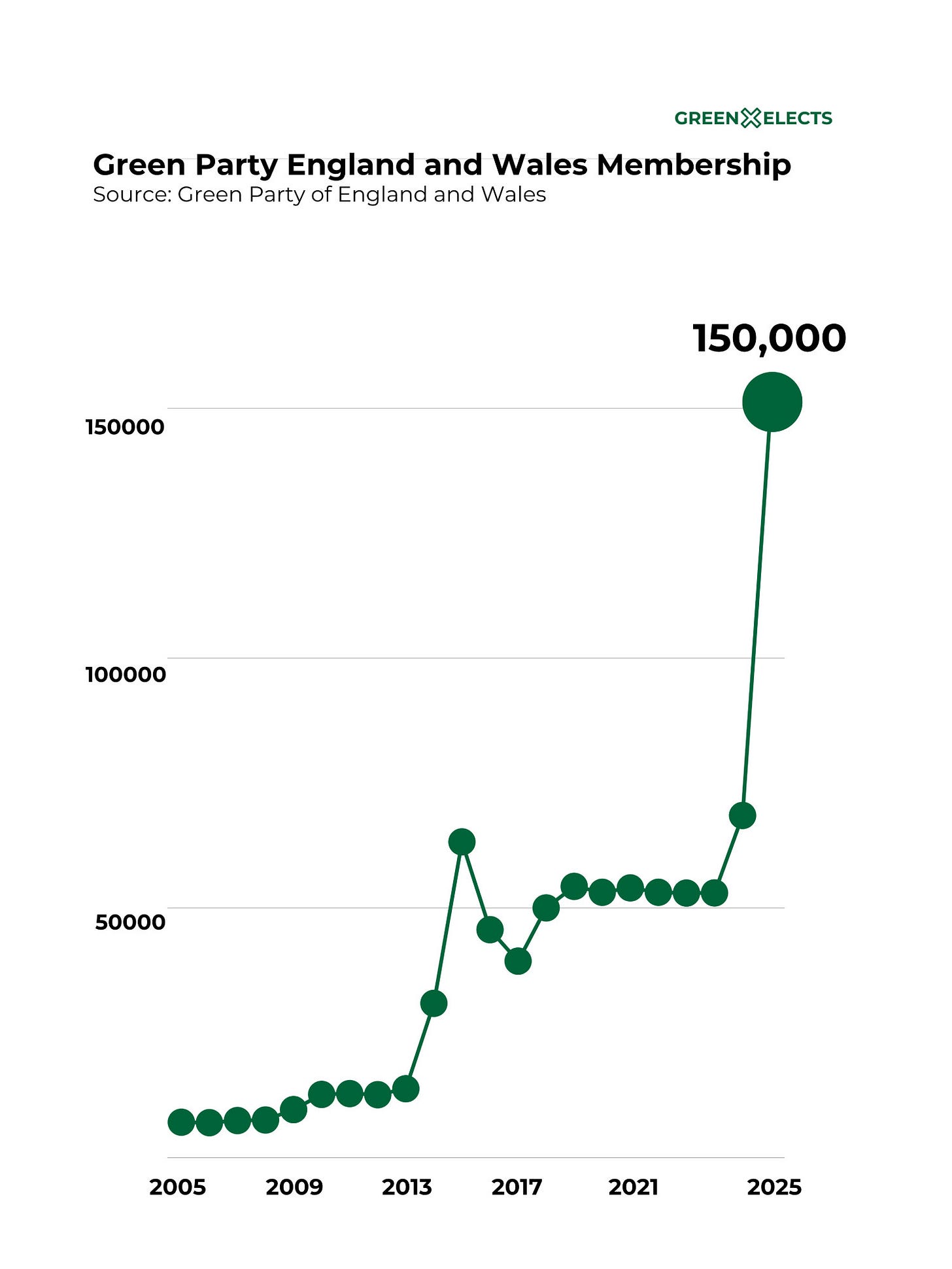
Any activism-based organisation experiencing a huge surge in membership (it’s now >184k) is going to struggle. The existing organisation needs to engage, educate and activate new members while they are still enthusiastic. For an organisation like the Greens that is primarily volunteer-driven at the local and regional level, this is a huge challenge - and one we failed in 2015.
This is not the first time the Greens have experienced a membership and polling surge - during the 2015 General Election campaign, the party’s membership doubled in just a few months. I was Coordinator for Southwark Green Party at the time, and it caught us by surprise at a time when we were already maxed out with the election campaign - we didn’t have the processes, tools, training or capacity to respond.
We therefore failed to build real commitment to the Green Party’s ethos and vision, so once Corbyn won the Labour leadership, we lost a lot of those members. By late 2016, our membership had roughly halved, back to where it had been at the start of the Surge, and only in 2025 did we finally surpass the 2015 peak.
The members who stayed, or joined through to c. 2024, were mainly aligned with the party’s ethos and vision, helping maintain a strong party culture, especially among councillors, officers and activists.
The good news is that this time, most local parties already have some form of new member engagement process in place, especially the larger parties that have experienced the largest increases. That this has happened outside of the most intensive campaigning season also helped, as it meant there was more capacity available to respond, plus for those parties with elections in May 2026, it has enabled the mobilisation of additional target and development wards.
Nevertheless, it has still required an intense amount of work - for example, Southwark’s membership has more than tripled in c. six months, and its Officers and activists had to work incredibly hard to engage those new members (hats off to them all!) - but it has meant that we are now running many more additional May 2026 target and development campaigns.
When the Green Party decided in 2018 to focus its available resources on becoming an election-winning organisation, one of the areas that was implicitly de-prioritised was the political education of members. The impact of that on the approach to the membership surge has been that new member engagement focuses on getting them out campaigning (leafleting and/or canvassing). The national onboarding process for new members does mention in passing our values etc., but it does not include any sustained political education. To evidence the impact of this, I polled Southwark Green Party’s main WhatsApp group, which has c. 5% of its total membership (so mainly activists) as to their awareness of the party’s Core Values.
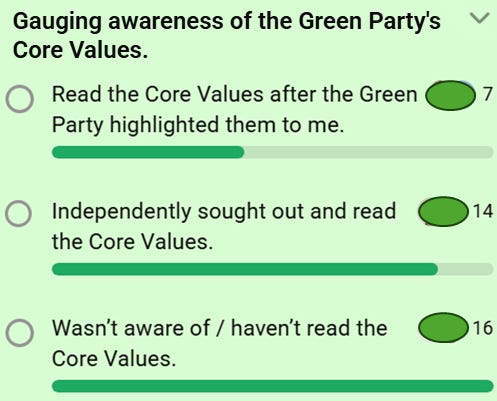
I appreciate it’s a small sample size, but it does illustrate how most of our local activists either had to proactively seek out our Core Values (38%), or just weren’t even aware they existed (43%)!
In my review of the leadership election, I wrote that:
The first thing we need is for the winners to be magnanimous in victory and the losers gracious in defeat. The UK is facing climate and societal breakdown, and we need to bring the party together quickly so that we can focus our energies on winning hundreds of new councillors and our first Senedd seats in the 2026 elections, as well as defeating as many Reform candidates as possible.
Thankfully, this is exactly what we did (I really do like being in a party with this kind of culture!) The high turnout, Zack’s emphatic victory and the underlying culture of party meant this ended up being a unifying result, with local parties stepping up to make the most of the polling and membership surge.
The Green surge has also so far seemingly not fundamentally changed the party culture - and in my discussions with ex-Labour members, many have positively embraced our culture, finding it a relief from the incessant, poisonous factional infighting that seems to be a feature of so many Labour branches.
While the Greens have had “Special Interest Groups” for many years, this year saw Greens Organise become the first really effective organised faction within the party.
From the outside (I’m not a member), based on their constitution, the events they have run, and their AGM resolutions, they combine a policy agenda with work to improve the effectiveness of the party, especially around comms and campaigning. They state they have over a thousand members, including a Green Party Executive (GPEx) member on their Steering Committee, and they pushed particular priorities during the leadership election (but did not specifically endorse any candidates) and supported/opposed specific motions at Conference. I note that, unlike the national party, a priority for them is delivering Political Education to their members - although of course, I don’t know to what extent that aligns with the Party’s Core Values. I was also glad to see they called out the need to avoid centralisation of power within the party.
The Green Party’s Constitution is basically silent on factions (unlike e.g. the Labour Party Rule Book), so as far as I can see, Greens Organise’s activities in 2025 all seem to have been constitutional. In terms of effectiveness, it’s hard to gauge precisely, but I believe they did influence (but definitely did not determine) the discussion around improving comms and around specific policies debated at Conference.
What I haven’t seen is any evidence that they are really pushing back against centralising tendencies or have tried to hold our governance and leadership to account. I do worry that, as far as I can see, many of the core Greens Organise activists, and the current GPEx, Green Party Regional Council (GPRC) and leadership, are all part of the same loose internal party “network”, and hence that Greens Organise are not really that incentivised to scrutinise the party leadership and governance and to push for transparency and inclusion in decision making - but I hope to be proved wrong!
Where would you go to find out what the live debates were in a political party? What independent, party-focused platform would you look to? Well, for the Tories, Labour and the LibDems, it is obvious - they all have well-resourced platforms delivering an ongoing feed of party-focused news, analysis and discussion. Your Party has also had multiple sympathetic publications delivering frequent articles providing analysis and discussion (plus podcasts and even a book!)
The Greens have…Bright Green? It usually publishes 1-2 news articles per month, and a similar number of comment articles (noting that the leadership campaign caused a temporary spike in both). As a volunteer-driven operation, Green Elects also does a good job within its chosen remit - but is understandably limited in what it can cover.
Some informed, independent discussion does take place in e.g. Facebook Groups, some YouTube channels, a few blogs, occasional articles published in more general media platforms, and via Greens Organise. The leadership election did provide some further limited opportunity for debate via hustings and (a few) articles, but even this was constrained in terms of time, voices and subjects.
Despite the lack of party-focused independent media platforms, the Greens just about muddled through 2025, mainly because our underlying ethos and vision are long-established, our activists share the objective of using Target-to-Win to get elected, and the culture is generally quite collegiate and inclusive.
Nowhere is there a really sustained discussion of the party by informed voices. I believe that if we’d had a vibrant Green Party-focused media delivering analysis, discussion and accountability, many of the problems and missed opportunities in 2025 would have been at least identified, and party leadership/governance put under real pressure to get them addressed (or at least explain why they couldn’t do so).
Green Party members have developed a thorough policy platform over many years, and this work has been done almost exclusively by volunteers. Many bring their professional skills and experience to this work, and others have dedicated their spare time to understanding the evidence and options in a given policy area.
What we do not have is really much in the way of think-tanks that focus on doing deep research and thinking specifically in the context of the Green Party’s ethos and vision (Green House is a small exception). This means that when, it comes to being able to explain how we would actually make policy work, e.g. in 2025 a clear example was a wealth tax, we do not have the deep background to counter the many voices (even some on the soft left) saying they can’t. We usually have to rely at best on think-tanks that are broadly left but politically neutral. This compounds the weakness of our platforms for debate and discussion (and weaknesses in our policy-making which I will cover in the next article), and so we have seen little discussion in 2025 (or earlier) of the impact of such policies before we adopt them, so even where we do see attempts to raise issues and policies (e.g. wealth tax, AI, climate change adaptation etc.), these are siloed and the discussion rarely gets started.
A small party with limited resources chose in 2018 to focus virtually all its efforts on winning elections - and in this the Greens have become relatively successful. This decision (which I supported) meant that there was very little activity or investment made into building the wider ecosystem around the party. Nevertheless, the strong, unified culture - especially among councillors, officers and activists - meant that the party managed to thrive in 2025 despite having minimal other unifying activities and structures.
The 2025 membership surge has brought in huge numbers of new members (so the majority of members have been with the party for less than 6 months). While the party has done well to not be overwhelmed by a near tripling in members in c. 6 months, as many joined based on e.g. Zack’s (excellent) social media and as the political education element of onboarding/engagement is generally low, this means that most new members have not (yet) progressed beyond a vibes-based relationship with the party.
The surge happened too late in 2025 for the potential impacts on party culture to become clear, although a harbinger of that may be the rise of Greens Organise as the first true faction within the party.
We also did not have in 2025 thriving, vibrant debate, discussion and deep thinking on the party, as we still do not have platform(s) that are independent of, but focused on, the party and the issues it faces, which meant that sustained debates on policy, messaging, strategy etc. were sporadic and disjointed, with consequent impacts on the quality of those discussions and decisions.
My next article will look at what happened in 2025 on campaigning, comms (internal and external), and governance/decision-making.
No posts
Comments
Nothing yet. Say the first thing.
Sign in to join the conversation.