
The current prioritisation of gender identity above sexed differences is another iteration of Greek philosophical ideas that associate the intellect, form, and rationality with the masculine and as superior to matter, the body, and nature which are connected to the feminine.
Lots of ancient cultures associated nature, the body and the earth, with the feminine which was often symbolised as a fertility goddess. Demeter and Persephone, for example, were part of an Earth or Mother-centered religion. Similarly, Gaia was revered as the Greek goddess of Earth whilst the Roman Goddess Diana was linked to fertility and was identified with the Greek goddess Artemis.
The prominence given to the divine feminine in ancient Greece is evident from Temple of Artemis at Ephesus in modern-day Turkey which was once one of the Seven Wonders of the World. Notably, it was at Ephesus where, in 430 an ecumenical Council officially gave Mary the title ‘Mother of God’. In Christianity, Mary is considered the contributor to the human nature of Christ whilst God is the paternal divine side. By 430, the Temple of Artemis had been destroyed by the Goths and was then impacted by the imperial decree of the fourth century prohibiting pagan worship. Unlike Artemis, Mary is not considered a fertility goddess. But, interestingly, both were virgins.
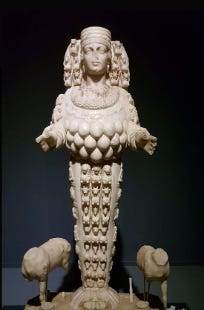
The word ‘mother’ is linked to the words material and matter which come from the Indo-European root mā- meaning to make or produce and which was sometimes used in relation to making the child within the womb. The root mā- is also in the Latin word matrix meaning ‘womb’ or ‘breeding animal’ and it is also in the word ‘machine’. Lots of Indo-European words for mother also come from this root including the Latin māter and the Sanskrit mātár-. In Irish we have máthair, in English mother, Spanish madre, German mutter, and you can see the root mā- also in mammy, ma, mam. This illustrates the cultural embeddedness of connections between the material, matter, and the feminine.

Plato also associated the earth with the feminine. In his dialogue Timaeus he wrote: ‘The earth, which is our nurse’ and he also wrote that if man failed to live well ‘at the second birth he would pass into a woman’. Plato maintained that ‘the so-called womb or matrix of women; the animal within them is desirous of procreating children, and when remaining unfruitful long beyond its proper time, gets discontented and angry, and wandering in every direction through the body, closes up the passages of the breath, and, by obstructing respiration, drives them to extremity’. Yet, his views on women can be conflicting. In The Republic he argued that women could be philosophers and rulers too.
Plato’s student Aristotle went a step further and, in On the Generation of Animals wrote: ‘the woman is as it were an impotent male’. He asserted: ‘For the first principle of the movement, or efficient cause, whereby that which comes into being is male, is better and more divine than the material whereby it is female’. He also wrote: ‘While the body is from the female, it is the soul that is from the male’ and he believed that semen was thick and white ‘because it is mixed with spirit’.
Along with the association of matter and the feminine was the idea that the soul or the mind is superior to the body. In Plato’s Phaedo, Socrates says that the ‘true philosopher, ‘would like, as far as he can, to be quit of the body and turn to the soul’. The body, says Socrates, is ‘a disturbing element, hindering the soul from the acquisition of knowledge’. Souls, he says, ‘are simply fastened and glued to their bodies: the soul is only able to view existence through the bars of a prison’.
The idea of the superiority of the soul and mind was taken up by the Neoplatonists in Late Antiquity. Neoplatonism, a philosophical movement that began in the third century in the Greco-Roman world, was the dominant political ideology up to the middle of the seventh century. Plotinus (c.205-70), the first Neoplatonist, used the words ‘receptacle’ and ‘nurse’ in relation to matter, again showing the link to the feminine. He rejected the view that the female contributed matter to the embryo and that the male contributed the form. However, bodies occupy a lower rung than the intellect in Plotinus’s framework. In The Enneads, he wrote that the intellectual principal is ‘the summit of our being’ and that it contains the Divinity. He also wrote in the Enneads: ‘Real awakening is rising up from the body, not with it’. He wrote that the body was ‘the inferior element’ and that the image of the Soul progresses downwards in the human ‘until the series ends in the faculties of generation and growth and of all production of offspring’. Here again is the idea of the feminine as the lowest.
Neoplatonists had ceremonies to purify the body that was seen as a vehicle for the soul. They believed there is an unknowable source from which everything originates, the One which is beyond words. From this, emanates Intelligence or nous, then Soul which comes in various forms that are further and further away from the One with the furthest emanation being matter. Neoplatonists prioritised ‘Mind over Matter’. Plotinus’s student Porphyry wrote the Life of Plotinus which begins: ‘Plotinus, the philosopher who was our contemporary, seemed to be ashamed that he was in the body. It is because of this attitude that he could not bear to speak about his race, his parents, and his native land’.
By relegating the body to a lower rung on their conceptual framework, Neoplatonists downplayed the importance of matter which has been associated with the feminine both in ancient goddess-centered religions and in Greek philosophy. However, the situation is complex. There were female philosophers within Neoplatonism who played important roles - including Hypatia, who was killed by a Christian mob in 415CE. Whilst Neoplatonism advanced the position of women in some senses, binary oppositions persisted, with the male associated with logic and transcendent spirituality, and the female associated with the maternal, the material, and nature.
The hierarchy of intellect over body is evident again today when theories about gender are considered more important than the actual physical body. The author, philosopher, and polymath Iain McGilchrist argues that bodies have come to be treated like machines in western civilisation and there is a prioritisation of abstract reasoning and rational control at the expense of recognition of the body’s importance and its role in emotion and meaning-making. I am not arguing that the body is more important than the mind or the intellect and I am not saying that the masculine or the feminine is more important than the other. As McGilchrist says: ‘Things and their opposites depend on one another for their being, bring about something new through their opposition, and ultimately co-create the world.’
No posts
Comments
Nothing yet. Say the first thing.
Sign in to join the conversation.