
It’s Friday morning, and here’s a rundown of some things I think you should know about.
Obviously, the biggest story across the country continues to be the trade negotiations between Canada and the United States.
And after months of threats, tariffs, counter-tariffs and Donald Trump seemingly finding a new reason to be angry with Canada every other week, it looks like we may finally be getting closer to some kind of deal.
But Canadians might not like everything that’s in it.
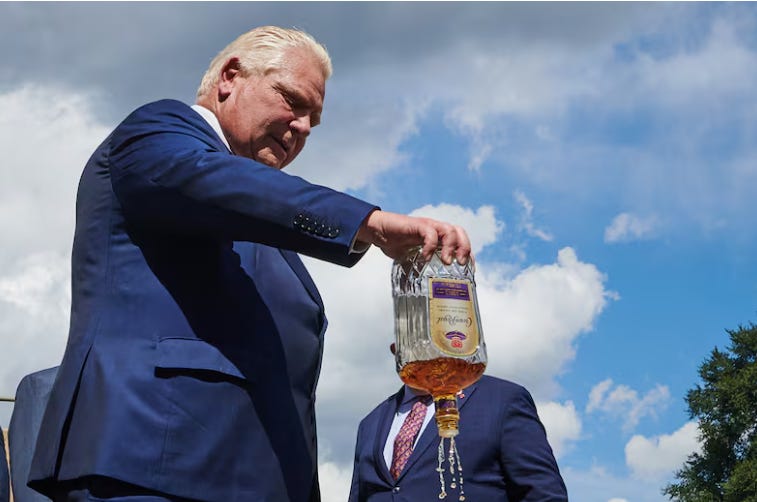
Let’s start with something that has become surprisingly important to the Americans: booze.
Prime Minister Mark Carney has asked the provinces to put American alcohol back on store shelves as part of Canada’s efforts to reach a deal with the Trump administration.
According to Manitoba Premier Wab Kinew, Carney went about as far as you can go without actually begging the premiers to do it.
Kinew still seemed apprehensive about putting American booze back on Manitoba shelves, but made an interesting point: if American products are available again, Canadians can simply choose not to buy them.
And let’s be real, Canadians aren’t going to drink it. At least the true Canadians won’t be drinking it. Maybe the separatists will. Anyway, back to the actual negotiations.
Canada’s chief trade negotiator, Janice Charette, remains in Washington meeting with U.S. officials. According to reporters, those negotiations are expected to continue very late into the night as the two countries try to finalize an agreement.
One of the biggest changes appears to involve Canadian steel.
CBC is reporting that Canada could receive some form of import quota for steel entering the United States.
Essentially, a certain amount of Canadian steel would face a lower tariff, but once Canada exceeds that amount, the much higher tariff kicks back in.
The Globe and Mail reported more specific details, citing an unnamed steel industry executive.
According to that executive, Ottawa has agreed to a tariff-rate quota that would allow four million tonnes of Canadian steel per year to enter the United States at a 25 per cent tariff.
Once Canada exceeds four million tonnes, the tariff would jump back to 50 per cent, which is what Canadian steel exporters currently face under Trump’s Section 232 tariffs.
The executive also claims Canada has agreed to eliminate its counter-tariffs on American steel and further restrict steel imports coming into Canada from third countries. So yes, Canadian steel producers would get some relief. But a 25 per cent tariff is still a tariff.
Canada is also pushing hard for relief for the auto industry.
Reporting suggests Canadian vehicles could receive a lower tariff, but potentially only on the American content contained within those vehicles.
The North American auto industry is incredibly integrated. Parts can cross the Canada-U.S. border multiple times before a finished vehicle rolls off the assembly line.
Canada is also seeking lower tariffs for other major industries, including aluminum, lumber and furniture.
Exactly how much relief those industries receive is still being negotiated.
The United States is reportedly demanding a number of major concessions from Canada as part of a broader agreement.
Those demands reportedly include giving Washington a right of first refusal on Canadian critical minerals, completing Canada’s planned purchase of F-35 fighter jets, purchasing additional American military equipment as part of Canada’s participation in Trump’s proposed Golden Dome missile defence system, and increasing Canadian oil exports to the United States.
Dairy is also part of the negotiations.
The reporting right now suggests Canada could allow more American dairy products into the Canadian market, but the country’s supply management system would remain intact.
That’s an important distinction.
It would mean increased access for American dairy without dismantling the entire system protecting Canadian dairy producers.
And that brings us to the politics of whatever deal eventually emerges.
I have personally spoken with a source in Ottawa who tells me there is significant concern among Liberal MPs about how Canadians will react to the deal currently being proposed by the United States.
According to my source, both Liberal MPs and Prime Minister Mark Carney have conveyed concerns that the current proposal would be difficult to sell to Canadians.
And when you look at what is reportedly being discussed, you can understand why.
Canada could remove some of its retaliatory tariffs.
American alcohol could return to provincial shelves.
The United States could get greater access to Canadian dairy.
Washington wants preferential access to Canadian critical minerals.
Canada could commit to buying billions of dollars worth of American military equipment.
And even after all of that, major Canadian industries could still face substantial U.S. tariffs.
So the question isn’t simply whether Canada and the United States reach a deal.
It’s what Canada has to give up to get one.
No posts
Comments
Nothing yet. Say the first thing.
Sign in to join the conversation.