
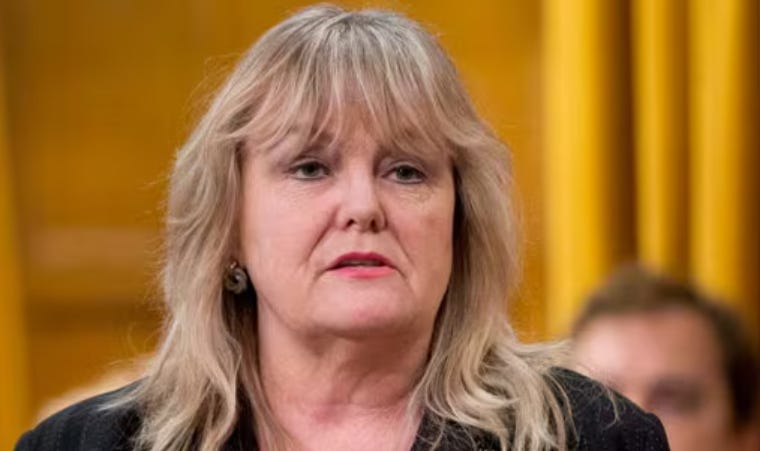
Kerry-Lynne Findlay is the newly elected leader of the Conservative Party of B.C., and if you live in British Columbia, I think you should probably start paying attention to who she is and the direction she appears to be taking the party.
Because this is not some fringe political party with no chance of forming government.
The B.C. Conservatives came within a handful of seats of winning the 2024 provincial election, and the party remains a serious contender for government. That means Kerry-Lynne Findlay could very well become the next premier of British Columbia.
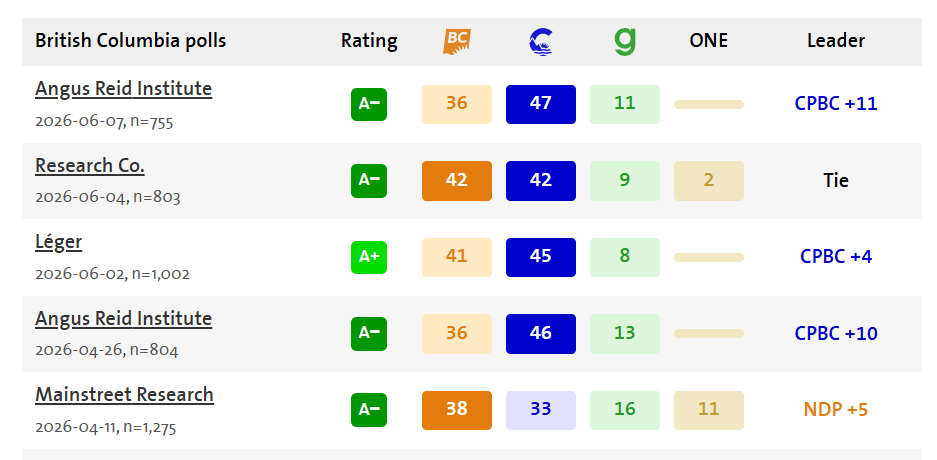
And based on what we have seen during her first few months as leader, I think British Columbians should be concerned about just how far to the right she intends to take the province.
As someone living next door in Alberta, I see a lot of similarities between what Findlay appears to be trying to build and what Danielle Smith has built here.
Trust me, you don’t want it.
Findlay was born in Ladysmith, B.C., in 1955 and grew up on Vancouver Island. She went to UBC, became a lawyer and began practising law in British Columbia in 1979.
Her first attempt at elected politics came in 2000 when she ran federally in Vancouver.
She lost. But the party she chose to run for is worth mentioning.
Findlay wasn’t a Progressive Conservative. She ran for the Canadian Alliance.
At the time, Canada’s political right was divided between two major parties. There were the Progressive Conservatives, the old federal conservative establishment, and the Canadian Alliance, which had evolved from the Reform Party and generally occupied the more populist, right-wing side of Canadian conservatism.
The Canadian Alliance and Progressive Conservatives eventually merged in 2003 to create the modern Conservative Party of Canada.
Findlay remained involved in public life. In 2006, Conservative justice minister Vic Toews appointed her to the Canadian Human Rights Tribunal, where she served until 2011.
Then she decided to give elected politics another shot. This time, she won.
Findlay was elected as the Conservative MP for Delta-Richmond East in Stephen Harper’s 2011 majority government. She quickly moved up the ranks, first serving as parliamentary secretary to the justice minister, then as associate minister of national defence and finally as minister of national revenue. Findlay isn’t some political newcomer. She has been around conservative politics for more than 25 years and served at some of the highest levels of the federal government.
She lost her seat to Liberal Carla Qualtrough in 2015 and then attempted another comeback in the 2017 South Surrey-White Rock by-election, where she lost again.
In 2019, she tried again and won.
She was reelected in 2021, and when Pierre Poilievre became Conservative leader in 2022, he appointed Findlay his chief opposition whip. She remained in that position until shortly before the 2025 federal election.
Then Findlay lost her seat again in 2025.
But by this point, there was another political opportunity opening up much closer to home.
Her husband, Brent Chapman, had been elected as a B.C. Conservative MLA in the 2024 provincial election. And by the end of 2025, the B.C. Conservatives were falling apart.
John Rustad, the man who had taken the party from relative obscurity to within striking distance of government, was pushed out as leader after months of controversy and infighting. Suddenly, the party needed a new leader.
Findlay saw an opportunity.
This is where I think the story becomes much more important.
Findlay entered the B.C. Conservative leadership race with decades of experience in mainstream federal politics. She had been a lawyer, a human rights tribunal member, a Harper cabinet minister and a senior member of Pierre Poilievre’s caucus.
She could have presented herself as the experienced candidate who was going to stabilize a party that had been ripping itself apart.
Instead, she made a very deliberate decision to run against the centre.
Her campaign framed the leadership race as a choice between:
“A reliable conservative, or a liberal takeover.”
Her own campaign promised to “keep it conservative.” It talked about getting “ideology out of schools,” putting “parents back in charge,” defending property rights and putting “freedom first.”
In other words, Findlay wasn’t hiding where she wanted to take the party.
During a leadership debate in May, the candidates were discussing B.C.’s Declaration on the Rights of Indigenous Peoples Act, better known as DRIPA.
All five candidates agreed that the legislation should be repealed.
But Findlay went after fellow leadership candidate Peter Milobar over whether he would face a conflict of interest dealing with Indigenous issues.
Why?
Milobar’s wife and children are Indigenous.
Findlay told Milobar she didn’t see how he would be able to get around conflict-of-interest rules on major issues.
Milobar responded by essentially forcing her to say what she was getting at, asking whether she believed he was conflicted because his wife was Indigenous.
Findlay then referenced his wife’s connection to the Kamloops Indian Band.
The exchange was condemned not only by political opponents, but by people within the conservative movement. Milobar described it as the “worst side of politics.”
Findlay ultimately won the leadership anyway. Barely.
The final ballot came down to Findlay against Caroline Elliott.
Findlay won 51 per cent to 49 per cent, taking 4,696.51 leadership points compared with Elliott’s 4,514.49. The raw vote between the two was even closer, with 10,907 votes for Findlay and 10,847 for Elliott. The party was almost perfectly divided. It seems today the party is still divided.
Fast forward less than three months.
On Friday, Peter Milobar announced he was leaving the B.C. Conservative caucus entirely and would sit as an Independent.
Milobar said the disconnect between his own values and the “new direction” of the party had become increasingly clear.
This is a longtime conservative politician who ran to lead the party and served as its finance critic deciding that he can no longer sit in the caucus because his values don’t align with the direction Findlay is taking it.
There are also reports of growing unrest within the Conservative caucus over that direction.
And while more moderate figures are walking away, take a look at who is being brought in.
After taking over, Findlay began reshaping the party organization.
One of the people brought in was Apollo Chung, who became the B.C. Conservatives’ director of operations.
Before that, Chung was associated with Alberta’s separatist Republican Party of Alberta.
Yes, you read that correctly.
A person associated with a political movement advocating for Alberta to leave Canada is now the director of operations for a party that could form the next government of British Columbia.
Findlay’s Conservatives also hired Cosmin Dzsurdzsa, formerly of the right-wing outlets Juno News and True North, as caucus communications director.
At the same time, senior figures associated with the B.C. Conservatives’ rise under Rustad have left the organization.
You can dismiss any one of these things individually.
It becomes harder to dismiss them when you put them all together.
Dallas Brodie was kicked out of the B.C. Conservative caucus under John Rustad in 2025 following a controversy over comments she made while discussing residential school survivors.
Her removal was so divisive that two other MLAs subsequently left the Conservative caucus, and Brodie eventually helped establish a new provincial party.
She represents precisely the faction of the political right that Rustad ultimately decided had gone too far for his caucus.
Now Findlay has been publicly engaging with that side of the conservative movement again,
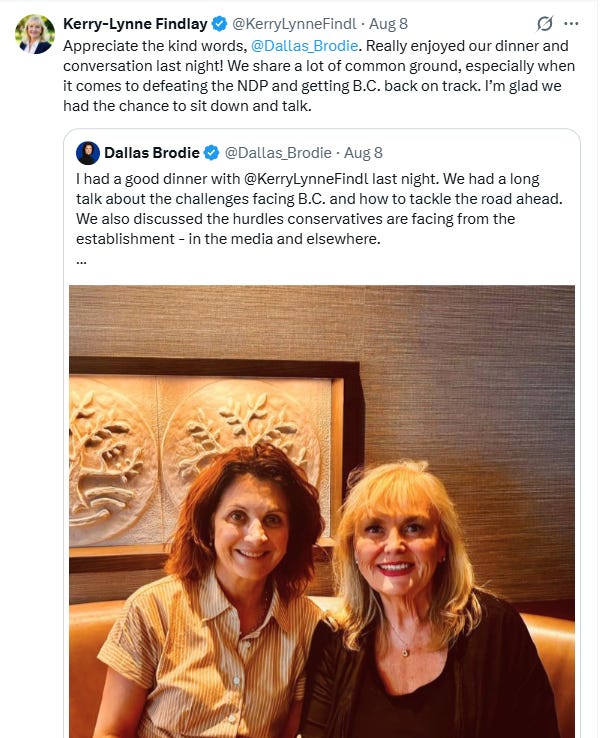
That raises a pretty obvious question. If moderate Conservatives are walking out the door while Findlay reaches toward people who were previously considered too extreme for John Rustad’s B.C. Conservatives, what exactly is she trying to turn this party into?
This is where British Columbians should look east.
Because what Findlay appears to be attempting looks very familiar to anyone who has watched Danielle Smith govern Alberta.
The strategy is to build one enormous coalition containing traditional conservatives, fiscal conservatives, suburban swing voters, populists and the hardest elements of the political right.
Then you run an election talking about things that appeal to almost everyone.
Taxes.
Affordability.
Crime.
The economy.
Government waste.
You don’t necessarily campaign on every ideological fight you’re going to pursue once you’re in office.
And then you win.
That is when the problems start.
Danielle Smith has spent years trying to keep moderate conservatives and an increasingly powerful populist right under the same political roof.
The result hasn’t been stability.
It has meant constant ideological battles over everything from health care and education to transgender rights, separation, the Constitution and the relationship between Alberta and the rest of Canada.
The government constantly has to feed the faction of its base that is never satisfied.
And that pulls the entire government further and further to the right.
I think Findlay is taking an enormous gamble if she believes she can recreate that coalition in British Columbia without eventually facing the same problem.
Peter Milobar leaving may be the first major warning.
None of this means Kerry-Lynne Findlay is guaranteed to become premier.
It also doesn’t mean we know exactly what she would do if she formed government.
But voters should pay attention to the signals politicians send before they have power.
Findlay explicitly ran against moving her party toward the centre.
She defeated the more moderate alternative by one of the narrowest margins imaginable.
A prominent moderate MLA has now left because he says his values don’t align with the party’s new direction.
Findlay’s organization has brought in a figure associated with Alberta separatism.
And she appears increasingly interested in rebuilding relationships with figures on the right who had previously broken with the B.C. Conservatives.
My prediction is that when the next election eventually comes, Findlay probably won’t campaign primarily on the ideological stuff. Or any for that matter. She will dog whistle to the right, like she did with her meeting of Dallas Brodie.
She’ll talk about taxes. She’ll talk about affordability. She’ll talk about crime, jobs and getting the economy moving.
And some of those messages may be very popular.
But British Columbians should pay just as much attention to who she is surrounding herself with, who is leaving her party and who she is trying to bring back into the tent.
Because that tells you something about what a Findlay government could look like after the votes are counted. Maybe she succeeds in keeping the moderate and populist wings together. Maybe she moderates as an election approaches. But right now, she appears to be moving in the opposite direction.
And if the B.C. Conservatives win the next election, British Columbia could end up with something it has never really experienced before: a provincial government considerably further to the right than the traditional B.C. Liberal coalition that governed the province for 16 years.
I’ve watched what happens when a conservative government becomes dependent on keeping its most ideological faction happy.
Take it from your neighbour next door.
B.C., pay attention to Kerry-Lynne Findlay now, not after she becomes premier.
If you enjoyed this article, consider supporting my work as a paid subscriber. Thank you for being here.
No posts
Comments
Nothing yet. Say the first thing.
Sign in to join the conversation.