
You shall teach us your songs new numbers;
And things that we dreamed not before:
Yea, in spite of a dreamer who slumbers,
And a singer who sings no more.
- Arthur O'Shaughnessy, “Ode”
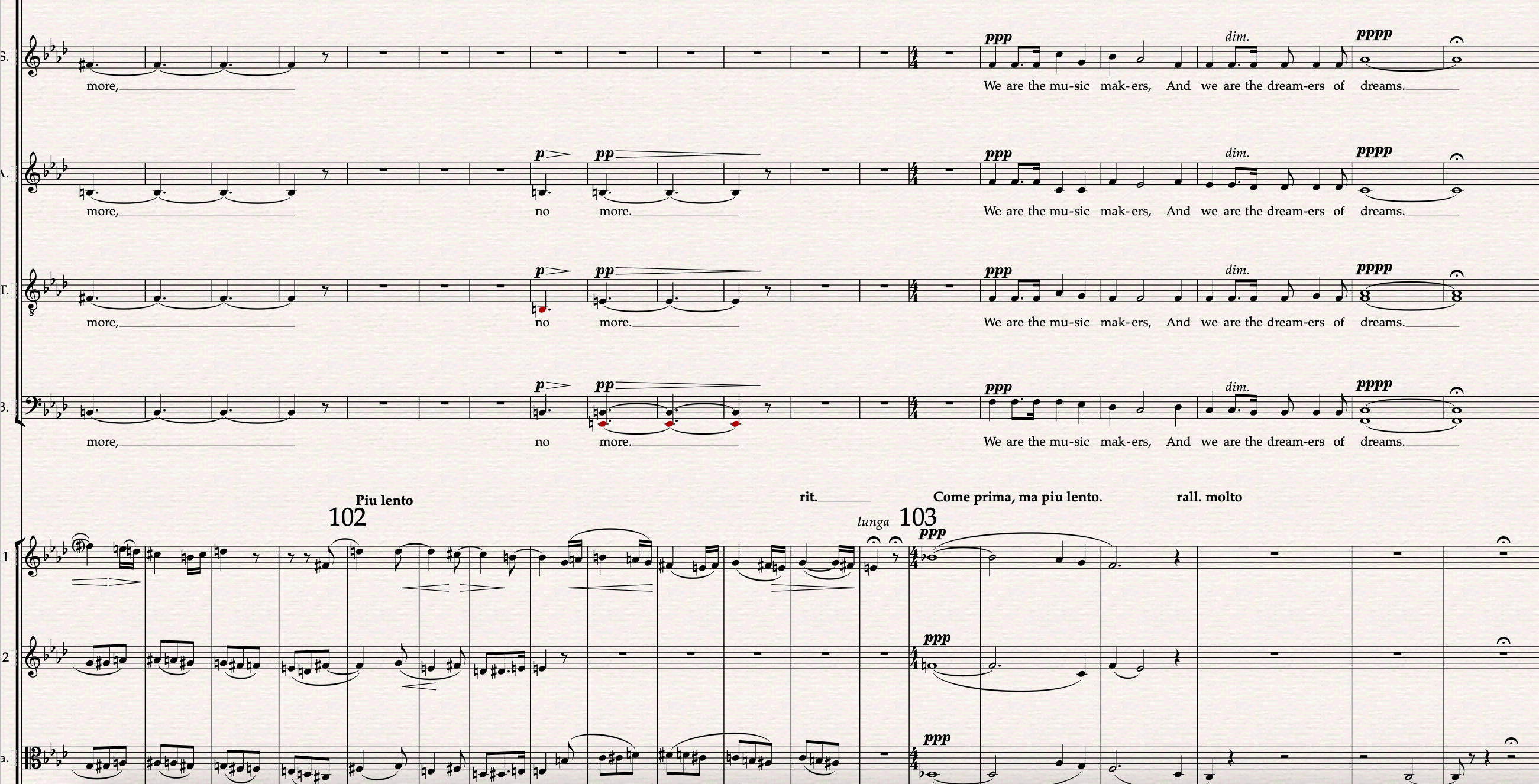
Nearly a year ago, I wrote that I was going to make a reduced orchestration of Elgar’s Music Makers a la similar works by George Morton, Iain Farrington, Joachim Linckelmann, and countless others who have worked to create reduced reductions for choral societies across the UK. The final notes have now been written; just short of 900 bars, 40 minutes and 22 players later.
What I couldn’t have told you at the time is that in doing so, I’ve learned more about myself, my writing style, my work approach, my work-life balance, and what I’m looking for next than anything else I could have done this year (other than some significant weight loss but I’m not talking about that right now).
So let’s start with the musical stuff.
Working notation software is hard work.
I’d originally planned for this experience to be a learning exercise in Dorico, a notation software published by Steinberg that has been getting much attention for its excellent design and layout. I canned that idea after about 2 hours of work - I had to get the notes in first and that was hard enough.
I learned to write on Sibelius, which continues to be one of the industry leaders in sheet music notation. I’ve been writing on this software for nearly 15 years on and off. Is it perfect? NO. Will it do for this job? Absolutely. Can I learn Dorico another time? Sure (and particularly given the collapse of Finale this year, I think it’s always good to be skilled in several pieces of software for this kind of thing, so it remains on my list). For now, however, this was a worthwhile exercise.
The art of the bodge
By FAR the hardest bit of writing this was a section where some sections of the ensemble sing in 12/8 (or, technically, 3/8) and others in 4/4. Yes, it’s still 4 beats per bar, but layout becomes a thing. This is made a little more complex when you’ve got to put in dotted barlines in the parts that are in quasi- 3/8, but not in the bits that are 4/4. In doing so, and working with loads of time on search engines, I found several piecemeal solutions, one of which I adapted and worked for my purposes. If doing it again, I may take a different approach, but this is the approach that works for me right now and holds it all together.
We had a builder friend try to fix a leak in our ceiling some time ago; he came up with a solution involving shuffling some insulation and stapling different things together and simply described it as a bodge job. In the circumstances, this was the best job for the task; anything else for what this particular incident was would have been an utter waste of time and money, but he knew the craft enough to know that this bodge would work.
Was my solution the most formal and pretty to do it? Perhaps not, and that may be somewhere where I get an editor to review the parts in due course, but it will work for now.
I work best on projects like these in intense bursts.
I’d attempted small chunks of this on and off since late 2023 and was proud of myself at the moments I did make progress. Still, it wasn’t until actively taking a two-week-long sabbatical that the real leg work was done. This was disrupted a bit by some personal matters, but allowing myself that focus was necessary for this type of work, which I cannot do when other activities are on my mind. There’s likely a load of reasons for this - historically, I’ve tended to work better creating a sense of urgency to get tasks like this done, so doing it as an intensive burst was probably crucial to its completion. Friends of mine will recall that as an undergraduate, people would laugh at me for completing essays in an all-nighter not the night before the deadline but around 7-10 days before the deadline. The false deadline gave me the urgency to do the task at hand while also having time to correct the mistakes.
It’s not manageable in all situations but was manageable in this one. The obsessive workaholic part of my brain felt guilty about not taking on other activities for a bit. The bit of me that’s looking at a complete score is grateful. That brings me to…
My workload has been reviewed - and I’m better for it.
After six years of working every hour I can, and longer before that trying to do the same thing with a PhD, I’ve reached a point where I am far more critical about what is going on in my diary. This has been a long process but I’ve now - just about - eked out a weekend (and often a three-day weekend!) in my routine. Dedicating time for rest on top of what I’ve been doing has been perhaps the greatest personal game-changer in my professional practice. There’ll be intense times - the silly Winter season will put paid to that, certainly - but what a difference it’s made even in the short term. It’s a fortunate position I’m in which means the extra things I take on are personally meaningful or helpful to my career progression. And to those things that I have turned down, I’m sorry because there’s a bit of me that still wants to do that. That being said, everyone benefits from a well-rested and thoughtful Cole. I’m learning that.
Choirs need an appreciation of the workload that goes into their work.
This is still at least slightly on me. There’s a choir I’ve been working with for 5 years who are lovely folks and excellent singers, while some perhaps expect me to deliver more. I mean this in the sense that I was a different person when I started with them 5 years ago. 5 years less knowledge, 5 years fewer commitments, 5 years less experience. The result is that when choirs asked me to jump, I asked “How high?” I would work myself to the bone with programming, trying to find the right solution, and not always going for the most straightforward response.
One result of this project has been that I’m now a better advocate for myself; I appreciate what my time is worth and where I’m putting in labours of love versus what is more of a gig that is - bluntly - for the fee. When I’ve said no to something, it’s not always been with a sense of guilt because I know why I’ve said no, recruited a deputy for an event, or asked someone else to take responsibility.
Yep, there’s been resistance to me taking this approach. However, the more I educate people on the other aspects of it, the more they’re coming to understand and perhaps even respect my approach.
I’d love to do this again.
This has been exhausting - probably the equivalent of three 40-hour weeks (I’m certain it got faster towards the end though!) on top of my routine. It’s also been the most rewarding exercise I’ve done in a while as it’s taught me so much about myself, the music I’m conducting, and what I want to achieve as a musician. So consider this an open call.
Approach me with the right piece (30-40m) and a choir/orchestra to work on it with, and I will gladly consider writing you a similar reduction. I’d like to get more experience in this and hope to work with more choirs and orchestras in the process. I’ll even do it for a reasonable fee (or work with you to find funding or a partner to split the costs).
Final notes
The piece is being premiered in Dorking on Saturday 7 December with Brockham Choral, Southern Pro Musica, and Judy Louie Brown. Tickets are still available at www.brockhamchoral.org. If you’re a pro-friend or someone who might genuinely be interested in programming it, or interested in speaking to me about conducting work, reach out to me and I’ll arrange a comp.
I intend to proof it again following the performance with the view to start promoting and selling it in Spring 2025 and welcome performances of it after that point. Anyone looking for a (rough) perusal score is welcome to it - again, reach out by e-mail.
Big thanks to Brockham Choral for trusting this project, and to the Elgar Society who provided partial funding for the concert costs.
Thanks for reading You Set the Tone! This post is public so feel free to share it.
No posts
Comments
Nothing yet. Say the first thing.
Sign in to join the conversation.