
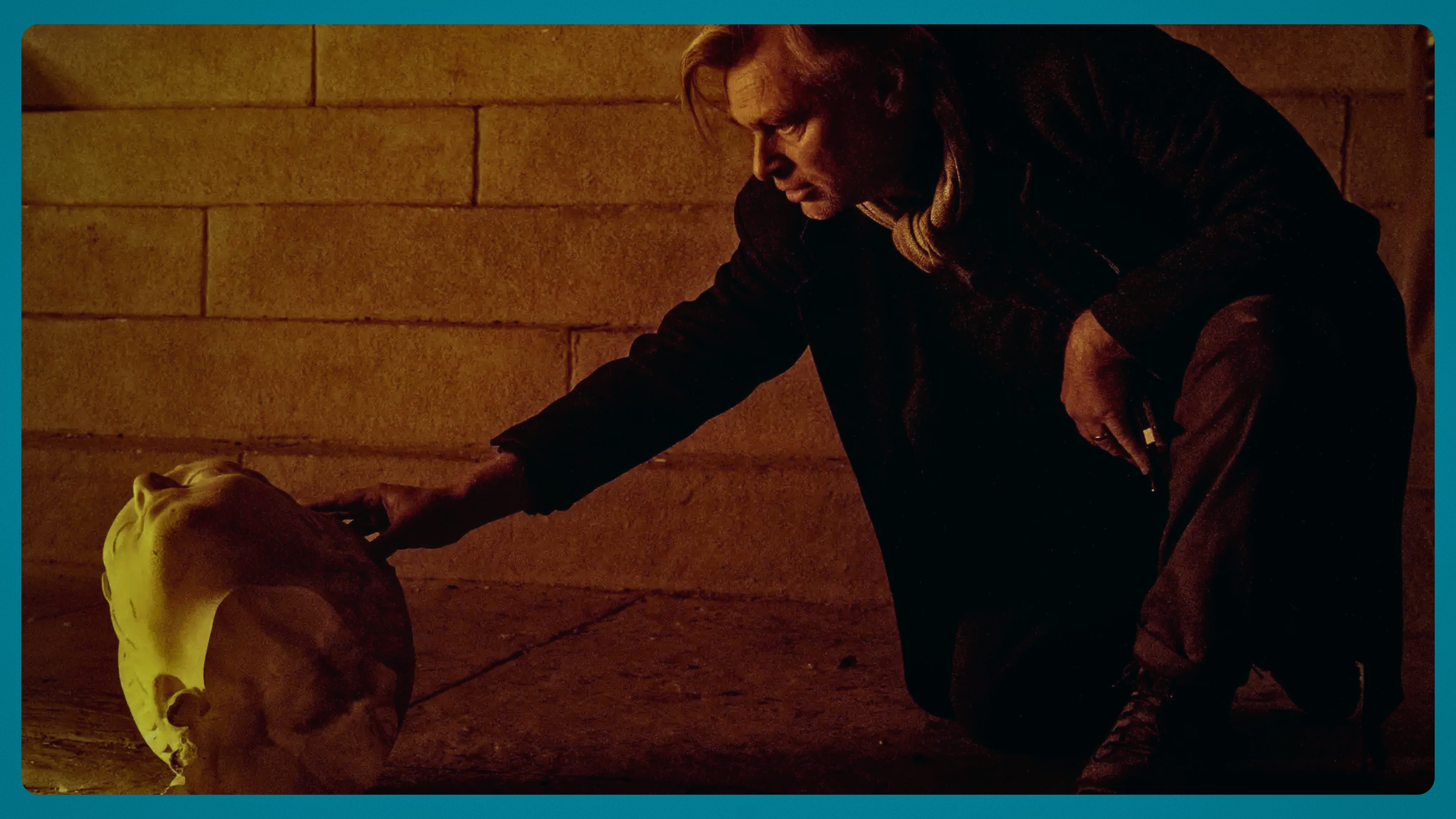
Over the past week or so, I’ve spent considerable time here at 5AM StoryTalk discussing Christopher Nolan’s The Odyssey, especially classicist and translator Emily Wilson’s review of it (read that here). Today, I’m also sharing a breakdown of the film, aimed at storytellers and especially screenwriters. Next week, another piece will be published discussing the film’s use of symbols and signaling – from casting to costume choices to accents – to create deeper meaning. The reason for this isn’t Nolan worship, as I might be accused of (no, I know I will be because it’s a tired trope amongst certain types of people who don’t care for his work). It’s because I’m a screenwriter, cinema is my religion, and I think there is a lot to learn from this behemoth of a film that has resonated with so many and will almost certainly win enough awards to fill up a Trojan Horse. If you want to better understand what Nolan put into this film’s story and how he used the moving image to add additional layers of meaning, continue reading here and be sure to come back next week!
When I was a kid growing up in Michigan, I lived through the Vietnam War. Or rather, I witnessed my father constantly reliving it. His two tours there had left him racked with trauma that we now call post-traumatic stress syndrome.
That’s a term we hear a lot these days, but some might not fully understand what it means. You see, our prefrontal cortexes are responsible for logic, sequencing, and time-stamping, but, when something terrible happens to us – like being forced by our government to murder other people – it shuts down. In turn, our amygdala – our emotional and survival center – goes into overdrive. As a result, these memories – these traumatic memories – aren’t neatly filed away as something that occurred in our pasts. Instead, they’re recorded as fragments, as sensory impressions, bodily sensations, or similarly intense emotional states. Simple triggers activate them in our present, which means that our pasts never really stop playing out and, consequently, become our futures.
Our recovery from trauma of this nature – but really, any kind of pain that permanently rewrites who we are – is never a straight line. It snakes and loops and circles back, sometimes even amplifying and changing memories completely unrelated to it until we can only experience some good memories through a scrim of our pain.
For my father, it took decades.
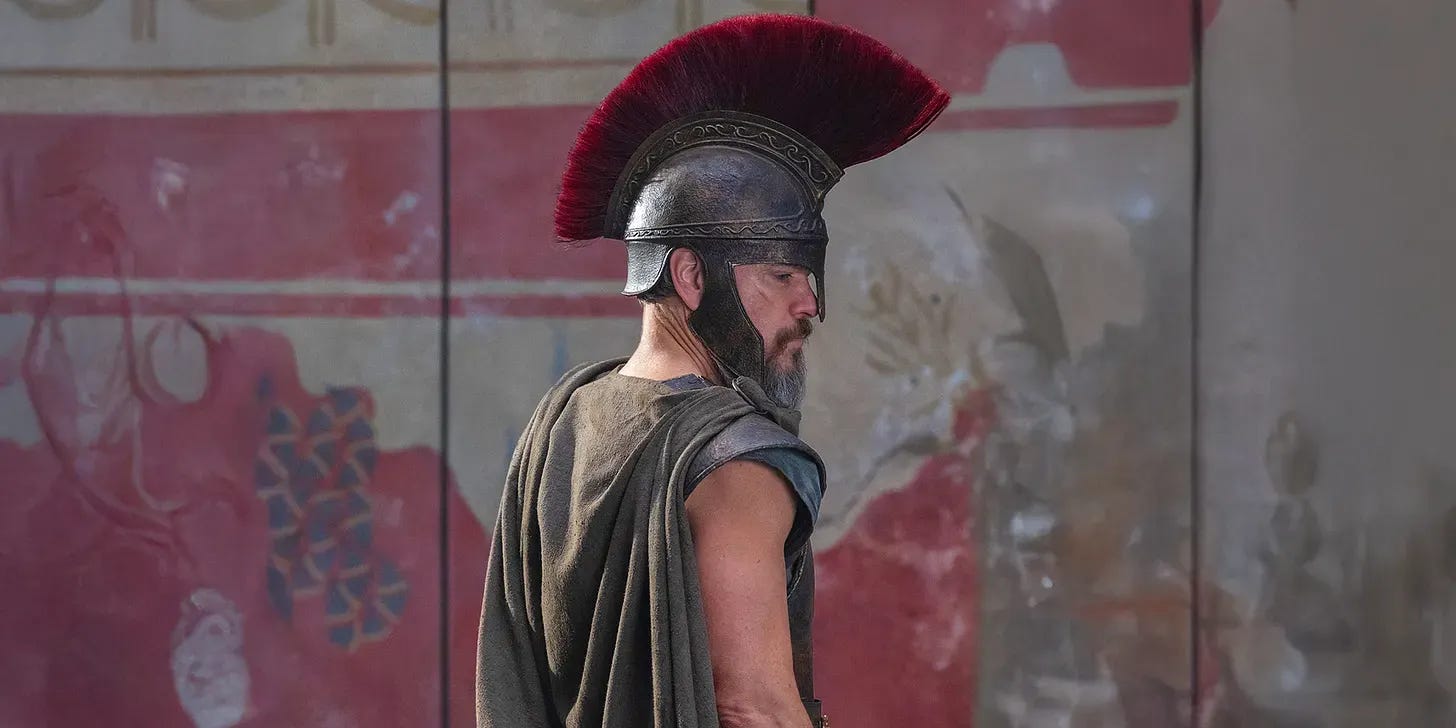
Which brings me to the film The Odyssey, writer-director Christopher Nolan’s adaptation of one of the foundational works of Western storytelling – Homer’s epic poem – which he has used to further explore his disdain for capitalism and war, the toxic masculinity that fuel both, and the apocalyptic dread that clearly plagues his sleep as much as it does mine. These are all themes that similarly defined his Batman trilogy, Interstellar, Dunkirk, Tenet, and Oppenheimer.
What makes The Odyssey stand apart is how PTSD is centered in the narrative, which Nolan translates for audiences as a deeply non-linear experience, using the central character of Odysseus’s 10-year quest to return home to his kingdom of Ithaca as a metaphor for reckoning with our violent pasts – both as individuals and as a culture. Because as much as The Odyssey film is about the titular character, it’s also about how we’ve destroyed our world, normalized crimes against humanity, and are now paying the existential and climatological price for our sins.
Let’s talk about how he chose to do this for various reasons, first and foremost because I think breakdowns like these help aspiring screenwriters and even working screenwriters improve their craft. What I mean is, once you work out how one of the greatest filmmakers of the 21st century decided to tell this massively successful story – regardless of your own opinion of it – you’ll understand how to better apply his storytelling logic and tricks to your own screenplays (and even fiction). Or, of course, how to avoid making his mistakes, if that’s how you feel about The Odyssey.
To begin – and for context – I wish I could tell you I’m a Homeric expert, but despite studying both The Odyssey and the poem that preceded it, The Iliad, I’m far from that. It doesn’t matter in the case of this essay, though, because I don’t give a shit how accurate anything Nolan did is to the original text. It’s a modern film interpretation of something written almost 2,700 years ago.
You shouldn’t care either. If you’re complaining about what Nolan got rid of, I’m going to venture to say you’re not quite serious enough yet to become a professional screenwriter. I know it seems valuable to you, or that you’re defending something pure and good in the world when you do this, but it’s one of the least interesting parts of the discourse around a film like this.
Let. It. Go.
At least if you want to get work as a professional screenwriter. Screen adaptations require a more flexible imagination.
Now, diving in…
I’ve learned over the years that a lot of incredibly educated people don’t know what linear and non-linear mean, especially if they’ve only heard it uttered aloud. So, for complete clarity, linear means in a straight line. Non-linear is the opposite. There might be the idea of a line, don’t get me wrong – but our relationship to it, our perception of it, isn’t from A to Z, but might be B to S to C to M to Z to A.
In quantum physics, we would even argue we’re all experiencing A to Z simultaneously and that Z is even directly affecting the A. Time is an illusion in science; it’s a construct of the human mind, which is why post-traumatic stress syndrome plays such havoc with it. By the way, I explored all of this in my novel Psalms for the End of the World.
As for Christopher Nolan, he’s made very few films with linear narratives, Insomnia and the final two of his Batman films being the sole examples of this in his oeuvre. Don’t come at me about Inception either. Its narrative is so fragmented, the result is fundamentally the same.
The Odyssey is similarly fragmented, but in this case, that’s also organic to Homer’s poem, which is told wholly out of order and actually begins very near the end of the poem’s historical timeline – if we can call a piece of fantasy fiction historical. It’s not, though, which is why Psychopathic Nazi Tech Führer Elon Musk will never be able to produce a “historically accurate” adaptation of the poem, as he claims he will do.
It’s easy to understand why Nolan told the LA Times that “I’ve been telling this story in all my films for years” about The Odyssey. As it turns out, it’s his urtext. It explains his whole oeuvre, in a manner.
This is an important question anyone setting out to adapt any story asks themselves. Is it relevant? If not, why is it relevant to me? How do I dramatize that personal aspect for today’s audiences?
Maybe – and I’m just surmising here, based on how I’ve reinterpreted classic works of fiction for some 15 different studios, streamers, and major producers around the globe – but maybe Nolan zeroed in on the central emotional and geographical question in the poem. This being, why Odysseus really couldn’t return home when Troy wasn’t that far from Ithaca as the crow flies. From there, the real work began.
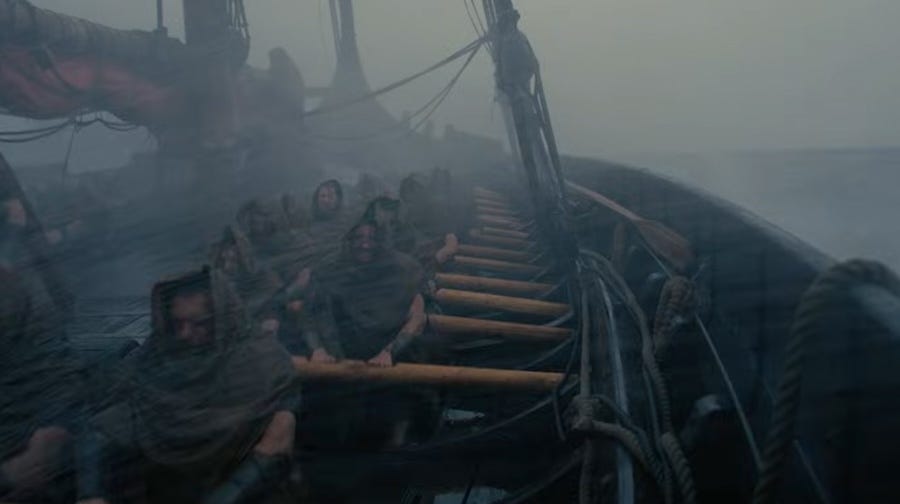
Yes, the poem explains myriad reasons why, including his crippling hubris. Yes, it touches on the toll the Trojan War took on Odysseus. Yes, it suggests he was increasingly afraid of going home after so long.
But what these things are lacking is an inciting incident to bring them all into focus for your audience today to care about and, moreover, a way to explain every decision Odysseus makes throughout a film.
An inciting incident is important in commercial film storytelling, though they come in many forms and I don’t want to be proscriptive here. But in most cases, you can define it as an event, typically somewhere in the vicinity of 9 to 12 minutes into your runtime, that sets your protagonists’ story in motion. I don’t mean the film’s narrative in motion. I mean how your protagonist’s participation in this bigger story, is triggered – even if they’re unaware the moment has passed.
For Nolan, though, nothing is straight forward – and not just because he likes non-linear narratives or because PTSD is a non-linear emotional experience and recovery journey.
In his case, instead of placing his inciting incident 9 to 12 minutes into his The Odyssey – he put at the end of the film, the same running time from THE END as most inciting incidents are from FADE IN on Page 1. More on this in a moment, but come on, guys, if you’re reading this, there are going to be spoilers ahead. I hope you know that and are treading responsibly here.
That’s a bold claim, I’m sure. After all, David Copperfield once made the Statue of Liberty disappear. No, really – I watched it live on television.
But magic is how Nolan has approached cinema, as an act of engineering intended to confuse, surprise, and delight his audiences. He’s a trickster, you might even say — just like Homer’s textual Odysseus. Everything he does, from the practical effects he puts on screen, to the narrative structures he employs, to the way he casts and, later, promotes his films services this mission even if you don’t see how you’re being manipulated by him.
I’ve never met the guy, even though I used to live around the corner from him. I mean, properly. We chatted in passing back when I was an arts journalist, but even then, his actors like Leonardo DiCaprio confessed they had no idea how he pulled off his tricks on screen. I recall Leo admitting he agreed to play the lead in Inception even though he didn’t understand one page of the script – entirely because he’d passed on playing the Joker in The Dark Knight as he didn’t trust Nolan enough at the time. Whoops.
I bring all this up because I don’t know Nolan, I can’t read his mind, but I’m fairly confident he is as terrified of where we’ve ended up in the 21st century as I am and has decided the best way to confront the horror of it is through commercial filmmaking.
He’s attacked these apocalyptic themes with a kind of religious fanaticism, refusing to abandon them as passing interests — which other filmmakers have — rather than an all-consuming purpose that will likely explain his entire filmography when he’s dead.
But who the hell wants to be preached at about how billionaires are bad, or war is bad, or climate change is bad, or genocide is bad, or…? Well, you get it. That’s where the magic comes in. That’s where Christopher Nolan the Magician takes over. He doesn’t hide the message, the medicine so to say, in some yummy, spectacle-y sugar like other filmmakers. Not that he doesn’t know how to do spectacle. But the spectacle is there to help hide his tricks.
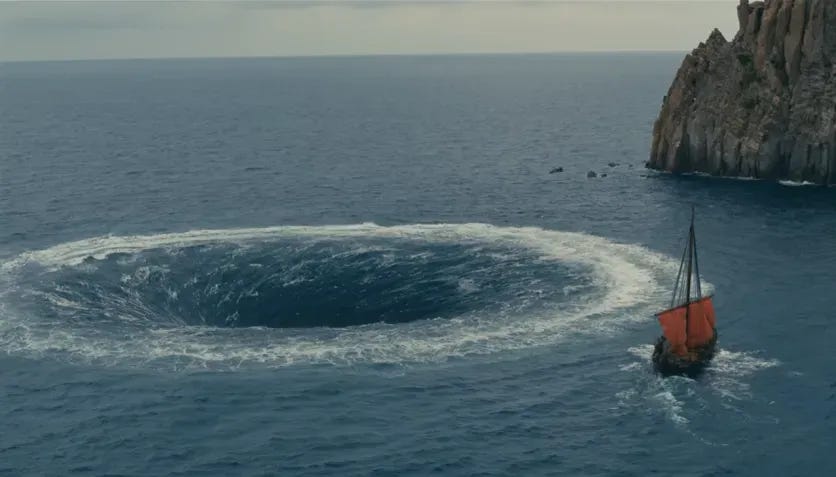
The spectacle is the Pledge, as he explained in his film about magicians – The Prestige. At the Turn, you mistake what he’s doing for something straight-forward, something mundane like the story of an arrogant man trying to get home and adventure ensues. He might even distract you with a flurry of fun tricks you get confused trying to understand, like the meaning of all those magical beings and their portentous words. But then comes the Prestige, the reveal, the twist that you didn’t see coming.
And in the case of Nolan’s The Odyssey, the Prestige – his twist – reframes the entire film you just watched. Like PTSD, it loops back to the beginning and sets the story in motion in a way that changes the meaning of everything that follows…even though, on that second viewing, you also discover he wasn’t hiding anything. You just interpreted it wrong the first time around.
Well, if you’re still reading, hopefully that means you’ve seen the film and are here to start articulating better some of what you just experienced (even if that’s just helping you find your own language and meaning).
Because I really don’t want to ruin The Odyssey for you.
Like almost all Nolan films, yes, this one also has a 3rd Act twist. But this one, as I say, is unusual in that it’s the film’s inciting incident, too – the event that sets Odysseus’s journey in this film in motion.
Yes, you could say The Iliad was that if you want to be incredibly simplistic and pointlessly contrarian. Agamemnon recruited Odysseus into the Trojan War and, voila, that’s how it all started, right?
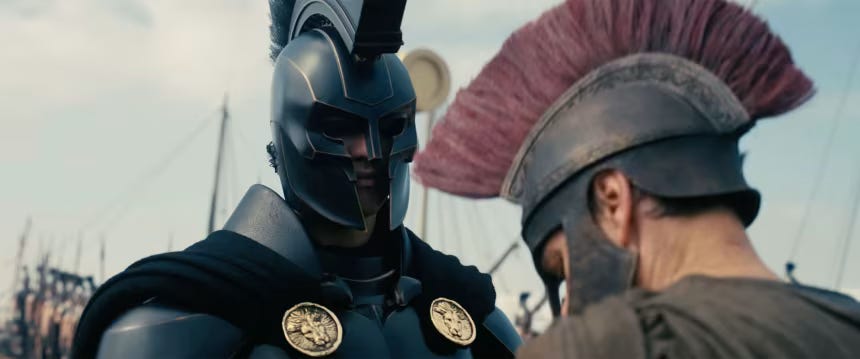
But that’s a different poem, a different film even, and not the story Nolan is telling here at all. This story is about what happened to Odysseus that made it impossible for him to return home for a decade – told, as all interpretations and adaptations are, through the lens of the time and culture they’re produced in.
No vague explanations would work. No academic summaries of scattered passages and such. It needed to be clear, concise, and painfully relevant to the world we live in today.
Which is why Nolan decided to make Odysseus a war criminal.
That’s the big reveal in The Odyssey’s 3rd Act. It was Odysseus’s idea to trick the Trojans by using their mutual religion against them and, in doing so, violate a sacred law of civility and civilization.
“We left them a gift, an offering of peace that they took into their home,” he tells his wife Penelope. “We violated all that is sacred between people and turned a fight into a hunt.”
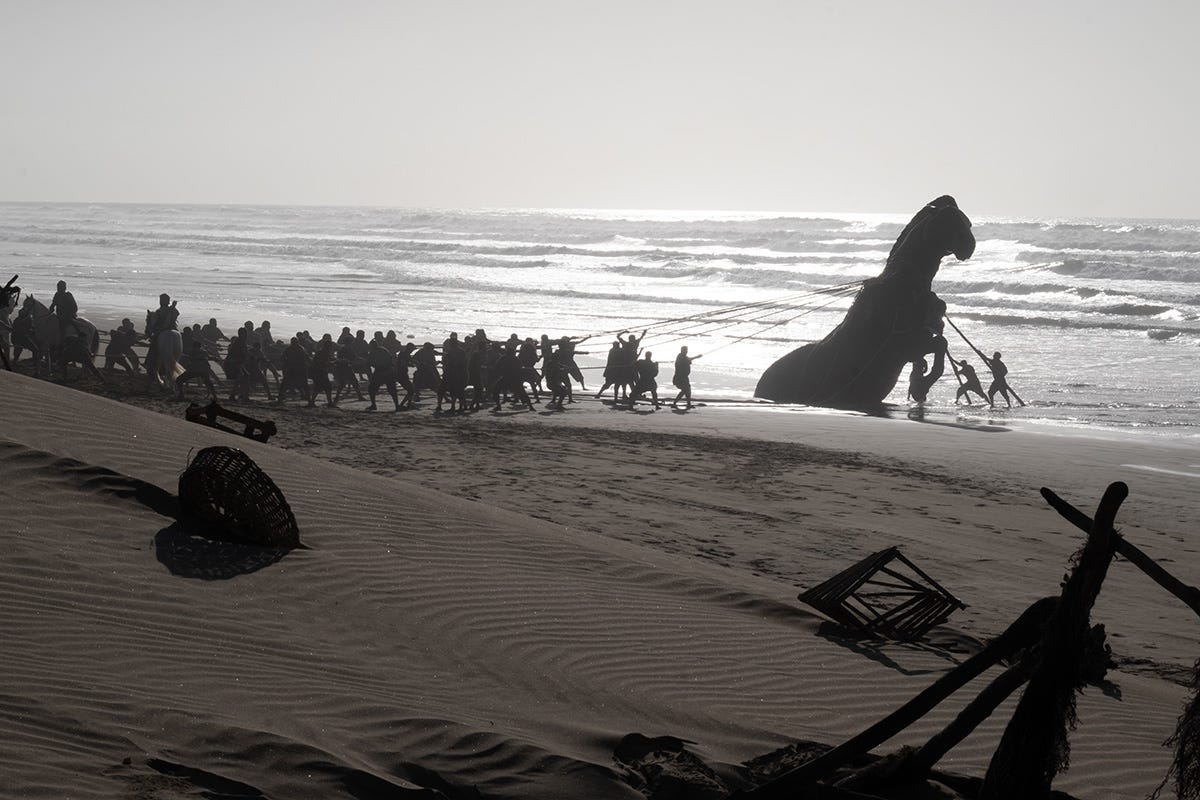
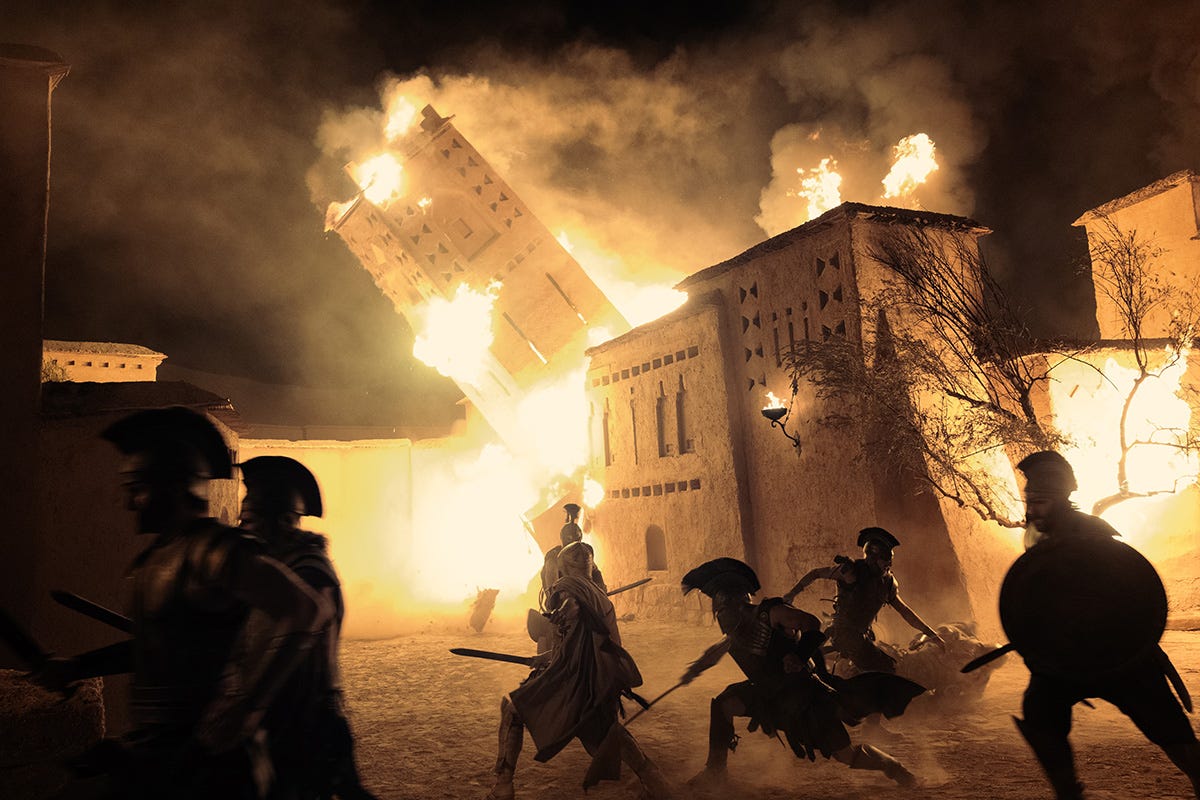
The consequence of this deceit, which also involved betraying and getting a beloved friend killed, is that Troy was sacked, its people raped and mass-murdered, and the city and culture wiped out. “To burn the world of Troy was to burn the world entire,” Odysseus later says.
There’s another name for what happens that’s incredibly relevant in recent years: genocide.
If you rewatch The Odyssey after this revelation, you discover your first interpretation of the film was wholly wrong.
Nolan didn’t craft the story of a man whose arrogance can trump his considerable decency, a man whose sanity and determination breaks more and more as the men who serve under him die, a man who bears the scars of war in a way that feels at times clunky and even nebulous.
Instead, he crafted the story of a man racked by guilt for the horrendous crimes against humanity he committed. Every erratic, contradictory, self-defeating decision he makes is directly informed by his PTSD, both the ugly ones and, later, the decision to drug himself silly for seven years with lotus petals and Calypso’s embrace so he doesn’t have to admit to his wife and son what happened in Troy.
Odysseus’s family, his kingdom, everything he used to know no longer exist for him because all of that belong to a version of him that also no longer exists (the extra rub being that he also broke the world with his actions, but I’ll discuss that in another essay).
As he says of the Sirens’ song, it told him that “what [he] most can’t have is what [he] already had but lost.”
Consider Zeus’s Law, which is allegedly so sacred to Odysseus. It sounds like the Golden Rule. Good metaphorically Christian dude, right? Except the very first stop he and his men make results in him leading a raid to steal provisions and burn a village down. Everywhere they go, there is the instinct to pillage and kill first.
Odysseus and his men’s encounter with the Cyclops, Polyphemus, son of Neptune is no different. Odysseus imposes immediately, claiming Zeus’s Law allows him to take what he wants and ask for permission later. He doesn’t attempt to negotiate with this monstrous “other” (foreigner) when he shows up. He instead blinds him and, after the fact, suggests it’s too late to try to reason with the being. To make matters worse, when his men escape – fully aware that the Cyclops can speak – Odysseus shoots him with an arrow.
“Why did you have to fire that arrow?” Eurylochus demands afterward. Odysseus doesn’t answer in the film, but in Homer’s poem, it’s the character’s trademark pride that does him in. He shouts his name at the Cyclops, announcing who he is in full – “Odysseus, raider of cities, son of Laertes, who makes his home in Ithaca” – so Poseidon can relentlessly hunt him down like John Wick and avenge his son’s maiming.
If you ask me, I’d suggest Nolan’s interpretation of Odysseus is behaving suicidally here. He’s found himself once again trapped in a dark place, surrounded by fire, besieged by screaming. Or hey, maybe it’s just meanness brought on by the same triggers.
If you’ve been around people suffering from PTSD, this is familiar behavior, I’m sure.
It’s important to recognize that almost every interaction Odysseus and his men initiate after departing Troy involves threat, theft or terror because after what Odysseus did in Troy, Zeus’s Law has become an antiquated notion to justify barbaric behavior rather than prevent it.
Civilization has been broken.
Odysseus broke it.
He can pretend to be decent and civilized all he wants, but he’s the real monster now.
That’s the real kicker of Nolan’s trick. On a second viewing, you discover the hero you cheered for the first time around is actually the villain of the story and realize he cast lovable, trustworthy Matt Damon to help you fall for him as your good guy. You discover how easily you were manipulated into supporting a white American man responsible for the genocide of a desert people – whose behavior has been so criminal that everyone along the Greek coast has come to fear the “People from the Sea” as they’re now called.
But hey, maybe you’re still on Odysseus’s side on the second viewing. How do you feel about rooting for a war criminal? What does it say about you that you still can’t condemn him? Does what it says force you to more deeply interrogate who you’ve become or force you to retreat even deeper into toxic beliefs you’ve collected to try to explain your world?
Odysseus’s crimes have become the stuff of legend by the time the film begins and, yes, you can absolutely interrogate the role capitalism and racism played in the war that put him in the position to blow up civilization with his Trojan Horse. But Nolan’s intent isn’t to interrogate Agamemnon’s greed, his willingness to profit off of a Black woman’s body, or how he murders his Black daughter just to get richer. It’s to explore how Odysseus reacted to it and how, after the fact, he suffered for it. Ultimately, it’s to condemn Odysseus, even if the audience can’t, and see him exiled from his home for his crimes.
Metaphorically – and this is for narrative purposes – Odysseus is the cause of the collapse of civilization, the end of “our Age of Bronze” as he refers to it. The reasons, again, are manifold, but he is the singular expression of it in this story, he is racked with PTSD because of what he did, and his journey home isn’t just a journey of recovery – it’s to spread the flames of his crimes, to burn the whole world down, to become the terrifying “People from the Sea”. Mediterranean kings and every community that lives under them must now react in turn, defend themselves, escalate.
War is contagious, after all.
I think back to Alfred in The Dark Knight telling his beloved Bruce Wayne, a rich man counterintuitively breaking the law to restore his collapsing city, “You crossed the line first,” about how Gotham’s crime leaders have ramped up their crime war. Put on a mask, the freaks come out. Upend the rules and there will always be unintended consequences.
Nolan loves rich and educated white men hubristically thinking they know what’s best only to have to contend with the horrors they unleash. Look no further than Oppenheimer, an excellent companion piece to The Odyssey, in which a scientist creates a nuclear bomb and then expresses shock and terror at the ensuing mass murder, arms race, and potential civilization-ending conflicts. Some of us grew up learning all this from Jurassic Park, of course.
But all is not lost, Penelope suggests.
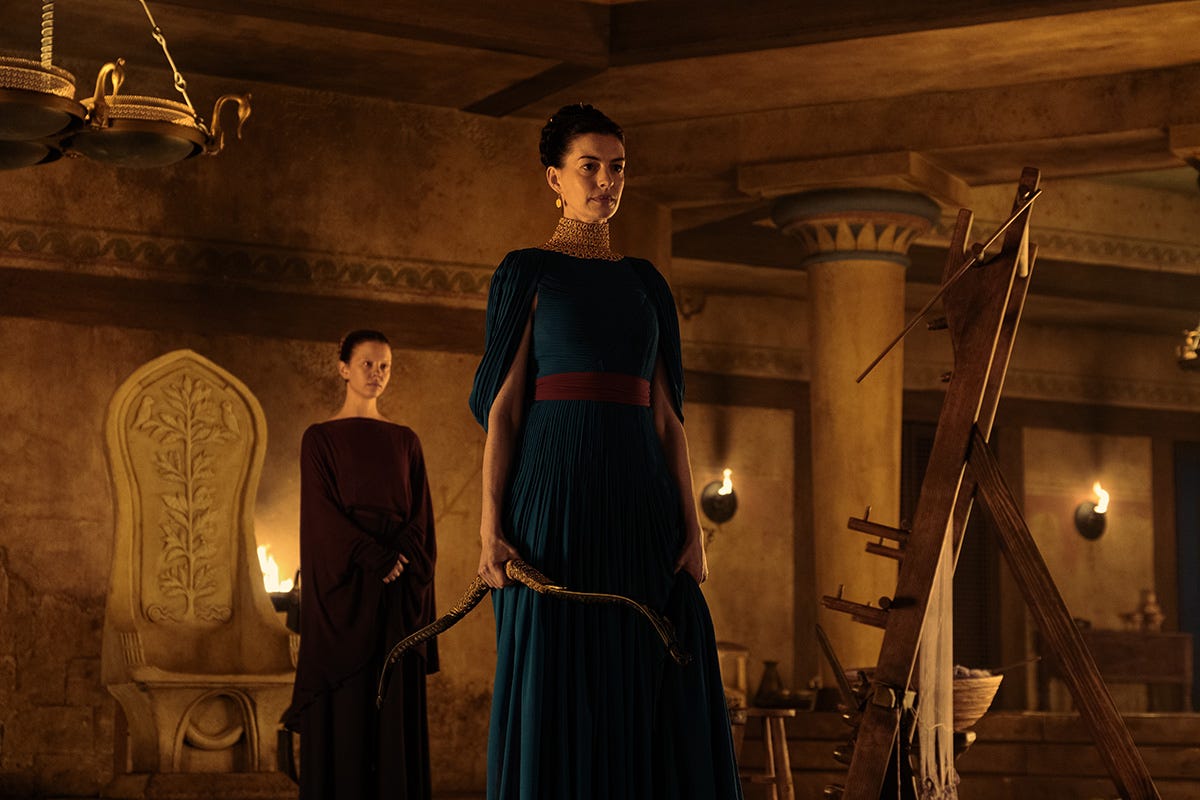
“That world is gone,” she roars at her son in The Odyssey. Yes, the world has changed forever since the Trojan War — and the genocide she’s so far unaware of unlike the audience — but there is a possible way back to its purity, she argues. All they have to do is invite all the suitors to the castle — men who are themselves expressions of this toxic capitalistic wealth and power that Odysseus nonetheless served, preserved, and exacerbated with his actions — lock them in, and burn the place down.
In other words, Nolan is saying the only way to get back what was lost through capitalism, through colonialism, through centuries of crimes against humanity is to collect the wealthy in one place, prevent their escape, and exterminate them. The powerful, in his films, are never to be trusted – even when they’re your heroes.
Kind of makes you appreciate why the League of Shadows in the Batman films, a secret organization willing to kneecap civilization when it becomes too corrupt, sounded so reasonable (it’s no coincidence that used Charles Dickens’s A Tale of Two Cities, about the French Revolution and its aftermath, as inspiration for The Dark Knight Rises). Nolan shares the League’s disdain while simultaneously decrying the loss of civility, of empathy, of decency itself that probably make such actions culturally necessary from time to time.
Nolan’s interpretation of The Odyssey is a deeply melancholy film like Oppenheimer. The filmmaking is exciting and boisterous in both cases, and the consequences of them similarly horrific and portentous of doom. In the case of The Odyssey, though, Nolan pushes that further and makes it a reality – all to make his interpretation of Homer’s poem the ultimate lamentation for the world we’ve lost, to point the finger at those most responsible for it, and, in the absence of a violent uprising, the sad “Age of Darkness” we’re now entering.
His metaphors are crisp and clear.
His protagonist’s circumstances and motivation are no murkier if you can see past the sleight-of-hand Nolan is otherwise performing.
His protagonist’s fate is…a different story. But even there, I think the reason is because he wants to force his audience to interrogate themselves through Odysseus’s fate.
“We broke the fragile bonds between men and for centuries to follow, the stories of Troy will only be sung,” Odysseus says, “because songs will be all they have to remember those of us who could write.”
That sounds pretty goddamn bleak. What a mood killer, huh?
And yet Odysseus also sails off into a setting sun with his beloved Penelope, into exile – a kind of happy ending despite the fact that war criminals deserve the opposite. Nolan is asking you to enjoy this swelling music, to forget that your hero is the villain, and leave the movie theater feeling good about the story you just watched.
The reason is he’s lost patience with your indifference. He’s challenging you to ask why you feel so good about the world as we know it ending, the rich white guy who caused it sailing off to a happy ending, and another rich white guy inheriting the throne he leaves behind. Nolan even tells you to ignore the appearance of a feel-good ending.
“A new dawn will break, and once again our mistakes will be forgotten, Odysseus says, closing out the film.
In other words: we will never learn. My father, victim of two wars instigated by the white, wealthy, and powerful, who spent his life haunted by the people his government ordered him to murder, wouldn’t disagree.
On a second viewing, maybe you’ll notice that what Nolan is really asking you to do is pay better attention to how you’ve been tricked into rooting for the wrong heroes. You’re not supposed to defend wealth as so many of us do in our twisted culture, nor the system that enriches these capitalists, nor the violent culture these people’s long reign has created and now is in the process of ending.
You’re supposed to take Penelope’s advice about how to fix it.
So, there you go. My epic breakdown of Nolan’s The Odyssey. See what I did there? Epic? Oh, never mind.
As I said upfront, this interrogation of the film is intended to help you reconsider the narrative and the decisions that Nolan made to construct it — even if you don’t agree with those decisions. It’s also here to help you better learn how to look at other films and do the same.
Do I think everything I’ve written here is correct? I expect not. But I’m confident I’m close enough. I’ve been doing this a long time and there’s a certain kind of math that goes along with this kind of interpretation, adaptation, whatever you want to call it. Eventually, you start to see the Matrix every time you sit down to watch a film. That’s not to say it distracts from the experience of watching one. Quite the opposite, in fact. When a filmmaker like Nolan can still surprise seasoned professionals, we experience and even more supreme kind of delight. Being in the hands of a master storyteller is one of the greatest thrills I know.
This screenwriting breakdown is free for all. If you took anything from it, why not share it across the multiverse?

Christopher Nolan's 'Oppenheimer' Script Blows Up All the Rules
·
March 16, 2024

Regardless of how you feel about Oppenheimer as a film, it’s impossible to ignore how innovative its screenplay is. In fact, it’s so audaciously inventive that many professional screenwriters I know have taken to griping about it, citing it as — and I’m paraphrasing here — “the kind of bullshit only
The Decisions That Made 'The Shawshank Redemption' a Perfect Adaptation
·
September 21, 2024

The Shawshank Redemption was released on September 24th, 1994 – thirty years ago this week. What you might not remember, though, is that this beloved adaptation of Stephen King’s novella Rita Hayworth and Shawshank Redemption (1982) was a box office bomb upon release. Instead, word-of-mouth turned it into a hit on home video. By the time Awards Season rolled around, it was nominated for a Best Picture Oscar and, more relevant to the point of this article, a Best Adapted Screenplay Oscar for writer-director Frank Darabont.
Emily Wilson's Christopher Nolan Hit Piece Is Painfully Transparent
·
Jul 29

Every week at 5AM StoryTalk, I publish a minimum of two feature articles. However, this week it became clear that the first of these – an epic breakdown of the approach to and storytelling decisions behind Christopher Nolan’s The Odyssey – wouldn’t be completed in time and, more, was so epic that a complementary second feature just wouldn’t be possible.…
Comments
Nothing yet. Say the first thing.
Sign in to join the conversation.