
Everything I know about professional wrestling I learned against my will. As with Pokémon lore, My Little Pony, and the music of Andrew Lloyd Weber, professional wrestling has become an unavoidable part of popular culture, regardless of how you might personally feel.
Jason Ridler’s Dead in the Ring understands this cultural context. There are no tedious Wrestling 101 details that could be gleaned by a casual glance through Wikipedia. Instead, Ridler knows that you know enough about wrestling he can drag you straight down into the muck and the mayhem.
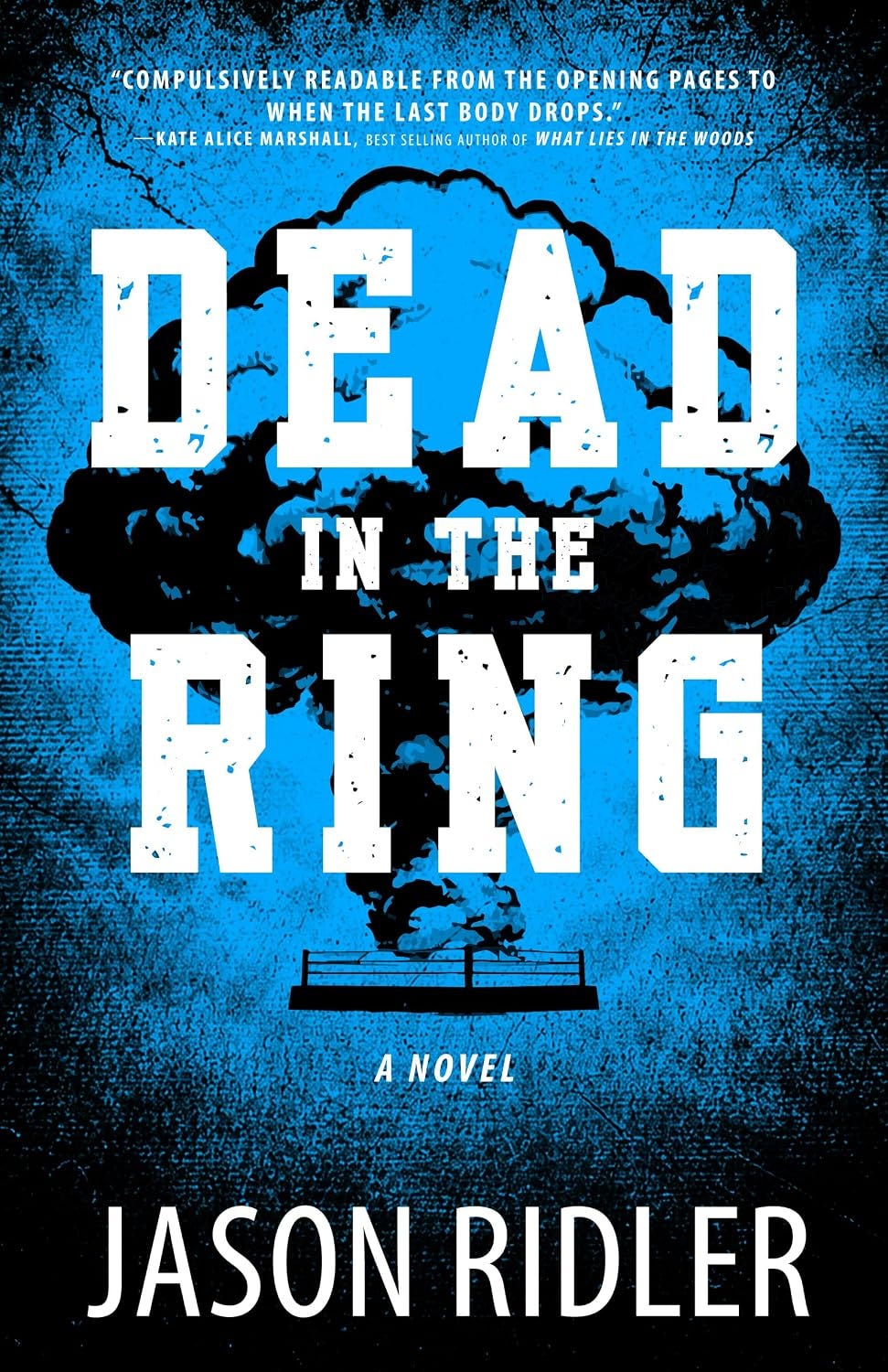
When we first meet Sully Alexander, the protagonist of Dead in the Ring, he’s getting his ass chewed by his editor, Val. Sully is barely eking out a living as a journalist for Amazing Wrestling!, but even that job is threatened when he wrongly reports the death of Sadistic Stan Rapowski, master of the flying knee-drop.
Called to Val’s office to take his lumps, Sully soon learns something even more shocking: His deceased mother, the touring wrestler Black Widow Moscow, is in fact alive, well, and working as a mall cop in Minneapolis. But when Sully later confronts his father over the lies about Black Widow’s death, he doesn’t get any sympathy:
“She’s not dead?”
His big mitten hand rose, then rubbed his neck as he turned his back. “Quiet.”
“That means yes,” I said, loud enough so Kara1 could hear me all the way from the living room.
That turned him around. “I said quiet.”
“Answer the question.”
“What do you want? An apology?”
“Ten birthdays. Christmases. Mother’s Days.”
“You’re being dramatic.”
“You conned me.”
“Listen to you. I can’t believe that mag pays you to write.”
I put the card in my pocket. “You said she died.”
“She did. From our lives.”
“God, you sound as bad as my writing.”
“She was no good, friend. I did you a favor. She did you a favor staying the hell away.”
I snorted. “Explains why I turned out so great.”
“Blame yourself. You’re a goddamn adult acting like a street kid, too smart for his own good and yet no spine to do the work to make a life for yourself.”
His father’s truculence makes this an unsatisfying confrontation for Sully, but he’s not necessarily eager to track her down, either. It’s not until another wrestler, the Atomic Kid, dies in the ring that Sully’s subsequent investigation of the tragedy leads to a maternal reunion. To understand what happened to the Kid, Sully finds himself allying with the only person who knows the sleazy underbelly of wrestling better than Sully himself.
*
There’s a lot going on in this novel. In the synopsis above, I haven’t even touched on several key plot points yet, such as the fact that Sully and the Atomic Kid were in juvie together at Red Wing, or that the Atomic Kid later made a career by claiming to be Black Widow’s son, details that serve as the background against which the main action plays out.
But while these details raise the stakes for Sully, they also create a complicated web of relationships for Ridler to squeeze in among other details of Sully’s job, family, and personal life. Sometimes it can feel a bit muddy, especially in the early chapters while the stage is still being set.
Fortunately, Rider has a solution for this. Throughout the novel, Sully’s narration alternates with chapters made up of news articles, transcripts, and letters. This technique is mostly effective, and can be especially fun when it has little to do with the central story. I loved, for example, the “transcript” that riffs on David Schultz’s famous slap of John Stossel.2
Another use of this device gives us the chance to hear directly from the Black Widow herself, as in this letter addressed to her husband:
Damon,
You win. Asshole. The document you sent is here. I can’t believe you got the law involved. You limp dick bastard, hiding behind books and lawyers and you know I’m on the comeback. You know I could make a difference. And you’re taking that away from me. Fine. See how well you do without me. I hope Sully is the monster you think he is. I hope he rips your arm off and beats you within an inch of your life. And my baby girl? Every time she says “Where’s Mommy” I hope it skins a year off of your cock. You have taken everything. My career. My movie. My life. And you don’t have the guts or the patience to just wait, sit tight, and let me bring it home like I said I would. You never believed in me, Damon. You fucking popped a hole in a rubber to tie me down and now as soon as I’m back being who I really am, kill the baby fat you gave me, you take what’s mine away. You are the devil’s fuck toy and I will never, ever forgive you for making me do this. You’ll regret it.
I, Ekatarina Moskowitz Alexander, being of sound mind and body, hereby do relinquish all parental and guardian rights to my children Sully and Kara Alexander to my former husband their father, Damon Alexander.
This letter and others add some nice nuance to the Black Widow’s character, but you still feel Sully has every right to his anger. His mother chose wrestling over her children, vanishing so completely from their lives they had no trouble believing she was actually dead.
But while the Black Widow may never win “Mother of the Year,” Sully’s not exactly a son she can be proud of either. If the Black Widow’s a Has-Been, Sully’s a Never-Was—despite his own dreams of life in the ring, he’s somehow got stuck in the just-as-grimy-but-much-less-glamorous world of wrestling journalism.
In their own ways, both the Black Widow and Sully are haunted by the ghosts of their unlived lives. For the Black Widow, that ghost takes the shape of her son, a very living reminder of what she abandoned. For Sully, it’s a little more complicated. He’s haunted by The Atomic Kid, yes, but also by the fact he was never willing to pay the hard price of fame and success.
That reluctance may have spared Sully’s life, as he learns during a revealing conversation about The Atomic Kid’s use of steroids:
“The steroids make it so you don’t feel the shitstains in your Fruit of the Looms,” Jack said.
“So … like Popeye with spinach?”
“A crude comparison,” Ripe said, “but apt. I have been around strongmen long enough to know they are vain, fearful of being weak, and willing to sacrifice their old age for a glorious young life. Like Achilles.”
“Or junkies,” I said. Charm glared at me. Davey sank lower in his crossed legs.
“More apt,” Ripe said, motioning to a seat on the floor beside Davey. “Could you imagine your old ally from Red Wing being a Colossus of the ring?”
I shrugged. “He was a fucking teenager. I just figured he got a growth spurt, hit the gym. He was dedicated.”
“And impressionable,” Ripe said.
“Wild claim, any goddamn evidence?”
Jack nodded. “Davey?”
The runt lifted his head as if it were a bowling ball. “He … learned quick. Because he was always imitating others. He tried to be me for like two weeks. I mean socially,” Davey said. “He wanted to please everyone, be friends with everyone—and that meant doing anything and everything. He liked being a spectacle and that led him to people who saw him as … a clown. One willing to try anything.”
Sully is no junkie, and he’s certainly no people pleaser. That’s probably why he’s constantly getting his ass kicked, but it’s also why his heart never exploded from steroid abuse. So which life is better?
As loath as Sully might be to admit it, the partnership he forms with his mother seems to be as much about understanding his own choices, as well as his mother’s choice to abandon her family, as it is investigating a murder. But those choices—and the Black Widow’s relationship with the Atomic Kid—turn out to be much more complicated than Sully could ever have guessed.
For all the piss, blood, and vomit, for all the violence and kayfabe, The Atomic Kid is a book about mothers and sons. Yes, they disappoint one another, and yes, they sometimes lie about who they are. But despite all the fury and bluster, Ridler seems to believe that real connection, and maybe even forgiveness, can still cut through all the rest of the bullshit.
Sully’s sister, a wrestling fanatic.
This is surely not the only Easter egg in the novel, but one that even a non-wrestling fan like myself could pick up on. Ridler does a wonderful job of world-building throughout this novel, and chapters like these add an interesting texture and depth to the central story.
No posts
Comments
Nothing yet. Say the first thing.
Sign in to join the conversation.