
Meth makes you want dentures.
—V. A. Crunkenstein
Homer Scoville, pharmacist: My wife got me the bulletproof vest for Christmas because she was worried a drug addict was gonna shoot me one day. It was awfully hot to wear, but I went along with it because it made me feel tough, and it even made me think it might be awesome to get shot. You know, bullets would bounce off my chest like Superman. Shows you how smart I am. I’ve got a bruise on my sternum my doctor says might be there forever. How is that even possible?
Stacy Mudge, reporter: My paper published its first story about the local meth crisis in 1995, but the police ignored the problem for years. The police chief said meth wasn’t affecting “ordinary citizens.” Then some tweaker shot the pharmacist down at Drug City.
Leo Hillman, chief of police: They caught me on a hot mike having a private conversation. When I said ordinary citizens, I was referring to tax-paying citizens. Meth dealers don’t pay income tax, and meth users don’t pay sales tax, so why should law enforcement care about them? They’re not paying our salaries.
Homer Scoville, pharmacist: This guy had been in and out of the store all morning, never buying anything, just looking around, always drifting back toward the pharmacy. He would peek at what I was doing, then go away and come back in maybe thirty minutes. Eventually, he caught me with the safe open, and that was when he shot me. He didn’t say anything. He just pulled out a gun and shot me in the chest. The bullet knocked me backwards, and I bounced off the counter behind me and landed on the floor. Then I closed my eyes and played dead. That was the only smart thing I did that day. I probably deserved to get shot for being so stupid. The second or third time I saw that guy, I should have called the police, but I kept telling myself that this is a free country and I work in a public place, so people have the right to come and go as they please. But that’s just naive. That kind of thinking will get you killed.
V. A. Crunkenstein, lab rat: I’ve got two conditions for this interview. First, you’ve got to say my name is V. A. Crunkenstein. Second, you are not gonna call me Dr. Crunkenstein. I know people think I must’ve gone to crunk school, but that’s not a thing. I’m just a lab rat. But yeah, the guy who shot the pharmacist worked for me, and I fired him right after that. He would’ve blown up the lab sooner or later.
Homer Scoville, pharmacist: I listened to the guy root around for I don’t know how long. First he was in the safe, then he was all over the place. When it got quiet, I opened my eyes and looked for his feet. I didn’t see anything, so I got up. I checked the safe, which was a mess, but everything was still there. Then I looked everywhere else, which took some time because half my stock was on the floor. It turned out that all the guy took was pseudoephedrine. He shot me for cold medicine.
Leo Hillman, chief of police: I will not deny that when people start shooting people for cold medicine, you’ve got a problem on your hands. In those circumstances, no doubt, law enforcement needs to be seen doing something.
Dr. Anson Phillips, methodontist: It was a couple of days after Homer Scoville had gotten shot, and I was at the poker club, sitting at a table with Leo Hillman on my right. He was talking about Homer and how unbelievable it was that a man could get shot for Sudafed, and I said I wasn’t surprised at all, given the meth problem around here. He asked me how I would know anything about that, and I told him, “You don’t have any idea what I do for a living, do you?”
Leo Hillman, chief of police: God put Anson Phillips in my path. I truly believe that. There’s no doubt that Bobby Thompson was the maestro of Operation T.O.O.T.H.—I don’t want to take anything away from what he achieved—but it all started with Anson Phillips.
Dr. Anson Phillips, methodontist: The chief of police was paying more attention to me than his cards. First, he told me I would have to hand over a list of my patients, but I laughed at that, so he moved on. He started asking me all kinds of questions about meth mouth and tooth loss. He asked me if addicts ever lose teeth in public, and I told him you can lose a tooth anywhere. Then he wanted to know, when you find a tooth on the ground, can you test it for meth? Would there be detectable traces of meth in the enamel? I laughed at that and said, “What enamel?” I told him he was overthinking it. I told him, “Around here, if you find a tooth on the ground, you can just assume.”
Ed Smith, methodontistry patient: It happens like this: All of a sudden, there’s this thing in your mouth, and you don’t know what the hell it is, you just know it’s in your mouth, so you spit it out, and then you see it’s your tooth. On the sidewalk. Your tooth is on the sidewalk. So what do you do? Do you pick it up? If it’s on the sidewalk, sure. But what if it’s in a toilet? What if it’s in a truck stop toilet? Maybe you reach into the toilet and pick it out of there—maybe, if this is the first time you’ve had a tooth fall out. But what if it’s the second time or the third time or the fourth time or the tenth time? Then you don’t care. Then you won’t pick it up. Not even off the sidewalk.
Det. Bobby Thompson, Operation T.O.O.T.H.: Chief Hillman called me into his office, and he told me I was in charge of making a show about cleaning up the meth problem. I was getting my own task force, which was straight off my bucket list, so I was stoked. I told the chief I would start by bringing in all the tweakers I could find, but he said no, that was the territory of the other task force, the one that was supposed to find the guy who shot the pharmacist. I asked him what else there was to do, and that was when he started talking about teeth.
Ed Smith, methodontistry patient: They had the whole good cop/bad cop thing going. The bad cop would come in and yell at me about how they knew I had shot some guy, and things would be a whole lot easier for me if I would just own up to the truth. Then the good cop would come in, and he would ask me to show him where I lost all my teeth. I told the good cop he had a deal if he would just get the bad cop off my ass.
Dr. Anson Phillips, methodontist: It turned out that Chief Hillman didn’t need any names from me. The week after that poker game, five of my patients missed appointments because they were temporarily incarcerated.
Det. Bobby Thompson, Operation T.O.O.T.H.: The task force needed a cool name. I came up with Operation T.O.O.T.H., and then I had a contest in the department to see what T.O.O.T.H. could stand for. I got a bunch of entries, but the best one was “Targeting Our Obliterators of Tooth Health,” so I decided maybe it shouldn’t stand for anything after all. I was going to change the name to plain old Operation Tooth, without all the capital letters and periods, but then I realized it was too late for that because I’d already ordered the t-shirts.
V. A. Crunkenstein, lab rat: You’ve seen Breaking Bad, right? That thing fucking rules.
Det. Bobby Thompson, Operation T.O.O.T.H.: We established foot patrols all over town so we could look for teeth. The people loved it because they thought we were getting back to good-old-fashioned know-your-community policing, and that bought us a lot of goodwill when things went sideways.
Officer Caleb Mitchell, T.O.O.T.H. Patrol: It was the worst seven months of my life. I spent eight hours a day walking around looking at my feet, and for what? The most exciting thing I found was a dead squirrel, and that wasn’t even my job. I had to call animal control.
Det. Bobby Thompson, Operation T.O.O.T.H.: The newspapers were saying that we were finding teeth all over town, but that wasn’t exactly right. I mean, yeah, we did find some entire teeth, but mainly we were finding pieces of teeth.
Officer Caleb Mitchell, T.O.O.T.H. Patrol: I’m not saying nobody found any legit teeth. Maybe the dogs found legit teeth, but I know for sure some of the teeth were bogus. I know one guy who turned in a tooth that his five-year-old daughter lost, and I know another guy who had his wisdom teeth out and turned in those. Bobby Thompson wanted people to find teeth, so they found teeth.
Det. Bobby Thompson, Operation T.O.O.T.H.: When somebody found a tooth—or a piece of a tooth—they logged the location. Then, if at any point we found a second tooth within 100 yards of the first tooth, we parked a van at the midpoint between the two teeth—or as near to the midpoint as we could come given the location of the nearest street parking.
Stacy Mudge, reporter: Forget about the stupid teeth—how many arrests did they make? Did you ask Bobby Thompson that? Did they arrest anybody other than Tim Shallop? Did they arrest anybody other than the one guy who turned himself in? And he’s doing time for arson—not drugs!
Det. Bobby Thompson, Operation T.O.O.T.H.: The greatest police work is all about creative improvisation. We were like jazz musicians, and we were jamming. We were finding teeth and setting up vans, and the more vans we set up, the less teeth we were finding, which meant we were winning the war. Fewer teeth meant fewer junkies, right? Now, Stacy Mudge will tell you that the junkies were running out of teeth, but I don’t subscribe to that sort of negativity.
Stacy Mudge, reporter: Adult humans have 32 teeth. They don’t grow back.
Sgt. Henry Knox, K-9 Krew: I worked in secret because I didn’t want Bobby to get his hopes up, but I knew I could be a game-changer, and I did it. I trained three dogs to sniff for teeth.
Det. Bobby Thompson, Operation T.O.O.T.H.: Once we had the dogs working, we were finding more teeth than before, but that was just because those dogs were so damn good. At that point we knew we had junkies everywhere, which probably meant we had labs everywhere, too, so the goal became to set up as many vans as we could get our hands on, equally spaced, all over town.
Dan Emmett, Dixie Salvage: I got a call from Bobby Thompson saying the city wanted as many windowless white vans as I could find for not more than $2000 per van. For that price, I asked him if the vans had to run, and he said not really. We could tow them into place if we had to, and once the vans were in the right spots, they could set up the equipment they needed inside. They really just needed the shells, so I went out and found them a bunch of shells. A couple of ’em didn’t even have engines. There was literally nothing under their hoods, but you could tow them.
Det. Bobby Thompson, Operation T.O.O.T.H.: The bean counters loved us. Usually, cops want expensive weapons and gadgets so they can play games and feel like a bunch of Robocop badasses, but what did my team want? A bunch of broken-down old vans that were practically free. And why did we want them? So we could end the drug trade in this town. What’s not to love?
Stacy Mudge, reporter: Debbie Fairchild asked me if I would do a story about the availability of parking downtown, which was strange because parking is one of the few things that we do have downtown. Debbie is the owner of Antique Antiques, and the problem turned out to be that the spot directly in front of her store was occupied permanently. One morning she went to open up, and there was a windowless white van parked there. When she closed for the day, the van was still there. The next day, the van was still there. When she called the police to complain, she got transferred straight to Leo Hillman, and he told her to mind her own business. Then she called me.
V. A. Crunkenstein, lab rat: The cops posted signs across the street saying everybody had to move their car, and the next morning, after the cars were gone, a windowless white van was there. I couldn’t stop thinking about what was in that van. In the movies, a van means your place is bugged, and the cops are out there listening, but that didn’t seem right. We were cooking in that house twenty-four hours a day, so nobody could’ve snuck in to bug it. But you know about tech. That shit gets better all the time. They might’ve put some kind of super-sensitive microphone on the outside of our house somewhere. Or maybe they had some kind of meth-meter that could detect our fumes. I knew they were going to get us. I just didn’t know how. At night, I would be all over our house, under our house, around our house, looking for electronics, trying to figure it out. One time, I might have been high, I went across the street and pressed my ear up to the van to listen. But I didn’t hear anything.
Det. Bobby Thompson, Operation T.O.O.T.H.: We got 358 vans in place, and some people thought that was too many. We got accused of shock and awe. We got accused of being Big Brother. But let me ask you this: Have you ever been to a big city? Some place like New York or London? They’ve got cameras hidden all over the place, and they’re filming you everywhere you go. That’s Big Brother. We put our vans right out in the open where everybody could see them. That’s not shock and awe. That’s honesty.
V. A. Crunkenstein, lab rat: It weighs on you. You know that sword, the one that hangs over your head? This was worse than that. If you’ve got a sword up there, you can just move your head, right? Or even if you can’t move your head, your skull might save you. But what if you’re the one doing the hanging? When happens when you drop? You’ve got no chance because that sword goes right up your butt and into your soft parts. Your butthole ain’t a skull, man.
Det. Bobby Thompson, Operation T.O.O.T.H.: The week before it ended, we found zero teeth. Zero. Even the dogs didn’t find any teeth. We had eradicated methamphetamine in our community, and we were preparing to share our methods with law enforcement across the country. Then Tim Shallop happened. This means that he is now responsible for the meth problem in America. All of it.
Debbie Fairchild, Antique Antiques: Tim Shallop is an American hero.
Leo Hillman, chief of police: To be honest, I think he should have been executed. His lawyer said that what he did was nothing but property damage, but murder was in his heart. He didn’t know those vans were empty. He was trying to kill police officers.
Stacy Mudge, reporter: There were 357 vans, and the city had 48 full-time police officers. I know those numbers because I’m a reporter. What would Tim Shallop have known? He could have extrapolated the truth from one empty van, but I’m not sure that he was in an extrapolating frame of mind.
Dr. Anson Phillips, methodontist: I’ve visited Victor once a week for as long as he’s been in prison. He knows that when he gets out, he’s got free dental care for life.
Ed Smith, methodontistry patient: Crunkenstein is my man. He didn’t rat me out, and he showed everybody that the emperor didn’t even have a dick.
V. A. Crunkenstein, lab rat: I knew the sword had got me. I had to turn myself in. Those guys in the van didn’t need more evidence. They had me. It was over. I wanted it to be over. I went outside to the van, and I banged on the door. I waited, but nothing happened. I banged on the door some more, really hard, and it almost fell off the van. It was just hanging there. And there wasn’t anybody inside. There was nothing inside. The whole van was empty. There weren’t even any seats up front. I felt betrayed. I went back to the house and got the gun, and then I went out and shot the van. I tried to hit the gas tank, but it didn’t explode. I thought maybe it didn’t even have a gas tank, but I knew where another van was, so I went and shot that one, but it didn’t blow up either, so I ran around until I found one more, and that one finally exploded. It felt great, but I was almost out of bullets, so I went back to the house and got everything I had. Then I ran around town and shot vans until all the bullets were gone. I ended up downtown, so I sat on the curb in front of the police station. If I’d had a bullet left, I might have shot myself, but foresight’s not my thing, so I just sat there and cried. I wasn’t sad or upset or whatever crying is supposed to mean. I just couldn’t think of anything else to do.
David Rachels has published short fiction in a variety of places in both the criminal world (Tough, Thuglit, Rock and a Hard Place, etc.) and the civilian world (North American Review, Sou’wester, Bombay Gin, etc.). As well, he has edited four volumes of Gil Brewer’s short stories, and he co-edits the Staccato Crime noir reprint series (all published by Stark House Press). He lives in Newberry, South Carolina, where he is an English professor at Newberry College.
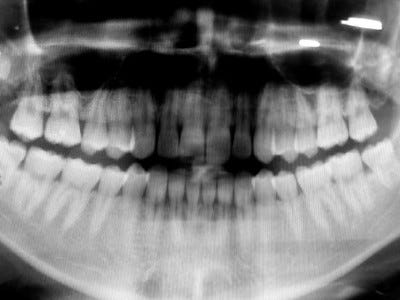
Image credit: "Teeth X-Ray" by Dick Thomas Johnson, licensed under CC BY 2.0.
No posts
Comments
Nothing yet. Say the first thing.
Sign in to join the conversation.