
Hello, Callers! Thank you for being here, and welcome to a new entry into our ever-irregular notes from the editor. Let’s get into it.
Summer has brought a modest lull in submissions, which is helping us catch up on our backlog. We’re still reading for our fall and winter slots—learn more about submissions and what we’re looking for on our About page.
I’ll also be part of the lineup for a crime fiction publishing panel on Saturday, October 10. Full details TBA, but this will be a fun opportunity to get a behind-the-scenes look at Cold Caller and other great publications, as well as tips for publishing short crime and mystery fiction. More on this very soon.
John Bosworth’s story “A Bad Place to Die,” featured in Best American Mystery & Suspense 2025, is now live on his website. This was one of my favorite stories from the anthology, with some great character work and a very satisfying puzzle.
Naomi Kanakia’s post “Don’t write for a magazine that is bad” has been rattling around in my brain for the last couple weeks. If you’re writing and submitting short fiction, I think this is a must-read.
Jessica Slee, no stranger ‘round these parts, is currently featured in the ongoing “The First Two Pages” craft series on Art Taylor’s website. This series is always a fun look under the hood of successful short fiction.
Recently, my wife and I made the wrong decision. Faced with the choice between Obsession and The Sheep Detectives—two viral movies with surprising and inescapable buzz—we chose the latter.
I knew nothing going into the movie, and so I assumed it was about Hugh Jackman solving crimes involving his sheep. It is actually about sheep solving crimes involving Hugh Jackman. The sheep talk, of course, and some of them talk with American accents, even though the movie takes place in England.1 (This is not actually part of the mystery.)
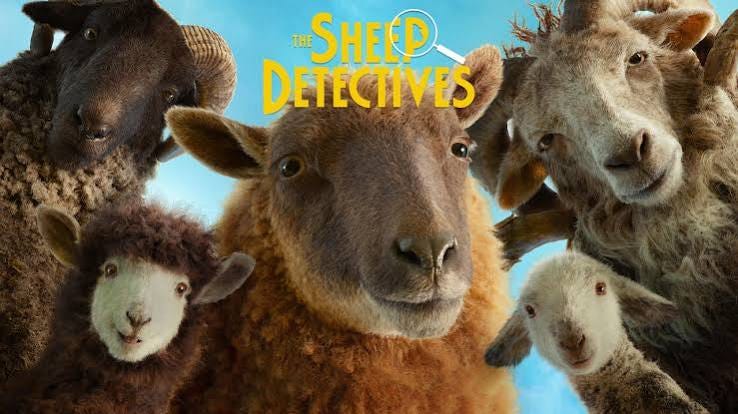
The story plays out about like you’d expect for any English countryside cozy mystery featuring a cast of talking animals, except for one surprising development. As it turns out, in the world of The Sheep Detectives, sheep have a very unusual ability. They can willfully forget anything they don’t want to know.
This shows up in a few interesting ways. For instance, the sheep don’t believe they can die, because every time one of them does the flock decides to forget the awful experience. As a result, a whole mythology has sprung up among the sheep that old age will simply transform into big fluffy clouds.
It’s played as a silly conceit at first, but after Hugh Jackman is murdered the flock has to decide whether they even want to remember what happened. Most of them don’t—most of them would prefer to forget this unpleasant thing, even if it also means forgetting their beloved shepherd. It’s only a desperate plea from Lily, the aspiring amateur sleuth, that convinces them otherwise.
This is not the only time Lily is tasked with this function. With Hugh Jackman dead, the flock learns they may be adopted by a neighboring shepherd. This seems like a happy ending until Lily learns that, unlike Hugh, this new shepherd sends his sheep to be butchered. But when she tries to warn her flock of the danger, the truth so horrifies them that they instead choose to forget. Lily has to figure out how to save the others from a fate they won’t even acknowledge.
By a funny coincidence, we went to see The Sheep Detectives at the same time we were watching True Detective for the first time. The plot of season one follows detectives Rust Cohle and Marty Hart as they investigate the ritualistic murder of a young woman in Louisiana. Over the course of the season, Cohle and Hart uncover a dark conspiracy that implicates local politicians, church leaders, and the police force, all working together to bury, hide, and collectively forget horrific crimes.
Although Cohle and Hart do achieve some measure of justice,2 it is imperfect at best. They’ve done as much as two men can do to right the wrongs of the powerful. There’s no further either can go—they’ve spent it all, burned every bridge, nearly given their lives, but some guilty men still go free. What’s left for the detectives at the end of the series isn’t to continue the fight but to remember what they’ve uncovered.
While the idea of “detective as memory” or “detective as witness” isn’t a new one, it’s surprising to me that The Sheep Detectives is the first time I’ve seen this function portrayed quite so literally.3 For a film about crime-solving sheep it wrestles with some heavy themes of death and collective forgetting. That doesn’t make it a great movie, but it also wasn’t that baa-a-a-a-ad.
In case you thought you wanted American actors to affect English accents, the movie also features Cousin Greg from Succession doing the worst English accent since Dick Van Dyke in Mary Poppins. Honestly, his performance may have been worth the price of admission.
Their detective work includes watching a video tape of a horrific crime, which they later force one of the criminal conspiracists to watch. It’s the most explicit example of the detectives serving the role of collective memory, literally pulling the tape out of a vault and forcing its contents back into view.
Am I just forgetting other, better examples? AM I THE SHEEP?
No posts
Comments
Nothing yet. Say the first thing.
Sign in to join the conversation.