
Keith Roysdon’s experiences in journalism didn’t just sharpen his skills as a writer, they also had a major influence on his fiction. With his new novel Seven Angels launching today, Keith joins us to talk about his books, his influences, and what makes him hopeful about book publishing.
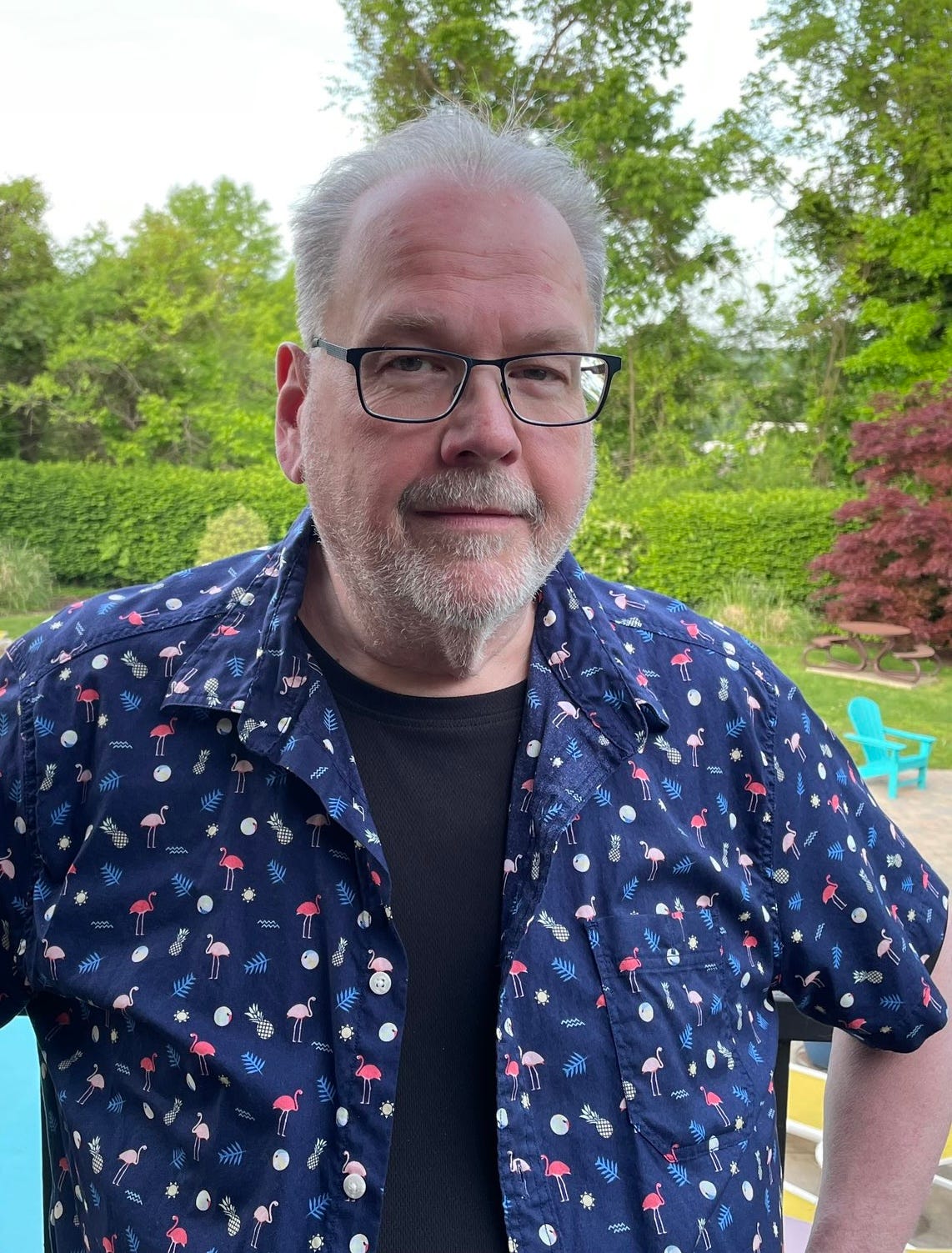
Congratulations on the launch of Seven Angels! This is a novel, but you’ve also written true crime and spent several decades as an investigative reporter. How do those experiences inform your fiction?
As you ask this, I realize not a lot of my experience as a newspaper reporter - a little, but not a lot - comes through in my novels but a lot of what I experienced as a reporter is there. I spent a lot of time talking to coroners (known in some states as medical examiners, but most of my experience came with coroners who did not have medical degrees, but who had been police or fire investigators) and combing through autopsy reports.
I think that helped me get a lot of the feel of the coroner’s job, as performed by Gloria Shepherd in Seven Angels, right. I’ve also learned a lot about the funeral home industry by knowing and dealing with a number of funeral directors. (That’s the gift of being a newspaper obituary editor for a couple of years.) That’s Gloria’s other job in Seven Angels. And of course you can’t write about crime off and on for decades without knowing how police officers and investigators work. Crime scenes also become very familiar to reporters. I’ll never forget covering the discovery of the body of a teenage boy and I was standing nearby when his mother identified the body found in a city park as her son.
What inspired Seven Angels? Was there anything that surprised you while writing this book?
Seven Angels was brewing in my head for a long time. I wrote some never-to-be-published novels in the early 2000s and made notes and an outline for Seven Angels in 2009 - but didn’t write it for another 10 years, in 2019. I’d taken a buyout from the newspaper industry, was working on the third true crime book I’d co-authored and knew I wanted to finally tackle book-length fiction. I don’t know if I was surprised that I did it, but maybe I was surprised by how I did it: a detailed outline, one paragraph per chapter, something I’d never done before.
As a plotter, I don’t think I could pants a novel or any kind of book now. I knew from that 10-year-old outline I wanted to set the book in a fictionalized version of the little town in Tennessee where my parents were from before they moved to Indiana. I’d read news stories about how wracked the town was by crime, poverty and opioid abuse - it was practically a poster child for all those problems - so I thought it’d be a good setting for the plot I wanted to write: a woman rallying her friends to take on crime and corruption.
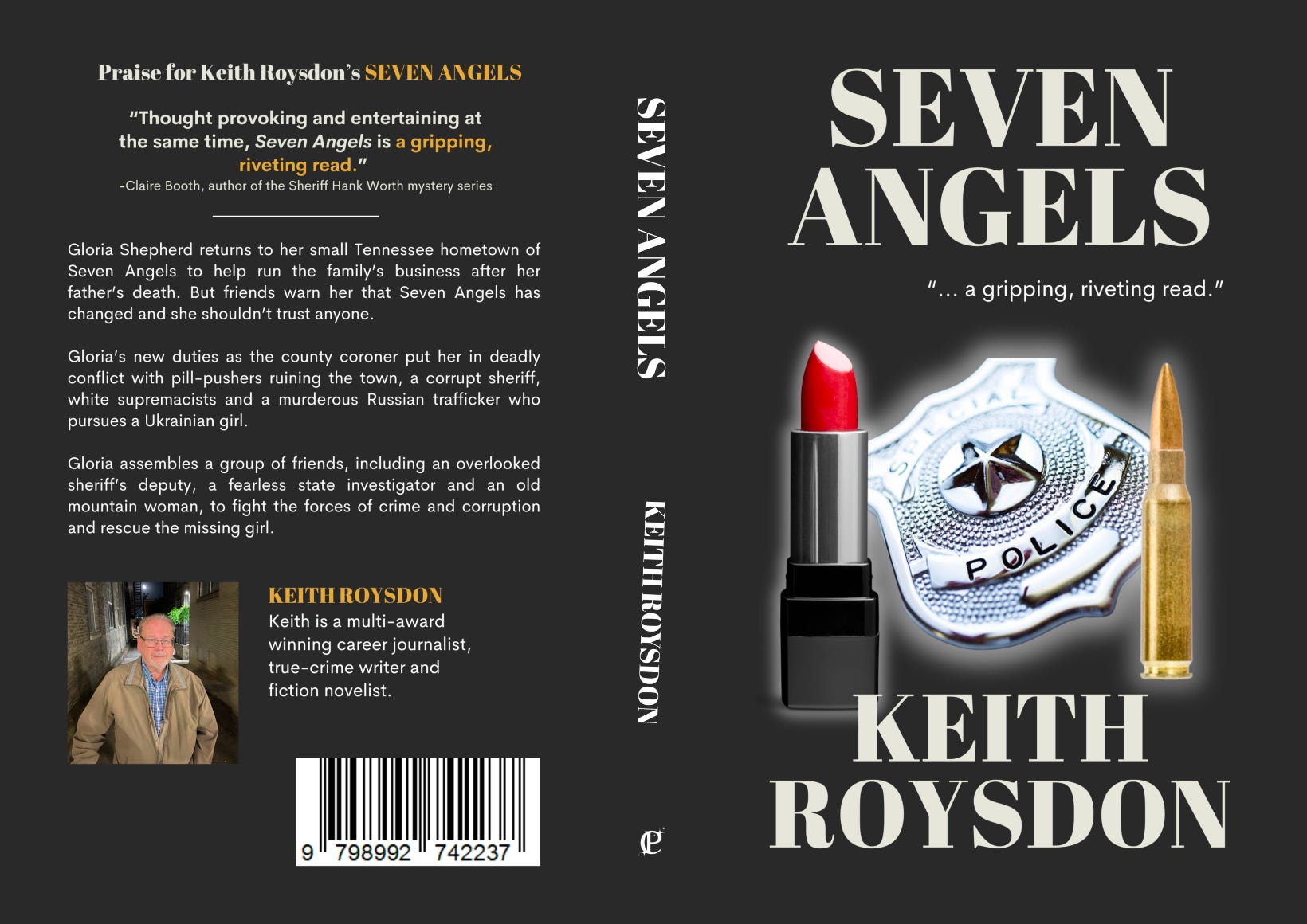
Who are your biggest influences as a novelist? Were there any books – fiction or nonfiction – that served as touchstones while writing Seven Angels?
I grew up reading comic books in the 1960s - which I think influenced my dialogue-intensive take on storytelling - and later devoured Robert B. Parker’s Spenser books, which I think influenced what one writer’s group called my “minimalist, almost-screenplay-like” writing. My favorite book series of all time is Dennis Lehane’s Patrick and Angie private detective series. They taught me that fiction could be dark, very dark, but still satisfying. (”Gone, Baby, Gone” is one book from about halfway through the series, but the series MUST be read in order.) I’m reading all the time, both published books and unpublished manuscripts that writer friends and I trade back and forth.
When did you first start to write seriously? Have you always wanted to write fiction?
I actually wrote most of a novel when I was in high school, in the 1970s, that was an intellectual property nightmare that I wouldn’t try these days: each chapter found my main character in a different fictional world, from Sherlock Holmes to Roger Zelasny’s “Damnation Alley.” I haven’t looked at the book in decades and I’m terrified I’d read some of it and think, “Wow, my writing hasn’t progressed at all since I was a teenager during the Bicentennial summer.”
There’s a surprising overlap between journalists and crime novelists. I’d be curious to hear your thoughts on how the skills you honed as a reporter translate to the art of writing fiction, whether that’s in terms of how you write or simply how you maintain discipline.
I’d like to think that my fiction is piercing and gets to the heart of my characters because of skills I learned as a reporter, but I think I’m hampered by the arms-length approach that you had to take back then in news stories. After I wrote Seven Angels and another way-too-long novel, I wrote That October because I thought I could overcome some of that self-inflicted emotional distance because I realized nobody is more emotional than teenagers.
My characters in That October are frustrated because adults aren’t working fast enough to help save a kidnapped friend. My young characters are really bruised: one has a father in prison, another is wary because her mother is thought of as a kook for her psychic abilities, another finds out her father has lied to her her entire life, etc. It’s the kind of emotional (there’s that word again) writing I couldn’t do enough of in newspaper reporting. Writing every day for a newspaper definitely instills some discipline - at least enough to make me feel lazy when I goof off now.
You also cofounded Constellate Publishing, along with Jill Blocker, which is no small undertaking. How did that come about? What are you hoping to accomplish through the press?
Jill self-published the English-language edition of her novel What Was Beautiful and Good in 2023 after it had been published in German by a German publisher. She really wanted an English-language platform for her wonderful historical novel, which I’d been lucky enough to do some edits on. (We’ve known each other for going on 20 years, since we worked together on a newspaper staff while she was in college.) She’d read and done edits on That October and she said, “We should publish it.” We did and it worked out well and has a beautiful comics-inspired cover by my artist friend Sara McKinley.
After that, Jill and I decided to publish our next books, Seven Angels and Happily Ever After, and thought, hey, we’ve got this editing and publishing and marketing system going, let’s see if we can publish some other writers’ work. She and her twin sister Jade had already founded Constellate Creatives, so the publishing arm is just a part of it. We’ve published one book, You Know Everything by Melanie Schular, besides ours and are actively working with the writers of a few other books to see if we can publish those too. Jill has a ton of expertise and I have a foolish amount of fun editing and marketing.
While major publishers seem to keep shrinking and consolidating, there’s also been a flourishing of small presses and journals. What’s your take on the state of the industry? Are you hopeful for the future of publishing, or pessimistic?
I’m hopeful in the same way I’ve been hopeful for the newspaper industry I grew up in. With newspapers, there’s never been more interest from the public for news and information. It’s essential to know what’s happening (and also to be able to pull back when it feels overwhelming, but that’s another story) and news reporting will find its way to people even if it’s through what once was considered unconventional avenues, like Instagram videos. I’m hopeful for the same for books and publishing: Despite what we hear about the lack of people reading, people are buying books and consuming short stories and long, complex book series and I believe the core of readership is there and won’t ever go away. I think books will always fill that need.
Where can people learn more about you and follow your work?
My site is keithroysdon.com, and I publish regularly there, sometimes odd pop culture ramblings. My online home away from home is at CrimeReads, where my wonderful editors have allowed me to write more than 70 offbeat pop culture pieces so far. And I’m on most social media platforms, although I feel a little sheepish about that because I know people doom scroll those sites. I know I do. Between those places, you get an idea of what I’m doing when I damn well should be writing fiction. I’m doing research for a couple of novels, one the flip side to Seven Angels with a definite horror bent, and one that’s a small town police procedural.
All of my fiction takes place in the same universe: Despite the decades of time that exist between the two books, a character from That October shows up in Seven Angels. A lot of my short fiction takes place in the town of Seven Angels or the Indiana city of Middletown, where That October takes place. I’ve got another character, Butcher Crabtree, who’s a good guy in Seven Angels and a neutral presence in That October but is decidedly a bad guy in a couple of stories that have been published online. Most of that is just for my own amusement, but I hope that someday somebody asks me about old Butcher, who keeps showing up everywhere despite being killed off in a couple of stories.
Keith Roysdon is the author of Seven Angels and That October. Learn more by visiting keithroysdon.com.
No posts
Comments
Nothing yet. Say the first thing.
Sign in to join the conversation.