
Let’s start here:
A company in China just released a new robot design by the name “XPENG Iron”. Watch the clip below to see it in action.
The fluidity of motion in this robot is so smooth that it is beginning to close the uncanny valley gap—some people even doubted that it was real, and not just a person in a suit, until the fabric was peeled back to show them that it was a robot.
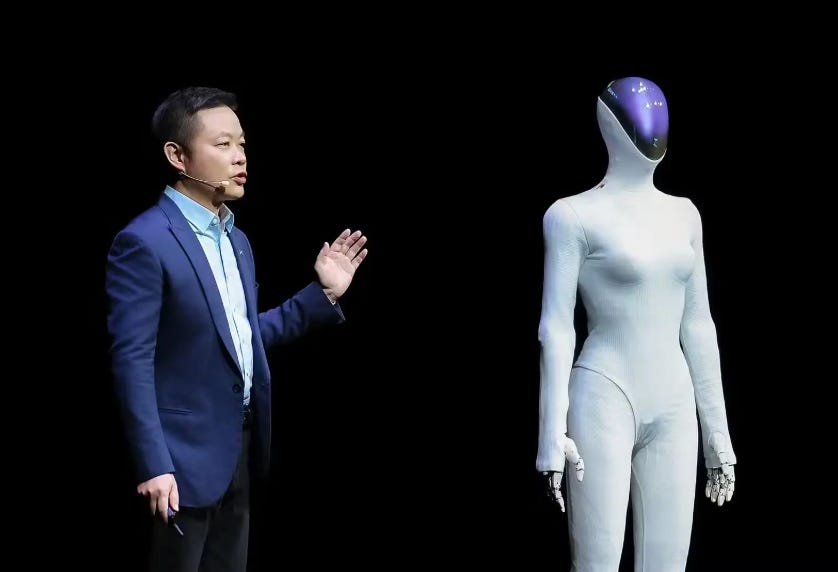
It has a synthetic ‘fascia’ to cover its metal skeleton, giving it a smoother body shape and skin like appearance than previous robots.
But the gait…wow, how amazing.
Robotics will continue to follow the same exponential trajectory that AI has been on since the fall of 2022; it’s just starting from a few-years later take-off point than AI. Improvements are now happening at an inconceivable pace.
Humanoid robotics holds the potential of significantly improving life for billions.
Consider just this one example (more will follow): what if every elderly person had a tireless, positive and supportive personal assistant to help them stand, walk, and do basic tasks at home—to help keep them out of assisted living or nursing home facilities for as long as possible?
What if there was a 24-hour assistant to walk behind the infirm and offer elbow support to steady their gait, hold their hand when needed, and see what their own limited vision and blindness might make them miss?
What if that same robot could also drive them to the store, take them to doctor’s appointments, walk the dogs, shovel snow, cook them meals, and escort them to social events?
Not to mention be a watchful and friendly companion to elderly people who might otherwise decline cognitively and emotionally due to lack of interaction and stimulation—because they no longer have friends or family networks as they did when they were younger.
Even just this singular use case gives me personal hope for a brighter future. I don’t want to be a burden on my own family when I age; I see a world coming where I won’t have to be.
Consider, too, that the grandfather of the Singularity concept and an early pioneer of neural networking that led us toward AI — Ray Kurzweil — recently said that he believes humanity may reach longevity escape velocity in the next four years.
This is the idea that—because of medical breakthroughs coming as a result of AI—longevity would start to increase at a rate greater than one year of life extension for every calendar year that elapses; essentially reversing aging and ending death from it. We could all become Benjamin Buttons.
update: right on time.
Meanwhile, over at Telsa, Elon Musk’s new CEO pay package was approved. If he succeeds in getting Tesla to reach the agreed to milestones, Musk will become a trillionaire. If he achieves those objectives, it is deserved.
One of the key pillars in his strategy is to bring the Optimus robot to market in a big way.
His vision: Robotics will eliminate poverty and potentially lead to a post-monetary world, where energy (and perhaps “cognition” in the form of AI)—instead of fiat currency—constitutes “money”.
from @shanaka86 on X comes this quote:
”Tesla’s $20,000 humanoid robot isn’t coming. It’s here. Production lines running. Right now. And Elon just said the quiet part so loud it should’ve stopped the world: “Optimus will actually eliminate poverty.
Optimus will actually give people incredible medical care. Optimus will ultimately be better than the best human surgeon with a level of precision that isn’t possible, that is beyond human.”
Then he dropped this: “Optimus is kind of like an infinite money glitch. Maybe there won’t even be money in the future but might be measured in terms of wattage.” Read that again. The richest legend alive just told you money becomes obsolete and your job disappears in the same breath.
Update 11/14/25: Consider this: Here’s Elon saying that Optimus will be able to do surgery as good or better than the best surgeon…on anyone, anywhere.
I think this is why Musk has eased back on the DOGE cuts path that he was so fired up about. He knows that only so much corruption can be cut, only so much cost cutting can be achieved with the powers that be on both sides of the aisle.
But if he achieves the vision that he has for AI and robotics, the resultant economic boom will do much, much more to ease the debt burden than any number of additional cuts could.
While some people are fearful that “AI will take my job”, another viewpoint is that AI will make working voluntarily optional—you can work if you want to, but to survive and thrive, you won’t need to. AI and robotics will lead us to a “post scarcity” world of abundance for everyone.
This future does require some form of Universal Basic Income, an idea which I strongly resisted in the era before humanoid robotics; but we essentially already have that for huge swaths of the population, anyway. It’s called welfare.
The problem I have with the current socialist systems throughout the world is that to fund them, other people have to work much harder just to meet their own family’s needs as well as to cover the needs of others, as their wealth is forcibly extracted and wages withheld involuntarily from their labor either through visible means (taxes) or through devious invisible means (monetary inflation).
But with AI and robotics doing the future labor, the “human slavery” problem would fade away. The burden of providing for UBI would not have to lead to socialist slavery (one group living on the backs of labor of another group.)
Let’s now consider how IQ and SNAP benefits fit into this whole picture.
Jordan Peterson gave a talk in San Francisco seven years ago that I attended with my younger daughter. In this talk, he said this about the US Army and IQ:
The gist is that the U.S. Army, over many decades, has determined—after trying very, very hard to find ways around this obstacle—that there is an IQ threshold of 83, below which they simply can’t train potential recruits for any meaningful job in the Army.
Given that some of the work in the Army is simply peeling potatoes in the mess hall for dinner, that’s a worrisome statistic. Jordan has reiterated this “useful work” floor relative to IQ several times in the years since, and these ideas are backed up by extensive research in Psychology.
So, what does it mean to US society that there is potentially an IQ threshold of 83 below which most people will be unable to do essentially any useful work and hold jobs?
In a population of 330 million, it means that 10-12% of the population — as many as 40 million people — fall below the IQ threshold and are effectively unemployable. Not because they don’t want to work, but because they aren’t trainable.
This is a harsh fact that we can’t just walk past.
This fact is the reason that we have so many people on EBT and SNAP welfare programs, among others—aside from the fact that millions subsisting on these programs are also illegal immigrants (and some of those also happen to fall below the same IQ threshold, too.)
Sure, there are also people attached to the teat of the State who are fit and capable of work who choose not to work out of sloth and laziness or a love for Xbox and Communism; but a sizeable fraction of people on these programs are there simply because they fall below this 83 IQ threshold.
The reflexive “get a job!” retort that many Republicans often lean on is entirely valid for those lazy, work-the-system, TikTok ne'er-do-wells who post videos about their abusing the welfare systems—but it doesn’t really hold for a vast majority of the rest. Those people don’t tend to post on TikTok.
The problem of low cognitive ability is not so simple to solve.
Imagine, though, a world in which every one of these people instead has a humanoid robotic companion (or two) with an IQ of 300 that not only helps takes care of their needs but also acts as a sort of “guardian angel” at the same time. The guardian that they needed but never had from their own parents.
Are there dystopic ways to view this? Of course, there are: Hollywood, YouTube, and the media have polluted your thinking for years about all of those possibilities. But is that really what lies ahead? I think not.
Many of the dispossessed in society also come from broken homes and suffer from addictions, compounding their misery further.
What if those people have a safe, comfortable place to live, plenty of food to eat, things to entertain and inspire them, but also a beneficent, patient, calm and watchful companion helping them to avoid being scammed or making poor decisions that would have led them to a life of greater misery and destitution as it does in our current world? Cooking healthy food for them that they couldn’t do for themselves, instead of buying junk fast food because that’s all they know how to do?
And what if providing these things for the dispossessed also did not pose a burden on the rest of us through the socialist slavery trap?
This is the potential promise of AI and humanoid robotics: a possible future with greater compassion and higher standard of living for those who are incapable of providing for themselves—without enslaving the rest of us to accomplish that.
Now also consider my “AI as Ark” hypothesis.
This is the idea that there are potential cataclysms looming just over the horizon that are caused either by the Sun or via the ECDO hypothesis.
I have covered these in the shows that I have been on this year, available here. To understand this “Ark” idea fully, watch this rumble video.
In it, you will hear some of the same ideas that I covered here as I explain the “Ark” concept.
There are three ways to view these cataclysms:
Assume they’re wrong, and ignore them
Accept as possible, but not likely near term
Accept as likely, and that we may experience them
Did God intend for us to be prepared for such disasters? Did he instill creativity and intellect in us? The evidence abounds that we have a talent for building things, including AI, so that we would help ourselves survive. This is the heart of the Ark idea.
Or are these threats an ‘end times’ scenario that we aren’t meant to survive? If we are meant to survive, it is inescapable to me that AI and robotics can help us prepare for, endure, and recover from these looming events.
The question is: will we be able to reach the level of sustainable AI and robotics in time, while also protecting what is necessary to restart from a disaster in a kind of Svalbard Seed Vault for AI?
Or will society—via leftist control freaks and mal-informed and malign governments hamstring our efforts—making it too little, too late?
The race to the Golden Age is on.
Ed: I have recently abandoned the use of Wikipedia for internal reference links. From now on, all references use Grokipedia, which is far less biased.
update:

Rohan Paul@rohanpaul_ai
Robots in China are doing it all now, even dancing on stage like pros. Here Unitree robots doing Webster flips and are performing at Chinese-American singer Wang Leehom’s concert in Chengdu.
4:38 PM · Dec 19, 2025 · 28.5M Views
1.93K Replies · 7.64K Reposts · 37.4K Likes
CognitiveCarbon’s Content is a reader-supported publication. To support my writing and research work and make it so that I can afford to buy a pack of steaks at Costco again, please consider becoming a paid subscriber: at just $5 per month, it helps me support a family.
You can also buy me a coffee here. Thank you for reading!
No posts
Comments
Nothing yet. Say the first thing.
Sign in to join the conversation.