
#
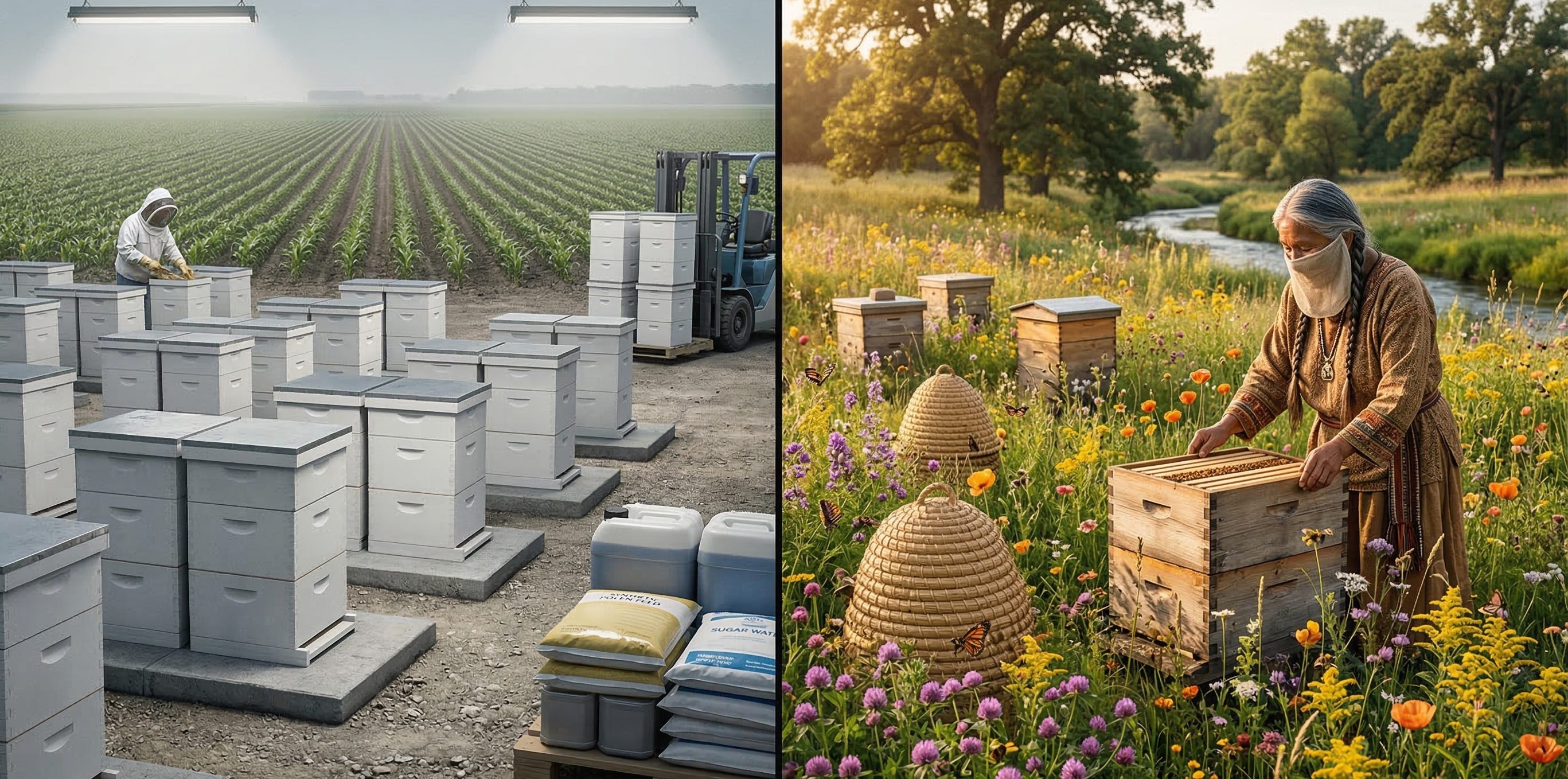
A recent study published through Phys.org announces a promising development: synthetic pollen feed can support commercial honey bee health. The research, conducted by academic scientists working with industrial apiculture operations, demonstrates that laboratory-formulated nutrition can help sustain bee colonies facing widespread collapse.
Good news, right?
Maybe. But also: a perfect example of how power shapes the stories we tell about ecological crisis.
Because here’s what the study—and most mainstream coverage of pollinator decline—carefully doesn’t say: The crisis killing bees is not a nutritional deficit. It’s a structural violence embedded in industrial agriculture itself.
This isn’t a story about synthetic pollen. It’s a story about what happens when the institutions causing collapse are allowed to frame the solutions.
The Framing Problem: Technology as Salvation
Let’s start with the obvious question the study never asks: **Why do commercial bee colonies need synthetic feed in the first place?**
The answer sits in plain sight, conspicuously absent from the framing: monoculture farming, neonicotinoid pesticides, and habitat fragmentation. Industrial agriculture has systematically destroyed the diverse plant ecosystems that pollinators need to survive. Then, when bees begin to starve in the biological deserts we’ve created, we respond with... more industrial products.
It’s the agricultural equivalent of selling insulin while banning vegetables.
This pattern is not new. The Green Revolution followed exactly this logic: monocultures degraded soil health, so we sold chemical fertilizers. Pests evolved resistance to pesticides, so we sold stronger pesticides. Each “solution” locked farmers deeper into dependency on industrial inputs, while the underlying ecological foundations continued to erode.
The bee crisis is the same story, told with different actors. Except this time, the victims can’t speak—and the marginalized communities who could offer alternatives are systematically excluded from the conversation.
What the Study Centers (And Who It Erases)
Academic researchers. Commercial beekeepers. Agribusiness interests. Science media outlets.
These are the voices centered in narratives like this one. Their framing treats bee health as a technical problem to be solved through innovation, rather than a symptom of how we organize food production itself.
And who’s missing?
Small-scale beekeepers who work with local ecosystems rather than against them. Indigenous land stewards whose pollinator management practices are integrated into biodiverse landscapes. Agroecologists who study how crop rotations, hedgerows, and reduced chemical use improve bee health without synthetic inputs.
These aren’t fringe perspectives. They’re **working models that have sustained pollinators for millennia—and they’re working today, in communities that have resisted the monoculture model.
But acknowledging this would require asking uncomfortable questions about who benefits from industrial agriculture, and who bears its costs. It would require recognizing that **Indigenous and smallholder knowledge systems often outperform industrial approaches** when measuring actual ecological health rather than short-term productivity.
So instead, we get synthetic feed.
Indigenous Knowledge: The Elephant (Or Rather, the Bee) in the Room
In many Indigenous agricultural systems, pollinators aren’t a separate “problem” requiring technical intervention. They’re integrated into broader ecological frameworks that prioritize **coexistence over control**.
These systems understand something that industrial agriculture actively resists: **you cannot isolate one element of an ecosystem and optimize it without cascading failures elsewhere.**
Take the Native Bee Conservation Initiative operating across Canada and Mexico. Rather than treating bees as units of production requiring nutritional supplementation, these programs focus on habitat regeneration—restoring the diverse native plant communities that support not just honey bees, but hundreds of native pollinator species.
Or consider traditional Maya milpa systems, where maize, beans, squash, and dozens of companion plants create layered ecosystems that feed people *and* sustain pollinators simultaneously. These aren’t historical curiosities—they’re actively practiced systems that demonstrate viable alternatives to monoculture.
But you won’t find them referenced in studies about synthetic pollen feed. Because acknowledging Indigenous expertise would require confronting a painful truth: **Western industrial agriculture has spent the past century solving problems it created by ignoring this knowledge in the first place.
The Historical Parallel Nobody Wants to Name
Let’s talk about the Green Revolution.
In the 1960s-70s, industrial agriculture was sold as the solution to global hunger. High-yield crop varieties, chemical fertilizers, and pesticides would feed the world. And in terms of sheer caloric production, they did.
They also:
- Destroyed soil fertility across millions of acres
- Created dependency on petroleum-based inputs
- Drove smallholder farmers into debt
- Reduced crop biodiversity to dangerous levels
- Poisoned groundwater systems
- Displaced Indigenous and peasant agricultural knowledge
Sound familiar?
The synthetic pollen study sits comfortably within this tradition. It takes a crisis produced by industrial monoculture—in this case, bee starvation in biological deserts—and proposes an industrial solution that legitimizes the system causing the problem.
This isn’t conspiracy. It’s how institutional power works. The researchers aren’t villains; they’re operating within funding structures, academic norms, and industry partnerships that make certain questions unaskable.
But the result is the same: **ecological crises are depoliticized into technical problems, and systemic transformation is replaced with incremental fixes that never threaten the underlying model.
---
What the Science Actually Says (When You Look Closer)
To be fair, the synthetic feed study provides genuine empirical data on nutritional supplementation efficacy. The researchers aren’t lying—synthetic feed does help colony survival in controlled conditions.
But here’s what the study doesn’t include:
- How synthetic feed interacts with pesticide exposure(neonicotinoids are a primary driver of colony collapse)
- Long-term effects on colony genetic diversity and resilience
- Comparative analysis with habitat restoration approaches
- Economic viability for small-scale beekeepers (synthetic feed costs money; wildflower meadows are cheaper and provide multiple ecosystem services)
- Impact on native pollinator species (honey bees are one species; bee decline affects hundreds of native species ignored by industrial apiculture)
In other words: the study answers a narrow technical question well, while systematically avoiding the broader ecological and political context that would reveal synthetic feed as a **symptom-management strategy, not a solution**.
The Agroecology Alternative (That Industry Doesn’t Want You to Know About)
Here’s the uncomfortable truth: **we already know how to support healthy bee populations without synthetic inputs**.
Agroecological research from Europe and North America consistently shows that:
1. Crop diversification dramatically improves pollinator health (studies in Germany show 60%+ increases in bee populations in mixed farming systems)
2. Hedgerows and field margins with native flowering plants provide year-round forage that synthetic feed can’t replicate
3. Reduced pesticide use has immediate positive effects on colony survival (French studies show colony collapse rates drop 40-70% when neonicotinoids are banned)
4. Integrated pest management and crop rotation reduce the need for chemical inputs while supporting pollinator habitat
The EU’s Farm to Fork strategy provides a policy blueprint: subsidies for habitat restoration, stricter agrochemical regulation, and support for smallholder agroecological transitions. Early results show measurable improvements in pollinator populations.
This isn’t utopian thinking. It’s working, right now, in real farming systems.
But it requires something industrial agriculture fiercely resists: **reducing monoculture dependence and sharing power with ecological knowledge systems that industrial institutions have historically marginalized**.
Four Pathways Forward (If We’re Actually Serious About Solutions)
The CognioNews analysis of this story proposes four solution pathways. Let’s examine them:
1. Integrate Agroecology with Pollinator Health
**What this means in practice:** Transition subsidies away from monoculture maximization toward diversified farming that provides natural bee forage. This includes crop rotations, hedgerow planting, and reduced chemical use.
**Why it’s blocked:** Agricultural policy is heavily influenced by agribusiness lobbying. The subsidies that incentivize monoculture corn/soy don’t go away just because bees are dying.
**Who’s doing it anyway:** Regenerative agriculture networks, permaculture farms, and small-scale organic operations are demonstrating viability at commercial scales. We need policy support to scale these models.
2. Amplify Indigenous and Smallholder Pollinator Stewardship
**What this means:** Recognize Indigenous land stewardship practices as sophisticated ecological management systems, not quaint traditions. Fund community-led pollinator programs and protect Indigenous land rights.
**Why it’s blocked:** Western institutions are deeply uncomfortable acknowledging that non-Western knowledge systems might outperform industrial approaches.
**Who’s doing it anyway:** The Native Bee Conservation Initiative, Indigenous-led permaculture projects, and traditional agricultural communities maintaining biodiverse farming systems.
3. Regulate Agrochemicals and Incentivize Habitat Restoration
**What this means:** Implement strict neonicotinoid regulations (like the EU has done) and offer payments to farmers who restore native pollinator habitats on marginal land.
**Why it’s blocked:** Chemical industry lobbying and resistance from large-scale farming operations dependent on current input models.
**Who’s doing it anyway:** Some U.S. states are implementing pollinator habitat programs. The results are measurable and positive where they’re actually funded.
4. Develop Holistic Monitoring Systems
**What this means:** Create monitoring that tracks colony health, environmental conditions, *and* incorporates Indigenous/local knowledge alongside scientific data.
**Why it’s important:** Technical solutions fail when they ignore the knowledge systems that could provide early warnings and alternative approaches.
**Who’s doing it:** Community science projects and Indigenous-researcher collaborations are pioneering these models, usually without institutional support.
The Power-Knowledge Question We’re Not Asking
Let’s return to where we started:
Who produces the narrative, and who benefits from how the problem is framed?
Synthetic pollen feed research is produced by:
- Academic institutions (dependent on agribusiness funding)
- Commercial beekeeping operations (serving pollination-dependent industrial farms)
- Science media (trained to valorize technological innovation)
It’s disseminated to:
- Farmers (locked into monoculture by subsidy structures and debt)
- Policymakers (lobbied heavily by agricultural and chemical industries)
- The public (primed to see science as politically neutral problem-solving)
And it serves:
- Agribusiness (legitimizes current production models)
- Chemical/feed industries (creates new product markets)
- Large-scale operations (marginalizes alternatives requiring system change)
What it doesn’t serve:
- Bee populations (which need habitat, not supplements)
- Ecological resilience (which requires biodiversity, not monoculture)
- Small-scale farmers (who can’t afford synthetic inputs)
- Indigenous communities (whose knowledge is systematically excluded)
- The people who eat food (who bear health costs of pesticide-intensive agriculture)
This isn’t a conspiracy. It’s how institutional power works—by making certain framings seem neutral and scientific, while systematically excluding the perspectives that would reveal the political stakes.
What This Means for How We Read “Science”
I’m not anti-science. I’m anti the pretense that science happens outside of power relations.
The synthetic pollen study is good science *within its narrow technical frame*. But that frame itself is a political choice, shaped by:
- Who funds research
- What questions are considered legitimate
- Which knowledge systems are recognized as valid
- How success is measured (colony survival vs. ecosystem health)
Reading science rigorously means asking: What is this study not looking at? Whose knowledge is excluded? What systemic questions are being avoided?
In this case:
- Not looking at: monoculture, pesticides, habitat loss as root causes
- Excluded knowledge: Indigenous land stewardship, smallholder agroecology
- Avoided questions: Who benefits from framing this as a technical problem?
When you read science this way, patterns emerge. The same patterns we saw in the Green Revolution, in industrial forestry, in pharmaceutical approaches to health, in geoengineering proposals for climate change.
Technological fixes for structural problems. Innovation that legitimizes power. “Solutions” that avoid systemic transformation.
Conclusion: Toward a Different Story
Imagine if the headline had been: **”Restored Native Habitats Support Honey Bee Health Better Than Synthetic Feeds—And Cost Less”**
Or: Indigenous Pollinator Management Practices Outperform Industrial Apiculture in Long-Term Colony Resilience
Or Study Shows Monoculture Agriculture Incompatible with Pollinator Survival
These are all true. The research exists. But you won’t see those headlines, because they name the structural problem rather than offering a product-based solution.
The bee crisis is not a nutritional problem. It’s a **power problem masquerading as a technical problem**.
And until we’re willing to name that—until we’re willing to center the knowledge systems that industrial agriculture has spent centuries marginalizing—we’ll keep getting synthetic solutions to structural violence.
The bees deserve better.
So do we.
---
Resources & Further Reading
Agroecology & Pollinator Research:
- Agroecology: The Ecology of Sustainable Food Systems* (Stephen Gliessman)
- EU Farm to Fork Strategy documentation
- Pollinator Partnership’s habitat restoration guides
**Indigenous Knowledge Systems:**
- Native Bee Conservation Initiative (Canada/Mexico)
- Braiding Sweetgrass (Robin Wall Kimmerer) on Indigenous ecological knowledge
- Traditional Ecological Knowledge and Natural Resource Management (UNESCO resources)
Critical Agriculture Studies:
- *The Unsettling of America* (Wendell Berry)
- Stuffed and Starved (Raj Patel) on power dynamics in food systems
- Altered Genes, Twisted Truth* (Steven Druker) on agricultural biotechnology framing
About This Analysis
This essay draws from a **7-dimensional epistemic analysis** conducted by CognioNews, which examines how power, knowledge, and framing shape public understanding of complex issues. The analysis incorporates:
- Indigenous knowledge perspectives
- Historical parallels (Green Revolution, monoculture crises)
- Cross-cultural agricultural wisdom
- Scientific evidence and its limitations
- Artistic and spiritual dimensions of human-pollinator relations
- Future scenario modeling
- Marginalized voices systematically excluded from mainstream coverage
**Read the original CognioNews analysis:** https://cogniosynthesisportal.uk/story.html?id=4b42fc6e1d03f564
**Original Phys.org article:** [Synthetic pollen feed supports honey bee colonies over term](https://phys.org/news/2026-03-pollen-honey-bee-colonies-term.html)
---
This analysis represents one approach to reading power dynamics in scientific coverage of ecological crisis. Your perspectives, especially if you work in beekeeping, agroecology, or Indigenous land stewardship, are welcome.
**Share this essay if it resonates. The conversation matters.**
---
**CognioNews** | Epistemic intelligence for a world that needs better stories
**Follow:** [@CognioNews](https://x.com/@cognionews)
**Subscribe:** cognionews.substack.com
No posts
Comments
Nothing yet. Say the first thing.
Sign in to join the conversation.